How Peer Support Differs From Traditional Case Management
Peer support builds hope through shared experience where case management coordinates systems.
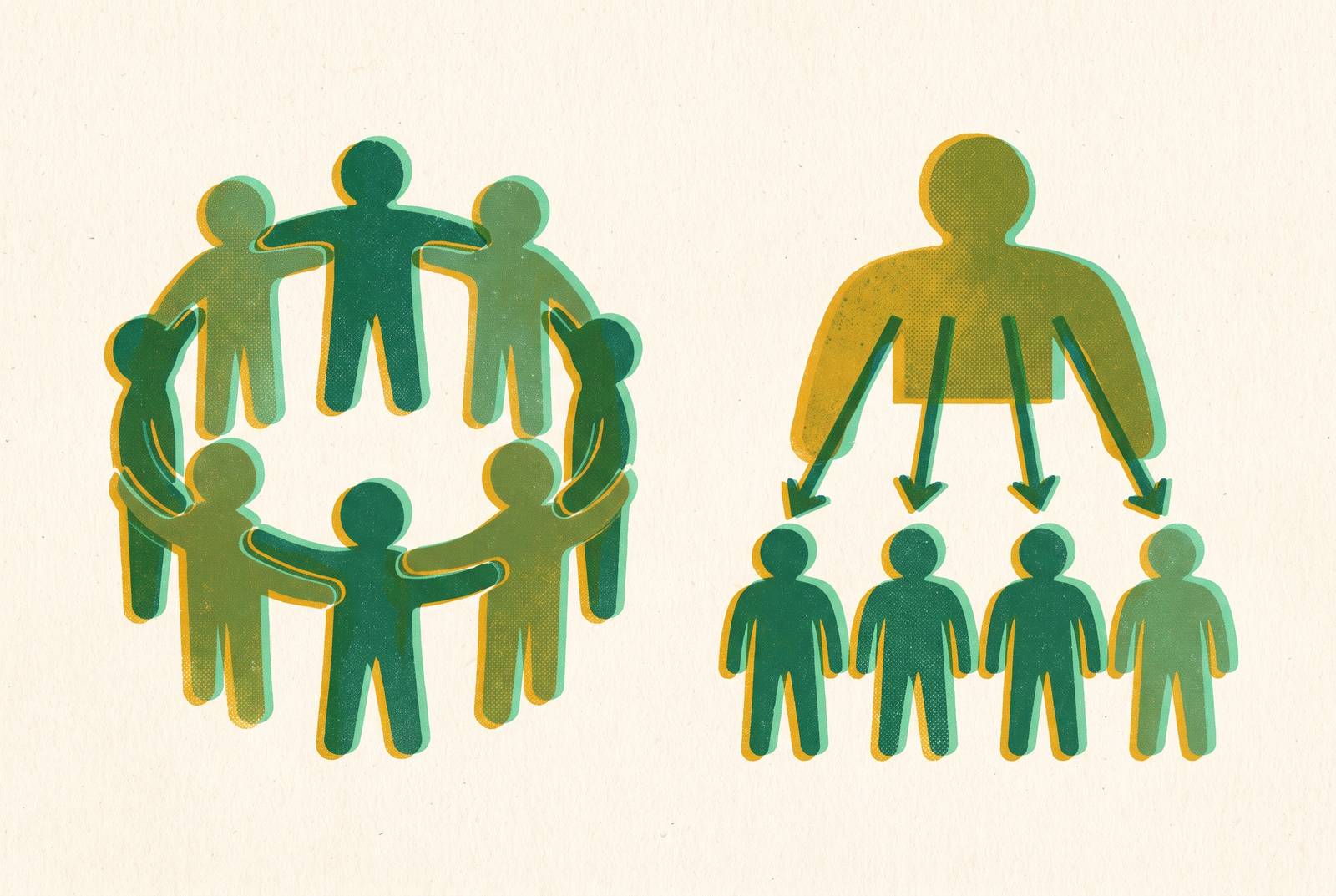
Case management and peer support get bundled together so often that the difference between them has started to blur, even inside the systems that run both.
The purpose of these two roles
Case management is a process built to move a person through systems: Medicaid, housing, appointment scheduling. Peer support works from a different starting definition entirely. SAMHSA describes it as a voluntary and mutual relationship grounded in lived experience rather than credentials, one meant to promote hope, empowerment, and recovery. Notice that neither definition mentions the other role. They were built for different jobs, even though they now show up on the same teams doing work that looks, from the outside, oddly similar.
That overlap is not incidental. And that proximity is exactly why the roles get flattened into one another so often: a peer specialist starts documenting like a case manager, a case manager starts leaning on rapport like a peer specialist, and the distinction that makes each one useful starts to disappear.
Consider what is at stake for someone leaving incarceration. The first weeks after release carry sharply elevated risk of overdose, psychiatric crisis, and homelessness. A case manager in that moment needs to get someone housing, a Medicaid card, a follow-up appointment. A peer specialist needs that same person to believe, based on nothing but another person's word, that survival past this point is actually possible. Both roles matter urgently here. But they matter for different reasons, and confusing those reasons is where a lot of program design goes wrong. The CCMC definition cited in Behavioral Health News frames case management as coordinating services, navigating systems, and building stability through institutional process (assessment, planning, facilitation, care coordination, evaluation, and advocacy). Both roles are present in CCBHCs, community mental health agencies, substance use programs, and reentry initiatives, shared turf, not separate silos.
Case management's capabilities and limits for people with serious mental illness
Day to day, a behavioral health case manager runs psychosocial assessments, writes individualized service plans, coordinates housing and Medicaid enrollment, schedules appointments, and keeps documentation current enough to satisfy reimbursement rules. None of this is bureaucratic filler. Assertive Community Treatment, the most intensive version of case management used with serious mental illness, has a real evidence base behind it: studies going back to Dixon in 2000 and continuing through Bond and Drake's 2015 review show reductions in hospitalization and gains in housing stability tied directly to this model. Coordination, done well, keeps people housed and out of the hospital. That is not a small accomplishment.
But the model has a built-in dependency, and that dependency requires the following. Authority in case management flows from the institution: the credential, the plan, the agency's mandate. The case manager acts on behalf of the system nearly as much as on behalf of the person in front of them. That arrangement works fine as long as the person trusts the system enough to engage with it. For someone who has been incarcerated, discriminated against, or harmed by a psychiatric institution before, that trust is not a given. It cannot be assumed into existence just because a service plan says it should be there.
The CMS Accountable Health Communities data makes the gap concrete. Among beneficiaries referred to social service navigation, only 14% had their needs actually resolved, and 33% were lost to follow-up entirely. A referral is not resolution. Someone can be handed the exact right phone number and never make the call, because nothing in that handoff addressed why they'd be reluctant to trust the person on the other end of it. Coordination cannot manufacture readiness or hope. Those are not administrative problems, so an administrative process is not going to solve them.
How shared experience changes the nature of the relationship
Peer support is not case management delivered with more warmth. It works through a different mechanism altogether: the reduction of a power imbalance, achieved through shared experience rather than institutional standing. The word SAMHSA chooses, mutual, is doing real work in that definition. A case management relationship, by design, is not mutual. One party holds the plan, the Medicaid authorization, the discharge paperwork. A peer relationship starts from the premise that both people have stood somewhere similar.
For someone with serious mental illness who has learned, through direct experience, not to trust psychiatric systems, a peer who has actually lived through something comparable closes a gap that no license or certification can close from the outside. What that looks like in practice is fairly plain: sharing a recovery story, modeling how to cope with a bad day, helping someone find language for a goal they haven't been able to name yet, advocating alongside someone rather than speaking for them.
A 2025 scoping review in Frontiers in Psychiatry named relationship, sense of meaning, and participation as the three pillars of any recovery journey, and each pillar shapes how recovery unfolds. Peer support touches all three directly, in a way coordination, however well executed, simply is not built to do. And there's a sharper point buried in the lived-experience literature: pressure from outside to recover before someone is ready tends to breed hopelessness, not progress. A mutual relationship is far more likely to meet a person exactly where they are, rather than where a treatment plan says they ought to be by now. The DC Department of Behavioral Health reports that Certified Peer Specialists also participate in program and policy development, with their lived experience serving as a clinical and organizational asset, not just a relational one.
How peer support outperforms coordination on outcomes
On the outcome measures everyone already tracks, rehospitalization and relapse, peer support and traditional clinical or case management approaches are in roughly the same place across systematic reviews. Systematic reviews show peer support scores higher on recovery-process outcomes: self-efficacy, empowerment, and engagement. A 2014 randomized controlled trial by Chinman and colleagues in Psychiatric Services found peer support services tied to both reduced inpatient use and improved recovery outcomes, a pattern that appears repeatedly once researchers look for it.
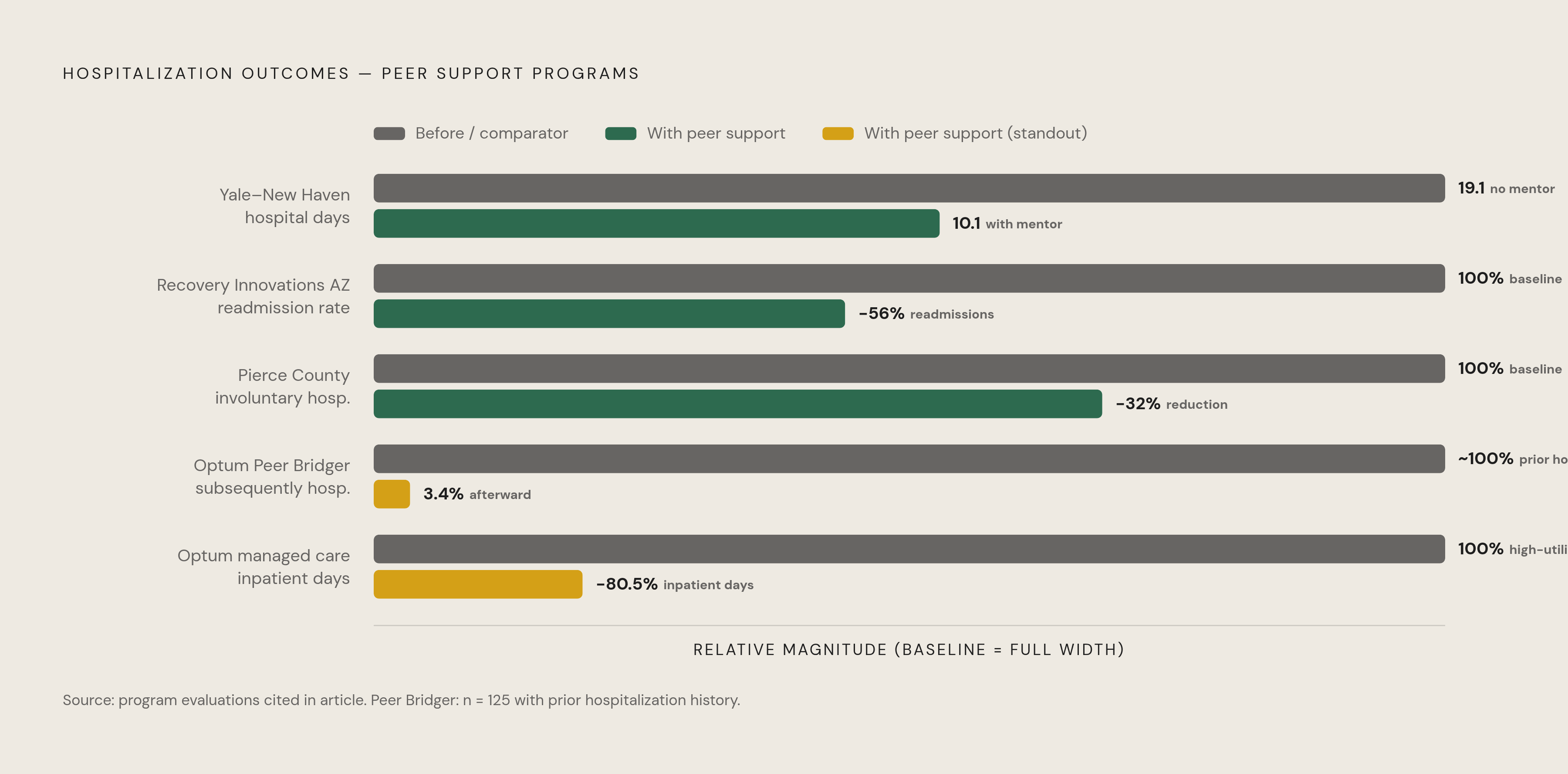
The hospitalization numbers, once you start collecting them, are hard to look past. Recovery Innovations in Arizona posted a 56% reduction in hospital readmission rates. Pierce County, Washington cut involuntary hospitalization by 32% using certified peer specialists running respite services, saving $1.99 million in a single year. Optum's Pierce Peer Bridger program served 125 people, every one of whom had a hospitalization history before getting a peer coach; afterward, only 3.4% were hospitalized. At Yale-New Haven Psychiatric Hospital, people assigned a peer mentor averaged 10.08 hospital days over nine months against 19.08 for those without one, with rehospitalizations averaging 0.89 versus 1.53. Under Optum's managed care contracts, people with at least two prior hospitalizations a year saw an 80.5% average reduction in inpatient days.
The dollar figures track the same curve. A New York City Medicaid study tied peer-staffed crisis respite use to Medicaid spending averaging $2,138 less per enrolled month. A Denver federally qualified health center measured a return of $2.28 for every dollar spent on peer support. Georgia's Department of Behavioral Health found its certified peer specialist model costing $997 per person per year, against $6,491 for day treatment, a savings of $5,494 per person annually. The Pierce Peer Bridger program alone generated $550,215 in savings from a 79.2% year-over-year drop in hospital admissions. NYAPRS data on the broader Peer Bridger model in New York shows a 47.9% decrease in people using inpatient services at all, a 62.5% drop in inpatient days, and a 28.0% rise in outpatient visits, which is the shape you'd want to see: fewer crises, more sustained engagement.
A 2013 study found 28.7% of people entering Certified Peer Specialist training had been unemployed or in transitional and sheltered employment beforehand, and 60% went on to reduce or leave public assistance because of their work as CPS, a figure that points somewhere the hospitalization data doesn't. Peer support, in other words, is not only producing better outcomes for the people it serves. It is building a workforce out of people the system had mostly written off as recipients of services rather than potential providers of them.
None of these gains came from adding more case management hours to the same teams. They came from a relational and motivational mechanism that coordination, on its own, does not have access to. Hospitalization reduction evidence comes from Mental Health America's 2019 evidence review. TN PeerLink recorded a 90% decrease in average acute inpatient days per month, while WI PeerLink recorded a 71% decrease.
Peer support added directly to case management teams
A comparative study makes the complementarity argument concrete rather than theoretical. Teams combining case managers with peer specialists were compared against teams pairing case managers with nonconsumer assistants, and the peer-specialist teams produced greater gains in quality of life along with an overall reduction in major adverse events. That is not a study of peer support replacing case management.
The framing that follows from this is straightforward: case management builds systemic stability, peer support builds relational trust and internal motivation, and neither one substitutes for the other. Something breaks when that division collapses. Ask a peer specialist to start documenting, assessing, and coordinating services the way a case manager does, and the mutuality that made the relationship work in the first place starts to erode. The peer shifts from partner to authority figure, and the entire mechanism that produced the outcomes above stops functioning the way it did.
There's also a workforce argument here that matters beyond any single program. HRSA projects persistent shortages of behavioral health professionals continuing through at least 2030. Peer specialists expand the system's total capacity to reach people; they are not a cheaper stand-in for clinicians who don't exist in sufficient numbers. One example of this division in practice: Guides and STRIVE Specialists operate alongside clinical and care coordination infrastructure, with lived experience positioned deliberately as the relational layer that makes engagement possible in the first place, not as a substitute for the coordination work happening around it. The design question for any health system building integrated teams is not peer support versus case management. It's how to structure the two together so each keeps doing the thing it's actually built to do.
The populations most likely to fall through the gap between coordination and trust
Roughly half of adults with serious mental illness receive treatment in a given year, and unmet need on that scale raises rates of homelessness, worsens physical health, and lowers life expectancy. That gap is not distributed evenly. KFF data from 2019 found 65% of White adults with moderate or severe anxiety or depression received mental health services, against 47% of Black adults and 60% of Hispanic adults, a disparity driven by stigma, cost, and a documented lack of cultural competence in the systems meant to serve them. Chronic homelessness follows a similar pattern: adults from certain racial and ethnic minority groups face substantially higher rates of chronic homelessness than white non-Latino adults, and homelessness and serious mental illness are tightly bound together. The Commonwealth Fund's 2026 State Health Disparities Report warns that policy shifts through 2025 and 2026 are likely widening these disparities in access, affordability, and outcomes, not narrowing them.
Social determinants compound distrust well past what clinical training alone can address. Research published in Epidemiology and Psychiatric Sciences found higher odds of mental disorder tied to income below 200% of the federal poverty level, housing insecurity, food insecurity, delayed care from lack of transportation, and living in an unsafe neighborhood. A companion finding from Translational Psychiatry notes there are no standardized clinical guidelines for addressing any of this inside psychiatric practice. Transportation alone carries its own weight: people facing transportation barriers show a significantly higher likelihood of chronic, rather than episodic, poor mental health. None of that is solved by a better service plan. It requires someone who understands, from the inside, what it actually costs to show up.
Peer support is not automatically exempt from these same gaps, either. Psychiatric Services literature documents a real need to expand cultural competence within peer support delivery itself, because the model's power depends entirely on the peer actually reflecting the community they're working with. A peer specialist who does not share the cultural or lived context of the person in front of them is not offering the same thing the model promises. The populations for whom coordination alone fails most often are, unsurprisingly, the same populations for whom trust-based, community-present peer support matters most. Boston University Sargent College reported that peer support programs for older adults with serious mental illness are rarely prioritized despite demonstrated benefit in reducing isolation and improving system navigation.
Scaling peer support without losing what makes it work
Scale is where peer support runs its biggest risk. As the model gets absorbed into Medicaid-funded systems built around documentation and compliance, there is real pressure to quietly redefine peer specialists as a cheaper version of a case manager. That redefinition, if it happens, erodes the exact mutuality that produced the hospitalization and cost outcomes described above. A peer specialist buried in paperwork stops being a peer in any functional sense.
Technology adds a newer wrinkle to this. Design here matters enormously; a poorly integrated tool doesn't just fail to help, it can actively erode the thing peer support depends on. Keeping lived experience genuinely in the loop, rather than automating around it, is not an optional detail.
SAMHSA's National Model Standards for Peer Support Certification offer one anchor against all this drift, setting a national baseline for training, certification, and scope of practice. Standards alone don't guarantee fidelity, though. Peer specialists need structured roles, supervision that actually honors lived experience rather than treating it as a liability to manage, pay that reflects the value of the work, and real protection against role drift back toward case management by another name.
The hospitalization reduction and cost savings data from Georgia, Pierce County, and NYAPRS make the business case for integration. The recovery-process gains, self-efficacy, empowerment, sustained engagement, make the clinical one. One approach to holding onto fidelity at scale involves keeping peer roles embedded directly in communities rather than centralized in call centers, treating on-the-ground presence and consistent relationships as structural commitments built into the program design, not just traits of whichever individual happens to be staffing the role that day.
The evidence on whether peer support works is not really in question at this point. What remains genuinely open, for any system deciding how to build this out, is whether the implementation protects what peer support actually is, or slowly turns it into a discount version of a service that already exists under a different name. A CMU study presented at CHI '26 in Barcelona found that introducing LLM-based tools into peer support can sustain, undermine, or amplify the relational authority that grounds peer support depending on how they are constrained and co-used, making lived-experience-in-the-loop design essential.
Sources
- Peer Support and Case Management: Complementary, Not Interchangeable - Behavioral Health News
- Evidence for Peer Support May 2019 The Case for Peer Support
- Large Language Models in Peer-Run Community Behavioral Health Services: Understanding Peer Specialists and Service Users' Perspectives on Opportunities, Risks, and Mitigation Strategies
- Frontiers | Commentary: Essential elements that contribute to the recovery of persons with severe mental illness: a systematic scoping study
- Consumers as peer specialists on intensive case management teams: impact on client outcomes | Psychiatric Services
- Peer Support in Mental Health: Literature Review - PMC
- Thriving in Recovery: How We Can Support Older Adults with Serious Mental Illness to Age Vibrantly | Sargent College of Health & Rehabilitation Sciences:
- Overcoming Barriers to Integrating Peer Support in Mental Healthcare Systems - Behavioral Health News