Assertive Community Treatment for Severe Mental Illness
Clinicians go to patients instead of waiting for them to show up.
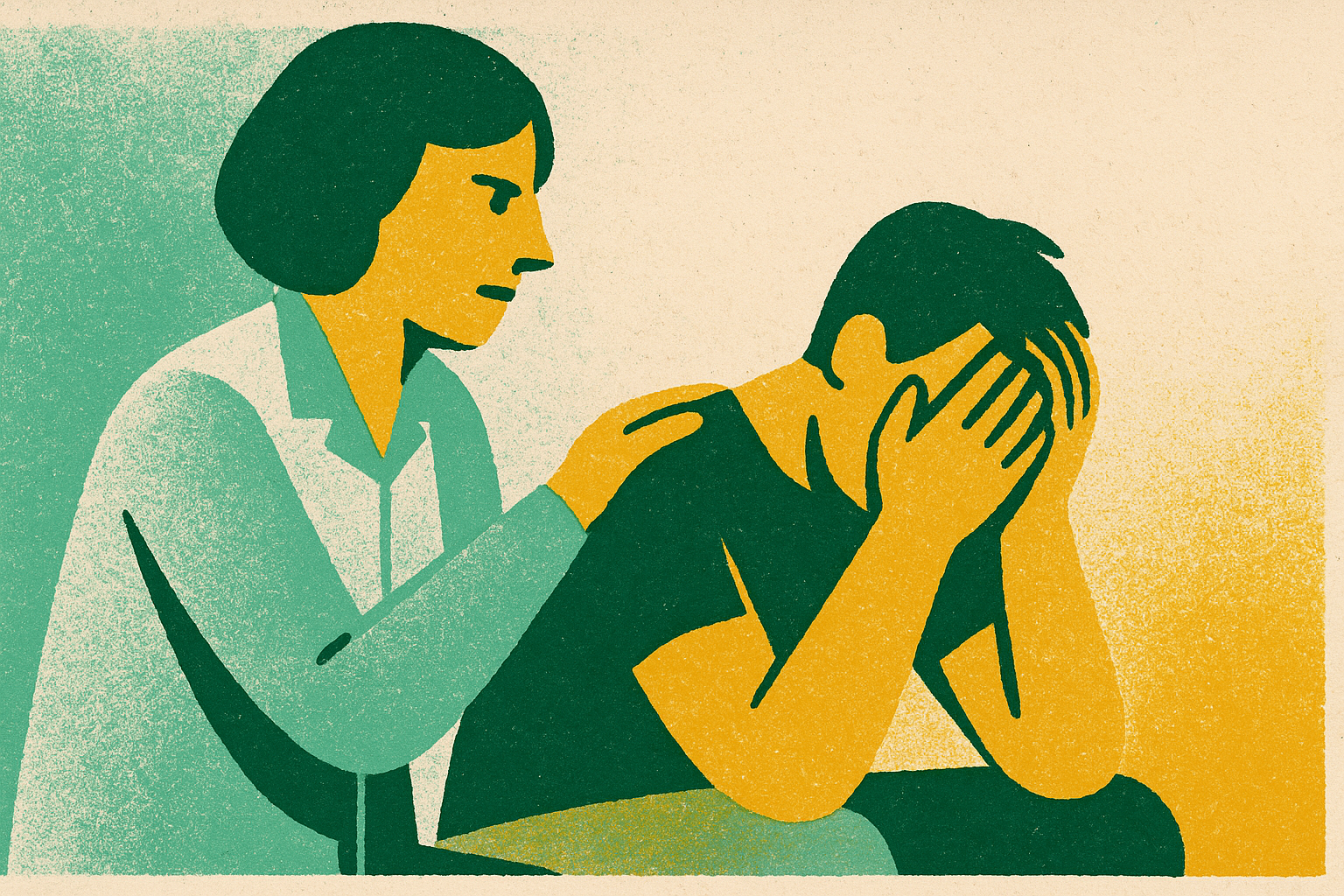
Assertive Community Treatment puts a full clinical team on the road: into someone's apartment, a shelter bed, the bench where a person spends most afternoons. The model exists because psychiatric crisis and "show up to my office at 2pm" don't mix, and fifty years of outcome data on hospitalization and substance use back up why that mismatch matters. This piece walks through where ACT came from, how the teams are built, what the evidence actually says (and where it doesn't say much yet), and what it takes to run this well at scale.
The scale of the problem is not small. In 2024, 5.6% of U.S. adults, about 14.6 million people, met criteria for serious mental illness, per NAMI. Serious mental illness (SMI) means real functional collapse: schizophrenia spectrum disorders, bipolar disorder, or depression severe enough that holding a job or keeping an apartment stops being realistic. Only 43% of adults with any mental illness got care in 2024, and that number gets worse for the SMI group specifically, the people who need care most and have the least capacity to go chase it down through a normal appointment system. People with SMI die 10 to 20 years earlier than the general population, mostly from physical health conditions nobody treated, tangled up with the same structural barriers that kept them out of psychiatric care to begin with.
Deinstitutionalization was supposed to solve this. Empty the psychiatric hospitals, move people into community care, done. It never fully delivered, and jails absorbed a lot of what community mental health systems couldn't catch. Somewhere between 8% and 19% of incarcerated people meet SMI criteria; 15% to 20% need psychiatric treatment while they're locked up. Traditional outpatient care assumes someone can book an appointment, get themselves there, and come back next month like clockwork. For a person cycling through unstable housing and psychiatric crises, that assumption just doesn't hold. Closing that gap, between how the system is built and what this group actually needs, is the entire reason ACT exists.
What Assertive Community Treatment actually is and where it came from
ACT emerged in the early days of deinstitutionalization, built for people getting discharged from psychiatric hospitals into communities with basically no infrastructure ready to catch them. The wards had emptied, and what came next rarely filled the gap that left behind.
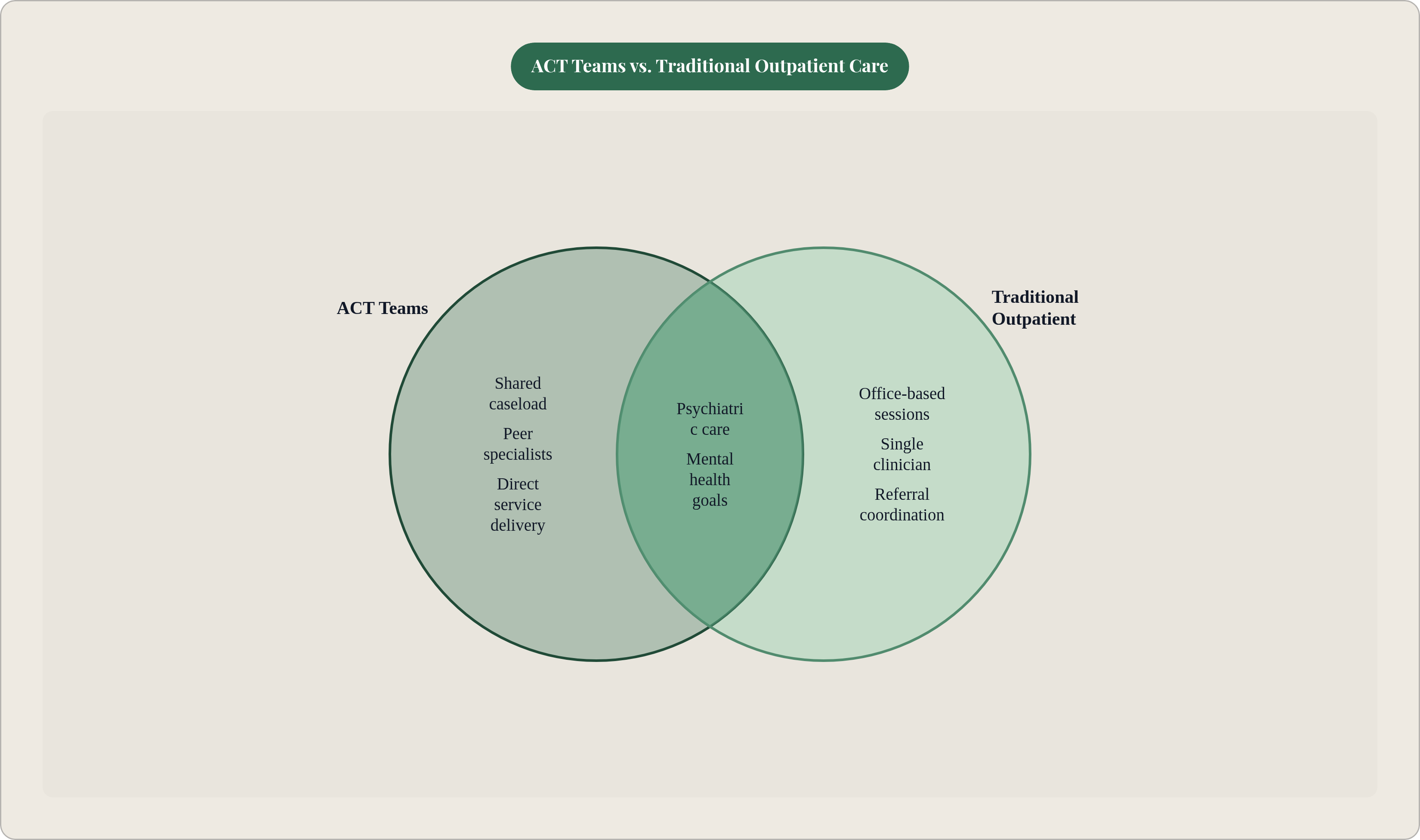
The distinction that still matters most: ACT delivers care directly, it doesn't refer people out to it. A case manager coordinates referrals and hopes the pieces connect on their own. An ACT team is the pieces. No routing someone through five different providers who never talk to each other. Go to the person, don't wait for them to come find you. Care happens in living rooms, in shelters, on whatever corner someone actually occupies during the day.
The population is narrow by design. ACT is for people with SMI showing a documented pattern: repeated or long inpatient stays, frequent crisis contact, justice system involvement, real trouble managing daily life. Many carry a co-occurring substance use disorder too, and the model treats that as the norm rather than some complicating exception. SAMHSA states it plainly: ACT exists for people traditional approaches have already failed. It was recovery-oriented from day one, meaning the goal was never just quieting symptoms; it assumes people can build self-determined lives, not just stabilized ones. More than 50 published empirical studies and several meta-analyses have examined ACT since then, which puts it among the more heavily tested community mental health interventions out there.
How an ACT team is structured and what each member contributes
A standard ACT team runs 10 to 12 staff across disciplines, with roughly one staff member per 10 people served. That ratio is the whole engine. Compare it to the caseloads of 50, 80, sometimes more that a traditional case manager carries, and the difference in what's actually possible becomes obvious fast.
The team typically includes a psychiatrist or psychiatric nurse practitioner for medication, a registered nurse for physical health monitoring and administering meds, a substance use specialist sitting on the team itself instead of reached through referral, a vocational specialist working on employment and education, and a peer specialist with lived experience of serious mental illness. Several state Medicaid plans, North Carolina's and South Carolina's among them, now require the peer specialist as a core team member, not an optional add-on.
No single clinician owns a client here. The team holds responsibility together, so care doesn't stall out when one staff member is sick or on vacation. The daily team meeting runs through the full caseload, and decisions get made as a group rather than by whoever happened to draw the case. Services go out direct: psychiatric care, psychosocial rehab, substance use treatment, housing help, a ride to a medical appointment, psychoeducation. No referral chain in between any of it.
The peer specialist's seat at that table matters enough to come back to later, because it brings something clinical training alone can't manufacture: the credibility of having actually lived through serious mental illness. SAMHSA describes peer workers helping with navigation, mentoring, goal setting, community building, the relational work that clinical staff, stretched thin across a full caseload, often don't have hours left to sustain.
Why meeting people where they live changes the clinical relationship
Office-based care has a built-in power imbalance. The clinician sits on home turf; the patient has to find a ride, show up on time, and perform enough wellness to survive fifty minutes. ACT flips that setup. The flip isn't cosmetic, it changes what the clinician can actually see.
A home visit reveals what a clinic room never will. Is the fridge empty? Is the pill bottle still sealed on a shelf, untouched? Is the lease three notices from eviction? Housing instability, food insecurity, gaps in transportation aren't background noise for people with SMI; they're direct triggers for relapse and rehospitalization, and ACT teams deal with them the moment they see them instead of writing up a referral that may or may not ever get followed.
Trust here gets built through showing up again and again, not through a diploma on a wall. Lived experience adds something specific on top of that. A peer specialist who rides along to a medical appointment, or sits next to someone filling out a housing application, is offering practical help and demonstrating recovery at the same time. Hard to fake that through a purely clinical role, since it depends on having actually sat on the other side of the form.
Care plans built out of this kind of sustained contact look nothing like what a once-a-month outpatient visit produces. They grow out of an actual relationship, not a fifty-minute snapshot every few weeks. And the goal was never just quieter symptoms. It's community integration: stable housing, something worth doing with the day, real people in someone's life.
What the outcome evidence shows, and where the picture is still developing
Fewer hospitalizations is the most consistent finding in the ACT research, full stop. A 2024 study of a hybrid ACT model in rural Greece found hospitalizations, voluntary and involuntary combined, dropped almost 80% over 16 months of follow-up. A separate 2024 observational study out of Salzburg, Austria, on a Flexible ACT program, found steady declines in both total inpatient length of stay and readmission rates after rollout. Two very different health systems, two numbers pointing the same direction.
Substance use outcomes move that way too. A systematic review covering 29 studies tied ACT to lower severity and prevalence of alcohol and drug use, plus higher engagement in substance use treatment itself, which matters given how common co-occurring disorders are on ACT caseloads. A review from the Rutgers Northeast and Caribbean Mental Health Technology Transfer Center, looking across more than 50 published empirical studies on ACT, found community integration outcomes positive in nearly all of them.
How much should that consistency carry, though? A 2026 scoping review in the Community Mental Health Journal found that where ACT outcomes do vary across studies, the variation traces back to fidelity to the model, local adaptation, and how well the team plugs into the broader system around it. Teams that drift from the core setup, team-based ownership, direct service, that 1-to-10 contact ratio, tend to get weaker results. Adaptations like Flexible ACT or Forensic ACT are built for specific populations, so their outcomes should get read in that context rather than folded into one flat verdict on "ACT" as a monolith. Underneath all of it sits a dollar figure worth sitting with: serious mental illness is tied to $190 billion in lost earnings a year. That turns ACT from a clinical nice-to-have into a cost argument on its own terms.
ACT adaptations built for specific populations who face additional barriers
Not everyone on an ACT caseload needs the same intensity of contact every single month. Flexible ACT, FACT for short, was built around exactly that mismatch: teams turn intensity up or down depending on where someone actually is that month, instead of running everyone at full throttle forever.
Forensic ACT handles a different pressure point entirely, people with SMI tangled up in the criminal justice system, the group correctional facilities have been absorbing by default since deinstitutionalization came up short. These teams usually add a probation officer or specialty court liaison to the clinical and peer staff already in place, so justice requirements and clinical care run as one coordinated track instead of two that never speak to each other. Forensic ACT is one of the more studied variants, partly because the pipeline it targets (release from jail with no community support waiting) is so well documented.
The rural Greece study matters beyond that single 80% figure: it shows the model working in a spread-out, resource-thin setting where specialty psychiatric care was scarce to start with. And ACT's approach to co-occurring disorders, building a substance use specialist directly onto the team rather than routing that care out to a separate referral, reflects an honest read on who actually fills these caseloads. Across every version of the model, the same core logic holds: multidisciplinary team, direct service, community-based contact, high intensity. What changes is who sits at the table and how the dosage gets tuned to the group in front of them.
The peer specialist's specific role in making ACT work for the hardest-to-reach
Peer support inside ACT addresses a trust gap that clinical credentials alone often cannot close for people with SMI.
A meta-analysis of 28 randomized controlled trials, 4,152 participants, published in Psychological Medicine, found peer support interventions beat control conditions across clinical, personal, and functional recovery measures. The subgroup specific to SMI showed clear superiority across all three categories post-intervention, one of the stronger signals in the entire peer support literature.
What a peer specialist brings to the table is different from anything else on it. They draw on their own lived experience, which builds trust in ways clinical training alone does not. They show recovery as something lived through, not something written up in a treatment plan. They walk through bureaucratic mazes (a housing application, a benefits appeal) alongside someone rather than doing it for them, keeping the person's agency intact. And they hold a kind of steady presence a packed clinical caseload usually doesn't leave room for anyone else to sustain at that depth.
There's a quieter mechanism running underneath all this. Telling a recovery story, the act of articulating a recovery narrative does something for the listener and for the peer specialist sustaining that role. A 2024 meta-analysis of 16 randomized controlled trials, 4,008 participants, published in Healthcare, found a combined effect size of d = 0.20 for self-efficacy gains linked to peer support. Modest, by clinical trial standards. But for a group whose confidence in managing their own illness has been ground down by repeated system failures, a real, statistically significant bump in self-belief carries more weight than the raw number lets on.
Some peer-led models build their entire structure on this premise, placing the lived-experience relationship at the center rather than as one seat among several on a clinical team.
What health plans and provider systems need to make ACT function in practice
Running ACT properly costs real money, and that cost is the point, not a bug to engineer around. A 1-to-10 staffing ratio, round-the-clock crisis coverage, and direct service delivery all need funding that holds steady for years. Short grant cycles or narrow contracts tend to wear the model down before it gets the chance to prove anything.
Medicaid is the main funding line in most states, so getting ACT, and the peer specialist role inside it, formally recognized and reimbursable under a state Medicaid plan is close to a hard requirement for scaling this at all. Fidelity monitoring belongs in that same conversation, and it's not paperwork for its own sake. That 2026 Community Mental Health Journal scoping review pointed to fidelity gaps as a key source of outcome variance across programs, which gives health plans reason to build fidelity checks into the contract rather than assume adherence takes care of itself.
The peer specialist workforce needs its own support structure to hold up, and this is where things often get shortchanged. Certification rules still swing wildly state to state and could use a lot more consistency. Supervision for peer specialists has to protect their wellbeing, not just track their output, given how directly the job draws on their own recovery. Paying them on par with the rest of the team sends a signal that actually counts: lived experience is a real clinical asset, not a lesser one riding along for optics.
One piece gets missed too often. Since the 10-to-20-year life expectancy gap for people with SMI comes mostly from untreated physical health problems, ACT teams need working handoffs into primary care, so the body gets attention alongside the mind. Peer-led organizations, First Hand among them, act as a natural complement to ACT teams on exactly this front, sustaining the trust-building and day-to-day navigation of housing, food, and appointments that a stretched clinical team can't always hold at the depth this population needs.