Recommended Preventive Care Screenings by Age Group
Discover which screenings matter most at each life stage and which ones people commonly delay.

The Bright Futures periodicity schedule governs preventive care from birth through age 21, and its architecture tells you something right away: visits are densest in early childhood, then progressively space out. This mirrors the pace of biological change. The first years of life concentrate more developmental risk windows than any other period, and the schedule reflects that reality rather than administrative habit.
In early childhood, the priorities cluster around development, sensory function, nutrition, and environmental exposures. Developmental screening occurs at well-child visits to catch delays when intervention is most effective. Vision and hearing are assessed at multiple points before school age. Once teeth emerge, fluoride varnish is recommended every three to six months based on caries risk, and it can be applied in a primary care office, not only a dental office. For families with limited dental access, that distinction is the difference between a child receiving the intervention or not. Lead and iron screening are conducted in toddlers depending on individual risk factors and local environmental conditions.
School age shifts the profile. Blood pressure screening becomes routine. BMI assessment is incorporated at every well-child visit, and the 2024 periodicity schedule reflects the AAP's 2023 clinical practice guideline on pediatric obesity, which took a more proactive stance on early identification and management than prior guidance did.
Adolescence adds another layer. Annual depression screening begins at age 11 and continues through age 21; the 2024 schedule also incorporates anxiety screening for children and adolescents, consistent with the USPSTF's 2022 recommendation. Substance use screening, including tobacco and alcohol, enters the conversation. For sexually active teens, STI screening becomes clinically relevant: the USPSTF carries a B recommendation for annual chlamydia and gonorrhea screening in sexually active women under 24. HIV screening is recommended for adolescents, with retesting annually or more frequently for those at increased risk.
Immunizations run parallel to every age band, updated annually by the Advisory Committee on Immunization Practices. They are foundational to this framework, not incidental.
The Screenings Young Adults in Their Twenties and Thirties Often Skip
A preventive health exam every three to five years is the common benchmark for adults between 18 and 39. Compared to the packed well-child schedule of early childhood, that cadence is jarring, and it creates a predictable problem. Young adults who are, by most clinical measures, the healthiest they will ever feel have little visceral motivation to schedule preventive care. The irony is that several important screenings cluster in exactly this window.
Blood pressure screening applies universally, regardless of age. Depression screening carries a USPSTF B recommendation for all adults; anxiety screening is recommended for adults under 65. Screening for unhealthy alcohol use with validated tools, and tobacco use screening with cessation counseling, are recommended for all adults regardless of life stage.
Sex-specific screenings introduce complexity. Cervical cancer screening begins at age 21 for women, with a Pap smear recommended every three years. Between 30 and 39, women may use a Pap smear alone every three years, high-risk HPV testing every five years, or co-testing every five years. Emerging guidance from HRSA and the Women's Preventive Services Initiative points toward primary high-risk HPV-based screening as the preferred approach for women ages 30 to 65, a shift worth watching as formal updates arrive.
Two screenings in this age group are particularly prone to being delayed or simply never initiated. HIV screening carries a USPSTF recommendation for all adults ages 18 to 79, as a one-time test for those not at increased risk. Many young adults have never had it. Hepatitis C screening is similarly recommended as a one-time test across this age range. Neither requires symptoms. A risk factor beyond age is also unnecessary. For women with a relevant personal or family history, the BRCA conversation is also appropriate in this decade; the USPSTF recommends that primary care clinicians use a brief familial risk assessment tool to identify women who may benefit from genetic counseling and evaluation.
Lipid disorder screening for the general male population typically begins at 35. Diabetes screening using blood glucose or HbA1c does not routinely begin until 35 for adults who are overweight or obese. Both are detecting conditions that accumulate silently over years, which is precisely why they matter before anyone feels a thing.
The Forties: When Cancer Screening Schedules Begin in Earnest
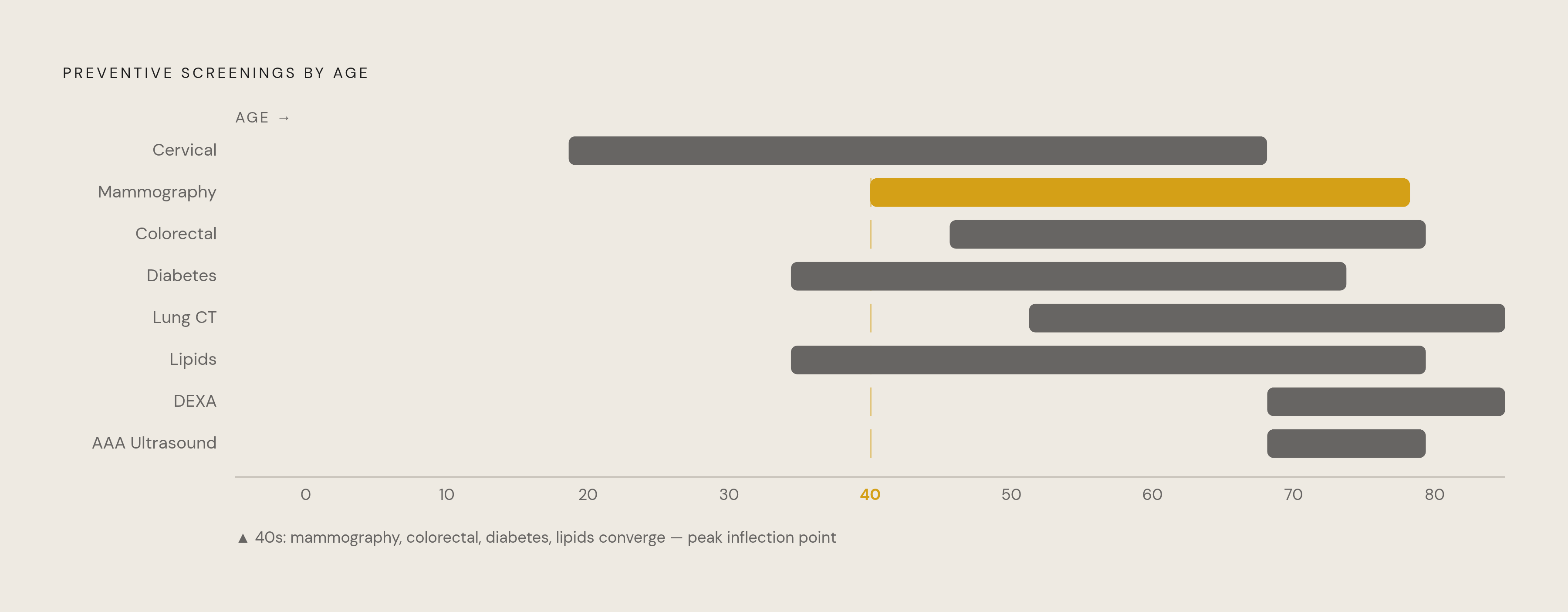
The forties represent a genuine inflection point in preventive care. Several major cancer screenings either begin or become newly recommended for the average-risk population in this decade, and at least one reflects a significant recent change that has not yet fully reached the people it affects.
Breast cancer mammography now begins at age 40. The USPSTF updated its guidance in 2024 to recommend biennial mammography starting at 40, a meaningful departure from the prior framework, which placed a B recommendation at age 50 and left the 40 to 49 window as an individual-decision C recommendation. Women who were counseled in their thirties that mammography could wait until 50 are now operating under a different set of expectations, and many of them do not know it yet.
Colorectal cancer screening now begins at 45, following the USPSTF's decision to lower the start age from 50 in response to rising rates in younger adults. Multiple modalities are accepted: annual high-sensitivity stool tests, stool DNA-FIT testing every one to three years, colonoscopy every ten years, CT colonography every five years, or flexible sigmoidoscopy every five years. The choice among them is a shared decision between patient and provider, informed by preference, access, and individual risk. In practice, the right colorectal cancer screening test is whichever one the patient will actually complete.
Diabetes screening using blood glucose or HbA1c begins at 35 for adults who are overweight or obese under the 2021 USPSTF B recommendation. Those who reach their forties without having had this conversation should have it now. Blood pressure, depression, alcohol use, and tobacco screening continue as in earlier decades.
The forties also lay groundwork for a screening that begins slightly later. Annual low-dose CT for lung cancer becomes available at age 50 for eligible patients, and eligibility depends heavily on a documented smoking history. A provider who has yet to take that history cannot flag the patient when the window opens. The forties is the time to establish that record.
Screenings in Your Fifties and Early Sixties, Including a Critically Underused Test for Lung Cancer
Most of the cancer screening protocols established in the forties continue through this decade. Biennial mammography runs through age 74. Colorectal cancer screening continues on whatever modality was selected at the outset. What's new in the fifties is lung cancer screening, and the gap between who qualifies and who actually gets screened is one of the more consequential failures in preventive care right now.
The USPSTF recommends annual low-dose CT scanning for adults ages 50 to 80 with a significant smoking history, defined as at least 20 pack-years, who currently smoke or who quit within the past 15 years. The 2021 update lowered the starting age from 55 to 50 and cut the minimum pack-year threshold from 30 to 20. That expansion was deliberate: it brought more women, more racial and ethnic minority groups, and more people from lower socioeconomic backgrounds into the eligible population, groups that had been systematically underrepresented under the prior criteria. Despite this, only a small fraction of eligible individuals are receiving the test. Patients in this age group who smoke or have smoked need to ask their provider directly whether they qualify. Waiting for the question to come from the other side of the desk has not worked.
Cardiovascular risk assessment takes on additional texture in this decade. Providers may calculate a ten-year cardiovascular disease risk score to guide discussions about statin therapy. The USPSTF's 2022 guidance on aspirin for primary prevention of cardiovascular disease is also relevant here: for adults ages 40 to 59 with a ten-year cardiovascular disease risk of ten percent or greater, initiating low-dose aspirin is now a matter of individualized judgment, not a standing recommendation. Adults who were told years ago to take a daily aspirin and have never revisited that advice should raise it explicitly.
Diabetes monitoring continues for those diagnosed or at elevated risk; the American Diabetes Association recommends at least annual testing in this category. Depression and anxiety screening remain part of the standard preventive profile throughout.
Screenings That Shift, Stop, or Become Newly Important at 65 and Beyond
The 65-plus period requires rethinking the entire screening list, not simply adding to it. Some screenings stop. Some continue unchanged. Some appear for the first time. The reasoning behind each of these moves is not uniform, and the distinctions matter.
Colorectal cancer screening continues through age 75 under a USPSTF B recommendation. Between 76 and 85, the decision becomes individualized, dependent on health status, life expectancy, and prior screening history. After age 85, screening is not recommended. Mammography continues every one to two years through age 74; the USPSTF does not extend a formal recommendation beyond that age due to insufficient evidence, which shifts the decision toward a more individualized conversation rather than ending it. Cervical cancer screening ends definitively at age 65 for women who have had adequate prior screening and are at average risk. This is a stop point, not a deferral, and it is grounded in evidence about the diminishing yield of continued screening in this population.
Lung cancer screening continues annually through age 80 for those meeting the pack-year and recency criteria.
Two screenings become newly relevant at 65. Bone density measurement using a DEXA scan is recommended by the USPSTF for persons assigned female at birth age 65 and older to prevent osteoporotic fractures. The current USPSTF guidance does not extend a routine recommendation for osteoporosis screening to men, citing insufficient evidence. Younger postmenopausal women at increased risk may qualify before 65, so the age is not a hard floor for everyone. Abdominal aortic aneurysm screening carries a USPSTF B recommendation as a one-time ultrasound for men ages 65 to 75 who have ever smoked. For men in that age range who have never smoked, selective rather than routine screening is the guidance. For women, the harms outweigh the benefits in the absence of a smoking or family history, and evidence is insufficient for those who have either risk factor. This is largely a screening for men with a relevant tobacco history.
Immunizations take on heightened importance here. Pneumococcal vaccine is recommended for all adults at 65. High-dose or adjuvanted influenza vaccine is preferentially recommended for adults 65 and older per the 2025 ACIP schedule, because older immune systems respond differently to standard formulations. RSV vaccine is recommended for adults 75 and older; for adults between 60 and 74, the decision is based on shared clinical decision-making and individual risk. COVID-19 vaccine recommendations have been revised in the 2025 ACIP schedule.
The Medicare Annual Wellness Visit covers many of these screenings at no cost-sharing. A striking number of Medicare beneficiaries never use it. That is a correctable problem, and it starts with knowing the visit exists.
Tests That Apply Across Every Adult Age Group Regardless of Life Stage
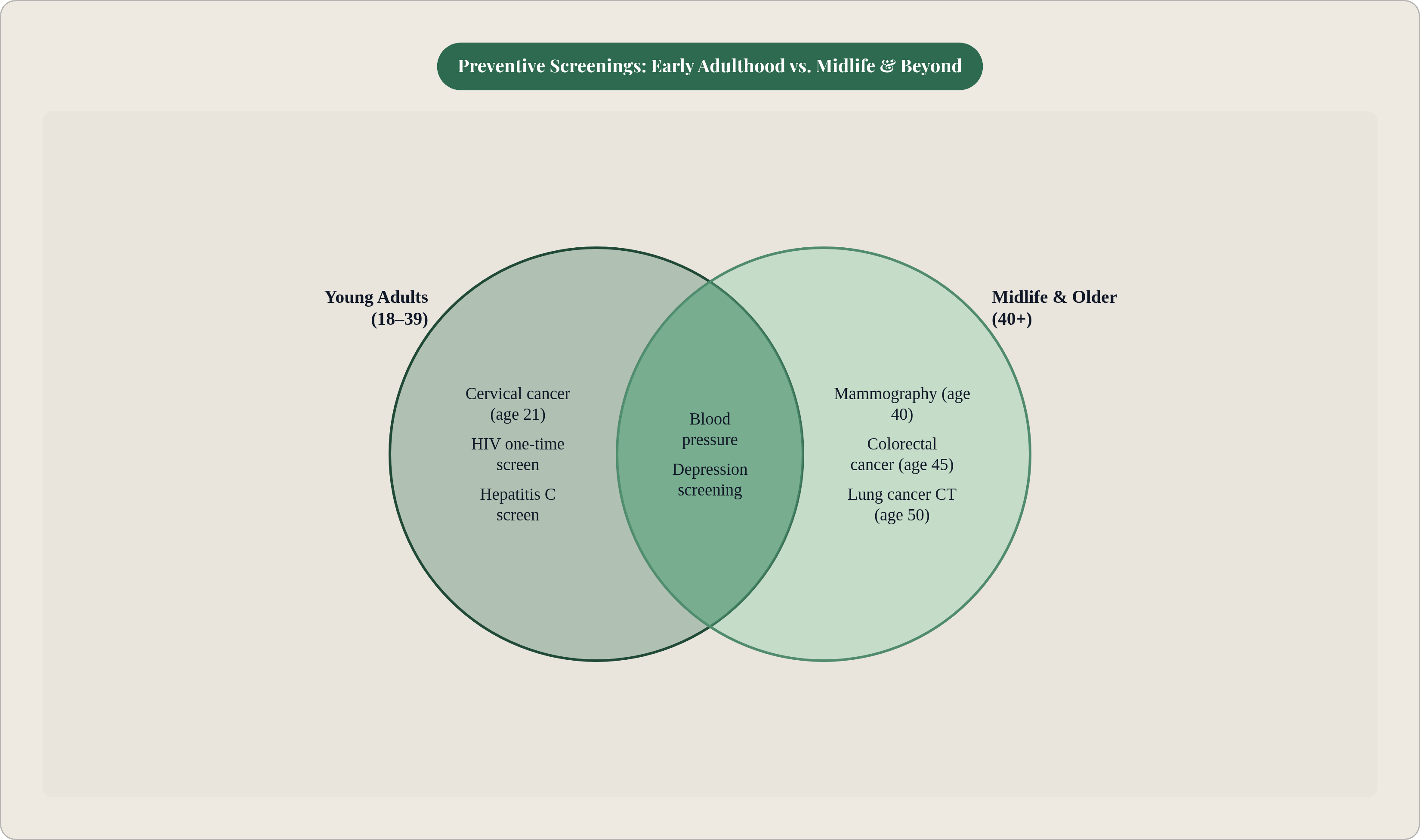
Some screenings don't have a meaningful start or stop age. They run continuously through adult life, active at every stage.
Blood pressure screening is universal for all adults. Elevated blood pressure is largely asymptomatic, and that is precisely the point. The absence of symptoms is not reassurance; it is the condition under which screening becomes necessary.
Depression screening carries a USPSTF B recommendation for all adults, with no upper age boundary. It is one of the few screenings that applies from late adolescence through the end of life without interruption. Anxiety screening is recommended for adults under 65. That upper boundary is intentional and grounded in the available evidence, not an oversight. The two screenings are often conflated in conversation, but their recommended age ranges do not perfectly overlap, and that distinction matters clinically.
HIV carries a USPSTF recommendation for one-time screening in all adults ages 18 to 79 who have not been previously screened. No symptoms required. No risk factor beyond age. For individuals at increased risk, more frequent testing is appropriate.
What these screenings share is that none of them require a triggering event. They require a patient who shows up to a preventive visit and a clinician who asks the right questions. Whether that actually happens is a separate and harder problem, one that most evidence-based guidelines are not designed to solve. Knowing what applies to your age group is at least the beginning of being able to ask.