Why People With Serious Mental Illness Get Undercounted in Community Needs Assessments
Standard disability surveys miss more than half of people with serious mental illness.
Roughly 14.6 million adults in the country had a serious mental illness in 2023, a federal oversight agency reported. Serious mental illness, or SMI, covers conditions like schizophrenia, bipolar disorder, schizoaffective disorder, and major depression severe enough to substantially impair someone's ability to function day to day. That population is undercounted in the very tools planners use to size demand and allocate resources, and the undercounting is a stack of failures. It's a stack of them: bad survey instruments, structural exclusion, equity gaps, and unmeasured social need, each layer compounding the last. This piece walks through those layers one at a time, so planners and health system partners can see what they're missing and why.
How federal surveys are supposed to capture disability, and where they fail for SMI
Most federal data on disability, mental health included, comes from a standard set of six questions called the Washington Group Short Set (WG-SS). It appears across multiple federal surveys as the go-to method for identifying who counts as disabled, and by extension, who gets counted for planning purposes.
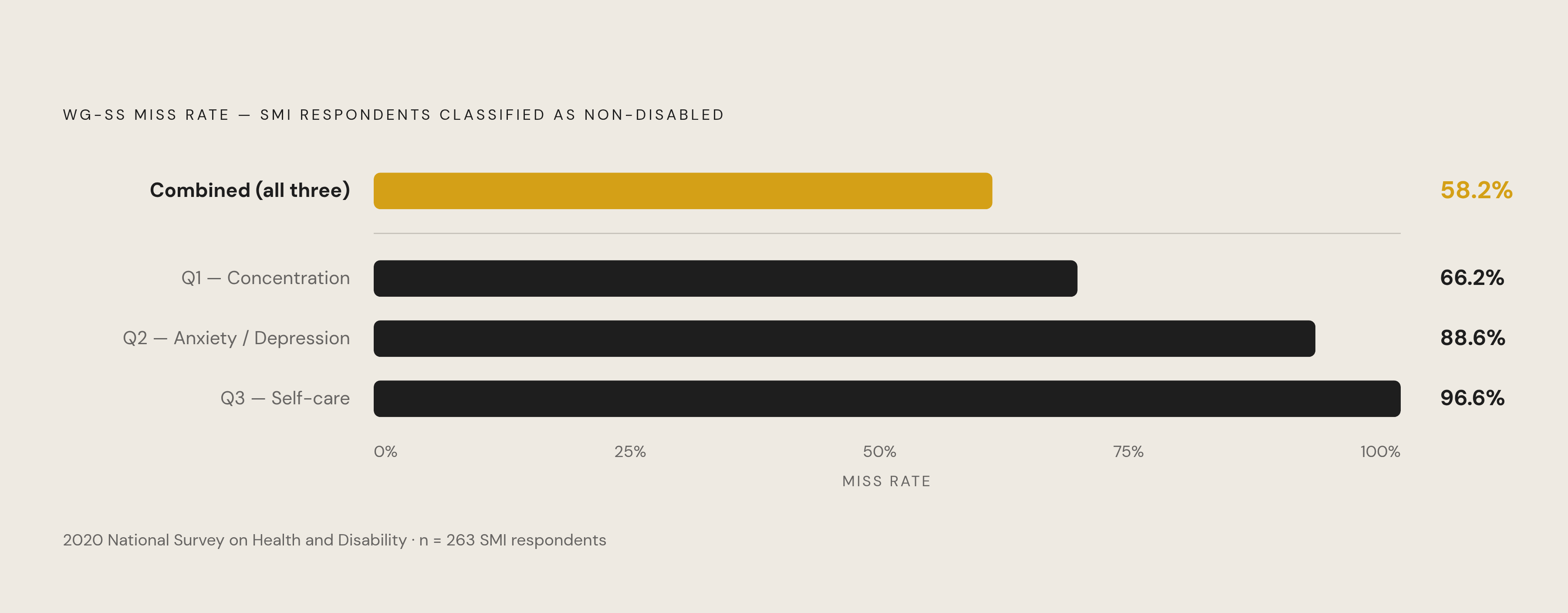
A June 2025 study in Frontiers in Psychiatry, led by researchers from the University of Kansas, UNC Chapel Hill, and Temple University (Hall, Thomas, McCormick, Kurth), tested how well the WG-SS does that job for people with SMI. Using 2020 National Survey on Health and Disability data, the team looked at 263 respondents who self-reported major depression, bipolar disorder, schizophrenia, or schizoaffective disorder, then checked how often the WG-SS flagged them as disabled at all.
The results should trouble anyone who builds funding models on this instrument. Of the three WG-SS questions researchers identified as most relevant to mental illness, one missed 66.2% of SMI respondents, a second missed 88.6%, and a third missed 96.6%. Combined across all three, 58.2% of people with SMI still got classified as non-disabled. More than half the population the instrument exists to identify slips through it entirely.
This isn't a fresh discovery, either. The study notes earlier work already found the WG-SS missed close to 60% of respondents with any mental illness, so what's happening here is less a bug than a known, persistent blind spot nobody has fixed. The reason comes down to what the WG-SS was built to measure: functional limitations that are easy to observe from the outside, like vision loss or trouble walking. SMI is episodic and cognitive. It doesn't map onto questions written for physical impairment, and it was never going to. So when a hospital or county pulls federal disability data to estimate how many residents need mental health services, the starting denominator already excludes more than half the people it's supposed to count. That's the foundation of the whole estimate, and the exclusion of more than half the people it's supposed to count is not a rounding issue in a spreadsheet somewhere. That's the foundation of the whole estimate.
What community needs assessments are built to do, and the assumptions that break down
A Community Health Needs Assessment (CHNA) is the process hospitals, health systems, and public mental health agencies use to figure out what a population needs and where to put money first. Nonprofit hospitals have run them since the Affordable Care Act took effect in 2012. Community Mental Health Service Programs (CMHSPs) face a parallel requirement under the Michigan Mental Health Code, with full assessments due at least every three years and an annual subset filed in between.
Michigan's CMHSP guidance shapes how planners build these assessments and which data sources they draw from. So the WG-SS undercount doesn't stay abstract. It flows straight into state-level decisions about where mental health dollars go.
Real CHNAs show what this looks like on the ground. Southern Illinois Healthcare's 2024 CHNA covered a seven-county service area, drawing on 613 community survey respondents, 90 key stakeholders, and 37 focus group participants. Behavioral health landed as a top-three priority, which sounds like the system working. But a community survey, by design, reaches people who are already connected enough to participate. The method has a ceiling on who it can find, and that ceiling sits right where SMI prevalence runs highest.
Integrated Services of Kalamazoo took a different route in its 2024 CHNA, building the whole process around behavioral health equity and underserved populations specifically. ISK notes that its 2021 CHNA presentation to SAMHSA helped spark SAMHSA's growing interest in CHNAs, which later became a requirement for all SAMHSA grantees. Better process design at one organization rippled outward into federal policy. Better process design at one organization rippled outward into federal policy, which is rare and worth pointing at directly rather than treating as one example among many.
Most CHNAs still run on the assumption that surveys, stakeholder interviews, and existing data, taken together, add up to a reasonably complete picture of need. SMI populations break that assumption in several distinct ways, covered in the next section. If the population is undercounted going in, the needs assessment underestimates demand, funding gets sized to match the underestimate, fewer people get connected to services, and the population stays invisible for the next cycle's data. The error doesn't correct itself. It compounds, cycle after cycle.
The structural reasons SMI populations don't show up in standard survey methods
Start with reach. Phone surveys, online surveys, household surveys: all of them depend on a stable address, a working number, or reliable internet access. That design choice quietly excludes people in unstable housing, psychiatric hospitals, jails, and shelters, which are settings where people with SMI are disproportionately represented. A national mental health advocacy group reported that 18.1% of people experiencing homelessness in the country had serious mental illness in 2024. The same group estimates roughly 4,000 people with serious mental illness sit in solitary confinement in facilities across the country at any given time, a population that institutional surveys essentially never reach.
Then there's the symptoms themselves. Active psychosis, cognitive impairment, disorganized thinking: these reduce a person's ability to complete a structured survey in the first place. The very symptoms that define a severe presentation are what make self-report unreliable, or in some cases, impossible to collect at all.
Self-report carries its own separate weakness even among people who can respond. The GAO's 2025 review flagged that HHS assessments of SMI programs relied mainly on self-reported data from people already receiving treatment. That approach carries built-in error on sensitive topics, and it structurally excludes anyone not currently in treatment, which is often the exact population planners need to find.
Underdiagnosis compounds this further, particularly in communities of color, where a lack of culturally sensitive screening tools and structural barriers to care mean many people are never diagnosed at all. Someone who has never received a diagnosis cannot self-identify as having SMI on a survey, no matter how well the survey is written. Stack stigma on top of that: even people who know their diagnosis may choose not to disclose it, especially in communities where mental illness carries heavy social cost. Each factor removes its own slice of the SMI population from view. Stacked together, these gaps turn the measured count into a significant underestimate of the true one, not through any single failure but through accumulation.
Who gets undercounted most, the equity layer inside the counting failure
Access to care isn't distributed evenly, and that unevenness feeds directly into how the population gets undercounted. KFF's 2023 survey found that among adults reporting fair or poor mental health, 50% of White adults received services in the past three years, compared with 39% of Black adults and 36% of Hispanic adults. People who aren't in treatment are less likely to show up in administrative data, less likely to carry a formal diagnosis, and less likely to be captured in the surveys that measure treatment populations. The access gap becomes a counting gap almost automatically, and that should be the headline, not a footnote: the same barriers that keep people out of care are the ones that keep them out of the data used to justify more care.
A leading psychiatric professional association points to specific patterns within this. These patterns mean that racial and ethnic minority populations with SMI are more likely to appear in crisis or emergency data than in outpatient prevalence counts, making their true need harder to capture through standard measurement.
KFF's 2023 survey points to barriers that suppress both care-seeking and survey participation among these populations. Those barriers suppress care-seeking and survey participation at the same time. A CHNA that doesn't build in active oversampling or alternative outreach for communities of color will understate SMI need in the populations most affected, then allocate resources on that understated basis.
There's legislative acknowledgment of this gap already. The Pursuing Equity in Mental Health Act, introduced April 10, 2025, would direct $80 million annually from fiscal years 2026 through 2031 toward organizations serving high proportions of racial and ethnic minority groups. A bill like that doesn't get written unless the current data and funding pipeline is already known to be missing people.
The social determinants that make SMI need invisible even when the person is identified
Being counted as having SMI doesn't mean the full scope of someone's need gets captured. Research on people already engaged with mental health services consistently finds unmet social needs, including food insecurity, housing instability, and neighborhood disorder, that never make it into a clinical chart.
A cross-sectional study in Epidemiology and Psychiatric Sciences backs this from a different angle, finding that social and economic factors, including income, education, housing, and food access, were tied to higher odds of depression and anxiety disorders. None of that appears in a diagnosis code.
The referral systems meant to catch these needs have their own leak, and it's a bigger leak than most planners assume. An evaluation of the CMS Accountable Health Communities model found that only 14% of beneficiaries referred to social service navigation had their needs actually resolved, while 33% were lost to follow-up entirely. So even when a system correctly identifies that someone needs housing help or food assistance, more often than not, that need goes unresolved and undocumented.
This matters for the counting argument specifically because a person's SMI-related social needs can sit entirely outside any dataset a CHNA pulls from. Someone's diagnosis might get captured. Their housing instability probably won't. Resource allocation built only on clinical prevalence numbers is, by construction, going to underfund the social supports that keep someone with SMI stable, help them keep a treatment relationship, and help them avoid crisis.
What accurate counting would require, and what better CHNAs already do
Fixing the measurement starts with the instrument itself. Supplementing or replacing the WG-SS with questions built for how SMI actually presents could mean condition-specific self-identification, functional impairment scales, or linking to administrative treatment data, and would close a lot of the gap the Frontiers in Psychiatry study documented. Anything short of that leaves the same 58.2% miss rate baked into the next round of federal data.
Michigan's CMHSP guidelines already point toward one practical fix: treating emergency rooms, free clinics, and primary care physicians as key points for identifying mental health need. Building data pipelines from those venues into CHNAs would catch a slice of the population that never appears in a household survey.
ISK's 2024 CHNA offers a working example. It was designed to identify communities experiencing disparities, built explicitly around health equity and underserved populations, rather than reporting aggregate numbers that hide the gaps. Southern Illinois Healthcare's 2024 CHNA shows what broader outreach looks like in practice, with surveys distributed through the Healthy Southern Illinois Delta Network, the SIH Patient and Family Advisory Council, homeless shelters, a local NAACP branch, food pantries, and faith communities, plus a translated version distributed at religious gatherings held in another language, local orchards, and through the Southern Illinois Migrant Council. That layered approach is how SIH reached 613 respondents across seven counties, people a standard mailed survey would have missed entirely.
Individual health systems improving their own methodology helps locally, but it doesn't touch the federal instruments that upstream policy and funding decisions still lean on. Both levels need to change together, not one instead of the other, and treating local fixes as sufficient on their own is exactly the mistake to avoid. Build survey design around institutional settings like jails, shelters, and inpatient facilities, use trusted community intermediaries to reach people disconnected from care, disaggregate data by race, ethnicity, and housing status so equity gaps can't hide inside an average, and screen for social determinants alongside clinical prevalence instead of treating that as a separate exercise tacked on afterward.
Why peer support infrastructure is uniquely positioned to close the identification gap
The populations that standard surveys miss are, almost point for point, the populations that peer support workers already reach. Peers work in community, in housing programs, in jails, in shelters, and they don't require someone to first navigate a clinical intake process before being seen. No survey instrument has that structural advantage, and building one that does would mean rebuilding the survey from the ground up.
Peer workers, community health workers, and outreach staff operating in the field routinely encounter unmet need that never appears in administrative data, including food insecurity, housing instability, and medication gaps that a claims record or a CHNA survey simply won't capture. Research published on PubMed has found peer support effective at improving clinical, psychosocial, and recovery-oriented outcomes for people facing serious mental health challenges. Evidence across diverse settings supports peer support as an effective component of recovery-oriented care. That effectiveness rests on the same trust relationship that makes peers good at engagement in the first place: shared lived experience lowers the barrier that stigma and mistrust otherwise put up.
That trust matters for counting, not just for care. When someone with SMI who is unhoused, disconnected from any provider, or wary of a system that has historically underserved their community gets reached by a peer with shared experience, that contact opens a path to identification and enrollment that no survey instrument can replicate. Peer workers already function as informal data-gatherers in the field. So why does that information almost never make it into the formal needs assessment process? Integrating peer support into CHNA methodology itself, not just into service delivery afterward, could reveal population need that current instruments are structurally blind to. That means treating peer workers as community informants with a role in the assessment.
firsthand's model reflects this logic directly, centering people with lived experience of serious mental illness and substance use disorder, working on the ground in the communities they serve, and using its helpinghand platform (HITRUST r2 certified) to document and coordinate support across housing, food, medication, and clinical needs. That infrastructure sits exactly where the counting failure lives: among the people surveys don't reach, and the needs that diagnosis codes don't capture.
What planners, health systems, and health plans should take from this
None of this is a rounding error. When a CHNA undercounts SMI, every downstream resource decision, housing programs, outreach teams, medication support, peer services, gets sized for a population smaller than the one that actually exists.
The treatment gap gives some sense of scale. In 2024, 70.8% of adults with SMI received treatment, which also means close to three in ten people carrying the most severe conditions went without any. That gap carries consequences visible well outside the mental health system: $193.2 billion in lost annual earnings tied to serious mental illness, and a 14-year gap in life expectancy for people living with it. Those numbers describe a system that cannot fully see the population it exists to serve, and that's the throughline connecting every section above, from the WG-SS's missed questions to the referral programs that lose a third of their referrals to follow-up.
For CHNA teams sitting inside hospitals and health systems, the practical starting point is an audit. Trace where the current SMI prevalence numbers actually come from. If the answer is federal disability survey data, primarily, the working assumption should be that the real number runs materially higher than what's on the page. From there the fix isn't exotic: add outreach channels that reach institutional settings, disaggregate by race and housing status, screen for social determinants alongside diagnosis, and treat peer workers already active in the community as a source of information, not just a delivery mechanism. The tools to count this population more accurately already exist. What's been missing is the will to treat the undercount as a design flaw to fix, rather than a limitation to shrug off and work around.
Sources
- U.S. GAO - Serious Mental Illness: HHS Assessments of Assisted Outpatient Treatment Have Yielded Inconclusive Results
- Joint Community Health Needs Assessment and Implementation Strategy
- iskzoo.org
- Undercounts of people with serious mental illness using the Washington Group Short Set questions – DOAJ
- Needs Assessment Guideline
- nami.org
- frontiersin.org