Cold vs Flu in People With Serious Mental Illness
People with serious mental illness face three times the mortality risk from respiratory infections.
Why People With SMI Die From Respiratory Illness at Disproportionate Rates
Serious mental illness, or SMI, is a specific clinical category: a mental, behavioral, or emotional disorder that causes serious functional impairment, substantially limiting one or more major life activities. It covers schizophrenia, bipolar disorder, schizoaffective disorder, and other psychotic conditions, a narrower and more severe slice of the much larger "any mental illness" population. This piece is about what happens to that specific, high-severity group when something as ordinary as a cold or a seasonal flu enters the picture, and why the outcome so often looks nothing like what happens to everyone else.
An estimated 59.3 million adults, 23.1% of the adult population, live with any mental illness, according to NIMH data from the 2022 National Survey on Drug Use and Health. SMI is the concentrated, higher-severity slice within that number, and the Healthy People 2030 national baseline shows only 66.7% of adults with SMI received treatment in 2022. More than one in three sit outside the treatment system. That gap is the structural backdrop for everything that follows: people disconnected from psychiatric care tend to be disconnected from vaccination programs, from primary care, and from the social scaffolding that helps anyone recover from a respiratory illness.
Start with the headline number, then push past it, because the number alone doesn't explain why it's true. A systematic review and meta-analysis (Ronaldson et al., eClinicalMedicine), covering twenty-nine observational cohort studies and a respiratory infections sub-analysis of 1,353,905 people, found a pooled relative risk of 3.27. People with SMI are more than three times as likely to die from a respiratory infection as the general population, and pneumonia alone showed roughly a four-fold increase in pooled mortality risk. Pneumonia is exactly where an untreated flu tends to land when it goes wrong.
A retrospective matched cohort study published in Schizophrenia Bulletin in 2026 found an adjusted hazard ratio of 1.69 for death from respiratory infections, even after adjustment for key confounders. The elevated risk survives those controls rather than dissolving into them, which should stop anyone from writing this off as a byproduct of lifestyle factors alone. If smoking and comorbidity explained the gap, adjusting for them would close it. If smoking and comorbidity explained the gap, adjusting for them would close it, but the elevated risk persists instead.
The COVID-19 pandemic offered an unplanned, large-scale stress test of the same pattern. A VA study found veterans with SMI were roughly 2.5 times more likely to die than veterans without SMI in the first six months of the pandemic, compared to the same period the year before. COVID didn't create this vulnerability. It exposed a pattern that was already there every flu season, built from high smoking rates, metabolic syndrome, antipsychotic side effects, housing instability, and a primary care relationship that, for many people with SMI, barely exists.
The biological reasons a cold or flu becomes more dangerous with SMI
Why does a virus that puts most adults out of commission for a week put someone with SMI in the hospital? The biology is loaded well before flu season starts, and it's loaded from several directions at once rather than any single cause.
Smoking rates run high in the SMI population, and smoking is a direct respiratory risk factor that weakens lung defenses before any pathogen shows up. Layering on metabolic syndrome, elevated rates of obesity, diabetes, and cardiovascular disease turns a moderate respiratory illness into something more severe. Antipsychotic medications carry their own cost too: weight gain, sedation, and reduced physical activity are documented side effects for many of these drugs, and over time they erode respiratory and immune function in ways that compound rather than resolve.
Some research suggests that certain psychiatric medications may interact with immune function in ways that complicate vaccine protection, meaning vaccination alone may not close the risk gap for every person on every medication. Treating vaccination as the single fix misreads the size of the problem.
None of this happens in isolation. Research consistently points to physical multimorbidity as a central factor in SMI mortality: the typical person with SMI who catches a serious flu is often already carrying conditions that raise the stakes considerably. That overlap is part of why life expectancy for people with SMI can run as much as twenty years shorter than the general population, a gap built from these risks starting earlier in life and going undetected longer than they should. The Royal College of Psychiatrists reported in 2024 that 130,400 adults with SMI died prematurely between January 2020 and December 2022, and estimated that 66% of those deaths, around 86,934, traced back to preventable physical health conditions including respiratory disease, heart disease, and liver disease. That is a specific, countable toll, not an abstraction, and it belongs at the center of how this population's respiratory risk gets discussed.
Social Conditions That Amplify Respiratory Illness Risk: Housing, Food, and Transportation
Biology explains part of the picture. It doesn't explain all of it, and social conditions do a lot of the remaining work. A study published in Community Mental Health Journal, covering 203 clients at a community mental health clinic, found food insecurity present in 64% of participants and neighborhood disorder in 93%. These weren't people lost to the system. They were actively engaged in treatment, showing up for appointments, and still living with these conditions in the background, which should unsettle anyone who assumes engagement with care eliminates the exposure itself.
Food insecurity during a respiratory illness isn't a side issue. Inadequate nutrition impairs immune response, slows recovery, and makes it harder to take oral medication on schedule when someone feels too sick to eat much of anything. Housing instability compounds the problem from a different angle: housing instability is disproportionately common among people with SMI, and crowded or shelter-based living conditions are exactly where respiratory pathogens spread fast and where rest, the most basic ingredient of recovery, isn't available.
Transportation gets overlooked in this conversation more than it should. It's a documented determinant of mental health service utilization, and the same logic extends to physical illness care. A flu that a housed, mobile person manages at home with rest and over-the-counter medication can become a crisis for someone who can't get to a clinic or a pharmacy when symptoms worsen. Social exclusion and material disadvantage, barriers to relationships, education, and work, are recognized contributors to premature mortality in SMI. Put together, these factors form a pattern that has nothing to do with personal failure. These are structural conditions the health system has treated as background noise instead of medical fact, and fixing that misclassification is the actual fix needed.
The paperwork is starting to catch up to that reality. The 2025 IPPS Final Rule from CMS elevated housing instability SDoH diagnosis codes from non-CC to CC status for inpatient reimbursement, a technical-sounding shift that signals something larger: the system is starting to treat social conditions as clinically relevant rather than incidental.
The vaccination gap: why so few people with SMI are protected before flu season starts
The numbers here are stark, and they point in a direction most people wouldn't guess. A 2024 to 2025 cross-sectional study of 500 psychiatric patients found only 3.6% had received an influenza vaccine in the previous year, and only 3.0% reported regular annual vaccination. Among the 14% of that group at elevated risk for pneumococcal infection, the vaccination rate was just 2%. Broken down by diagnosis, patients with psychosis (13.6%) and depression (14.6%) had the lowest rates of regular influenza vaccination among all psychiatric groups studied.
The obvious explanation is vaccine hesitancy specific to this population. That explanation is wrong. The same study found 76.2% of these patients received a COVID-19 vaccine during the pandemic, which points the other direction entirely: people with SMI take up vaccination readily when there's focused outreach and priority access. The flu vaccine gap isn't a refusal problem, and treating it as one misdirects whatever resources get aimed at closing it.
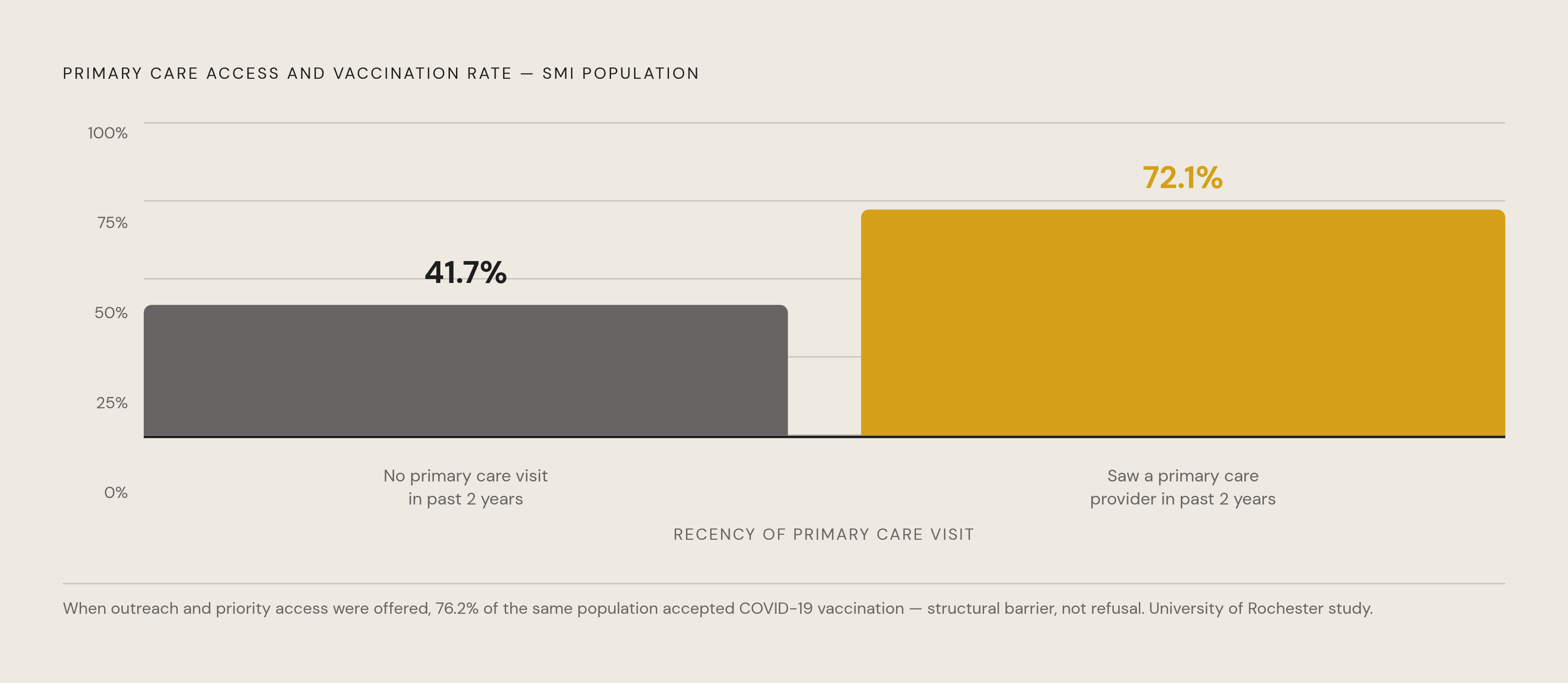
A University of Rochester study gets closer to the actual mechanism. Participants who had seen a primary care provider in the past two years were vaccinated at a rate of 72.1%, compared to 41.7% for those who hadn't. The vaccination gap tracks the primary care connection gap almost exactly. Get someone in front of a primary care provider and the vaccination rate looks close to the general population's. Break that connection and it collapses, which is the whole mechanism in one comparison.
A racial equity layer sits inside this population too. In the same dataset, White (73.3%) and Hispanic/Latino (81.8%) participants were more likely to have been vaccinated than Black/African American participants (54.9%). The disparity compounds across race as well as diagnosis, and it appears again in NYC cohort data, where SMI patients had vaccination rates of 45.6% versus 58.9% in non-SMI patients, even inside a large urban health system with formal vaccination infrastructure already in place. Closing the flu mortality gap means closing the primary care connection gap first, and community-based navigation and peer support have a specific role to play there. That point gets picked back up below.
Medication Barriers and Care Fragmentation During Illness
People with SMI are often on complex medication regimens, frequently involving polypharmacy and periodic adjustments to find what works. That complexity runs straight into prior authorization requirements: prior authorization requirements create documented friction in accessing schizophrenia and bipolar disorder medications, adding administrative burden at the point when continuity of care matters most. The administrative friction built to control costs appears, in practice, to make people sicker, which is a strange trade for a system supposedly designed around patient safety.
The pandemic showed what happens when that fragile system gets stressed further. NYC cohort data (Thiruvalluru et al.) found a 20% reduction in outpatient visits and a 40% decrease in inpatient visits among SMI patients during the pandemic period. Care dropped exactly when need was highest. The 2024 VA study found a similar pattern: veterans with SMI showed a significantly larger pre-to-post-pandemic decrease in outpatient, inpatient, and ED visits than veterans without SMI, despite carrying more chronic medical illness and more prescriptions.
People with SMI are prescribed more, need more coordination among providers, and disengage from care more sharply than anyone else the moment something disrupts the system. That fragility is baked into a model built on the assumption that the patient will initiate and sustain contact alone, an assumption that doesn't hold for a population already managing psychiatric symptoms, chronic disease, and a workforce shortage on the provider side. Behavioral health workforce shortages, noted in ASPE reporting, make the picture worse still: there aren't enough providers, and the ones who exist aren't distributed evenly across the country.
So when someone with SMI gets the flu, they have to keep taking psychiatric medication, keep appointments, manage other chronic conditions, and get to acute care, all at once, while feeling too sick to manage any single one of those tasks alone. Asking whether that's realistic without help, for a lot of people, the honest answer is no.
The Role of Peer Support Beyond the Clinical System
SAMHSA defines peer supporters as people with lived experience of mental health or substance use challenges who support others through nonclinical activities: advocacy, navigation and linkage to resources, sharing of experience, social and community connection, group facilitation, skill building, mentoring, and goal setting. That mandate is wide, and it exists precisely because clinical systems built around appointments and diagnoses tend to lose people between visits.
Trust is the mechanism doing the work here. A person who has navigated SMI can maintain a connection with someone who has already disengaged from formal care, in a way a clinician meeting that same person for a fifteen-minute intake appointment usually can't. A systematic review and meta-analysis (Lee & Yu, Healthcare), covering 16 randomized controlled trials and 4,008 participants, found statistically significant effects of peer support on self-efficacy (d = 0.20), with large point estimates for empowerment (d = 1.17) and quality of life (d = 0.70). A 2025 systematic review identified 41 eligible RCTs examining peer support competencies and implementation, evidence that this field has moved well past anecdote. Evidence from multiple studies suggests peers can be particularly effective at sustaining engagement and supporting recovery outcomes in ways that complement formal clinical staff.
Applied directly to flu season, that translates into something concrete rather than a talking point. PeerTECH, described in a June 2025 mHealth publication, is a peer-led mobile health intervention that demonstrated feasibility and effectiveness in improving medical and psychiatric self-management among people with SMI and chronic comorbidities, exactly the population most at risk when a respiratory illness hits. A peer, someone with lived experience of SMI, can help someone get a flu shot before the season starts, navigate a telehealth visit when transportation falls through, keep medication adherence from lapsing during illness, and connect a household to food support during recovery.
firsthand's model, built around Guides, STRIVE Specialists, and community operations staff who bring lived experience and meet people where they actually are, reflects this approach directly. Its helpinghand platform, HITRUST r2 certified, supports the kind of secure, ongoing coordination that community-based care at this level of complexity requires. Peer support is the mechanism by which the system reaches the people it otherwise loses, and the data above suggests that mechanism outperforms most clinical substitutes attempted so far, largely because it builds the trust that clinical intake never gets the time to build.
Recognizing Layered Risks in Practice: Individuals, Families, and Health System Partners
None of this is abstract once flu season actually arrives. For individuals living with SMI and the families around them, a cold or flu is a real risk rather than a minor inconvenience. Knowing the warning signs that a respiratory illness is escalating, a sustained fever, difficulty breathing, an inability to keep up with medications, matters as much as having a plan in place before anyone gets sick.
Vaccination remains the highest-leverage preventive step available, and the data throughout this piece points to one conclusion: the gap is about access and connection to primary care, not refusal. That means the barrier is navigable rather than fixed, and the fix is a matter of getting people in the door, not changing anyone's mind. Anyone designing an intervention around persuasion is solving the wrong problem.
Stable housing, reliable food access, and a trusted person who shows up when things get hard aren't peripheral to flu recovery. They're the conditions that make recovery possible in the first place, and no amount of clinical excellence substitutes for their absence. For health system partners and health plans, the mortality and hospitalization figures cited throughout this piece make a fairly direct economic and clinical case for investing in community-based, peer-led models that maintain connection between formal care episodes, rather than waiting for the next crisis to reestablish contact.
The Royal College of Psychiatrists finding, that an estimated 66% of premature deaths among people with SMI trace back to preventable physical health conditions, reframes the entire subject. This is a quality and equity problem with a known set of levers, not an inevitable outcome baked into the diagnosis itself. People living with serious mental illness deserve support that treats physical health, behavioral health, and social need as connected parts of one picture. The risks documented here are real and well established, but they aren't fixed, and the right support, delivered by people who have walked a similar path, can change how this story ends for the person living it.