Long-Term Outcomes for People With Schizophrenia Spectrum Disorders
Early intervention and social support reshape long-term outcomes more than diagnosis alone.

Long-Term Outcomes for People With Schizophrenia Spectrum Disorders.
Schizophrenia spectrum disorders and who lives with them
Schizophrenia spectrum disorders are a family of serious neuropsychiatric conditions marked by hallucinations, delusions, disordered thinking, and cognitive impairment. Long-term outcomes for the people who live with these conditions depend on far more than the diagnosis itself: clinical trajectory, quality of life, and personal recovery all shift depending on what kind of support someone gets, and when they get it. That's the throughline of this piece. It's less a story about prognosis in the abstract and more a story about what actually makes a better outcome possible.
That number isn't just hospital bills and prescriptions. It folds in health care, housing, employment, the justice system, and the cost carried by caregivers National and State Societal Costs of Schizophrenia in the US in 2024. Which is really the point. Reducing SSD to a diagnosis code misses who's actually living with it: people embedded in families, in neighborhoods, in jobs that may or may not be stable, in relationships that either hold or don't.
So the natural next question is the one this piece spends the rest of its space answering. What actually happens to people over the years and decades after diagnosis? An estimated 3,070,739 adults in the U.S. are living with schizophrenia spectrum disorders, with a 2024 societal burden estimated at $366.8 billion and per-person costs of $119,436 National and State Societal Costs of Schizophrenia in the US in 2024.
Clinical trajectories from 20-plus years of follow-up data
The honest answer isn't a comfortable one. But "unlikely for many" is not the same as "true for everyone," and the long-run cohort data bear that out with more texture than the headline suggests.
At the 20-year mark, 17% were in clinical recovery and 40% were in symptom remission pubmed.ncbi.nlm.nih.gov Long-term prognosis of schizophrenia in a Danish context. Roughly half showed no meaningful improvement in negative symptoms, even where positive symptoms had stabilized. Among those who had stopped taking antipsychotics, 36% were in remission of psychotic symptoms, and that subgroup had better outcomes than people who were still symptomatic, whether medicated or not pmc.ncbi.nlm.nih.gov Long-term prognosis of schizophrenia in a Danish context. Medication status alone doesn't predict how someone is doing. Remission does.
OPUS also found something that has nothing to do with pharmacology. It reframes social connection as something closer to a prognostic variable than a pleasant side effect of doing well.
More recent data sharpen the question of timing. The six-year GROUP cohort study, published in 2025 by de Winter and colleagues in BMC Psychiatry, found improvement across most recovery domains: positive symptoms, social functioning, executive functioning. Depressive symptoms and subjective well-being were the exceptions, stubbornly flat. And the improvements that did occur were largest among patients with a shorter duration of illness.
Behind these percentages and symptom scores sits a harder fact the clinical trajectory data doesn't fully capture on its own. Per an overview from the MGH Psychosis Clinical and Research Program at Harvard Medical School, the honest summary is that SSD has a challenging long-term prognosis, with stable remission and recovery unlikely over 25 years for many people. The Danish OPUS cohort (n=578) was longitudinally followed for more than two decades after first diagnosis, between 1998 and 2002. 29% were still in active antipsychotic treatment at 20 years Long-term prognosis of schizophrenia in a Danish context. The OPUS data also surfaced a striking social finding: 38% of participants had become parents over two decades, and those individuals showed better functional and clinical outcomes than those who had not (social connection as a prognostic factor, not just a byproduct of recovery) Long-term prognosis of schizophrenia in a Danish context. A six-year GROUP cohort study on recovery domains by de Winter et al. Covering 57 longitudinal studies, a meta-analysis by de Winter et al., published in Schizophrenia Bulletin, found only modest cognitive improvement overall, with the largest gains concentrated in patients with duration of illness under 10 years, reinforcing the early-intervention argument.
The mortality gap and what drives it
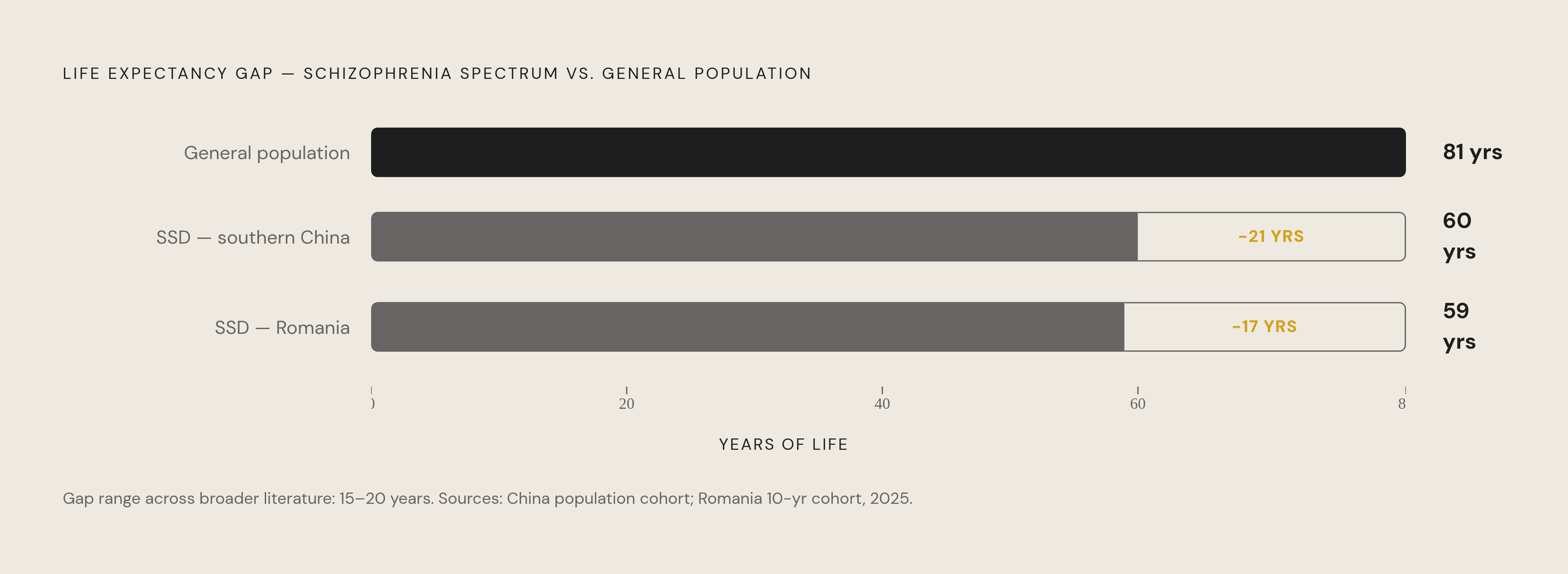
People with schizophrenia lose, on average, 15 to 20 years of life expectancy compared to the general population nature.com pubmed.ncbi.nlm.nih.gov. A population-based study out of southern China put the number at around 60 years of life expectancy, 21 years short of the general population, with an overall mortality rate twice as high and a suicide risk 15 times greater nature.com pubmed.ncbi.nlm.nih.gov. Different countries, different cohorts, the same grim range.
What's actually killing people, mostly, is cardiovascular disease, respiratory illness, infections, and cancer, compounded by suicide, accidents, and homicide. It's cardiovascular disease, respiratory illness, infections, and cancer, compounded by suicide, accidents, and homicide. Smoking, alcohol and substance use, a sedentary lifestyle, and metabolic dysfunction all feed into that list, and every one of those factors is, at least in principle, addressable with the right kind of support around a person day to day. In the OPUS cohort specifically, 14.4% of participants (82 of 578) died over the twenty-year follow-up, and suicide was the single leading cause, responsible for 27% of those deaths Long-term prognosis of schizophrenia in a Danish context aspe.hhs.gov.
There's a genuinely encouraging data point buried in here, though. One comparison across treatment eras found the incidence of sudden death fell from 0.79% in a 1989–2013 cohort to 0.27% in a 2014–2024 cohort, a shift credited to better multidisciplinary care, faster transfer to general hospitals when something goes wrong physically, and wider adoption of second-generation antipsychotics Long-term prognosis of schizophrenia in a Danish context pmc.ncbi.nlm.nih.gov. That's real progress. People with schizophrenia face a reduction in life expectancy of 15–20 years compared to the general population nature.com pubmed.ncbi.nlm.nih.gov. It's narrowed at the edges. Which raises the obvious question: what else has to change before that gap closes for good, rather than just getting a little less wide?
Clinical trajectories and mortality curves describe what happens to a person from the outside, measured in symptom scales and death certificates. What do people living with SSD say is actually happening to them? A 2025 Romanian 10-year cohort found mean age at death was 58.97 years, reflecting a 17-year reduction pubmed.ncbi.nlm.nih.gov. Clinical data and mortality statistics describe outcomes from the outside; the research also captures what people living with SSD say shapes their experience from the inside.
What people living with schizophrenia say their experience involves
A 2024 first-person account published in the South African Journal of Psychiatry, the inaugural entry in that journal's "Lived Experience" series, gives a rare unmediated window into that question. The author's message is blunt and repeated for emphasis: "Isolation, isolation, isolation. I cannot stress that enough." When someone is diagnosed, the account goes, they often come to believe that "normal" people simply can't understand what they're going through, and that belief becomes its own trap. The author describes a cascade: untreated anxiety tips into depression, untreated depression tips into suicide attempts or anger, and prolonged anger makes the underlying schizophrenia worse. Loneliness starts the chain. Symptoms don't.
That's not just one person's testimony floating free of the broader literature. It lines up with 2025 qualitative research in BMC Psychiatry on first-episode psychosis, which identified personal resources and agency as the central drivers of recovery. Participants in that research described recovery less as symptom absence and more as an active, ongoing practice: making decisions in daily life, recalibrating what risk and limitation mean for them personally, and in some cases moving from being the person who receives care to being the person who gives it to someone else further behind them on the same path.
One might argue this is all somewhat soft, hard to quantify, more a matter of narrative than of measurable clinical fact. But the numbers say otherwise, and not in a reassuring direction. A 2024 meta-analysis by de Winter and colleagues in Schizophrenia Bulletin, pooling 46 studies on personal recovery and quality of life, found only small improvements overall in personal recovery and subjective quality of life, and marginal to no improvement in connectedness, hope, identity, meaning, and empowerment. The honest implication is uncomfortable: the clinical system, as currently built, isn't reliably delivering improvement in the dimensions people with SSD identify as central to their lives.
Why not? Part of the answer sits outside the clinic altogether, in conditions no prescription touches.
How social circumstances function as clinical prognostic factors
The GROUP six-year study found improvement across most recovery domains (positive symptoms, social functioning, executive functioning), except depressive symptoms and subjective well-being. It found what was driving the variation, and the answer wasn't primarily clinical. Longitudinal changes in symptoms, social functioning, cognition, and quality of life were mostly explained by social patient characteristics, education level, ethnicity, living situation, employment status, marital status, rather than by clinical variables alone.
Consider what that looks like on the ground. A 2025/2026 study of 203 clients with serious mental illness at a community mental health clinic found 64% reported at least one indicator of food insecurity, and only 36% were food secure pmc.ncbi.nlm.nih.gov aspe.hhs.gov Long-term prognosis of schizophrenia in a Danish context. Read that the other way around: food instability isn't the exception in this population, it's the default. Housing works the same way. When someone can't count on stable shelter, everything downstream, including mental health, gets harder to hold together, which is part of why housing assistance programs that link people directly to health care and community services tend to matter so much. Medication adherence follows the same logic. Lower education levels correlate with psychosocial instability, family disruption, substance use, and unstable employment, and these interfere with a person's ability to accept treatment in the first place, let alone stick with it. Transportation gaps and unemployment add another layer, feeding directly into the isolation the lived-experience account described as the defining wound of the illness.
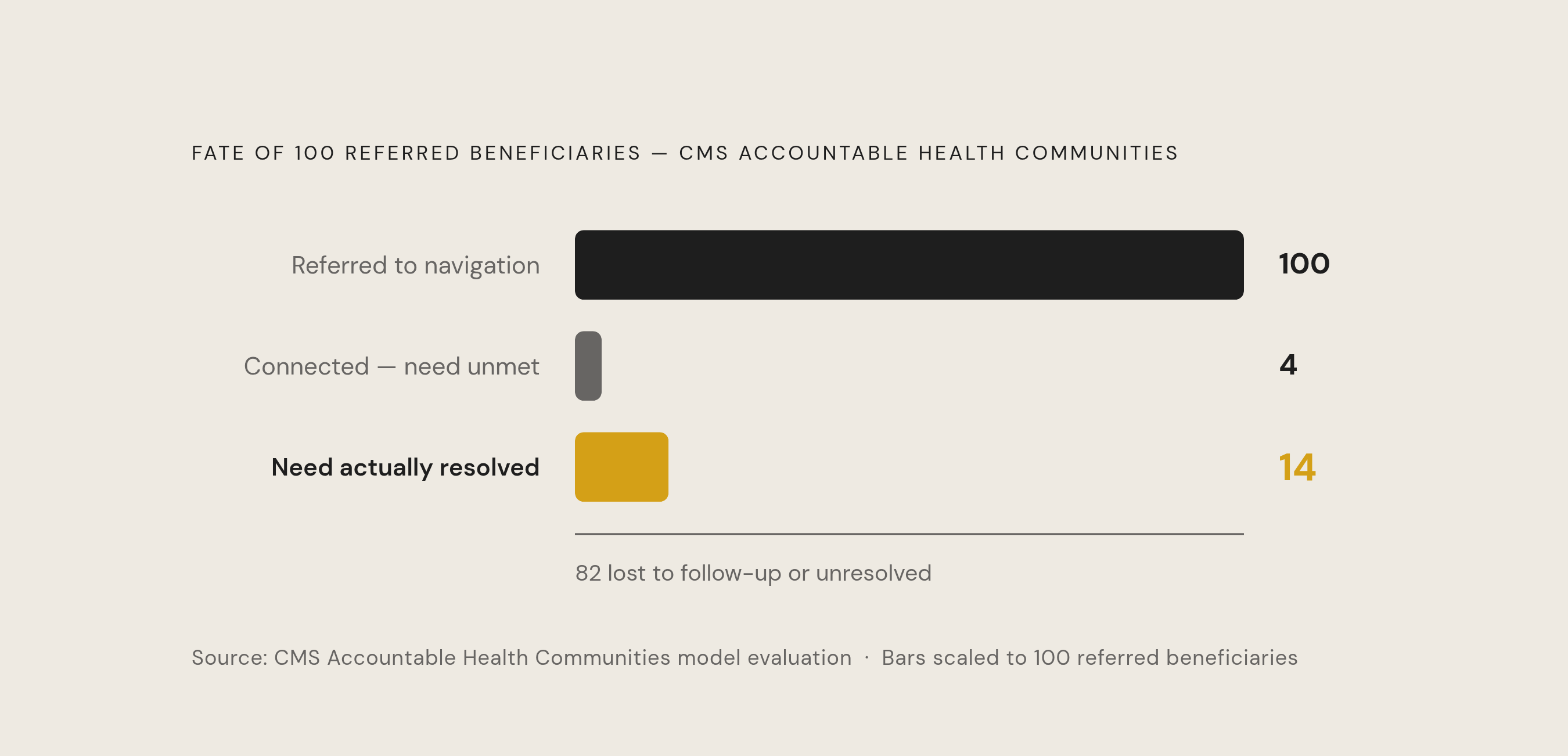
And yet current U.S. Clinical psychiatric practice has no standardized approach for evaluating or addressing social determinants of health, even for patients who are already receiving both psychiatric and medical treatment, according to a Translational Psychiatry analysis. Consider what happens when a system tries to fix this the obvious way, by referring people out to social services. An evaluation of the CMS Accountable Health Communities model found that among beneficiaries referred to social service navigation, only 14% had their needs actually resolved aspe.hhs.gov. Four percent got connected to a service but still had the underlying need unmet https://pmc.ncbi.nlm.nih.gov/articles/PMC12436774/. It's close to the strongest evidence available that a referral slip, on its own, does not function as an intervention. Connecting someone to a resource, it turns out, takes something closer to a relationship than a hand-off.
That gap doesn't land evenly across the population, either.
Which populations carry a disproportionate share of poor outcomes
Racial and ethnic minorities, along with gender and sexual minorities, face worse mental health outcomes overall, driven by inaccessible care, cultural stigma, and outright discrimination, per the American Psychiatric Association.
One might expect the rapid expansion of telemedicine after COVID-19 to have narrowed that gap, given how much it lowered the logistical barrier to seeing a provider. It didn't. A 2025 follow-up from the same research group, published in JAMA Network Open, found the digital expansion of care access was not racially neutral, and in practice reproduced existing disparities rather than resolving them. A systematic review covering literature from 2010 to 2024 traces the mechanism: structural racism, economic inequality, gaps in the healthcare system itself, cultural stigma, and the same social determinants already discussed, education, employment, housing, neighborhood conditions. These aren't separate problems stacking on top of each other by coincidence. They compound.
One structural response that shows some promise: integrating physical and behavioral health care in a single setting has been flagged as particularly valuable for improving access among historically underserved groups, people of color, various ethnicities, and those living with severe and persistent mental illness, according to the American Hospital Association. It's a start, though not yet sufficient on its own. Whether it's sufficient on its own is a fair question, and the evidence so far suggests it isn't, at least not by itself.
With the scope of the problem laid out this far, clinical trajectories, the mortality gap, isolation, social determinants, and unequal access, the natural next move is to ask what actually changes any of it. A study in Psychiatric Services by Normand et al. of Harvard Medical School found Black Medicaid beneficiaries with schizophrenia in New York State were disproportionately affected by disparities in quality of care.
The evidence on peer support and the gaps it addresses that clinical care cannot
Peer specialists are people with lived experience of serious mental illness, in their own recovery, who use that experience directly to support others navigating the same terrain. The mechanism is mutual recognition, built on having actually been through something similar. It's mutual recognition, built on having actually been through something similar, and a clinical relationship, structured around expertise and authority, has a harder time producing that trust on its own.
This matters for SSD specifically because the lived-experience literature already identified isolation as the central wound of the illness. A peer who has walked the same path offers something a clinician, however skilled, structurally cannot: the credibility of having actually lived it. In practice, that translates into help getting into treatment, navigating housing applications, food assistance, medication routines, transportation, and medical appointments, the exact list of social determinants the previous section showed clinical systems aren't set up to address on their own.
That number makes the structural case for peer support almost by itself. Navigation without a sustained relationship behind it tends not to hold aspe.hhs.gov. Peer support is, functionally, the relationship that makes navigation stick, and given that the GROUP study traced longitudinal clinical change back to social characteristics, housing, employment, connection, improving those circumstances isn't adjacent to clinical care. It functions as clinical care.
firsthand builds its model around exactly this logic. Guides, STRIVE Specialists, and community operations staff are themselves people with lived experience of serious mental illness and/or substance use disorder, and they meet people where they actually are, in their communities, not in waiting rooms. The scope of what they help with mirrors the research directly: housing, food, medication, medical appointments, behavioral health resources, the full range of social determinants this piece has traced back to outcomes at every turn. The helpinghand platform, which holds HITRUST r2 certification, underlies that work, giving the model secure, compliant infrastructure to operate on. The organizing conviction is simple to state even if it's hard to execute: trust gets built by someone who has walked a similar path, and sustainable recovery starts there, not at the intake form.
What better outcomes require, and what they make possible
Pull the threads together and a clear picture emerges. Outcomes for people with SSD are not fixed by diagnosis. They're shaped by timing, by the kind of support available, and by whether that support reaches past the clinical and into the social circumstances that surround a person's daily life.
Timing is concrete. Both the GROUP study and the cognition meta-analysis found larger gains among people with a shorter duration of illness, which means early intervention isn't just a nice-to-have, it's a modifiable variable with a measurable effect. Remission without medication is documented: the OPUS cohort shows a real subgroup off antipsychotics and in remission, outperforming people who were still symptomatic regardless of medication status. That's a benchmark, evidence of what sustained support, at the right moment, can actually produce.
Social connection carries weight that the data can measure, not just imply. Belonging appears on a clinical scale, in other words, even though nobody prescribed it.
For health systems and health plans, the CMS referral data (14% resolution, 33% lost to follow-up) shouldn't be read as a reason to give up on connecting people to resources aspe.hhs.gov. It's an argument for the opposite: investing in the sustained human presence that makes those connections actually hold, rather than assuming a referral slip does the job on its own.
For individuals and families living with this day to day, none of this supports a single fixed prognosis handed down at diagnosis. What it supports is something more useful and considerably more hopeful: that the right support, arriving at the right time, from people who understand the experience firsthand, changes the trajectory. Long-term outcomes for people with schizophrenia spectrum disorders were never primarily a story about diagnosis. They're a story about what people actually have access to, and unlike the diagnosis itself, that variable can change. Social connection is not soft, the OPUS finding that 38% of participants became parents, and those individuals had better functional and clinical outcomes, is a measurable signal that belonging and relationship are part of the clinical picture Long-term prognosis of schizophrenia in a Danish context. SOURCE PAGES (what the pages behind the outline's links say).
Sources
- Long-term Changes in Personal Recovery and Quality of Life Among Patients With Schizophrenia Spectrum Disorders and Different Durations of Illness: A Meta-analysis
- Long-term prognosis of schizophrenia in a Danish context
- Long-Term Changes in Cognition Among Patients With Schizophrenia Spectrum Disorders and Different Durations of Illness: A Meta-Analysis - PubMed
- Interrelationships of long-term changes in recovery domains among patients with schizophrenia spectrum disorders: a six-year follow-up study
- National and State Societal Costs of Schizophrenia in the US in 2024
- pmc.ncbi.nlm.nih.gov
- nature.com
- pubmed.ncbi.nlm.nih.gov