Federally Qualified Health Centers and Underserved Populations
FQHCs serve 32 million low-income patients but face mounting pressure from rising uninsured rates.

In 2024, more than 32.4 million people received care at HRSA-funded health centers. The number alone understates what it means. Approximately 90% of those patients had incomes at or below 200% of the federal poverty level. Roughly 63% identified as a racial or ethnic minority. One in eight was a child under 18.
The uninsured share deserves closer attention. About 18% of health center patients were uninsured in 2024, and that figure is moving in the wrong direction: uninsured patients grew by more than 250,000 between 2023 and 2024, from 5.6 million to nearly 5.9 million. These are not people who chose to forgo coverage. They are people for whom coverage was structurally unavailable or simply unaffordable. What happens to a funding model anchored in Medicaid revenue when the uninsured share keeps climbing? That question is becoming harder to defer.
One in four Medicaid patients in the United States receives care at a community health center. More than one in five uninsured patients does the same. These are not marginal utilization figures. They describe a sector that functions as a primary care home for an enormous portion of the safety net population.
Geography compounds the picture. In 2025, one in five rural residents received care at an HRSA-funded health center. Medically underserved areas and health professional shortage areas are the designations that determine where Section 330 funding flows, and rural counties disproportionately carry both.
For anyone working adjacent to this sector, what the demographic profile implies is fairly unambiguous: FQHCs are not a first stop before a patient finds a better option. For most people walking through those doors, there is no better option. The patients present with high rates of complex, undertreated chronic conditions, low health literacy, language barriers, and transportation constraints. The system was not built for them. FQHCs were.
How the patient-majority governing board changes what a health center prioritizes
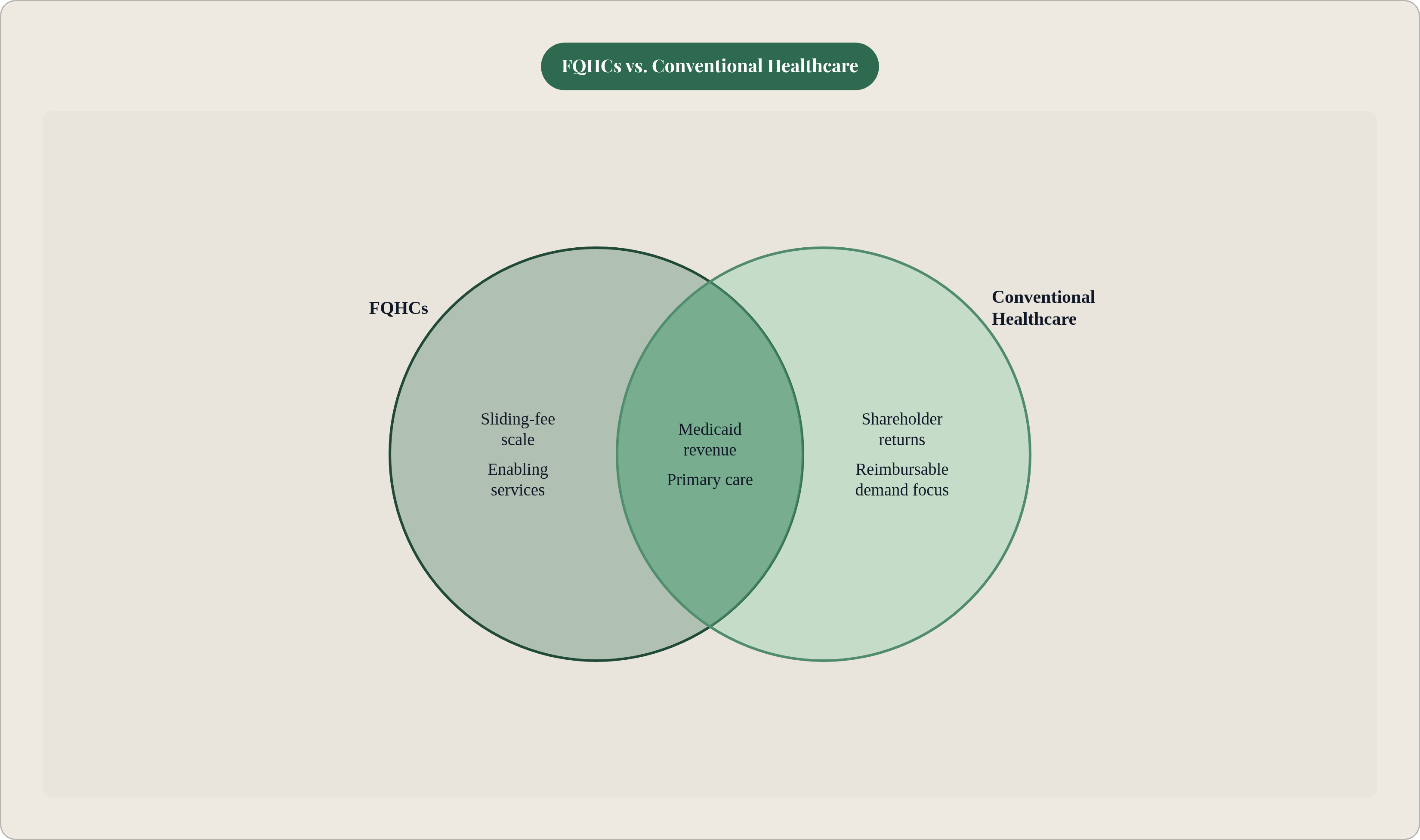
Federal law requires that at least 51% of an FQHC's governing board be patients of the center. This is a governance structure that places decision-making authority in the hands of people who have personally experienced the access barriers the center was built to remove.
Consider what that means operationally. The individuals setting organizational priorities, approving budgets, and holding leadership accountable are not investors evaluating return on capital, not payers managing utilization targets, not administrators optimizing throughput. They are people who have sat in the waiting room, filled out the sliding-fee application, and relied on the translation services. They know from direct experience what fails and what does not.
This is why FQHCs fund enabling services, including transportation assistance, language interpretation, and social service referrals, that no conventional fee-for-service model would ever incentivize. There is no billing code for helping a patient get to their appointment. There is no margin in hiring a community health worker to conduct home visits. But a board composed of patients understands that without those services, the clinical care simply does not reach the patient. They have lived that failure personally.
The contrast with hospital systems or large private practices is instructive. Governance in those settings reflects a different set of interests: bond covenants, payer contract relationships, administrative efficiency, and in some cases shareholder returns. None of those interests are inherently malicious. They are just oriented toward a different patient population under different financial constraints. Governance structure shapes mission whether anyone formally acknowledges it or not.
This is also why FQHCs have historically served undocumented immigrants. A patient-majority board represents who actually comes through the door, not who federal policy assumes should. When the community being served includes undocumented individuals, a board composed of that community will prioritize serving them. Recent policy shifts, discussed later, are now testing that orientation directly.
The breadth of services FQHCs provide and why it matters for underserved patients
The service menu at a well-resourced FQHC is comprehensive in ways that are easy to underestimate from the outside. Primary care and chronic disease management are the foundation, but the clinical scope extends to behavioral health, dental, vision, pharmacy, laboratory, and radiology. Enabling services address the non-clinical barriers that routinely derail care for low-income patients: transportation, interpretation, social services coordination.
In 2024, health centers collectively generated 139.4 million total visits. Sixty-five percent were medical, 14% were mental health and substance use disorder services, 12% were dental. That mix reflects actual patient need rather than reimbursable volume. Dental and behavioral health are chronically underserved in low-income populations and notoriously hard to access through conventional providers. The fact that they constitute more than a quarter of FQHC visit volume reflects what patient-majority boards prioritize when they control the service mix.
The 2024 outcomes data are concrete. More than 3.6 million patients had controlled hypertension. More than 2.2 million had controlled diabetes. More than 4.6 million pediatric patients were screened for weight and nutrition. These are the conditions that disproportionately burden low-income populations and generate the highest long-term costs when unmanaged. Managing them at the primary care level is precisely where the savings in this model accumulate.
Telehealth has extended that reach further. By 2025, 98.38% of health centers were using telemedicine in some capacity; 93.18% used it specifically for mental health services. For patients who cannot travel, whether because of work schedules, transportation costs, or geographic isolation, this is not a convenience upgrade. It is access that would not otherwise exist.
When a patient has no other entry point into the healthcare system, a comprehensive FQHC functions as their entire care continuum. Not a triage stop, not a referral source to services they cannot afford. The whole of it, under one roof or one organizational umbrella.
The funding model that makes no-barrier care financially possible
The revenue architecture of a Federally Qualified Health Center reflects the complexity of the mission it supports. Medicaid is the largest single source, comprising the largest share of total revenues. Medicare, private insurance, sliding-fee patient payments, and federal grants make up the remainder. Federal grants through the Community Health Center Fund account for approximately 11% of total health center funding on average, a figure that consistently surprises people who assume the model runs primarily on federal grant dollars.
Medicare pays FQHCs through a Prospective Payment System: a bundled per-encounter rate designed to account for the higher complexity and cost of serving this population. It is a deliberate policy recognition that care for high-need, high-barrier patients costs more to deliver than conventional fee-for-service structures capture.
The 340B Drug Pricing Program receives less attention than it warrants. The program requires drug manufacturers participating in Medicaid to sell outpatient drugs to safety-net providers at significantly reduced prices. For FQHCs, this creates the capacity to offer pharmacy services to patients who could not otherwise afford their medications. A 2024 study published in JAMA Health Forum, examining hundreds of FQHCs over an eighteen-year longitudinal period from 2004 to 2022, found that increases in 340B-registered locations were associated with higher patient volumes among uninsured, low-income, and non-English-speaking populations. The same study found increased provision of low-margin preventive services, including tobacco cessation and HIV testing, at 340B-participating sites. The evidence suggests 340B participation expands the safety net rather than simply improving organizational margins.
The sliding-fee scale governs what uninsured and underinsured patients pay. Fees adjust to income; no patient is turned away for inability to pay. The funding model holds when all revenue streams flow at adequate levels. It becomes precarious when any one of them contracts. The most consequential stream, by a considerable margin, is Medicaid.
What 1,512 health centers operating at 17,000 locations actually costs the system, and what it returns
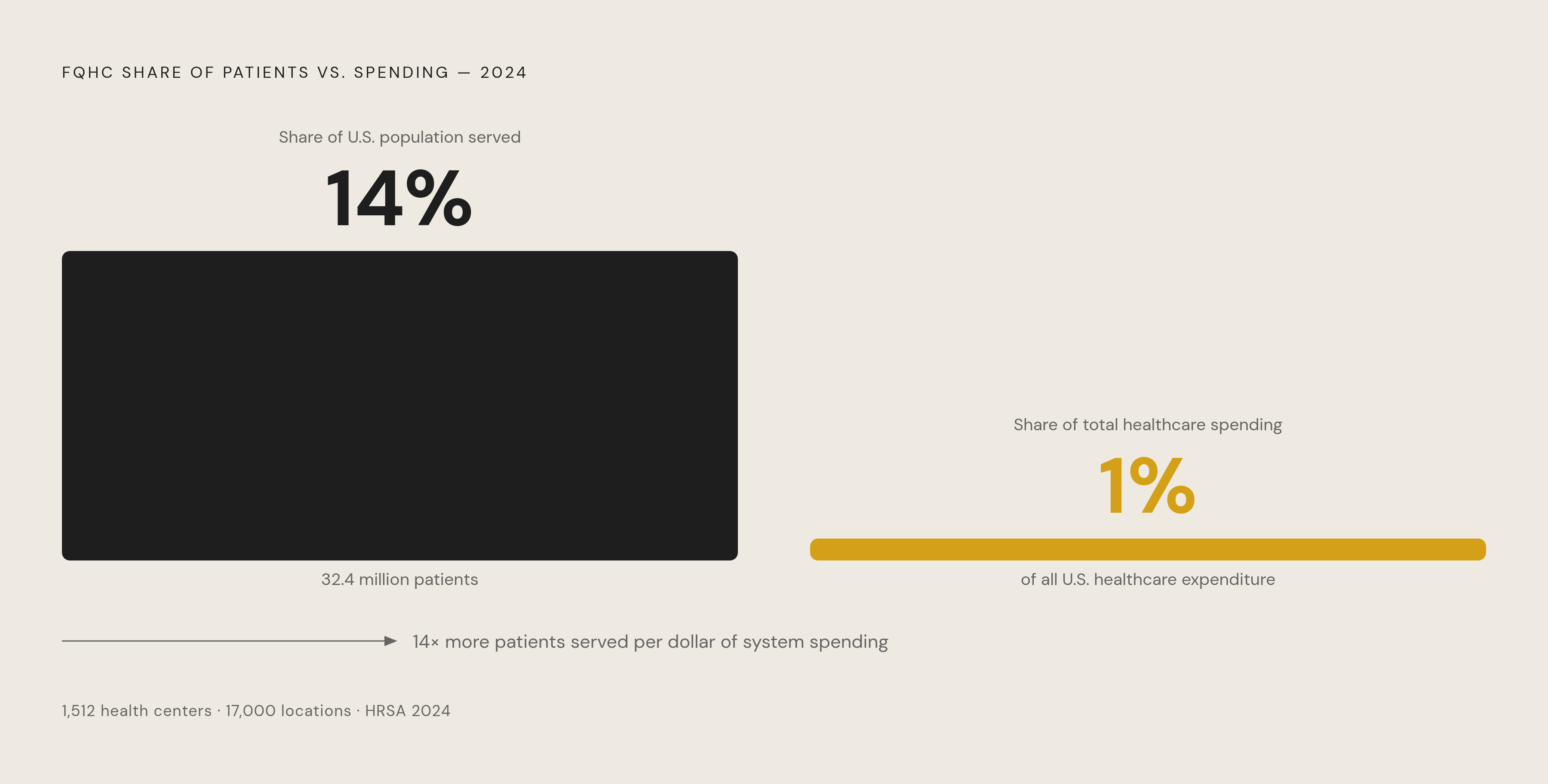
As of 2024, 1,512 community health centers operated at more than 17,000 locations across the country, employing 326,000 full-time staff. California alone had 171 centers, the largest concentration of any state.
The most striking figure in the cost-effectiveness argument: FQHCs deliver primary care to approximately 14% of the U.S. population while accounting for only 1% of total healthcare spending. One percent. It is tempting to be skeptical of that ratio, to assume it masks some form of service rationing or deferred cost. But the mechanism behind it is not mysterious. It reflects a care model calibrated to prevention and primary management rather than high-cost episodic intervention. Sixty-one percent of health center staff work directly in patient care or enabling services, a workforce allocation that contrasts sharply with the administrative overhead patterns visible across the broader system.
The efficiency case does not stand in isolation, though. It depends on FQHCs functioning as the first point of contact for patients who would otherwise present to emergency departments. The cost differential between a primary care encounter at a health center and an ED visit for the same condition is substantial, and that differential compounds across tens of millions of patients annually.
Cutting FQHC funding does not eliminate the cost of caring for this population. It relocates that cost to higher-cost settings, most often emergency departments, where the same patients will present sicker and more expensive to treat. The savings from FQHC investment are not hypothetical; they are the difference between managing a chronic condition at a primary care level and treating its acute complications downstream.
The financial pressure building inside the system right now
FQHC net margins were already fragile before any recent policy disruptions. In 2019, net margins across the sector were less than 1%. Federal relief funding during the COVID-19 pandemic produced a temporary improvement between 2020 and 2022. By 2024, margins had turned negative.
Federal grant dollars remained essentially flat between 2019 and 2023 even as healthcare costs rose substantially over the same period. Flat nominal funding in an inflationary cost environment is a real cut, even when it does not appear as one in the budget tables.
The liquidity position makes the flat funding worse. Nearly half of FQHCs are operating with fewer than 90 days of cash on hand. The practical question that raises is not abstract: what happens when a disruption arrives, a delayed grant payment, a sudden increase in uninsured volume, a payer policy change, and there is no buffer left to absorb it?
Recent Commonwealth Fund research found that nearly half of health centers expected their uncompensated care to increase, and one quarter expected their overall financial stability to worsen. These are not projections generated in the abstract; they are organizations reading their own balance sheets.
The closures that have already occurred are clarifying. A rural New Hampshire FQHC announced the closure of one location in late 2025, citing a projected operating shortfall. A South Carolina FQHC closed six locations under combined pressure from rising numbers of uninsured and underinsured patients and deteriorating financial conditions. Both cases follow the same pattern: financial pressure translates into reduced access, and reduced access in this sector does not redistribute patients to competing providers. There are no competing providers. It eliminates access entirely for the communities those locations served.
The policy developments in 2025 and 2026 that are compounding that pressure
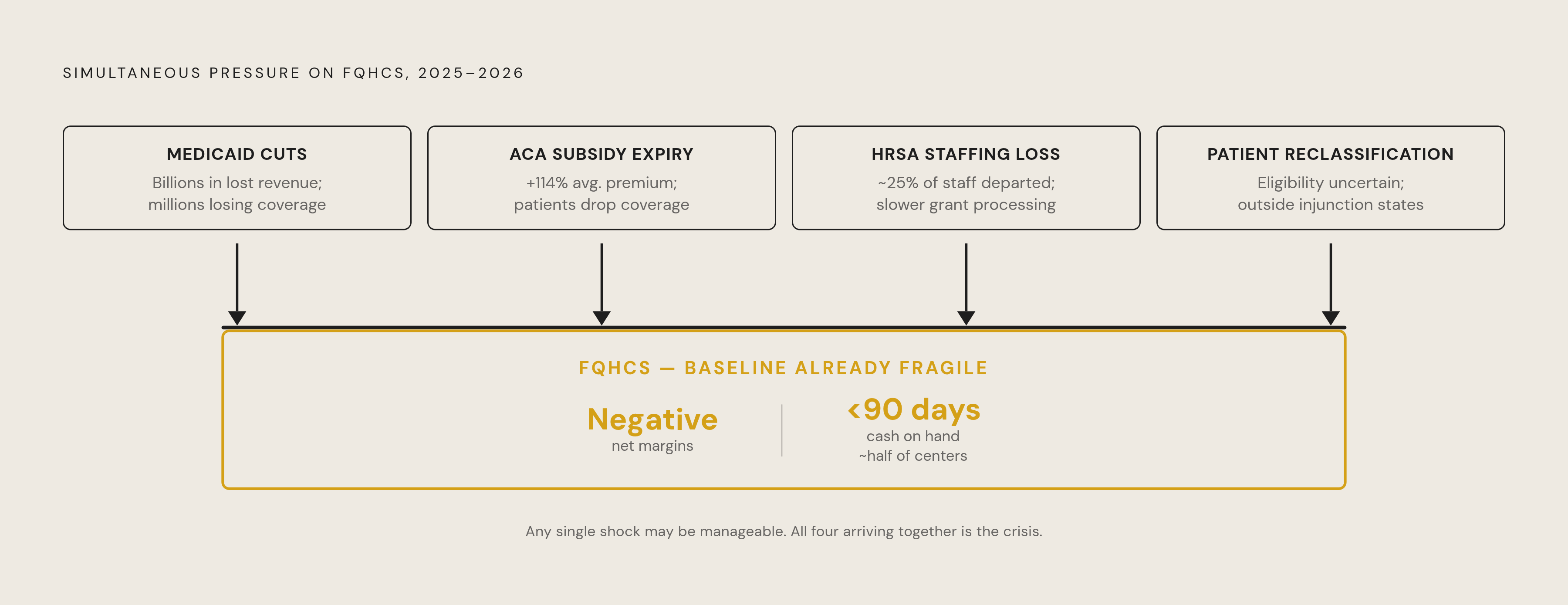
What FQHCs now face is not a single adverse development but a convergence of simultaneous pressures landing on organizations that are already operating at negative margins with cash reserves insufficient to absorb a prolonged disruption.
The 2025 reconciliation law includes Medicaid cuts projected to reduce health center revenues by billions of dollars. Millions of Americans are projected to lose Medicaid coverage over the subsequent decade. For FQHCs, this means more uninsured patients arriving while the revenue base that currently supports uninsured care contracts. The arithmetic is not complicated, and it is not favorable.
Enhanced ACA Marketplace subsidies expired at the end of 2025. For subsidized enrollees, this produced average premium increases of 114%. Some portion of those individuals dropped coverage and are predictably shifting toward FQHCs as the only remaining affordable option. That is not a hypothetical; it is the foreseeable behavioral response to a coverage affordability shock.
HRSA, the federal agency that administers Section 330 funding and oversees many billions of dollars annually in support for health centers, addiction treatment, and workforce programs, has experienced significant staffing losses since February 2025. Roughly a quarter of HRSA staff have departed, including grant managers and auditors. Fewer staff means slower grant processing, reduced oversight support, and administrative uncertainty for centers that depend on timely disbursements to sustain cash flow.
Beyond the staffing losses, HRSA itself is scheduled for elimination under a broader HHS restructuring, with some functions transferring to a newly created Administration for a Healthy America. Organizational disruption at the funder level creates uncertainty even where nominal funding levels nominally continue. For health centers trying to plan staffing and service capacity six months out, administrative instability at the oversight agency is not a peripheral concern.
The January and February 2025 federal funding freeze offered a preview of what sustained disruption looks like in practice. Several health centers closed temporarily or reduced staff during the period when they could not access federal funds. The freeze was temporary. Its effects on those organizations were not.
In July 2025, HHS reclassified the Health Center Program as a federal public benefit from which undocumented immigrants are statutorily excluded, reversing an interpretation that had stood since 1998. As of September 2025, a federal district court had issued a preliminary injunction blocking enforcement in twenty states and Washington D.C. Centers operating in non-injunction states face a legal and operational environment in which the scope of their patient-eligibility mandate is genuinely uncertain. For organizations governed by patient-majority boards that include undocumented community members, this is not an abstract legal question. It is a direct challenge to the governance logic described earlier.
Taken individually, each of these developments would represent a significant but potentially manageable disruption for a financially stable organization. They are not arriving individually.
Why FQHCs remain the most structurally coherent answer to the access problem they were built to solve
The mainstream healthcare system has not solved the access problem that created FQHCs. The patient demographics served by health centers have not improved; the uninsured and underinsured population is, by the numbers, expanding. The problem FQHCs were designed to address is getting larger, not smaller.
No comparable alternative has emerged. The combination of sliding-fee access, patient-majority governance, comprehensive service breadth, and intentional geographic presence in medically underserved areas is not replicated by private practices, urgent care chains, or hospital outpatient departments. Those providers follow reimbursable demand. FQHCs follow need. No market-driven provider has filled the gap because the gap is precisely where market incentives fail.
The efficiency ratio, 14% of the population for 1% of total healthcare spending, reflects a care model calibrated to prevention and primary management. The savings it represents are real, and they accrue to payers, employers, and government programs that would otherwise absorb the cost of unmanaged conditions presenting in acute settings.
The governance structure makes the mission self-reinforcing in a way most institutions are not. Patient-majority boards will not voluntarily reorient their organizations toward more profitable but less accessible patient populations. The board composition makes that drift structurally difficult, because the people who would have to approve such a reorientation are the people it would harm.
What keeps me uncertain is not the structural logic of the model. That holds. What I keep returning to is whether the policy environment will allow the structure to function in practice, given the simultaneous pressures now bearing down on organizations with negative margins and 90-day cash runways. The need is growing, the model is proven, and the financial trajectory is moving in the wrong direction at the same time. That combination does not resolve itself.