Involuntary Psychiatric Treatment Laws by State
States set vastly different rules for forcing psychiatric care on unwilling patients.
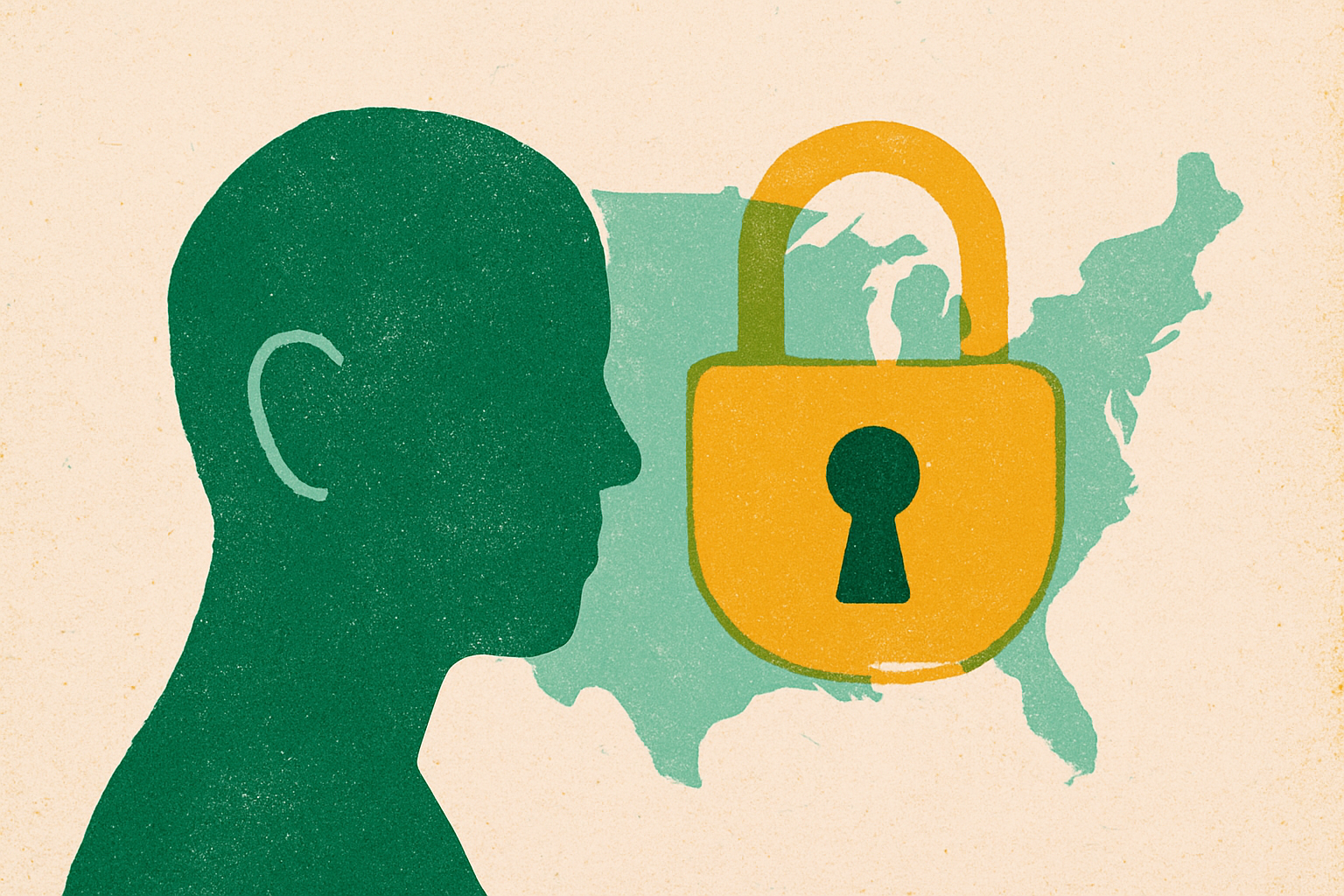
There's no federal standard for involuntary psychiatric treatment in this country. Each of the 50 states writes its own rules for who can be held, under what conditions, for how long, and by whose authority, and the Treatment Advocacy Center's 2020 Grading the States report called it what it is: 50 separate experiments running at once, none of them coordinated. Whether someone in crisis gets timely care often depends less on how sick they are and more on which state line they happened to be standing behind when the crisis hit. An estimated 14.6 million U.S. adults, 5.6% of the adult population, were living with serious mental illness in 2024. This piece maps the three legal mechanisms states actually use, shows where they pull apart from each other, and sits with what those gaps mean for the people caught in between.
The three legal tools states use, and what each one actually does
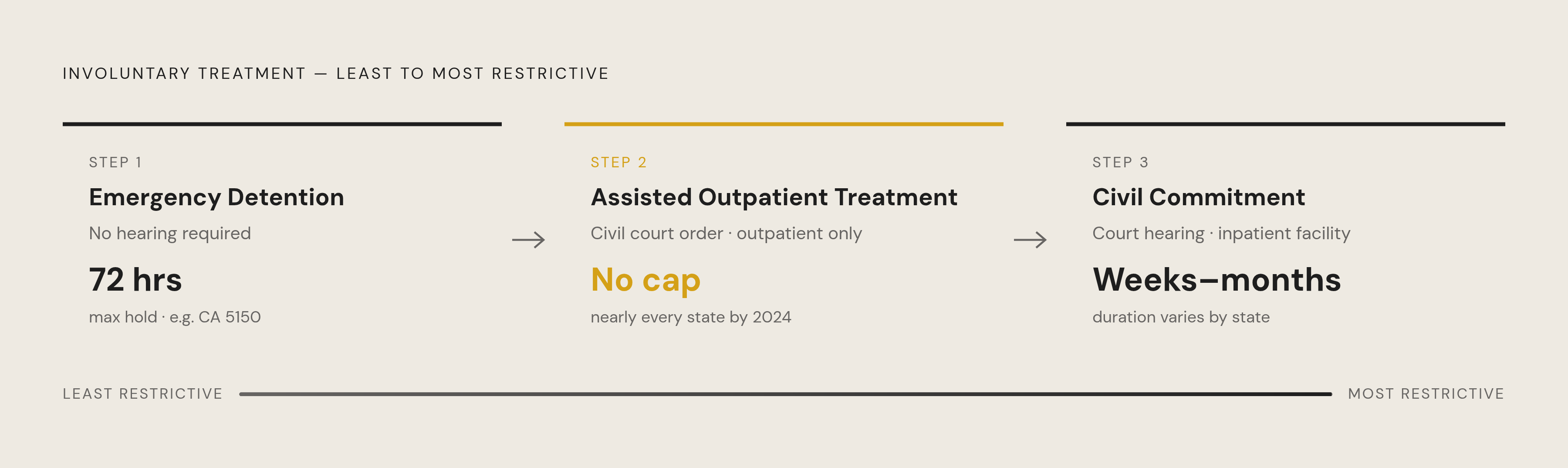
States lean on three distinct legal mechanisms, and how they get combined varies enough that the same person, showing the same symptoms, can end up with completely different outcomes depending on which side of a border they're on.
Start with emergency detention, sometimes called a short-term psychiatric hold, which is brief, involuntary, and meant for evaluation and stabilization when someone appears to pose an imminent danger to themselves or others. California's version is the one most people have actually heard of: the 5150 hold, under Welfare and Institutions Code Section 5150, allows up to 72 hours of involuntary detention. The scale alone is worth pausing on, since California processed over 200,000 such holds in a recent year, according to the state's Department of Health Care Services (2024), and that number tells you as much about unmet need as it does about how heavily the system defaults to emergency detention as its first response, sometimes its only response. But who can actually initiate a hold (police, clinicians, sometimes family) and how long it lasts and where the person ends up afterward differ from state to state, sometimes wildly. New Hampshire changed its approach for 2025: people on an involuntary hold there can no longer be routinely parked in an emergency room, a quiet admission that an ER was never built for psychiatric stabilization in the first place.
Second is civil commitment, the longer, court-authorized version, which requires a hearing and usually places someone in a psychiatric hospital or something licensed to function like one. Here's where things start pulling apart: some states require proof of imminent danger, full stop, while others will commit someone based purely on an inability to meet basic needs, no threat required. Duration swings just as hard, with some states capping commitment in weeks while others stretch it into months. That gap, weeks versus months, can be the entire difference between a person actually stabilizing and a person getting discharged mid-crisis because the clock ran out.
Third, and the one almost nobody outside the field seems to know exists, is involuntary commitment for substance use disorder and alcoholism specifically. Some states allow court-ordered treatment for both, while some allow one but not the other, for reasons that don't always track any obvious logic, and some states have no statute permitting involuntary addiction treatment under any circumstance, period. Vermont is set to be a state that permits commitment for substance use disorder while having no separate statute covering alcoholism at all, an odd legal seam that says a lot about how piecemeal this corner of the law really is. New Hampshire goes the other way entirely: under NH RSA § 135-C:2, substance misuse is explicitly excluded from involuntary commitment. Picture a family in Concord watching someone they love deteriorate from addiction, refusing every offer of help, with no legal door for them to walk through.
None of these three tools work in isolation. States stack them, and it's the stacking, not any single statute read on its own, that decides what care looks like for the person actually living through it.
Assisted outpatient treatment: the court-ordered middle ground most states now use
Assisted outpatient treatment, AOT, is a civil court order requiring someone with severe mental illness to follow an outpatient treatment plan without inpatient hospitalization. It gets pitched as the middle path: less intrusive than commitment, more binding than a voluntary referral nobody's obligated to follow.
By 2024, nearly every state had some version of AOT on the books. But a July 2025 GAO report found eligibility criteria, order duration, and financing mechanisms varying so much from state to state that "AOT" barely functions as a single category anymore; it's a label stretched over dozens of different programs. The standard clinicians are supposed to apply, using AOT only once voluntary treatment has already failed from non-adherence, sounds clean on paper. How each state actually codifies that threshold, and how much room a clinician has to decide it's been crossed, is where the cleanliness falls apart.
AOT has become the go-to policy response to visible homelessness among people with severe mental illness, and both California and New York have pushed to expand it in recent years. Some of that push is just arithmetic. An early evaluation out of Nevada County, California, found AOT produced a 45% net savings, $503,621, over the program's first 30 months, with projections suggesting close to $190 million if scaled statewide. Those figures have clearly done real work shaping political appetite for AOT expansion. But this is one county's early data, and anyone treating those statewide projections as settled should probably go looking for the more recent evaluations first.
What's strange about AOT, and maybe what keeps it alive, is that it doesn't fully satisfy anyone. It skips the harshest tool, inpatient commitment, but it still overrides someone's stated wish to refuse care. Critics of coercion call it court-enforced compliance wearing a compassion costume. Advocates for stronger commitment laws call it too weak a substitute for real hospitalization when someone's actually in crisis. Maybe that's exactly why it's spread to nearly every state anyway: not because it resolved the argument, but because it's the version both sides can live with without winning.
How states set the bar for intervention, and why the standard matters enormously
Nearly everything in this piece comes down to one question: what has to be proven, and to whom, before a court will force treatment on someone who doesn't want it.
The most common baseline is danger to self or others. It demands evidence of imminent risk, and in practice, that filters out a lot of people who are genuinely in crisis but haven't yet acted on a threat or said one out loud clearly enough to satisfy a judge. Think about who that leaves stranded: someone spiraling into psychosis, deteriorating fast, who simply hasn't voiced anything a court would recognize as a threat, and who can be turned away at the door as a result.
A wider standard, grave disability, catches people who aren't threatening anyone but are too ill to keep themselves alive: no housing, no food, no ability to manage their own medication. Some states use it, others don't, so the same person in the same condition might qualify for help crossing one state line and find nothing waiting for them on the other side.
Then there's the need-for-treatment standard, the broadest of the three, which allows intervention earlier, before things collapse into crisis. Fewer states use this one, and it draws by far the sharpest civil liberties scrutiny, for reasons the next section gets into directly.
Duration piles on top of all this. Even where commitment is legally authorized, states differ on how long treatment can run before a mandatory re-evaluation kicks in, and some require discharge before the person is actually stable. Put it together and you get scenarios like this: someone with untreated schizophrenia, living on the street, refusing all care, not visibly violent, might qualify for sustained treatment in one state and get turned away in the next, only to be picked up again days later by police instead of clinicians. The Treatment Advocacy Center's grading system evaluates states on the adequacy of their standards and durations, on the reasoning that gaps in these areas make real, sustained stabilization, the kind that outlasts a 72-hour reset, structurally impossible to deliver.
What recent state reforms reveal about where policy is heading
New York moved first among the recent high-profile reforms. In January 2025, Governor Hochul proposed strengthening the state's involuntary commitment laws and expanding Kendra's Law, New York's AOT statute, aimed squarely at people with serious mental illness cycling in and out of homelessness.
California took a more structural swing with CARE Court, the Community Assistance, Recovery, and Empowerment Act. It isn't standard AOT, and it isn't civil commitment either; it's a new civil court pathway built for people severely impaired and often cycling through homelessness or jail. A court-ordered CARE Plan can run up to 12 months, extendable for another 12. The first cohort launched October 1, 2023, across seven counties, including San Diego, Orange, Riverside, and San Francisco. What makes CARE Court worth watching is the framing: structured enough to build in real accountability, but pitched as support rather than punishment, an attempt to thread a needle that neither AOT nor commitment law has managed cleanly so far.
The overall direction is hard to miss: states are expanding involuntary and court-ordered treatment, not narrowing it, pushed largely by visible homelessness and by high-profile incidents involving untreated serious mental illness. But that's not the whole picture, and it would be a mistake to pretend it is. Some jurisdictions are pushing the opposite way, building non-coercive crisis response as an alternative rather than an add-on. LA County's Alternative Crisis Response program routes mental health calls away from police and paramedics toward specialized responders instead, a bet that a lot of crises can be de-escalated without legal force entering the picture at all.
So the country isn't converging on one answer. It's moving two directions simultaneously, in different places, for different reasons, and how those two approaches collide over the next decade will probably tell us more about the future of psychiatric care than either one does by itself.
The civil rights argument that sits at the center of every state debate
Every involuntary treatment statute is a collision between two things that are each legitimate on their own: beneficence, acting in someone's health interest, and autonomy, the right to refuse treatment even when the refusal looks irrational to everyone standing in the room. I don't think either principle is wrong, and that's exactly what makes this hard to write about honestly.
Under AOT, clinicians are supposed to reach for court-ordered treatment only after voluntary approaches have already failed. Who decides that threshold's been crossed, and how much of that decision comes down to one clinician's judgment on one afternoon, varies by state and, frankly, by the individual making the call. The civil liberties critique of broader standards and longer durations isn't paranoia. It's grounded in an actual documented history of psychiatric institutionalization abusing exactly this kind of discretion, and that history earns the skepticism rather than deserving to be waved off as an obstacle standing between the system and good policy.
But sit with the opposite failure for a second, because it's just as real and gets a lot less airtime. Narrow standards leave people in acute crisis with no legal pathway to care until they've already hurt themselves or someone else, a bar set so high that by the time it's cleared, the damage has usually already happened and can't be undone. Calling that outcome a win for civil liberties misses something: leaving a person with no route to care at all is its own rights failure. It just doesn't get counted as one, because nobody files a complaint on behalf of the crisis that didn't happen because nobody showed up.
People living with serious mental illness get stuck squarely between these two failures: subject to coercive intervention during the acute moment, then discharged into a system with nowhere near enough voluntary support to keep the next crisis from happening. A 2025 review in the Suffolk University Journal of Health and Bioethics Law engages directly with this tension in current reform debates, the pull between care and control. And here's something that doesn't fit neatly into either side of the debate: people who've actually lived through psychiatric crisis and involuntary treatment tend to hold the messiest views of anyone, not reflexively against coercion, not naively grateful for it either. Some will tell you a hold saved their life. Some will tell you it was the worst thing that ever happened to them. Occasionally the same person says both, about the same event, a few years apart.
What the legal gaps mean for people living with serious mental illness
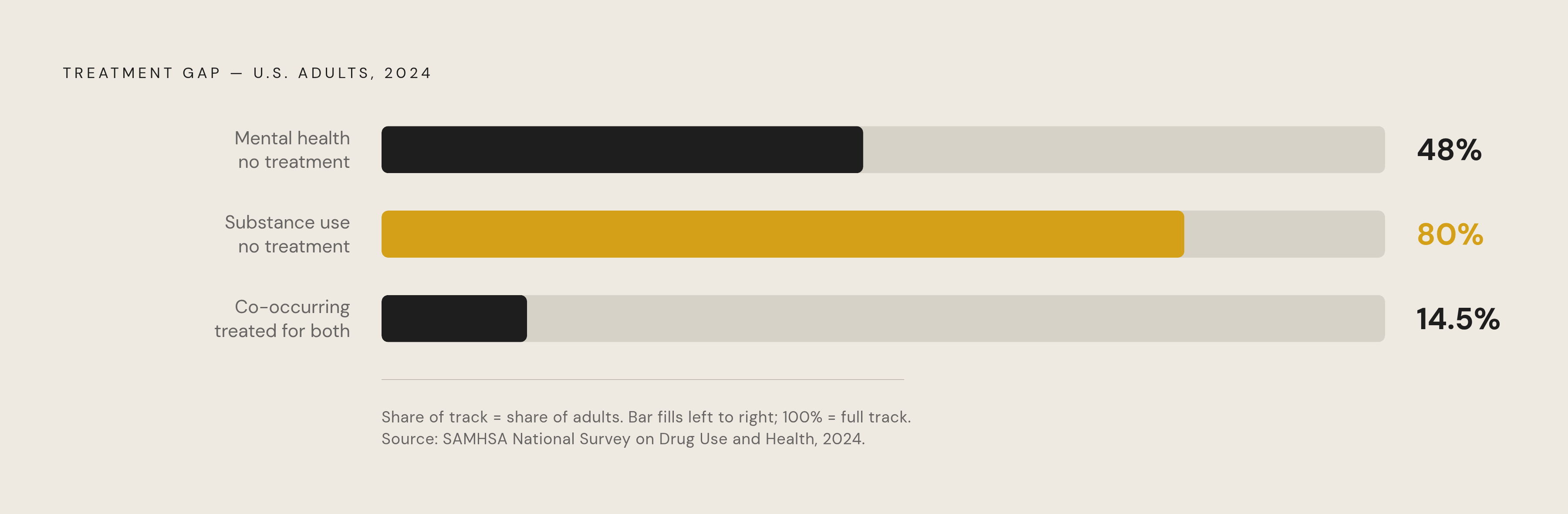
Step back from the statutes for a second, because the scale underneath all this legal architecture is hard to fully take in. Of the 61.5 million U.S. adults living with a mental health condition in 2024, 29.5 million did not receive mental health treatment. That's not a niche failure at the margins; it's roughly half the people who need help getting none, regardless of what any state's commitment law happens to say.
For substance use disorder, it's worse. About 80% of people who needed SUD treatment didn't get it, and among adults dealing with co-occurring mental health and substance use conditions, only 14.5% got treatment for both conditions. Involuntary treatment law matters a great deal for the smaller slice of people too ill to engage with care voluntarily at all. But for the much larger population living with serious mental illness, what actually decides their outcomes is whether voluntary systems exist and function, systems these laws were never designed to build in the first place.
Where does the overflow land? Often, jail. An estimated 4,000 people with serious mental illness are currently held in solitary confinement in U.S. prisons and jails right now, a direct, predictable result of a system that criminalizes psychiatric crisis because it hasn't built anywhere else to put it. Social conditions make it worse from there: housing instability, food insecurity, and gaps in medication access mean that even people who do get short-term involuntary treatment often walk right back into the exact conditions that caused the crisis to begin with.
Duration seals the trap. Laws authorizing only brief holds or short commitment windows produce exactly the outcome you'd predict: a revolving door, stabilization without the follow-through recovery actually needs to hold. People in states with narrow commitment standards and no real AOT framework end up stuck in a gap most statutes don't even have a name for: not sick enough to commit, not well enough to manage alone. That's not a clinical mystery; it's a legal vacuum, and in a lot of states right now, there's simply no remedy written into law for it.
Where peer support fits in a system built almost entirely around legal mechanisms
Holds, commitment, AOT, CARE Court, every mechanism this piece has walked through so far is built for acute crisis, but none of them are built to sustain the kind of trust that actually drives long-term recovery for someone living with serious mental illness. That's not a knock on the law; it's just outside what law was ever designed to do.
Peer support fills that exact space. People with lived experience of serious mental illness provide recovery support and help others navigate systems they've navigated themselves, and they build a kind of trust that credentials alone don't get you, because the relationship starts from "I've been there" instead of "I studied this." A 2022 systematic review and meta-analysis in Psychological Medicine found that, specifically for people with serious mental illness, peer support showed a significant edge over control conditions across recovery outcomes measured after the intervention ended. That's not a soft, feel-good finding; it's a documented outcome advantage, measured after the fact.
The Bazelon Center's report, When There's a Crisis, Call a Peer, cited in the Suffolk University legal review mentioned earlier, documents how people with lived experience make crisis services measurably more effective. Peer specialists already sit inside a lot of the systems these laws govern, emergency departments, crisis units, post-discharge follow-up, which happen to be exactly the points where people fall through the cracks between one legal mechanism and the next.
firsthand's model runs on that same principle. Guides and STRIVE Specialists, each carrying their own lived experience of serious mental illness and often substance use disorder too, meet people where they actually are: help with housing, food, medication access, behavioral health navigation, the social conditions no involuntary commitment statute so much as glances at. The peer workforce behind this has grown fast; more than 100,000 certified peer specialists now work nationally, and as of 2024, 49 states plus D.C. have statewide certification programs running. Access still isn't even, though, and the reason isn't mysterious: the same geographic patchwork that shapes involuntary treatment law state by state also shapes peer support funding, reimbursement, and program quality. A strong peer workforce in Pennsylvania does nothing for someone three states away where that infrastructure was never built.
What a more coherent system would actually require
Legal reform by itself, broader commitment standards, longer durations, wider AOT eligibility, only ever touches the acute end of the continuum. Even the best-written commitment statute in the country does nothing for someone who's stable today but headed for relapse in six months because they don't have anywhere to live.
A system that actually works for people with serious mental illness needs legal mechanisms proportionate to the standard they're applying, sure, but it also needs voluntary pathways strong enough that coercion becomes the rare last resort instead of the default first move. Housing, food, medication adherence: none of that shows up anywhere in a state's commitment statute, and yet those are exactly the factors that decide whether someone stabilized under legal intervention actually stays stable once the order expires.
Peer support is the connective tissue that's been mostly missing from this conversation, or at least badly underweighted next to how much legal machinery the field has built instead. The evidence is there, the workforce exists and keeps growing, and it closes precisely the trust and continuity gaps that legal mechanisms were never built to close, no matter how carefully the statute gets drafted.
The geographic inequity running through every section here, where a zip code decides what care is even legally available, isn't some unavoidable fact about how serious mental illness works. It's a policy choice, made independently by 50 different legislatures over decades, and it remains a choice those legislatures are fully capable of revisiting. For people living with serious mental illness, for their families, and for the health systems responsible for serving them, knowing exactly what the law in your state actually allows, and what it doesn't, is where this has to start.