When a Mental Breakdown Is a Sign of Serious Mental Illness
Untreated early warning signs often precede psychiatric crises by months or years.

"Mental breakdown" has no clinical definition. No diagnostic manual lists it as a condition, yet people reach for the phrase constantly to describe the moment someone stops being able to function under psychological weight that outpaced what they could carry. That's the trouble with it: the phrase names a moment, not a cause, so it tells the people watching almost nothing about what happens next. Most families read a breakdown as self-contained, a crisis followed by recovery followed by a return to normal. Read correctly, a breakdown is usually the first visible mark of something that had already been running for months, sometimes years, beneath the surface.
How serious mental illness begins (not all at once, but in early signals)
The American Psychiatric Association has noted that major mental illnesses like schizophrenia or bipolar disorder rarely appear without warning. Family, teachers, friends, or the individuals themselves usually notice something first, some sense that things aren't tracking right, before the illness declares itself in full.
Two terms do real work here. SAMHSA defines any mental illness (AMI) as a diagnosable mental, behavioral, or emotional disorder meeting DSM criteria, excluding developmental and substance use disorders. Serious mental illness (SMI) is narrower. It's what an AMI becomes once it substantially limits one or more major life activities, and that severity threshold marks the line between a diagnosis someone manages and one that reorganizes a life. As of 2022, SMI affected roughly 6.0% of adults, about 15.4 million people.
Age is the detail that should reframe how people think about this. Half of lifetime mental illness starts by age 14, and 75% by age 24. Research published in PMC narrows that further: serious mental illnesses, including schizophrenia and bipolar disorder, predominantly first develop in adolescence and early adulthood. That's precisely the range where a person has the least language to describe what's happening to them, and where the adults around them have the least practice interpreting it. The onset window and the interpretive skill gap overlap almost exactly, and that overlap is the reason so many early cases get missed rather than caught.
The APA names concrete markers for the pre-onset period: dramatic changes in sleep and appetite, decline in personal hygiene, social withdrawal, mood changes, and attenuated psychotic symptoms. When a breakdown finally happens in someone already showing this pattern, the question that matters is how long it had been building before anyone named it. It's how long it had been building before anyone named it.
Psychosis as the pivot point most families don't recognize in time
Psychosis is the clinical term for a break in how someone perceives and interprets reality, marked most often by hallucinations and delusions. Like SMI onset generally, it's usually preceded by the same attenuated signals described above. That makes the pre-psychotic window a real opportunity.
Recognition runs into a wall most people don't expect, though. People experiencing psychosis often can't distinguish what's real from what isn't, and frequently can't recognize they're symptomatic. That is a direct symptom of the condition itself, distinct from denial in the everyday sense of a conscious refusal to accept a hard truth. It's a direct symptom of the condition itself: the perceptual apparatus a person would need to notice something's wrong is the same apparatus the illness has compromised.
Consider what that looks like from the family's side. Someone urges a loved one to see a doctor, and gets back not fear or hesitation but confusion, maybe irritation, because as far as that person can tell, nothing is wrong. Families read that as resistance. Clinically, it's closer to a blind spot the illness creates on its own terms. When a psychotic episode becomes "the breakdown," then, it arrives with the hardest obstacle already built in: the person at the center may be the last one able to see what's happening to them. Early intervention ties to better long-term trajectories, and untreated psychosis tends to set a pattern that repeats, which is what the next section tracks.
The relapse pattern after a first episode
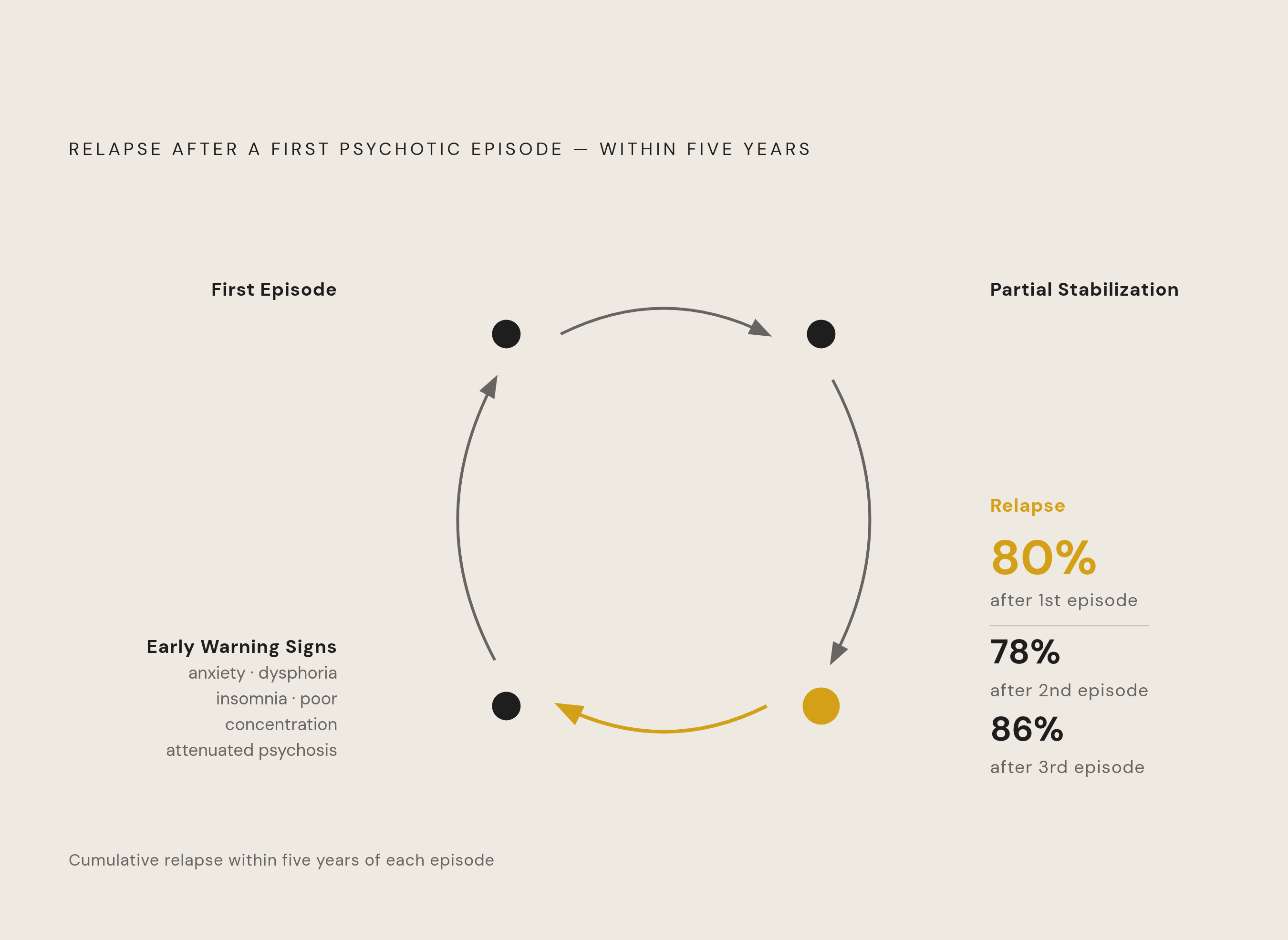
Relapse after a first psychotic episode is closer to the default outcome than the exception, and the numbers make that case better than any description could. Clinical trial protocol literature puts relapse within five years at around 80% of people treated for a first episode of psychosis. Cumulative relapse climbs to 78% after a second episode and 86% after a third, within that same five-year window. Anyone treating a first episode as a closed chapter is working against those odds, not with them, and the odds don't forgive that assumption.
Relapse doesn't arrive without warning any more than the first episode did. Clinical literature identifies early signs in the weeks beforehand: anxiety, dysphoria, insomnia, poor concentration, and attenuated psychotic symptoms returning. Some trial protocols even track fear of relapse as its own measurable factor, which says something about how much this cycle weighs on people who've already lived through it once.
The pattern runs in a loop: first episode, partial stabilization, early warning signs, relapse, and then the cycle repeats, unless someone is actually watching in the gaps between episodes. The warning signs before a first episode and the warning signs before a relapse are close to the same signal, just appearing twice. Families or individuals who walk away from a first breakdown without any ongoing structure in place aren't missing a nice-to-have. They're unprepared for what the research says is, more often than not, already on its way back.
The systemic gaps that turn a recognizable signal into a years-long delay
Recognizing the pattern is one problem. Getting care once it's recognized is a separate, harder one, and the space between the two is where most people get lost. Data registered on ClinicalTrials.gov show that globally, an estimated 70% of people who need mental health care go without adequate treatment or without any treatment.
The World Health Organization's World Mental Health Today and Mental Health Atlas 2024 put scale to that gap: more than 1 billion people live with a mental health disorder worldwide, while median government spending on mental health has held at roughly 2% of total health budgets since 2017, essentially flat for close to a decade. In low-income countries, fewer than 10% of people affected receive any care.
When systemic constraints leave people without accessible care, emergency departments often end up absorbing the overflow by default. Crisis care has to exist somewhere in the system, but it should never function as the front door, and treating it as one is where a lot of the downstream cost in this piece originates.
A narrative review published in MDPI in September 2025, led by Wiesepape and colleagues, sorts the barriers into three domains, and the framework matters because it shows how little of this traces back to a single failure point. Structural and logistical barriers cover geography, disjointed medical and mental health systems, and gaps in technology access. Intrapersonal and patient-level barriers include the symptoms of SMI itself getting in the way of seeking help, medical mistrust, low health literacy, and limited awareness of physical health problems layered on top. Provider and system-level barriers cover clinician burnout and demand that keeps outpacing supply, year over year.
A 2026 narrative review in PMC adds the detail that explains why this persists even when someone actively wants help: people with SMI often describe operating in short-term survival mode, focused on getting through the day rather than planning ahead, because fragmented services, unstable housing, and unpredictable income make long-term thinking a luxury they can't afford. Research in this area consistently shows that systemic barriers, societal stigma, and economic inequity compound each other rather than operating on separate tracks. A breakdown that never gets read as an SMI signal isn't just a missed diagnosis, in other words. Inside a system built like this, it usually means years pass before anyone circles back to it.
The physical and social toll of untreated SMI
The delay raises costs in the body, not just in the psyche, and this is where the stakes stop being abstract. A PMC review found that people with severe mental illness have a life expectancy roughly 14 years shorter than the general population. A co-occurring substance use disorder widens the gap to as much as 20 years. Even depression, a far higher-prevalence condition, carries a 13-year gap on its own. These numbers aren't rounding errors, and no amount of downstream treatment fully closes them once the delay has already happened.
Function erodes alongside longevity. Research cited in an arxiv preprint estimates that around 70% of patients with mental disorders experience some degree of social functional impairment, with schizophrenia and depression showing the sharpest effects. An MDPI review notes that people with SMI are less likely to receive adequate medical care for unrelated physical conditions, and that gap in access is part of what keeps the mortality difference from closing even as treatment elsewhere improves.
Housing turns this into a feedback loop instead of a static problem. Housing costs present a serious obstacle for many people with SMI, whose incomes are often limited, and rental assistance programs do not reach everyone who needs them. Food access and transportation follow the same logic. They aren't side issues to mental health treatment, they're preconditions for it, and losing ground in one domain drags the others down.
Untreated SMI, when a breakdown is read as an isolated crisis rather than tracked over years, produces a measurable distance that appears in life expectancy tables, in functional impairment rates, in eviction filings. The distance between a breakdown read as an isolated crisis and years spent living with untreated SMI is documented, repeatedly, across every domain researchers have thought to measure. It's documented, repeatedly, across every domain researchers have thought to measure.
How peer support closes the recognition and engagement gap that clinical systems leave open
Given a system with holes this structural, what actually reaches someone who doesn't believe anything is wrong with them? Clinical care alone often can't, because the barrier is trust, and trust responds to a different mechanism entirely than clinical competence does. Peer support is broadly understood as services delivered by people who draw on their own lived experience with mental health challenges or recovery to support others facing something similar.
Psychiatric Services describes the function this way: peer specialists work to build belief in the possibility of recovery and help people identify their own goals, operating alongside clinicians rather than replacing them. That distinction matters most for exactly the population this piece has been tracking. Someone in a first episode of psychosis, who by definition may not recognize their own symptoms, is often more reachable by a person who has lived through something similar than by a clinician they just met an hour ago.
The evidence isn't thin here. A 2023 meta-analysis by Smit and colleagues in Psychological Medicine, covering 28 randomized controlled trials and 4,152 participants, found peer support interventions outperformed control conditions across clinical recovery, personal recovery, and functional recovery. For SMI patients specifically, peer support showed significant advantages across all three categories at the end of treatment, and the gains held beyond the end of treatment. Three high-quality trials found small but real positive effects on quality of life (SMD 0.24) among SMI patients.
A qualitative shift produces those numbers. Peer support pushes toward empowerment, identity, and meaningful life roles, not symptom suppression alone. A 2021 paper in PMC documents this as a shift from telling an "illness story" to telling a "recovery story," a change in how someone narrates their own experience to themselves. That's not a small thing for someone whose grip on reality has already been shaken once. Peer specialists are also one of the fastest-growing parts of the mental health workforce, and they work inside communities rather than only inside clinics, which answers the structural barriers named above more directly than another clinic ever could.
What firsthand's model does that the system alone cannot
firsthand builds its model around exactly this mechanism. Its Guides and STRIVE Guides have personally navigated serious mental illness, substance use disorder, or both, and the model treats that lived experience as a clinical asset.
The approach is community-based and in-person by design. Guides meet people where they are, working through housing, food access, medication management, medical appointments, and behavioral health resources inside the communities people already live in. That answers two of the three barrier categories named in the MDPI framework directly: a Guide who shares lived experience can work through medical mistrust and low health literacy in ways a clinical stranger, however competent, generally cannot.
Housing and food are part of the mental health work, structurally. They're part of it, structurally. The same team helping someone through a psychiatric crisis is also the team helping them find stable housing, because recovery doesn't happen under ongoing instability, regardless of how strong the clinical care layered on top of it is. Firsthand's helpinghand platform holds HITRUST r2 certification, which matters in practical terms because the model depends on secure coordination across housing, medical, and behavioral health data that would otherwise sit in separate, disconnected systems, unreachable to the people trying to coordinate around them.
If a breakdown is a signal of emerging SMI, the outcome depends less on someone reading it correctly in the moment than on what happens afterward. It hinges on whether someone trusted keeps appearing afterward, consistently, on the timescale the relapse research describes, a timescale clinical systems as currently structured often can't sustain. firsthand's model targets the population that research points to directly: people the system has already missed once, people who don't trust it, and people who need something more durable than a single crisis intervention.
What families and individuals can do when a breakdown happens
A breakdown calls for stabilizing first and watching closely after. Whether it was an isolated crisis or the surface of emerging SMI is a question that only answers itself over time, never in the acute moment itself.
Once things settle, the signs worth tracking mirror the pre-onset markers named earlier, and if psychosis was part of the original episode, the relapse-specific signals matter just as much: sleep and appetite changes that don't resolve once the crisis passes, personal care that keeps sliding, social withdrawal that deepens instead of easing, mood disturbances that linger, and any perceptual oddities or unusual beliefs, even mild ones. The clinical literature on relapse patterns shows that if psychosis was part of the original episode, the relapse-specific signals matter just as much: rising anxiety, dysphoria, insomnia, and trouble concentrating tend to appear in the weeks before a repeat episode.
Age still matters here. A breakdown in someone between 14 and 25 carries a meaningfully higher likelihood of marking SMI onset, simply because that's the window when schizophrenia and bipolar disorder overwhelmingly first appear.
When trust is the obstacle, and it often is for anyone who's just been through a first psychotic episode, expectations need to adjust accordingly. Self-referral isn't realistic from someone who doesn't yet believe anything is wrong with them, no matter how clearly the people around them can see it. Someone with shared lived experience tends to close that gap in a way a clinical stranger structurally cannot, serving as the bridge that makes clinical care reachable rather than as a substitute for clinical care.
None of this asks a family to diagnose anything on their own. The relapse research points, repeatedly, to consistent presence in the months following a breakdown mattering more for outcomes than any single intervention delivered in the moment. Peer specialists and peer-support organizations grounded in community presence exist for that exact reason. Individuals and families can connect with firsthand through health plan or provider partnerships, since the organization was built specifically for the population this piece has traced throughout: people living with SMI who have already fallen through the system's cracks once, and who need something sturdier than a single crisis response to keep it from happening again.