Housing First Programs for People with Serious Mental Illness
Data shows housing first cuts emergency room visits nearly in half.

Housing First rests on one claim you can actually test: people with serious mental illness recover faster and more fully when they get housing before anyone asks them to prove sobriety, compliance, or anything else. I've spent enough time around this data, and around the programs trying to implement it, to think the claim holds up better than its critics admit and worse than its advocates sometimes pretend. This piece walks through what the evidence says about retention, what happens to health costs once someone has an address, and where the model still trips over its own implementation.
The population Housing First is designed for and what they face before housing
Start with a number: 18.1% of people experiencing homelessness in the U.S. carried a diagnosis of serious mental illness. That's not a rounding error, and it plays out in very specific ways once a psychiatric history shows up on a rental application. A background screen flags a hospitalization, and a landlord calls a reference, hears the word "schizophrenia," and quietly moves to the next applicant. Discrimination against people with mental illness runs through nearly every stage of renting, and the private market has done little to close that door back up.
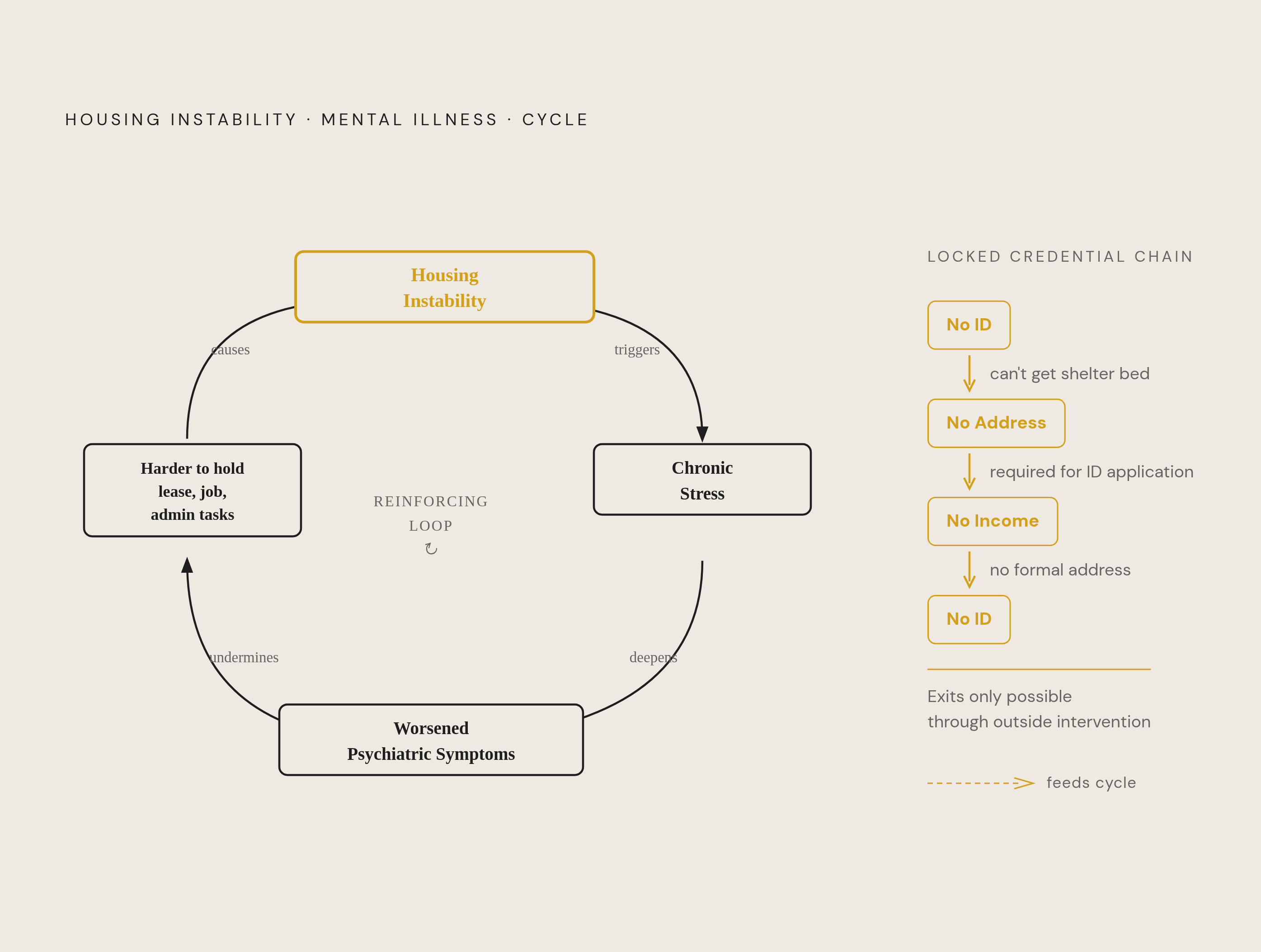
What builds from there is a trap that runs in both directions at once. Housing instability drives up chronic stress; chronic stress worsens psychiatric symptoms; worsened symptoms make it harder to hold a lease, keep a job, or manage the small administrative tasks housing quietly demands of everyone, showing up for a lease renewal meeting, keeping a bank account funded, answering a certified letter. Each side feeds the other, and the life expectancy gap sits on top of all of it: people with serious mental illness die 15 to 20 years earlier than the general population, a gap driven largely by the accumulated weight of poverty, instability, and thin access to care.
Food insecurity stacks on that, and so does unreliable transportation and income loss, each one chipping away further at whatever stability someone has left, making treatment harder to stick with even for a person who genuinely wants to engage with it. The systems meant to help are fragmented, and they're locked behind credentials nobody in crisis actually has: an ID to get a shelter bed, an address to get the ID, income to get the address. None of it was built to meet a person where they actually are, and I don't think that's an accident so much as an inheritance from decades of treating housing as a reward rather than a foundation.
What the evidence actually shows about housing retention and stability
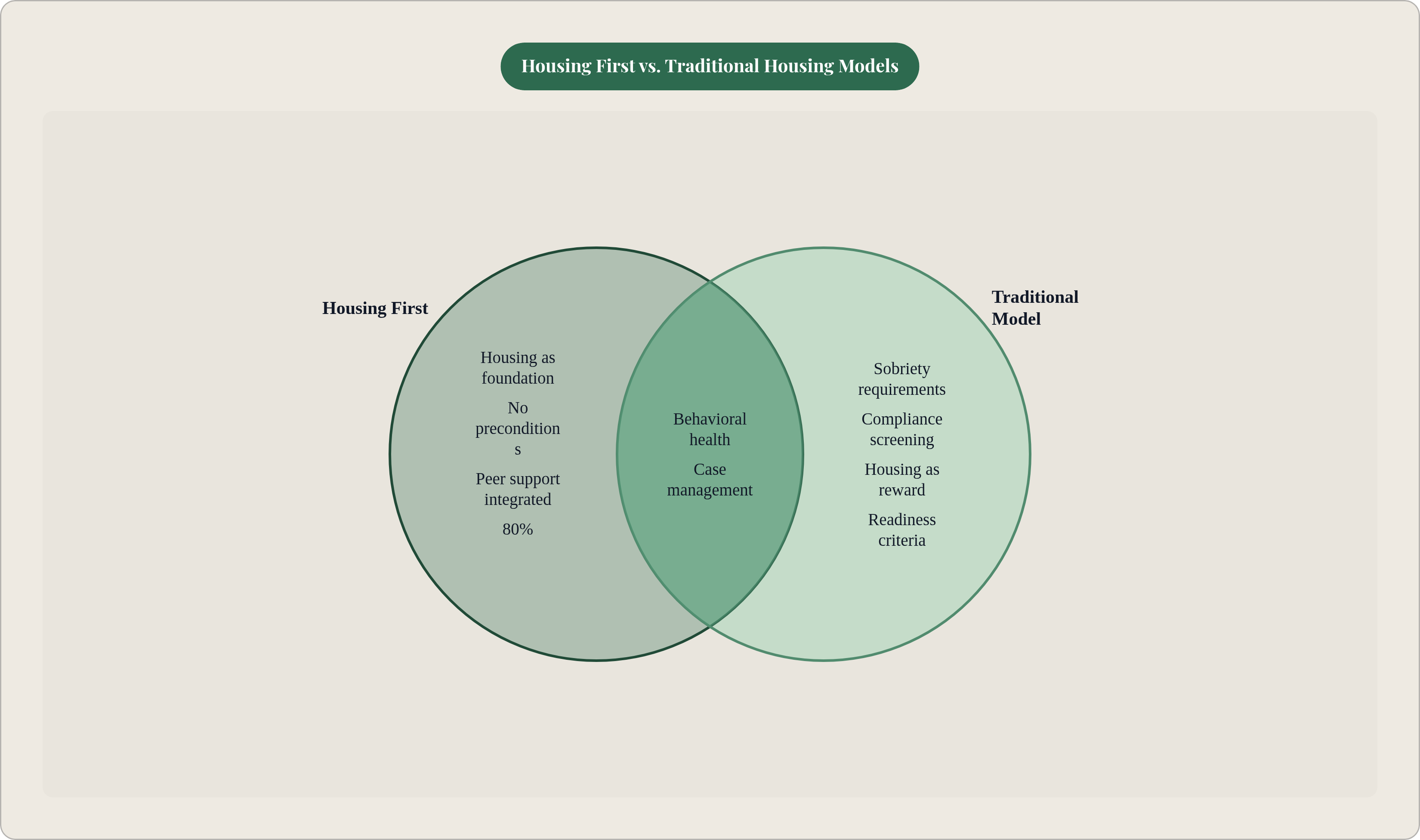
Housing First programs hold around 80% housing retention. Sit with that next to the old clinical assumption, still repeated in plenty of training rooms, that people with serious mental illness aren't "housing ready" until they've proven something first: sobriety, medication compliance, some demonstrated capacity to behave. The data doesn't just complicate that assumption; it guts it.
The clearest evidence we have comes from the At Home/Chez Soi randomized controlled trial. Participants assigned to Housing First got housed sooner, stayed housed longer, and reported more perceived choice than people in treatment-as-usual arms; they also showed faster gains in community functioning and quality of life. About 13% didn't reach housing stability within the first year, and what predicted that 13% is the part worth sitting with: longer lifetime homelessness and more severe mental health conditions predicted it, but sex, ethnicity, substance use, and criminal history didn't.
The factors clinicians and program staff have historically used to screen people out, sometimes without realizing that's what they were doing, turn out to have no bearing on whether housing actually works for someone. Separately, roughly 15% of people placed through Housing First leave voluntarily or don't stabilize, a number that holds up well against whatever it usually gets compared to. And the research is blunt on one more front: a psychiatric diagnosis by itself has no relationship to someone's ability to get or keep independent housing. So what, exactly, was "readiness" screening ever screening for?
What happens downstream once housing is secured: health costs and system use
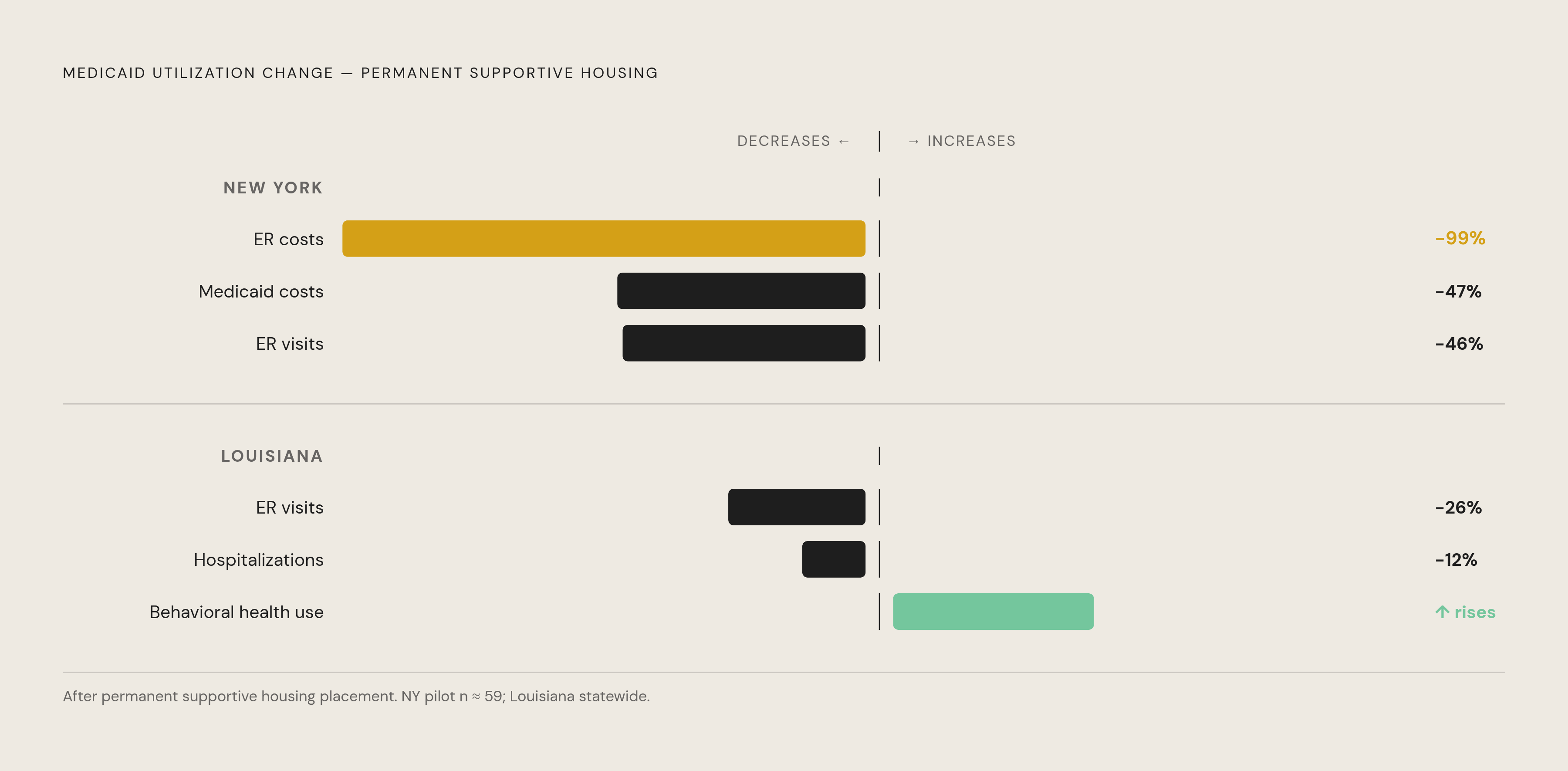
Two state Medicaid analyses answer that question in dollars, and the dollars are not subtle. A New York pilot pairing Medicaid with housing providers for high utilizers found a 46% drop in ER visits, a 47% drop in Medicaid costs, and a 99% drop in ER costs among participants. In Louisiana, comparing Medicaid recipients before and after they entered permanent supportive housing turned up a 26% drop in ER visits, a 12% drop in hospitalizations, and a rise in behavioral health service use.
Two different states, two different Medicaid systems, and the same pattern in both: acute, high-cost crisis care falls sharply while lower-intensity, ongoing care climbs. That's close to a mirror image of what happens during active homelessness, where the emergency department absorbs costs housing would have prevented from piling up in the first place. Systematic reviews back this from another angle, finding no negative impact on mental health, substance use, or mortality outcomes when Housing First is measured against usual care.
None of which makes the model flawless, and I want to be straight about that rather than bury it. Housing First did not meaningfully improve primary care retention in the studies reviewed, and getting someone housed doesn't automatically plug them into a primary care doctor. That connection has to be built on purpose, as its own piece of program design, not assumed as something the address delivers on its own.
Why housing stability is the precondition for every other dimension of recovery
What does an address actually do, mechanically, for someone rebuilding a life? Without one, medication adherence breaks down because there's nowhere stable to keep medication and no routine to hang it on. Appointments slip, food security becomes nearly impossible to establish, and trust in any provider, clinical or otherwise, stays thin, because trust needs continuity, and continuity is the first casualty of homelessness.
Qualitative research with people in Housing First programs finds that trust, recognition, relationships, and belonging sit at the center of how people talk about their own recovery, not symptom reduction or medication counts. Living independently, or living with people of one's own choosing, was tied to a stronger sense of autonomy and belonging. Residents pointed specifically to being able to make their own daily decisions while still having support available when they wanted it, which is a distinction that matters more than it sounds like it should.
Housing produces routine. Routine supports medication adherence, and adherence opens the door to real engagement with behavioral health services, the kind that actually requires showing up more than once. An address is also what unlocks benefits applications, food assistance, and the employment paperwork that all require one, plain and simple. And housing lowers the crisis-state thinking that leaves no room for anything but survival, which frees up the bandwidth to actually engage in treatment. At Home/Chez Soi, the New York and Louisiana Medicaid numbers, and this qualitative research are pointing at the same thing from three different directions: housing comes first, and recovery follows from it, not the other way around.
Where peer support fits inside Housing First and why it belongs there
Wraparound services make up the second half of the Housing First model, and they only work as far as people trust whoever's delivering them. That's exactly where peer support does something clinical credentials alone can't.
Peer specialists, people who've lived through serious mental illness and rebuilt their own lives around it, extend care past the clinic walls and into the ordinary texture of daily life that housing makes possible: the first appointment, the benefits application, the grocery run nobody else will do with you. What they bring is credibility built from shared experience, plus the plain work of showing up again on the day it would be easier not to. A peer specialist is also living proof, in a way no clinician can quite be, that recovery is a reachable outcome and not a slogan someone printed on a brochure.
The research backs this up. High-quality trials show a small but statistically real positive effect favoring peer-delivered interventions on quality of life for people with serious mental illness, with an effect size of 0.24. Two equivalence trials found peers performing on par with health professionals on clinical symptom improvement and quality of life, which has real implications for how programs staff and budget this work. There's also a documented "helper therapy" effect: peer specialists go through their own identity shift, from an illness story to a recovery story, so the model builds something for the workforce delivering care, not only for the people receiving it. But the interventions that actually produce results are structured around trained, deliberate goal-setting curricula, and casual, informal check-ins don't show the same effect. Which suggests the "peer" part of peer support isn't sufficient by itself; the structure carries as much weight as the shared experience.
The implementation gaps that prevent Housing First from delivering on its potential
Housing First doesn't implement itself, and this is where I think a lot of the model's reputation gets made or unmade. The evidence base is strong, but what a person actually experiences depends heavily on how a given program gets built, staffed, and funded on the ground, and that gap between design and delivery is where things fall apart.
A few factors keep showing up in implementation research as the line between programs that work and programs that struggle. On the facilitating side: a genuinely wide menu of services, and real collaboration with community partners, housing providers, Medicaid plans, behavioral health systems. On the barrier side: inadequate external resources, meaning funding, available housing stock, staffing capacity, show up again and again, alongside a shortage of evening and prosocial activities. People need community alongside four walls and a lease, and that part gets underfunded almost everywhere. Outside peers who steer someone's recovery plan in a direction that conflicts with program goals are another documented friction point, and one that doesn't get talked about enough.
The primary care gap from earlier resurfaces here too. Even a successful housing placement doesn't automatically produce a connection to ongoing medical care; closing that gap takes deliberate integration work, not hope. There's a political dimension worth naming honestly: some critics still push for abstinence or work requirements as conditions of housing, positions the evidence doesn't support, yet these shape funding decisions and program design across a number of states regardless. And the roughly 15% who don't reach stable housing are a real population, not a rounding error; what separates programs that serve them well is sustained, individualized support rather than discharge at the first sign of trouble.
How health plans and provider systems can make Housing First work at scale
The New York and Louisiana Medicaid numbers make the clearest case available for why payers should care about this model beyond its humanitarian value. The cost of housing support tends to come back, often more than come back, through lower emergency and inpatient utilization down the line. There's a financial argument sitting right next to the clinical one, and the two rarely line up this cleanly in health policy.
What does real partnership look like in practice? Medicaid managed care organizations co-investing directly with housing providers, the way the New York pilot did. Health systems building warm referral pathways straight from hospital discharge into housing support, so nobody gets released back into homelessness before a shelter intake can catch them. Peer specialists built into care teams inside Housing First programs as a core part of the model, not an afterthought bolted on later. Research on post-discharge recovery, often gathered under the banner of "Opening Doors to Recovery," is blunt about the stakes: insufficient community-based support after an inpatient stay leads directly to re-hospitalization, criminal justice involvement, and renewed homelessness. Those are exactly the high-cost outcomes payers are trying to avoid.
Some organizations are built specifically to sit in that gap. Some organizations connect people with serious mental illness to community-based care navigation and benefits support through staff who bring their own lived experience into the work, meeting people in their homes and communities instead of waiting for them to show up at a clinic. First Hand is one such organization, pairing people with guides who have navigated serious mental illness themselves. That kind of peer-integrated, community-based layer is what makes a housing placement hold over time, well past the day the lease gets signed. For a health plan sizing up potential partners, the open question isn't whether Housing First works; the evidence already settled that. The real question is whether the wraparound layer underneath the housing is staffed by people who can build the kind of trust that keeps the whole thing from coming apart.
What stable housing actually means to the people living in it
Forget the retention percentages and the Medicaid cost curves for a moment. What do people in these programs actually say about their own lives? Qualitative research keeps landing on the same four words: trust, recognition, relationships, belonging. These are what make a recovery feel real to the person living it, past anything a symptom checklist or medication compliance rate was ever built to measure.
Autonomy comes up again and again as central to that feeling: deciding what to eat, when to sleep, who gets to come through the door, decisions homelessness strips away entirely and that even some institutional care settings still limit more than they should. People describe being treated like a person instead of a diagnosis when peer-supported care runs alongside stable housing, a distinction that sounds small until you consider how rarely it's held true for them before. An address changes something beyond the practical too, and it changes how institutions respond to them, from benefits eligibility to voter registration to a job application that finally has somewhere to send the callback.
Recovery from serious mental illness was never going to be a straight line from diagnosis to stability; nobody's recovery from anything is. It's a life getting rebuilt piece by piece, and a home is where most of that rebuilding actually happens. Housing First treats stability as the thing that makes everything else, medication, treatment, trust, work, possible to even attempt, rather than something a person has to earn before they're allowed to receive it. People with serious mental illness deserve the chance to find out what they're capable of once they're not spending every waking hour just trying to get through the day.