Psychiatric Crisis Stabilization Units as ER Alternatives
These residential crisis centers cost a fraction of what emergency rooms spend per patient.
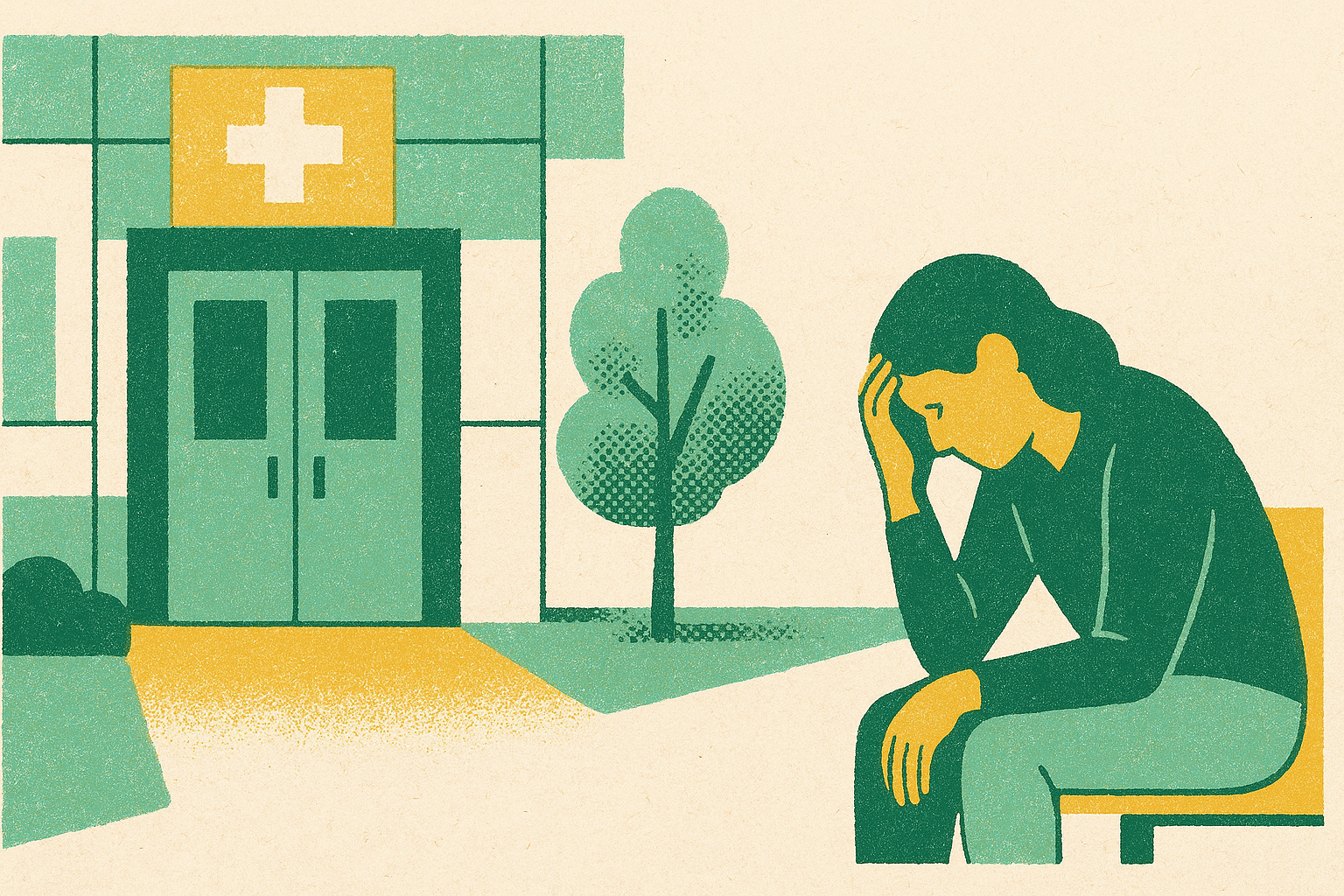
The emergency room is the default front door to psychiatric care in America. Crisis stabilization units, or CSUs, exist as a specific, evidence-backed alternative built for behavioral health crises, distinct from a model meant for chest pain and broken bones. This piece walks through how CSUs differ from ERs, what the outcomes data shows, where they exist and where they don't, and how peer support fits into the model. The goal is to give families, clinicians, and health plans a clearer sense of what the right tool for a psychiatric crisis looks like, and why so much of the country still defaults to the wrong one.
Decades of underinvestment in community mental health left the ER holding a job nobody designed it to do. Emergency departments are loud and bright, built around triage logic suited to a heart attack more than a panic attack. Staff there train in medical stabilization, so psychiatric evaluation gets delayed for hours, sometimes days, while a patient "boards" in a hallway or an exam room meant for someone else's emergency. That wait doesn't sit neutrally. Agitation builds, and the interventions that follow (physical restraint, forced sedation) can retraumatize someone already in crisis, and put staff at risk too. A 2024 poll of American College of Emergency Physicians members found the vast majority said they or a colleague had been assaulted on the job in the past year. That number stopped me for a second — it's nearly everyone. The sickest patients (people with psychosis, medical comorbidities, involuntary status) are often the ones community programs turn away, leaving them boarding untreated in the one place required to say yes to everyone.
Mental-health-related visits now make up 12.3% of all adult emergency department visits nationally each year, according to NAMI, a volume the ER absorbs by default rather than by design. SAMHSA's 2024 data puts 14.6 million American adults (5.6% of the adult population) living with serious mental illness, and roughly 30% of them get no treatment at all. Sit with those two figures side by side and the ER's role starts to look like what happens when a system has nowhere else to put people. Figuring out what actually fits that gap is the point of everything that follows.
What crisis stabilization units are and how they differ structurally from ERs
SAMHSA describes the ideal crisis response as three connected pieces: someone to call, someone to respond, and somewhere to go. The 988 Suicide and Crisis Lifeline is the first piece. Mobile crisis teams are the second. Crisis stabilization units, and the broader family of receiving and stabilization facilities they belong to, are the third, and they run on assumptions a hospital ER simply doesn't share.
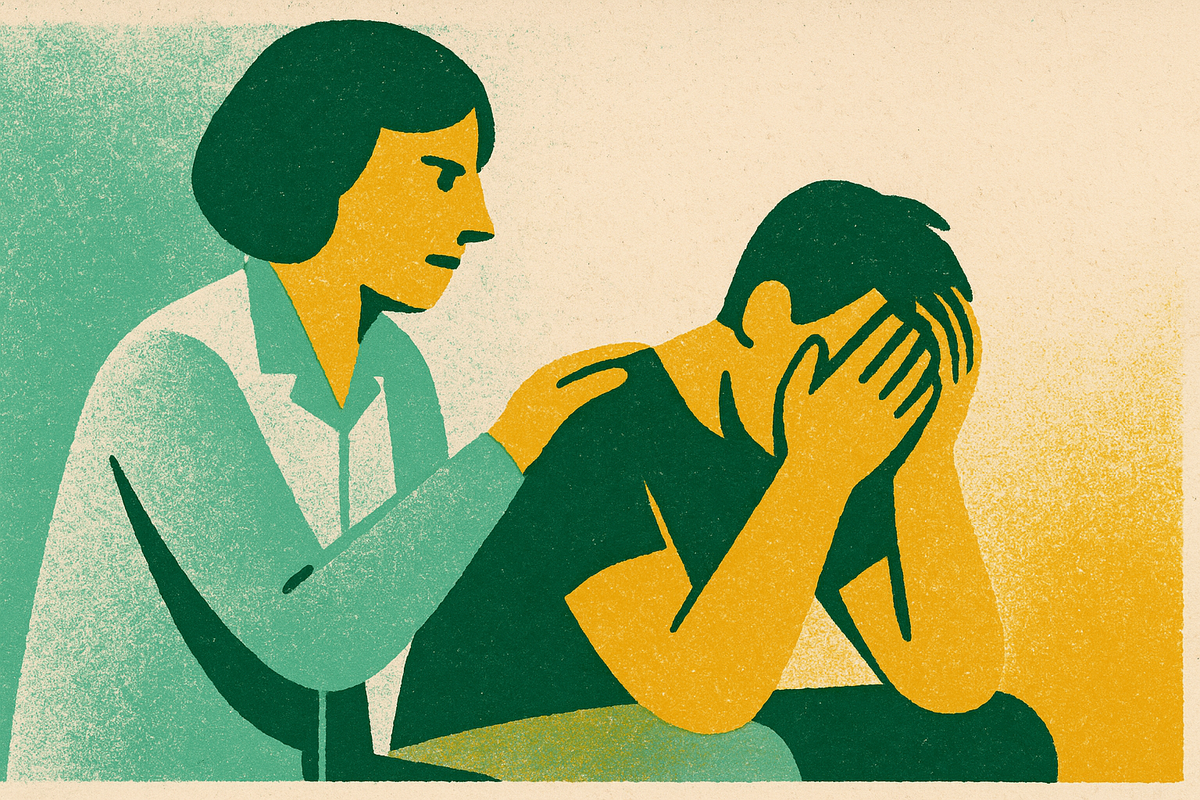
The physical environment gives it away first. CSUs run quieter, less clinical-feeling, designed to keep arousal low instead of managing it after it's already spiked. Staff train specifically in crisis intervention, medication management, counseling, and discharge planning. The goal is short-stay stabilization and a warm handoff to whatever comes next. The ethos, at least in well-run programs, is non-coercive: patients describe being spoken with rather than spoken over, and plenty of these facilities operate without a single locked ward.
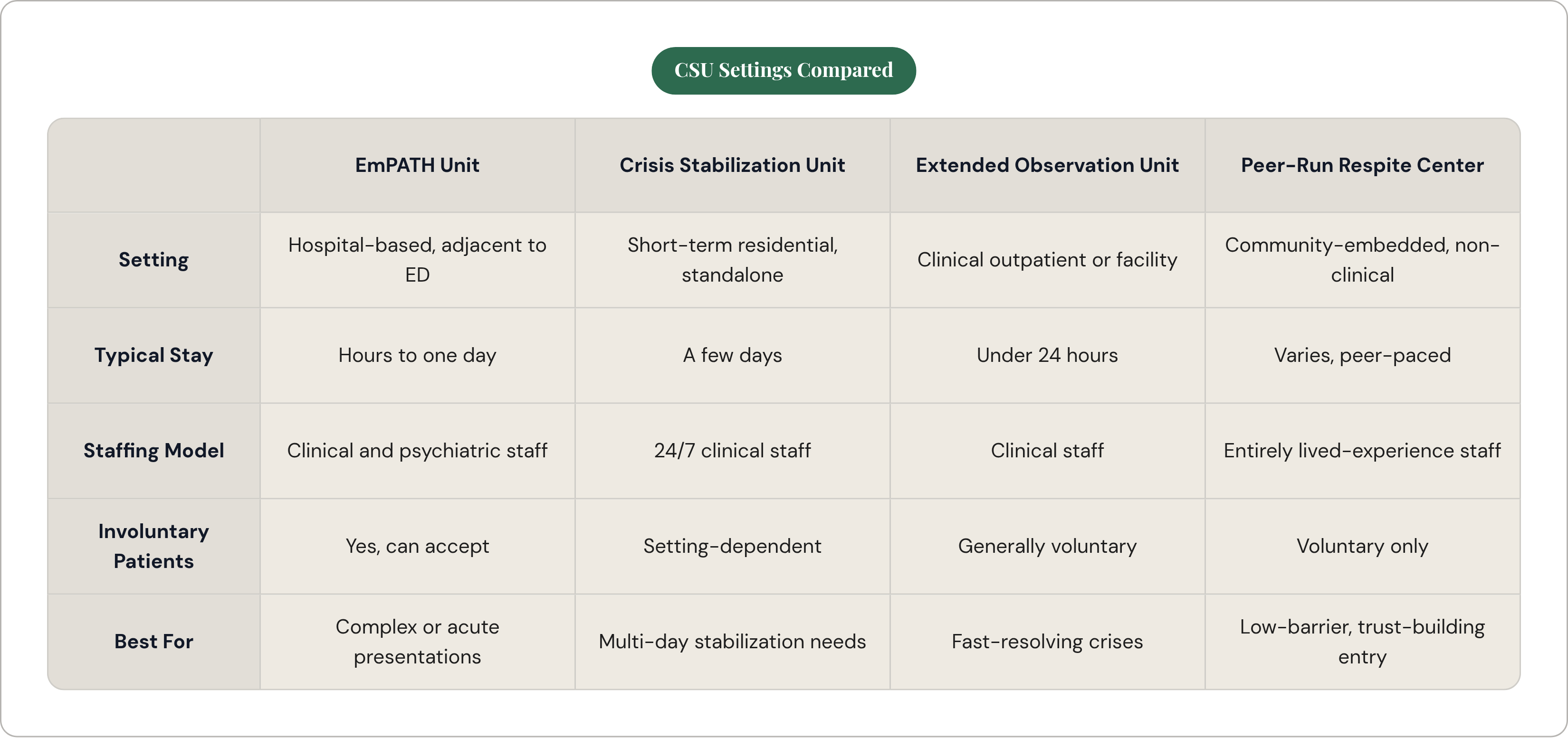
The CSU label actually covers a range of settings, and it helps to know the differences. EmPATH units are hospital-based, a calmer space built inside or next to a medical ED, and they can take even involuntary patients, often moving someone from crisis to discharge in hours rather than the days a typical ER boarding stay drags on. Crisis Stabilization Units proper are short-term residential settings, staffed 24/7, with stays usually running a few days; South Carolina's regulatory definition describes a facility run by or in partnership with the state Department of Mental Health, serving adults 18 and older. Extended Observation Units handle situations that resolve in under 24 hours. Peer-Run Crisis Respite Centers sit at the most community-embedded, least clinical end of the spectrum, staffed by people who've lived through mental illness themselves, a model we'll come back to.
One premise ties all of these together: a behavioral health crisis calls first for a human response, with acute hospital infrastructure serving as backup. Emergency psychiatry seems to be maturing as a field in real time. The inaugural National EmPATH Summit, held May 21 to 22, 2025 in Dallas, suggests the field is moving away from a patchwork of improvised workarounds and toward something closer to a recognized subspecialty.
What the evidence shows about CSU outcomes compared with emergency and inpatient care
Does diverting patients from ERs to CSUs actually work, or does it just sound good in a grant proposal? I went looking for reasons to doubt it, and the data holds up more consistently than I expected, across more than one setting.
Research has found that in areas where CSUs exist, ER visits for mental health crises drop. The Arkansas Crisis Stabilization Study found CSUs help people feel safe almost immediately and get connected to follow-up care, outcomes ERs struggle to deliver given how they're structured and how busy they run on a given Tuesday night. On clinical effectiveness more broadly, the current literature treats crisis residential care as comparably effective to longer inpatient psychiatric admission for improving symptoms and functioning, and it gets there at a fraction of the cost and length of stay.
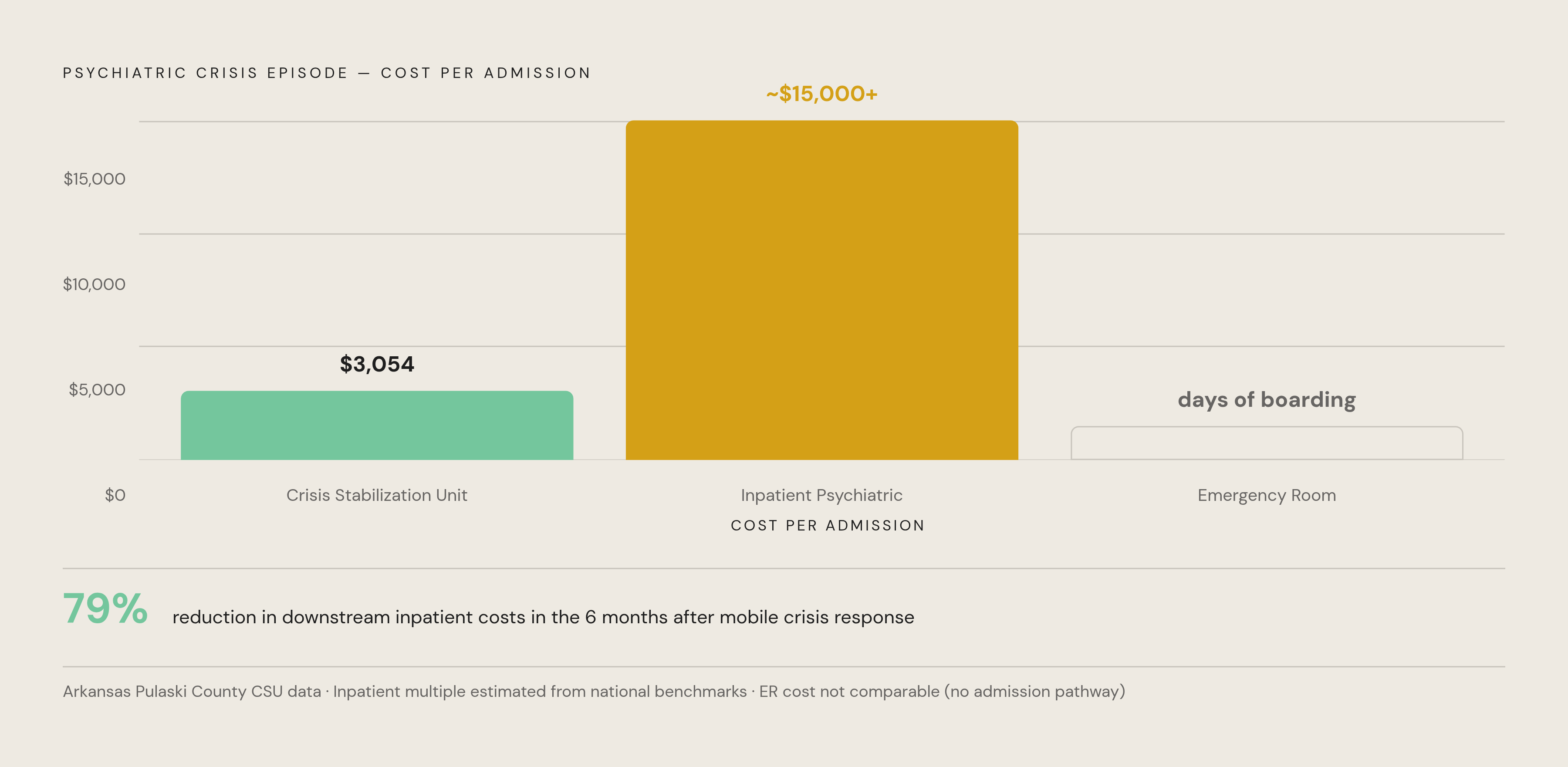
The Arkansas numbers are specific enough to sit with for a second. The Pulaski County Regional CSU logged 536 admissions during the study period, with an average stay of 60.27 hours, roughly two and a half days. Total annual cost ran $1,636,831, working out to about $3,054 per admission. Inpatient psychiatric admission typically costs multiples of that. That gap alone makes the CSU model look like a fiscally serious option as well as a compassionate one.
The cost evidence holds up elsewhere too. Direct comparisons show community-based crisis centers costing less than inpatient units, and mobile crisis services have cut inpatient hospitalization costs by roughly 79% in the six months following a crisis episode, according to BH Economics. Wilder Research calculated a return of $2.16 for every dollar invested in mental health crisis stabilization services, with a net benefit around $0.3 million in their study population. At the system level, Maricopa County, Arizona built its Crisis Now business case around all three continuum pieces together; the financial model projected that a $100 million investment in the full crisis continuum could cut inpatient spending by as much as $260 million.
None of this comes from a randomized controlled trial, and that gap bothered me enough to dig into why. Most of the evidence is observational; there's no landmark RCT putting CSUs head-to-head against ERs under controlled conditions. Part of the answer is practical: randomizing people in acute psychiatric crisis to different care settings raises ethical questions that most institutional review boards won't sign off on easily. So the case for CSUs rests on a pattern showing up again and again, across different states, different study designs, different populations. That's a real form of evidence, even if it's not the kind a skeptical researcher would ask for first, and it's worth being honest about that limit rather than papering over it.
Where CSUs are and aren't available (and who that absence harms most)
Georgia shows what serious state investment in this model looks like. The state runs 509 adult crisis stabilization beds across 26 units, at 94% occupancy, plus 71 crisis stabilization urgent outpatient beds at 85% occupancy. In fiscal year 2019, Georgia fielded 15,000 mobile crisis dispatches out of 250,000 annual crisis phone calls, backed by $58.2 million in state behavioral health crisis spending: $12.8 million from Medicaid, $45.4 million from state general revenues. That's what commitment at scale looks like. Most states aren't close, and the gap isn't subtle.
Reports from crisis centers across the country point to widespread staffing and funding shortfalls, despite the need sitting right in front of everyone running these programs. Some of the barriers are structural, tied to policy rather than to any lack of will. Insurance parity for psychiatric crisis care isn't consistently enforced, and in many states ambulances get reimbursed to take patients to ERs but not to crisis centers, so EMS defaults to the hospital based on financial logic rather than clinical judgment. Licensing and regulatory frameworks for CSUs remain underdeveloped in a lot of places too, which slows expansion even where the political will exists.
Who ends up absorbing these gaps? People with serious mental illness, first and most directly: 14.6 million adults nationwide, nearly a third of them getting no treatment at all, many cycling between ERs and jails instead of ever reaching a CSU. The overlap with incarceration is stark. Mental illness prevalence runs an estimated 64% among jail detainees and 56% among state prisoners, and CSUs work as an explicit pre-arrest diversion tool for exactly this population. People experiencing homelessness carry a similarly heavy burden, with 18.1% reporting serious mental illness, a population with the least access to specialized crisis settings even as its need runs highest.
Awareness gaps stack on top of access gaps. Awareness of crisis resources like 988 remains uneven across communities, and the infrastructure that exists isn't reaching everyone most likely to need it — that's probably not coincidence. CSU deserts tend to track with underfunded public behavioral health systems, and those systems disproportionately serve people of color and people living in poverty. The access gap traces back to how funding gets allocated in the first place, more than to any accident of geography.
How peer support changes what crisis stabilization can accomplish
Clinical credentials alone don't solve every problem a crisis presents. Someone with a long history of coercive or traumatizing encounters with the psychiatric system may not trust a clinician on sight, no matter how well-trained that clinician is. That's the exact gap peer support specialists close: someone who has navigated serious mental illness or a substance use disorder themselves, sitting with a person in crisis, offering presence alongside whatever clinical oversight is happening around them.
What does that look like in practice? It means the person in crisis feels seen instead of processed. It means someone across from them can show, just by being there, that recovery is actually possible, what researchers sometimes call "hope transfer," a mechanism that works less like a soft touch and more like a clinical intervention in its own right. And it means help with the stuff that determines whether stabilization holds after discharge: housing, food, medication access, the follow-up appointment that's easy to schedule and even easier to skip once the crisis passes.
Research on peer support programs for serious mental illness populations has found consistent evidence that peer support improves outcomes around hospitalization risk, recovery, self-efficacy, and stigma for adults with serious mental illness. Peer-run crisis respite centers are the fullest expression of this idea: staffed entirely by people with lived experience, sitting at the most community-embedded, least clinical end of the CSU spectrum, and producing outcomes comparable to more clinical crisis settings for the populations they serve.
Some community-based peer programs run this model outside the walls of a formal CSU, with people who have lived experience of serious mental illness or substance use disorder meeting people where they actually are. That approach closes a gap CSUs often can't close by themselves: the connection to housing, food, medication, and ongoing behavioral health resources that has to happen after discharge for stabilization to actually stick. The peer model functions as its own clinical asset here, one that reaches somewhere clinical training alone doesn't.
What health systems and health plans need to understand about integrating CSUs into crisis response
The business case for CSUs isn't really in dispute anymore. The $2.16 return per dollar invested, the roughly 79% drop in downstream inpatient costs tied to mobile crisis response, the $260 million in projected inpatient savings from Maricopa County's $100 million continuum investment: these numbers all point the same direction. What's left is implementation, and the barriers there are structural, which also means they're fixable, at least in theory.
Three levers sit within reach of health systems and plans specifically. Reimbursement parity means insurance actually pays for psychiatric crisis care on par with medical emergency care; right now the gap makes ERs artificially cheap by comparison, which pushes patients toward the ER regardless of what's clinically appropriate for them. Transport parity means ambulances get reimbursed the same whether they take someone to a crisis center or a hospital; without that, EMS keeps defaulting to the ER out of financial necessity, not clinical judgment. And contracting matters too: health plans that build CSU referrals and peer support directly into care management pathways for members with serious mental illness expand the set of destinations worth building a payment structure around, rather than funneling everyone back to the same overloaded ER.
There's a workforce question underneath all of this that's easy to skip past. Scaling CSUs means scaling the peer specialist workforce right alongside them, and that workforce is still something of a patchwork nationally. Certification standards and reimbursement rules vary a lot by state, which creates real gaps in supply even where demand is obvious to anyone paying attention. Health plans that invest here get a return that compounds over time: lower hospitalization rates, better medication adherence, stronger follow-up engagement, the kind of outcomes that show up months after the initial crisis, not in the discharge paperwork itself.
For county and state health officials, there's a cross-agency argument worth making too. CSUs work as pre-arrest diversion tools, cutting criminal justice costs alongside health costs, and given that mental illness prevalence runs to 64% in jail populations, the overlap between people who end up incarcerated and people who could have been served by a CSU is substantial. That overlap opens funding conversations a purely health-system framing wouldn't reach on its own; it's a budget argument for the sheriff's department as much as it is for the hospital system.
A CSU alone, though, has real limits. Stabilizing someone for two and a half days and releasing them right back into the same gaps that caused the crisis hasn't actually solved anything durable. It needs the full continuum (988, mobile crisis, and peer follow-up) to hold onto what stabilization starts. Organizations working the social side, housing, food security, medication adherence, appointment navigation, stretch the value of a CSU investment well past the discharge date. Health plans partnering on that piece of the continuum end up protecting the return on their CSU investment, well beyond simply checking a box on it.
How individuals and families can find and access crisis stabilization alternatives to the ER
There's a hierarchy worth knowing before a crisis hits, not during one, when it's much harder to think straight. The 988 Suicide and Crisis Lifeline takes calls and texts 24/7 and can connect callers to local crisis resources, including mobile team dispatch where that service exists. Mobile crisis teams work as an alternative first-responder option, reachable through 988 or through local mental health authorities directly, and they can sometimes resolve a situation on the spot without any transport at all.
CSUs and EmPATH units take a bit more digging to find, since not every community has one, and not every ER will volunteer that information even when an alternative sits a few miles away. Asking directly (of the 988 dispatcher, a local mental health authority, or a primary care provider) is usually the fastest way to find out what's actually available near you. For people already engaged with the mental health system, checking whether peer support services exist locally, including peer-run respite centers, can offer a lower-barrier entry point than a clinical CSU, especially for someone who's had rough experiences with more traditional psychiatric settings before. First Hand, and other organizations working in the same peer-support space, are worth asking about too, since they work specifically in the stretch between the initial crisis and the follow-up care that decides whether stabilization actually holds, or just gets undone within a week.