Peer Support Specialist Roles in Psychiatric Crisis Response
Lived experience in crisis response creates trust that formal services struggle to build.
What peer support specialists do (and what makes the role distinct)
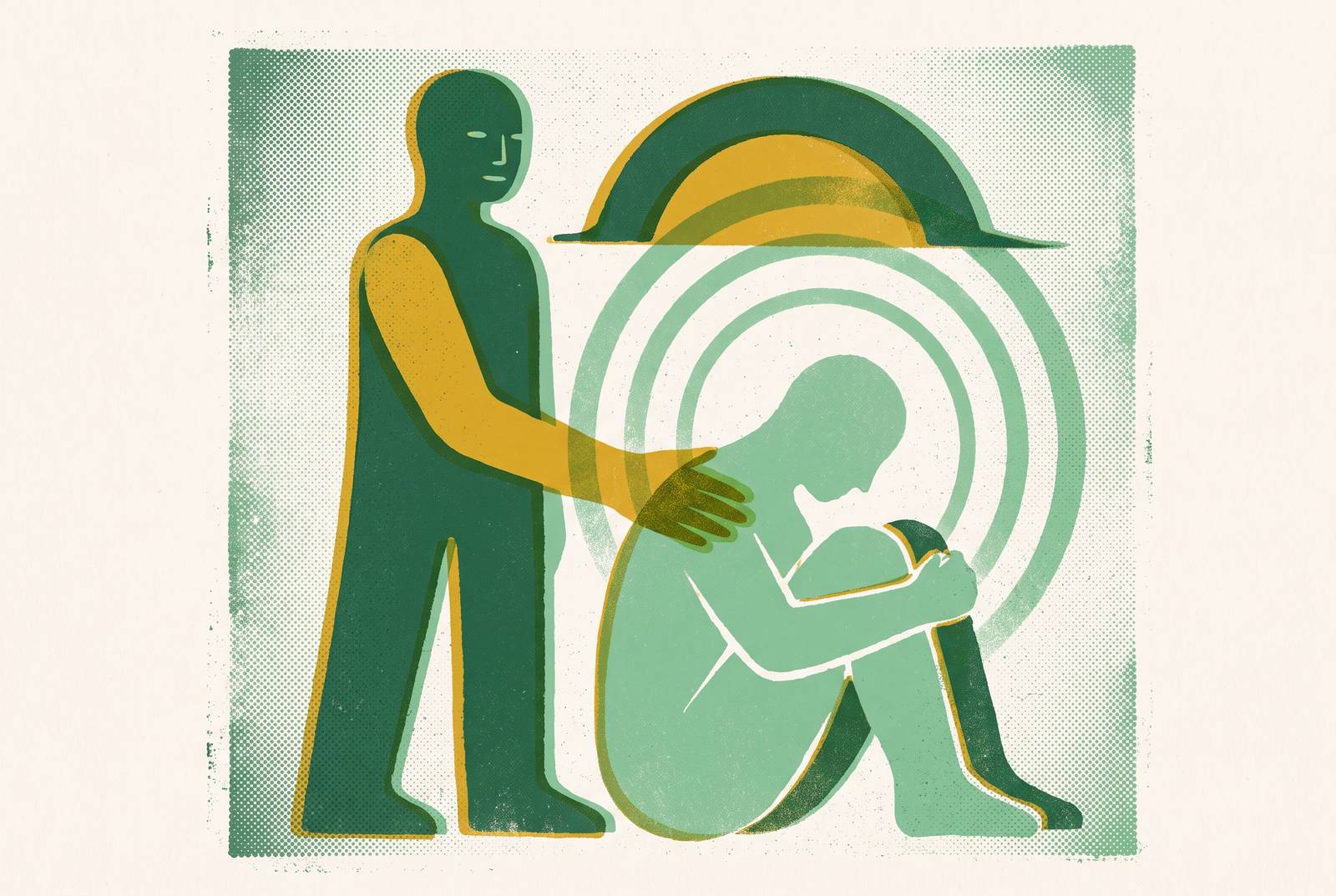
SAMHSA's National Model Standards define a peer supporter as someone with lived or living experience of a mental health or substance use condition (directly, or through a current or former dependent) who supports others facing similar struggles through nonclinical means. That definition draws a hard line. What a peer specialist offers comes from having survived something. What a clinician offers comes from a license.
The activities SAMHSA lists read almost mundanely on paper: advocacy, resource navigation, sharing experience, group facilitation, skill building, goal setting. In one state behavioral health framework, Certified Peer Specialists work as mentors, resource advocates, treatment team participants under supervision, and group leaders. None of that qualifies as clinical intervention in the traditional sense. It's structured relationship, delivered by someone who has sat on the other side of the table.
Most people misjudge what that means. They treat the role as a diluted version of clinical care, a cheaper stand-in for when a licensed provider isn't available. Most people misjudge what the peer specialist role means: they treat it as a diluted version of clinical care, a cheaper stand-in for when a licensed provider isn't available, but the relationship runs peer-to-peer, not provider-to-patient. A peer specialist works under supervision, sure, but the relationship itself runs peer-to-peer, not provider-to-patient. The focus sits on recovery and self-determination rather than symptom management, and the work is often community-based: meeting someone where they physically are, instead of waiting for them to show up at an intake desk. In a crisis moment, that distinction does real work. No clinician, however skilled, can replicate a form of connection built on having lived through the same thing the person in front of them is living through right now.
Firsthand's model runs directly on that premise. Guides and STRIVE Specialists are people who have personally navigated serious mental illness or substance use disorder, and that shared history functions as the operational asset of the role.
The trust gap that formal crisis services have not closed
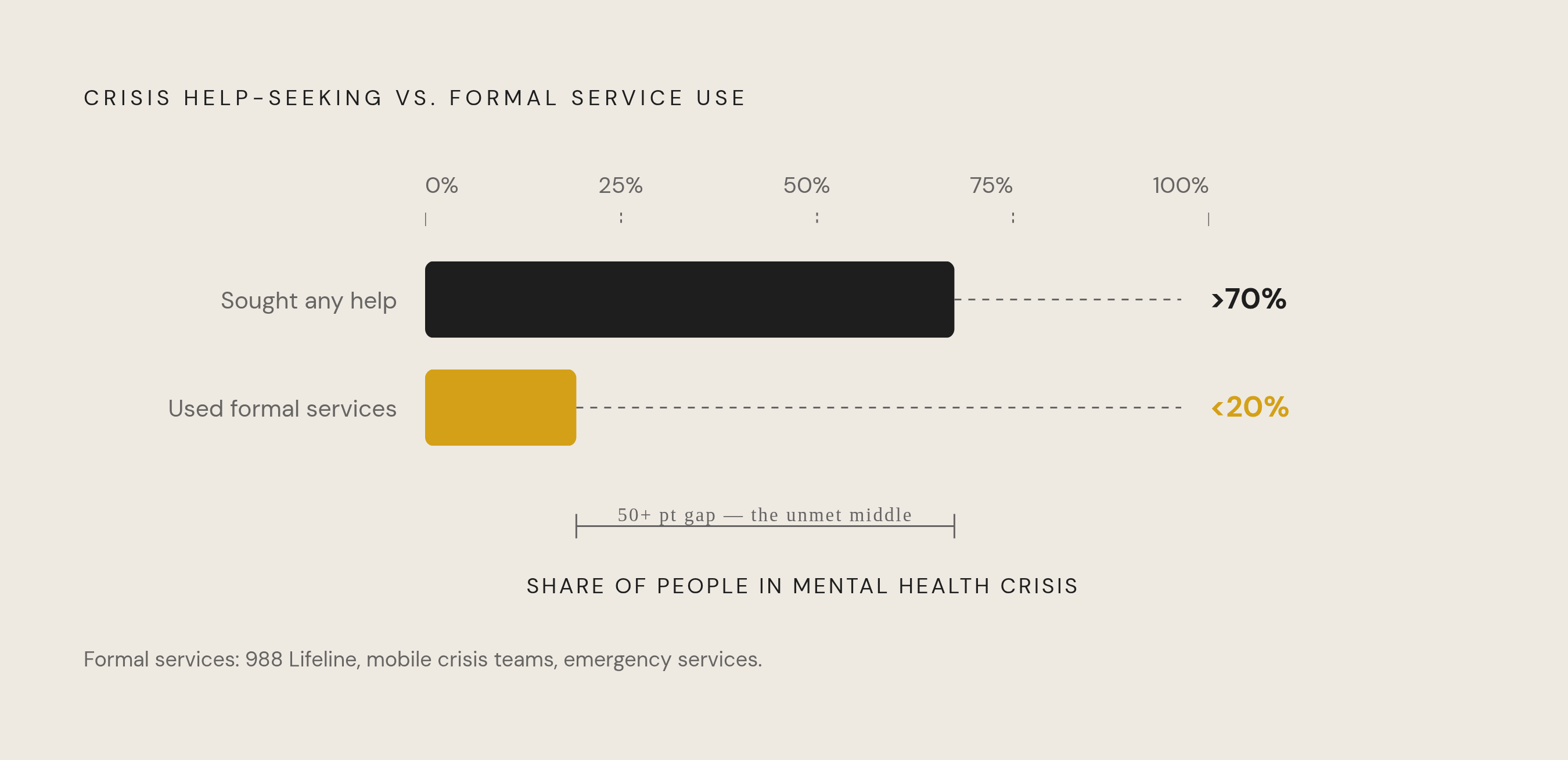
Research published in Health Affairs Scholar found that more than 70% of people who experienced a mental health crisis sought help of some kind, but fewer than 1 in 5 used formal services like the 988 lifeline or a mobile crisis team. That gap tells most of the story by itself. People in crisis are reaching out. Just not toward the services built specifically to catch them.
Why not? A handful of forces compound on each other: prior bad encounters with clinical or law enforcement responders, stigma attached to a formal diagnosis, cultural distance between whoever staffs a crisis line and the community calling it, and a founded fear of involuntary hospitalization once someone enters the formal system. None of these fears are irrational. They come from documented, repeated experience, and national survey research backs this up: adults from Black, Hispanic, or low-income communities often prefer informal or peer-based support over formal crisis infrastructure because they know what tends to happen after they call 988.
The distribution of who actually gets served isn't even, either. Documented disparities in treatment receipt show that White adults with a mental health condition are substantially more likely to receive services than Black or Asian adults. That gap tracks closely onto the populations least represented among crisis responders themselves. So can a system close a trust gap it doesn't reflect? Based on those patterns, it hasn't yet, and there's little reason to expect it will on its own.
Peer specialists close that gap not by explaining services more clearly or simplifying paperwork. They close it by embodying something no brochure can: proof that someone who has been exactly where you are now made it through. That's the entire mechanism, and the next section turns to where, structurally, that mechanism actually gets used across the crisis response system.
Peer specialists across the three tiers of the crisis continuum
SAMHSA frames the crisis continuum around three pillars: someone to call, someone to respond, and someplace to go. Between 2021 and 2024, SAMHSA put an estimated $1.3 billion into building out 988 and mobile crisis teams nationally, which says something about how central this framework has become to federal crisis policy.
The 2025 update to SAMHSA's National Guidelines for a Behavioral Health Coordinated System of Crisis Care writes peer roles into all three tiers explicitly, including peer-operated warmlines, and extends coverage to prevention and postvention rather than just the acute moment. That expansion reflects a lesson learned since 988 launched in 2022: a crisis response that responds only during the emergency misses the buildup and the aftermath, and a good share of the real prevention work happens in exactly those two windows.
Broken down by tier: at "someone to call," peer-operated warmlines give people a non-clinical, non-emergency alternative to 988 before things escalate to acute. At "someone to respond," peer specialists staff mobile crisis teams, either alongside clinicians in co-response models or on standalone peer teams, offering de-escalation without a police presence in the room. At "someplace to go," peer support is present in crisis stabilization units, respite programs, and the follow-up period after an acute episode resolves.
According to the National Alliance on Mental Illness, 44% of people in jail and 37% in prison carry a mental health condition. Peer specialists with justice-involved histories are positioned to reach that population across every one of these tiers, and their credibility there rests on shared history, not clinical training. None of this is fully built out, though. Jurisdictions across the country say the right things about peer integration, but workforce shortages, especially in rural areas, remain a documented and persistent constraint on actually doing it.
What the research shows about peer support in acute crisis settings
The headline finding holds up well: research has found that people supported by peer workers after an acute crisis episode showed lower rates of readmission to acute care compared to people who received usual care alone.
The complication is that a systematic review of the peer support literature found no consistent effect on clinical outcomes, with only modest positive tendencies on psychosocial outcomes. The evidence is uneven, and pretending otherwise does the field no favors.
Why the split? Readmission rates are easy to count. Hope, stigma reduction, and someone's willingness to seek help again after a bad experience sit at the center of what the recovery model is actually trying to produce, and they're much harder to measure cleanly. The review's authors also flagged consistently low methodological quality across the primary studies: an absence of strong evidence is not evidence of no effect, so weak study design leaves the recovery model's actual impact unverified. It means nobody has run the studies rigorously enough yet to say either way with confidence.
The PeerIntervent study, run at the Crisis Intervention Service in Bremen between April 2023 and April 2024, makes the pattern concrete. Peer support workers improved patient access precisely because of their experiential knowledge, the kind no clinical credential substitutes for. But clinical staff at the service were initially skeptical of the model, and as a result, peer workers ended up deployed mostly outside of acute crises, in roles where staff saw them as relieving pressure rather than as active participants in crisis response itself. The peer role didn't underperform. The institution never let it operate where it mattered most, and that difference matters for how the rest of this piece reads the evidence.
Separate qualitative research on service user perspectives, comparing acute, outreach, and outpatient psychiatric crisis interventions with and without peer support, lands on the same point from the user's side: what stands out is the relational quality of the encounter, not any particular clinical technique. Taken together, the evidence points toward something real but still underspecified, which raises the next question directly.
The open question of what crisis-specific competencies peer specialists need
No consensus exists yet on the core competencies a peer specialist needs specifically for crisis work, which is a notable gap given how much money and infrastructure has already gone into scaling the role. General peer specialist training prepares someone for ongoing recovery support in an outpatient or community setting. It does not automatically prepare that same person for the emotional intensity and split-second judgment calls acute crisis intervention demands. The two skill sets share a foundation, but they are not the same thing, and treating them as interchangeable is where a lot of implementation plans quietly go wrong.
An e-Delphi study published in Community Mental Health Journal, led by Karyczak, Spagnolo, Higbee, and colleagues, used expert consensus methods to try to define what those crisis-specific competencies should include.
In the meantime, PeerIntervent already flagged several prerequisites that weren't fully met in practice: clear support from team leadership, role definitions transparent to everyone involved, adequate training and supervision, and onboarding periods long enough for peer specialists to build relationships with clinical colleagues before deployment into acute situations. Where those prerequisites were missing, institutional resistance appeared almost immediately, in how clinical staff pushed peer specialists to the margins and leaned on them for follow-up work instead of the crisis moment itself.
The peer support model held up. Implementation failed, and those two things get conflated far too often in this field. A model that needs deliberate structural scaffolding to function is one that simply hasn't been given the scaffolding. Organizations that build in clear roles, real supervision, and visible leadership buy-in from day one get a meaningfully different outcome than organizations that bolt a peer role onto an existing clinical hierarchy and hope it sorts itself out.
How social determinants shape the crisis moment
Nonmedical factors referred to as social determinants of health have been estimated to drive as much as half of overall health outcomes. For people living with serious mental illness, these upstream conditions are frequently the direct trigger for the crisis itself. They're frequently the direct trigger for the crisis itself. Social determinants such as housing instability, food insecurity, and economic hardship are associated with higher rates of mood and anxiety disorders, and none of that sits apart from the psychiatric symptom picture. It feeds it directly.
Food insecurity, neighborhood disorder, and homelessness degrade quality of life and compound existing comorbidities for people with serious mental illness, contributing to worse health outcomes overall. This is where a peer specialist's structural position becomes genuinely distinct from a clinician's, and arguably more useful for the problem actually in front of them.
Take transportation. Colorado's Medicaid peer support policy, effective July 1, 2025, covers peer specialist travel time with a member, including accompanying someone in the community to help them navigate daily tasks. That's a concrete, reimbursable admission that getting someone to a pharmacy or a follow-up appointment is sometimes the actual clinical work, even when it doesn't look like clinical work on paper.
Medication adherence tells a similar story. Most analyses of social determinants of health don't fully account for housing and food insecurity as adherence factors, but peer specialists who raise those upstream conditions during routine check-ins are positioned to move the needle in ways a fifteen-minute clinical visit, boxed in by time and scope, rarely reaches. Trust built through shared experience is what makes conversations about housing, food, and money possible in the first place, and those conversations are often what keeps a situation managed instead of letting it tip into a crisis. Well-designed peer support models build this in directly, with peer specialists helping people access housing, food, medication, and medical appointments as part of the ongoing relationship.
Peer representation in crisis response and the communities it serves
The populations carrying the largest treatment gaps aren't randomly distributed. Deep disparities in access hit Black and Indigenous Americans, people of Latin or Spanish ancestry, immigrants and refugees, low-income individuals, and LGBTQ+ people, often stacking on top of each other. American Indian and Alaska Native populations carry disproportionately high rates of serious mental illness relative to other racial and ethnic groups, and some communities face compounding disparities that push treatment gaps even higher.
This is where the whole mechanism can quietly break down, and it's the part hiring committees tend to underweight. A peer specialist trained mainly through a neurodiversity-focused lens might miss the specific weight of racial trauma on a Black or Indigenous person's mental health, not out of carelessness, just out of a mismatched frame. A rigid, purely medical read on someone's distress can alienate a person who understands their own suffering through the lens of systemic racism rather than personal pathology. The lived experience credential only transfers trust when it actually maps onto the lived experience of the person receiving support. Assuming any lived experience will do is the mistake that undoes the model.
Crisis systems have to take this seriously in hiring, as an operational requirement. Crisis programs should recruit peer workers with a genuine range of lived experiences, not just varied mental health histories, but distinct cultural, linguistic, and community-specific knowledge. With 44% of people in jail and 37% in prison carrying a mental health condition, peer specialists with justice-involved histories represent a workforce need most crisis systems still haven't built out.
Hiring someone with lived experience is necessary, but on its own it isn't enough. The lived experience has to match the community being served, or the trust the entire model depends on simply doesn't transfer. Firsthand's workforce is built around that principle directly, with a team of people who have personally navigated serious mental illness or substance use disorder, matched deliberately to the populations they support.
Integrating peer specialists into crisis systems not designed for them
Research shows that expanding access to peer support improves people's willingness to start and stay in treatment, and that peer services support recovery and reduce reliance on acute and institutional care. Those are exactly the outcomes health systems and health plans get held accountable for, and it's one reason peer integration stays a policy priority even where the clinical outcomes evidence remains mixed.
The barriers are structural. Workforce shortages, geographic gaps in rural areas, and chronic underinvestment in peer roles appear across jurisdictions in the documentation. Nobody serious argues against the value of the role itself anymore. The argument that's left is over who pays to build it properly, and how fast.
Drawing on the broader implementation research, a short list of requirements emerges. Leadership support has to be explicit and visible, not assumed and left to chance. Role definitions need to be clear to both peer specialists and clinical colleagues before deployment starts, not negotiated on the fly in the middle of a crisis. Training has to be built specifically for crisis work rather than adapted from general peer specialist curricula, and onboarding periods need to run long enough for peer specialists to build real relationships with clinical teams before an acute situation forces that relationship into existence under pressure. Supervision structures need to support peer specialists without folding their identity into a clinical hierarchy that was never built to accommodate them.
The policy infrastructure to support this is starting to take shape. SAMHSA's 2025 National Guidelines embed peer roles across every tier of the crisis continuum, and Medicaid billing codes like Colorado's H0038 are beginning to build the reimbursement foundation the peer workforce needs to scale to the size of the problem. Whether that infrastructure catches up to the need in time is still an open question, one that will get answered over the next several years as 988 and its surrounding systems mature past their launch phase.
Sources
- Mental health crises and help-seeking among US adults in 2024-2025 | Health Affairs Scholar | Oxford Academic
- Service users’ perspectives on acute, outreach and outpatient psychiatric crisis interventions with and without peer support: results of a qualitative study - PMC
- [Effects of Peer Support Work in Psychiatry: A Systematic Literature Review of Reviews] - PubMed
- Identifying the Core Competencies for Crisis Peer Support Specialists: an e-Delphi Study - PubMed
- Peer Support Services Across the Crisis Continuum
- Identifying the Core Competencies for Crisis Peer Support Specialists: an e-Delphi Study | Community Mental Health Journal | Springer Nature Link
- Peer support in acute outreach psychiatric crisis interventions: results of a qualitative study - PMC