Serious Mental Illness and Physical Health Comorbidities
People with serious mental illness die 10-28 years earlier, mostly from preventable disease.
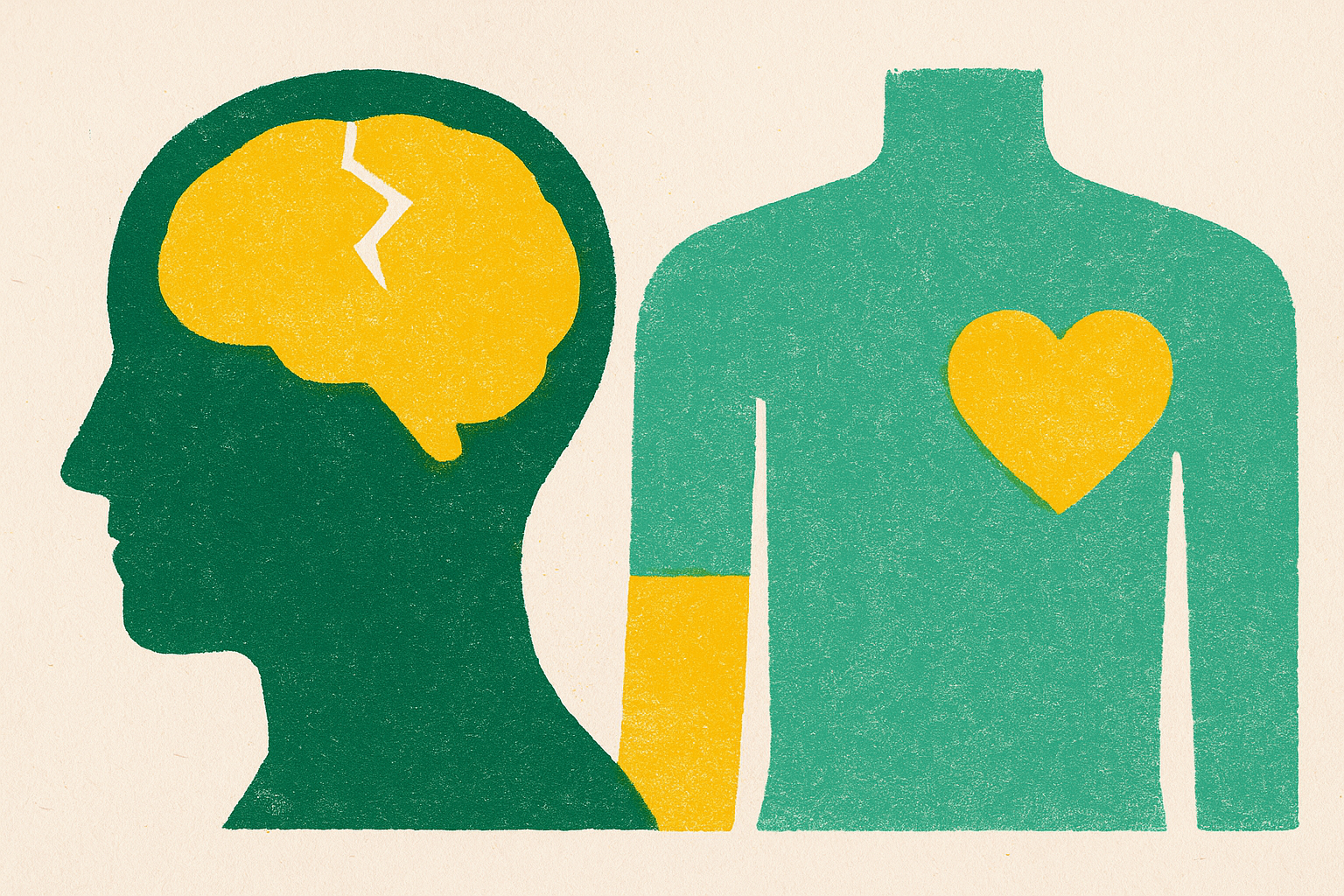
Serious mental illness carries a physical health cost that gets treated as an afterthought when it should be the main event. Schizophrenia spectrum disorders, bipolar disorder, and major depressive disorder with serious functional impairment affect an estimated 5.6% of U.S. adults, or 14.6 million people, according to NAMI's 2024 figures. That's roughly 1 in 20 adults carrying a diagnosis that predicts a great deal about their cardiovascular health, their teeth, their lungs, and how long they're likely to live. We keep treating "mental" health and "physical" health as separate ledgers, delivered in separate buildings by separate providers with separate records, and that framing has nothing to do with what it actually feels like to live in a body and mind struggling at the same time. What follows is a walk through that reality: the physical toll, the reasons behind it, who absorbs the worst of it, and what a real response would actually require.
The mortality gap: how many years of life SMI actually costs
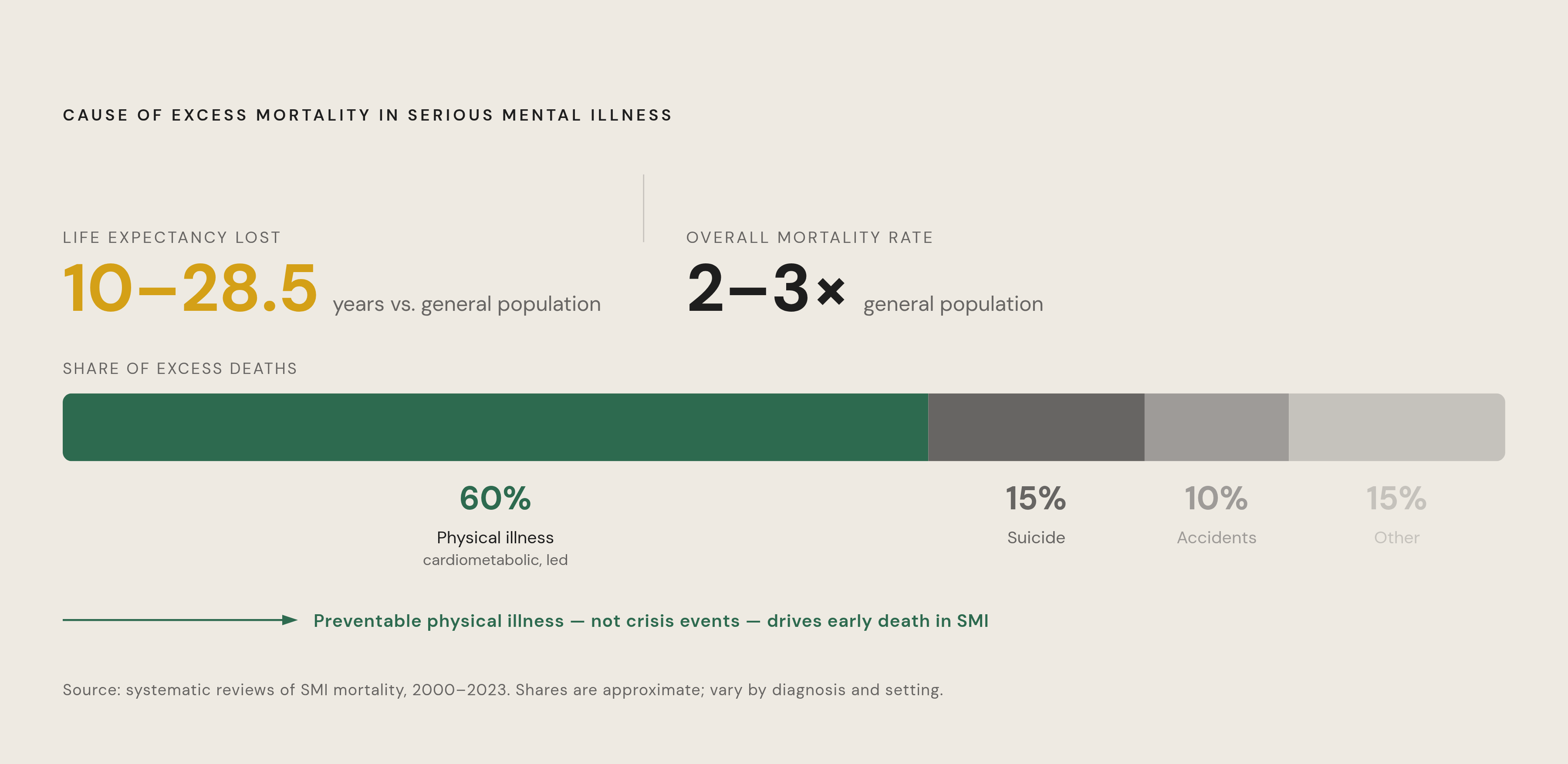
Start with the number. People with serious mental illness lose somewhere between 10 and 28.5 years of life expectancy compared to the general population, a gap so large it reframes everything that follows. In high-income countries, the British Journal of Psychiatry put the gap at roughly 20 years for men and 15 years for women living with mental illness, and called it a reflection of "a cynical disregard for these lost lives." A peer-reviewed journal doesn't use language like that casually.
Here's what caught me off guard when I first sat with these numbers. Suicide and accidents draw most of the public attention, and the risks are real, but they account for a smaller share of excess deaths than physical illness does. About 60% of excess mortality in the SMI population traces back to physical illness, more than crisis events contribute, and overall mortality runs two to three times higher than in the general population, with cardiometabolic disease doing most of the damage.
So what does that inversion mean for how we respond? If suicide were the dominant driver, the fix would be mostly clinical and mostly crisis-oriented: more beds, faster response times. But the dominant drivers are heart disease and diabetes, conditions medicine already knows how to screen for and treat well. Sit with that for a moment: most of these deaths are preventable, and a preventable death that isn't prevented stops being a tragedy of illness. It becomes a question about a system that had the tools and didn't use them.
Which physical conditions are most common in people living with SMI
Cardiovascular disease, diabetes, hypertension, hyperlipidemia, metabolic syndrome: these are the conditions that show up over and over as the most heavily documented in this population, and asthma tracks elevated too. Cancer risk data is mixed. Rheumatic disease risk actually appears lower in people with SMI than in the general population, one of the few places where the pattern runs backward, and worth pausing on precisely because it doesn't fit the story the rest of the data tells.
The more telling finding is how often these conditions stack. Research has found that people with schizophrenia or bipolar disorder are up to four times more likely to be living with two or more chronic physical conditions at once, compared to the general population. That's multimorbidity: several conditions running at the same time, usually under different providers who never talk to each other, sitting on top of a psychiatric diagnosis rather than trailing behind it as an afterthought.
Age adds another layer. Researchers are just starting to document distinct challenges around dementia, osteoporosis, cancer, menopause, and oral health in people with SMI, areas where the standard geriatric playbook wasn't built with this population in mind at all.
None of this is random. Chronic inflammation, dysregulation of the HPA axis, medication side effects, behavioral factors: they all push in the same direction, which leaves an obvious question hanging: why does the damage keep compounding instead of leveling off?
Why these conditions develop and compound — the causes behind the pattern
The research generally sorts the contributing factors into four buckets, and it's worth walking through each, because no single one explains the pattern alone. On the patient side, the cognitive effects of serious mental illness can make it genuinely hard to keep regular checkups, and smoking and substance use rates run higher here than in the general population. On the psychiatrist side, clinical attention often narrows to psychiatric symptoms alone, sometimes at the direct expense of physical monitoring that would catch a problem early. Other medical providers add a third layer: many are unfamiliar with SMI, appointments run short, and diagnostic overshadowing, where physical symptoms get chalked up to the psychiatric condition instead of investigated on their own terms, delays real diagnosis for months or years. Then there's the system itself, behavioral and physical health running in separate silos with almost no coordination between them.
Medications complicate things further. Certain antipsychotics and antidepressants carry real metabolic side effects: weight gain, glucose dysregulation, shifts in lipid profiles. Treat the psychiatric condition effectively, and you may worsen the exact cardiometabolic risk driving the mortality gap in the first place. Psychiatric Services has also flagged smoking, poor nutrition, physical inactivity, and broader social determinants as compounding factors stacked on top of the medication problem.
It would be convenient to isolate the single biggest driver and fix that one thing. I went looking for that one thing while working through this material, and the evidence doesn't support that convenience. No single cause dominates, which is exactly why interventions built one axis at a time, treat the depression now, circle back to the diabetes later, keep falling short. The conditions aren't sequential; they're simultaneous and interacting, and care that treats them as separate problems is already behind before the first appointment starts.
How housing, food, and transportation make physical illness harder to manage
Clinical care is only part of the equation, and probably not the largest part. Up to 80% of health outcomes trace back to circumstances outside the exam room: housing, food, transportation, economic stability. For someone managing SMI alongside a chronic physical condition, these aren't background stressors. They're active mechanisms that make illness harder to manage day to day.
Start with housing. NAMI reported that 18.1% of people experiencing homelessness in 2024 were living with serious mental illness. Losing stable housing doesn't just add stress; it disrupts medication adherence directly. Refrigerated insulin and a consistent psychiatric medication schedule both need somewhere stable to sit and a routine to follow, and neither survives well without four walls and a fridge.
Food insecurity tells a similar story at larger scale. More than 44 million Americans lived in food-insecure households in 2022, per USDA data, a jump of about 10 million from the year before. When someone has to choose between groceries and a maintenance prescription, that's a rational response to scarcity, and it happens constantly in this population.
Transportation gets talked about the least of the three, but it's no less consequential. Over 3.6 million Americans delay or skip care altogether because they can't get to it. For someone juggling a psychiatric condition and a chronic illness, a missed bus isn't a minor inconvenience; it can mean a missed specialist visit, which can mean a lapsed prescription, which can mean the whole treatment plan quietly comes apart at the seams. There's some movement worth flagging here: as of late 2024, more than 20 states had approved Section 1115 Medicaid waivers building health-related social needs, housing, nutrition, employment, medical respite, directly into coverage. That's a real acknowledgment that clinical care alone isn't enough. Whether it changes anything on the ground is a separate question, and one this piece comes back to later.
Who bears the greatest burden within the SMI population
The mortality gap doesn't spread evenly across the population. Racial and ethnic minorities, low-income individuals, LGBTQ+ populations, and rural residents face a double bind: higher rates of SMI to start, and lower access to quality care once they need it.
The numbers make it concrete. Black adults are about 36% less likely than U.S. adults overall to receive mental health treatment, and according to the Office of Minority Health in 2024, only about 14.7% of Black adults received any mental health service in a recent year, against 22.9% of adults nationally. Coverage gaps widen things further. Uninsured rates stay higher among Black, Hispanic, and American Indian and Alaska Native residents, and coverage gaps compound the disparities in mental health service use already documented for these communities.
There's a workforce angle too, and it matters more than it looks at first glance. As of 2022, only about 32% of psychology doctorates went to people from underrepresented racial and ethnic groups combined, per medrxiv.org research. A workforce that doesn't reflect the communities it treats carries a trust problem before a patient ever sits down.
None of this sits apart from the mortality gap covered earlier. It's the same gap, with the volume turned up for populations the system already sidelines on other fronts. Stack racial disparity, income disparity, and geographic isolation on top of a mortality gap that's already 15 to 20 years wide, and the burden doesn't add. It compounds.
Why the siloed healthcare system is structurally unable to close this gap on its own
Here's the structural problem underneath all of it: mental health and physical health get delivered in separate systems, by separate providers, with separate records and separate billing, even when it's the same patient walking into both waiting rooms. Diagnostic overshadowing shows up again here as a direct consequence. Physical symptoms in people with SMI get attributed to psychiatric causes often enough that real workups get delayed, sometimes for years.
Psychiatrists train to focus on psychiatric symptoms, and primary care providers are frequently undertrained in the specifics of SMI. Neither side reliably covers the other's territory, and the patient sits in the gap between them. NAMI estimates SMI costs the U.S. $193.2 billion annually in lost earnings, the economic face of exactly this coordination failure. Investment in the integrated infrastructure that would close the gap stays scattered and inconsistent from state to state.
Sit with the result for a second: the patients with the most complex, interacting needs, the ones who most obviously need coordinated care, are the ones least likely to get it. Calling this "the system failing people with SMI" is accurate, but a little too soft and a little too passive for what's actually happening. The system doesn't fail this population randomly, the way a coin flip lands wrong. It fails them in the same places, the same way, over and over, which means the fix has to be structural too. Pilot programs here and there won't close a gap that's built into how care gets organized and paid for.
What integrated, whole-person care looks like in practice
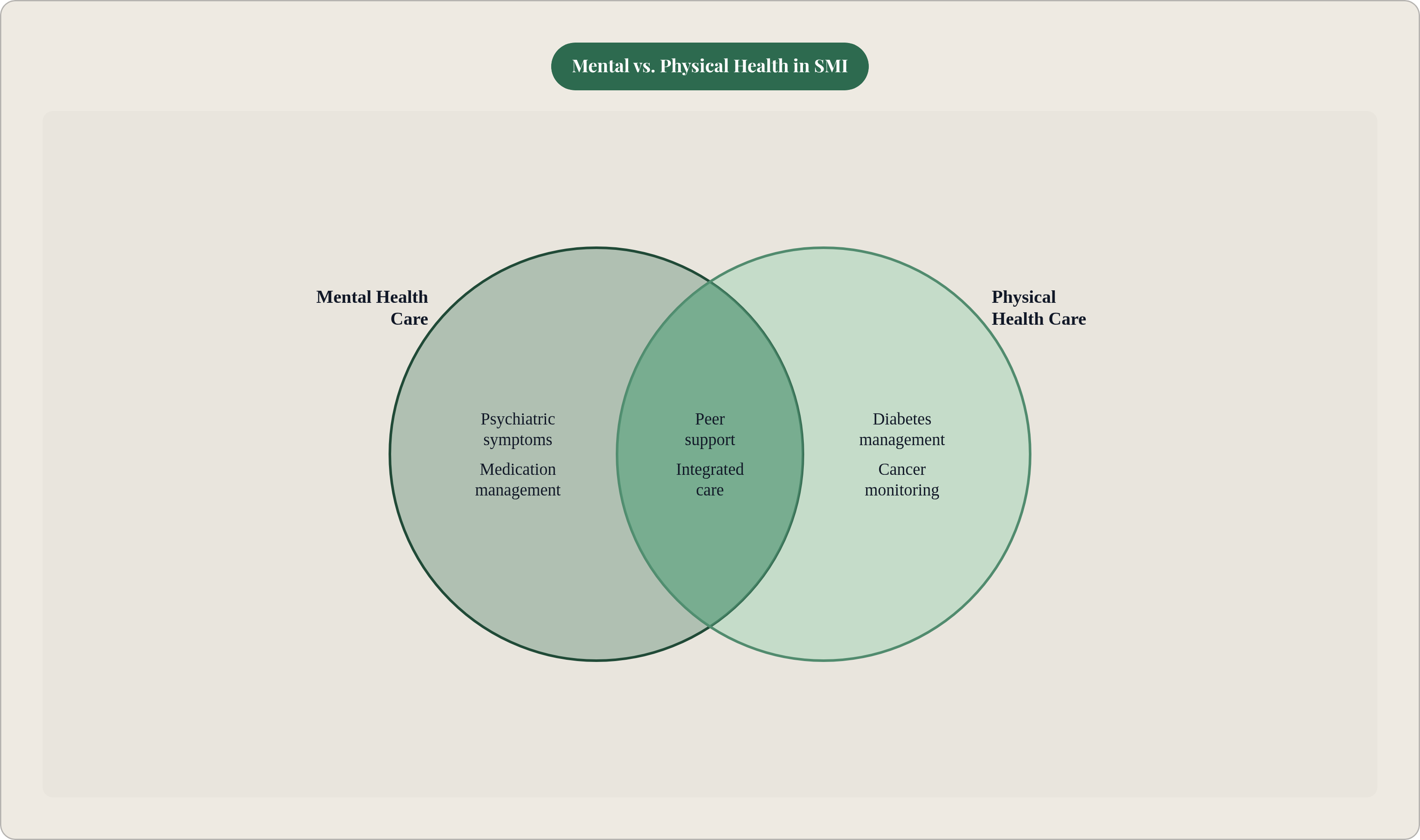
Integrated care means bridging mental and physical health inside the same care relationship: shared records, coordinated treatment decisions, psychiatric and cardiometabolic conditions discussed in the same conversation instead of two separate ones held months apart. Whole-person care goes further, folding medical, behavioral, and social needs into one coordinated effort, medication access, specialist appointments, housing navigation, food access, instead of a patchwork of programs each handling one slice.
The Lancet Psychiatry multimorbidity findings from earlier explain why this matters so much. If two or more chronic conditions are the norm in this population rather than the exception, a model built around managing one condition at a time is inadequate by design, not by accident. Where the care happens matters too. Meeting people in their communities, not only inside clinic walls, turns out to be part of what makes the model actually work, especially for people who've disengaged from institutional care after years of being underserved by it, or worse.
There's movement at the policy level as well. CMS recognized homelessness as a comorbidity for inpatient settings in 2024 and has proposed expanding screening for social determinants of health, both signs that integrated care is gaining ground where funding decisions actually get made. Recognition on paper and implementation on the ground are two different things, though, and that gap is where a lot of people with SMI are still slipping through.
How peer support addresses the physical health gap that clinical care alone misses
Peer support specialists, people with lived experience of serious mental illness themselves, can do something clinical providers structurally can't: rebuild trust with people who've disengaged from, or been failed by, the traditional care system. That trust is the actual mechanism through which someone re-engages and starts managing the physical conditions that would otherwise cut their life short.
The evidence holds up. Peer support improves self-care, medication adherence, and engagement with healthcare broadly, all of which feed straight into physical health outcomes. A randomized trial of integrated illness management and recovery, known as I-IMR, found increased medical and psychiatric self-management skills alongside fewer hospitalizations compared to usual care. A 2024 umbrella systematic review out of King's College London found consistent evidence that peer support lowers hospitalization risk in adults with SMI and improves recovery outcomes, while noting, fairly, that the evidence base for some specific outcomes is still thin and needs more rigorous study.
In-person peer support specifically has been linked to lower self-stigma, less inpatient service use, and higher treatment engagement, with clear downstream effects on how well someone manages physical health over the years. First Hand's model reflects this directly: Guides and STRIVE Specialists with lived experience of SMI, and in some cases substance use disorder, work alongside members to navigate housing, food access, medications, and appointments, the social determinants layer that compounds physical illness, in the communities where people actually live instead of waiting for them to show up at a clinic door.
What health plans and care systems can do differently to reduce this burden
Integrating behavioral and physical health matters, but it's not enough by itself. The social determinants layer, housing, food, transportation, needs dedicated infrastructure built to address it head-on, not a screening question tacked onto an intake form and forgotten about.
Medicaid managed care organizations operating under Section 1115 waiver authority now have real tools: housing supports, nutrition supports, medical respite programs. More than 20 states had approved these components as of late 2024, which matters, though rollout speed varies a lot state to state. Workforce investment matters just as much. Peer support specialists embedded in care teams extend what clinical providers can reach on their own, cut avoidable hospitalizations, and chip away at the trust deficit keeping people with SMI from primary and preventive care in the first place.
Data sharing across mental and physical health providers needs real investment too. It's tempting to assume electronic health record systems already bridge that gap; having looked at how these systems actually operate in practice, most don't come close. Fixing this takes more than a referral slip to another specialist. It takes someone who understands both the clinical side and the practical, social navigation side of a person's life, which is where community-based care navigation, staffed by people with lived experience of SMI, fills a gap purely clinical models leave wide open. Organizations like First Hand bring health plans something hard to build from scratch: a workforce grounded in lived experience, real presence in the communities being served, and the technical backbone, including HITRUST r2-certified systems, to keep care secure and coordinated across settings.
The mortality gap is measured, and the causes are documented in detail, across the research cited throughout this piece. The interventions exist, and several have already shown results in trials and pilots. What's missing isn't knowledge; it's whether the institutions holding the money and the mandate actually fund and deploy what already works, at the scale this problem demands.