Medication Adherence Barriers for People With Schizophrenia
Nonadherence stems from illness, medication, stigma, and fragmented systems—not personal failure.

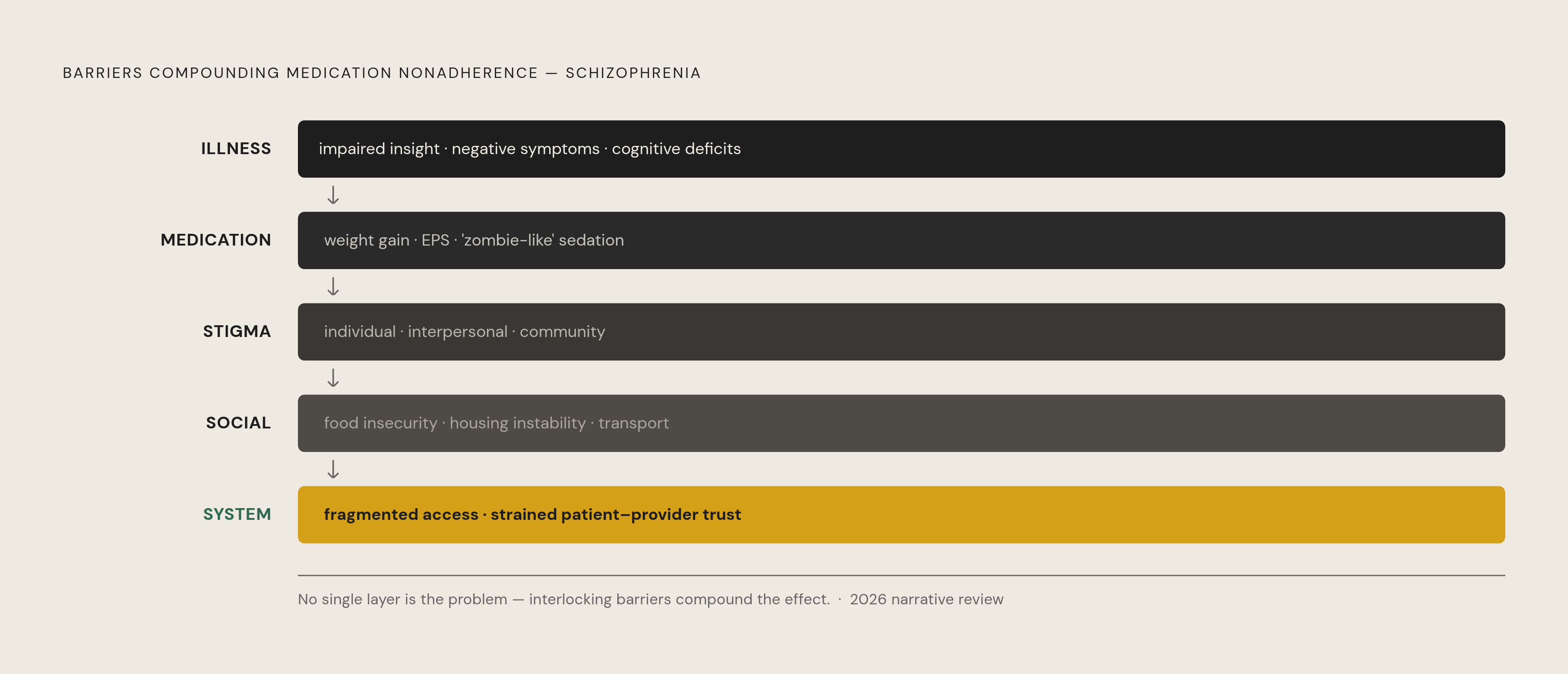
Medication nonadherence in schizophrenia is usually discussed as a problem of patient compliance, as though the person taking the pills were failing to honor a simple agreement. The research tells a different story. Nonadherence is the predictable outcome of forces stacked at every level of a person's life: the illness itself, the medication, the social world, and the systems meant to deliver care. This piece maps those layers.
A 2026 narrative review confirms that determinants of poor adherence span the patient, the illness itself, the medication, the family, and the healthcare system, and that these factors are intertwined. They do not merely coexist. They amplify one another, so that a person struggling with impaired insight also contends with side effects, stigma, unstable housing, and a fragmented care system at the same time. To call this a failure of individual will is to miss the structure of the problem entirely. The first step toward meaningful support is to understand what is actually stacked against a person.
What nonadherence actually costs — in health and in life trajectory
The relapse rate within one year after treatment discontinuation can be as high as 80%. Individuals who discontinue medication are more than three times more likely to experience relapse within that same year. These are not distant risks. They describe what happens to a person trying to hold a life together while navigating a chronic illness without consistent treatment.
A single relapse does not end with the episode itself. Each relapse can exacerbate symptoms, further impair cognitive and social functioning, and produce a progressive decline in academic, occupational, and interpersonal domains. Relationships that took years to build erode under the strain of a crisis the person did not choose.
There is also a clinical danger too little discussed. When patients take medication irregularly, some develop pseudo-treatment resistance and are wrongly diagnosed with treatment-resistant schizophrenia. Care is delayed while the real problem, inconsistent medication delivery, goes unaddressed. Understanding why this cascade begins requires examining the distinct layers that produce it, each on its own a sufficient barrier and together something more intractable.
How the illness itself undermines the decision to stay on medication
The most counterintuitive barrier is also the most interior. Schizophrenia's core symptoms directly interfere with a person's ability to recognize the need for medication and to take it consistently. A cross-sectional study found a significant association between moderate to severe lack of insight and nonadherence, with lack of insight remaining a significant risk factor in regression analysis.
Insight is a clinical concept. It names the patient's awareness that they have an illness and that medication helps. The Korean meta-synthesis identifies lack of insight and the perceived burden of taking psychiatric medication as the two key intrapersonal barriers. A person who cannot perceive the illness cannot perceive the logic of treating it. This is a neurological and perceptual reality, not a character assessment.
The mechanism runs deeper than awareness. Severe negative symptoms and cognitive impairment can strip a patient's motivation and ability to adhere. Sometimes a belief takes hold, rooted in impaired perception rather than defiance, that treatment is unnecessary or ineffective.
This is why framing nonadherence as a patient choice is clinically inaccurate. The illness causes the very impairments that produce nonadherence. Any intervention that begins by treating the decision as a willpower problem has already misread the situation.
Why side effects are not a minor inconvenience but an active force against adherence
Even when a person recognizes the need for treatment, the medications themselves create powerful disincentives to continuing. Side effects including weight gain and extrapyramidal symptoms are a significant reason patients reduce or discontinue medication on their own. These are not abstract risks listed on a package insert. They are bodily experiences that shape the daily calculus of taking a pill.
A first-person account by a peer support worker with schizophrenia, published in Schizophrenia Bulletin Open, describes antipsychotic medication making a person feel very tired, lethargic, passive, tranquillized, and even zombie-like. That word appears in the account itself. Patients are responding to what they actually feel, not to an abstract fear of medication.
This creates a painful bind. The medication that treats the illness also produces symptoms that make staying on it feel unbearable. Stopping becomes a rational-feeling response to an intolerable present, not an irrational rejection of care.
The adherence conversation cannot stop at prescribing. It has to reach the person where they are, in the body that carries the side effects and the life that feels flattened by them. A prescription that does not account for the experience of taking the medication is only half a plan.
How stigma operates as a barrier at the individual, family, and community level simultaneously
Stigma does more than make a person feel ashamed. It shapes the decisions, environments, and relationships that determine whether someone stays on medication. The Korean meta-synthesis situates stigma related to psychiatric medication use specifically at the community level within the ecological model, distinguishing it from the intrapersonal barriers of insight and perceived burden. Stigma is not an internal failing. It is a social force that presses in from outside.
The Turkish qualitative study identifies experiences of discrimination as one of four barrier themes. In collectivist cultural settings, the pressure operates with particular intensity. Individuals may avoid disclosing their condition or taking medications publicly because they fear stigma and shame and want to maintain family harmony. Diagnosis goes unmentioned.
The result is a barrier that operates at three levels simultaneously. Internally, there is shame and internalized stigma. Interpersonally, there is the hiding of diagnosis and medication from family members whose support might otherwise help. Structurally, there is community-level judgment that makes public medication-taking an act of disclosure with real social risk. Stigma discourages help-seeking, not just adherence once treatment has begun. The social world does not wait for the clinical encounter to end before it begins extracting its costs.
Social determinants — housing instability, food insecurity, and transportation — as direct adherence barriers
The material conditions of a person's life are not background context. They are active mechanisms of nonadherence, interrupting treatment in ways that no amount of patient education can fix. A systematic meta-analysis found that food insecurity, housing instability, and social determinants overall each had significant, independent associations with lower medication adherence. A 2025 NIH All of Us cohort analysis added a sharper figure: individuals who reported concerns about food not lasting were more than twice as likely to report cost-related medication nonadherence.
The mechanisms are concrete and mechanical. Some antipsychotics should be taken with food to boost absorption. Food insecurity directly undermines this, which means the pill taken on an empty stomach does less than it should. Transportation barriers block access to long-acting injectable medications, which require clinic visits. The injection that would reduce the frequency of adherence decisions is itself unreachable without a ride.
People with psychotic disorders have a very high prevalence of food insecurity, alongside other compounding social adversities including interrupted education, long-term employment challenges, housing instability, poor healthcare access, and limited transportation. People with serious mental illness are substantially more likely to report food insecurity than controls. These conditions do not merely correlate with nonadherence. They are the daily realities the medication is supposed to fit into, and often cannot.
The point is not that these factors are sad and significant. The point is that they operate at the level of whether a dose gets taken today, whether a clinic visit happens this week, whether a prescription gets filled this month. Education cannot tell a person without food to eat before taking a pill. It can only describe the problem the person is living.
Why the healthcare system itself generates barriers through fragmentation and strained relationships
Even when the person, the medication, the stigma environment, and the social conditions are navigated, the structure of care delivery can undermine adherence on its own. The 2026 Frontiers review identifies strained patient-provider relationships and poor accessibility of medical services as system-level factors that profoundly affect adherence. The system that is supposed to treat the illness also, in its organization, creates conditions under which treatment fails.
The qualitative study names therapeutic alliance with the healthcare team as one of four facilitating factors. The same study identifies difficulties in accessing healthcare services and providers explicitly as a barrier theme, distinct from stigma and from social determinants. Access failures within the system itself compound everything already stacked against the person.
The scale of the problem makes the fragmentation harder to excuse. Recurrent psychiatric hospitalizations and emergency department utilization are common among those with serious mental illness, resulting in preventable overuse of services. The system is absorbing the cost of its own fragmentation, in emergency visits and readmissions that might not have happened with continuous, relational care.
Each barrier layer examined, the illness, the medication, stigma, social determinants, and the system, does not operate in isolation. Housing instability blocks the transportation that would get them to the clinic where a trusted provider could rebuild the alliance that the system's fragmentation has already strained. This is the hinge. The problem is not layered in a way that any single fix can reach.
Why conventional clinical approaches alone cannot bridge all these gaps
The standard clinical toolkit, medication management, psychoeducation, appointment reminders, is built to address certain barrier layers. It is not built to reach others. The 2026 Frontiers review concludes that no single intervention can comprehensively address the adherence problem. The review is not an indictment of these approaches. It is a recognition of the shape of the problem.
Psychoeducation matters. This study found significant associations between lack of psychoeducation and nonadherence. A person who understands what the medication is for and what to expect is in a better position than one who does not. Yet psychoeducation alone does not resolve impaired insight. It does not address housing or food. And it cannot manufacture trust where trust has been broken by past experience with the system.
The trust problem is structural, not technical. The facilitating factors identified in the qualitative study, therapeutic alliance, social support, future expectations, require sustained relational presence, not episodic clinical contact. Long-acting injectable medications reduce the frequency of adherence decisions, a real advantage, but they still require consistent transportation, clinic access, and a trusting relationship with the prescribing team. They solve one mechanism while leaving others open.
The logic of the problem now demands something the clinical system alone cannot supply. The barriers that remain, stigma, social determinants, broken trust, are precisely the ones that exist outside the clinic walls. What could reach them is not another appointment type. It is a different kind of presence altogether.
How peer support addresses the barrier layers that clinical care cannot reach
Peer support works on medication adherence because it addresses the relational, practical, and community-level barriers that clinical appointments cannot. It does so through the one thing that closes the trust gap: shared experience. The first-person account in Schizophrenia Bulletin Open describes peer support as drawing on lived experience to explore common humanity and overcome mental health challenges through hope-filled, empathetic relationships. This is not a supplement to care but a different kind of presence, one that meets a person where they are and stays.
The workforce evidence supports the mechanism. Peer support specialists comprise one of the fastest growing sectors of the mental health workforce. They have lived experience in self-management practices, and they offer access to support in the community, beyond the reach of a clinic schedule. The PeerTECH randomized controlled trial demonstrated feasibility and effectiveness of a peer-led mobile health intervention in enhancing self-management among individuals with serious mental illness and chronic comorbidities. The mechanism is not theoretical. It has been tested.
The outcome data are concrete. In an ED diversion program assessed by ASPE, peer specialists working alongside mental health professionals in emergency departments saw only a small fraction of the over 1,000 individuals they worked with during a 14-month period require hospitalization. That is a high-acuity setting, the exact point where fragmentation and relapse converge, and the presence of peers changed the trajectory.
Firsthand operationalizes exactly this model. Guides and their teammates with lived experience of serious mental illness meet people in the communities where they live, helping with housing, food, medication, medical appointments, and behavioral health resources. That is not a clinical service added to the list. It is the social determinant barriers from the earlier section, addressed directly by people who have navigated those conditions themselves. The trust gap that the clinical system could not close is precisely what this presence, built on shared experience and sustained contact, is designed to close.
How the field is moving toward integrating peer support into schizophrenia care at scale
The case for peer support as a systemic component of schizophrenia care is no longer marginal. In March 2026, the National Council for Mental Wellbeing and Bristol Myers Squibb announced a collaboration to bridge critical gaps in schizophrenia care, launching with a white paper on peer support workers and initiating two pilot programs: one expanding peer support, another applying predictive analytics to enhance continuity of care. The institutions that fund and design care are beginning to treat peer support as infrastructure, not as an auxiliary program.
The integration vehicles are also taking shape. Peer support workers are among the most commonly reported types of newly hired staff across Certified Community Behavioral Health Clinics, the CCBHCs that represent a growing route for bringing peer specialists into formal care settings. The NYAPRS Peer Bridger program and the Optum Pierce RSN PORCH program show what integration looks like at the housing level. The Recovery Centered Housing program, where half of staff are peer specialists, reported that the vast majority of enrolled individuals now have stable housing. That is one of the core social determinant barriers mapped earlier, addressed by a workforce whose lived experience includes the instability it works against.
The gap now is adoption, not evidence. Recovery is possible. The right support from the right people makes it more likely.
Sources
- Barrier and facilitator factors affecting the medication adherence of ındividuals diagnosed with schizophrenia: a qualitative study
- Frontiers
- Factors Influencing Medication Adherence among Individuals with Schizophrenia: A Qualitative Meta-Synthesis Based on the Ecological Model
- Antipsychotic medication non-adherence and factors associated among patients with schizophrenia in eastern Ethiopia
- PeerTECH: a randomized controlled trial of a peer-led mobile health intervention to improve medical and psychiatric self-management for persons with serious mental illness - Fortuna - mHealth