Clozapine Use in Treatment-Resistant Schizophrenia
The only antipsychotic proven to reduce suicide risk in treatment-resistant schizophrenia.

Clozapine treats the form of schizophrenia that doesn't respond to standard medications, and it's still the only drug proven to work once other antipsychotics have failed. Somewhere between 30% and 37% of the roughly 1.5 million Americans living with schizophrenia meet criteria for treatment resistance, by most estimates. That's a lot of people caught in the gap between who could benefit from clozapine and who actually gets it, and this piece works through that gap, from the trial data down to the logistics that quietly undercut it.
Patients drift into treatment resistance along different paths. About 24% show resistance from their very first psychotic episode, which means for a real chunk of patients, TRS arrives at the very start of their illness, not after years of other treatments have failed. That changes the clinical clock. If someone is treatment-resistant from day one, every month spent cycling through other antipsychotics before reaching clozapine is a month of illness that didn't have to happen.
What makes clozapine the guideline-recommended choice for TRS
Clozapine's efficacy case goes back to 1988, when landmark trial data set off decades of confirmatory meta-analyses and, eventually, near-universal endorsement in international treatment guidelines. That kind of consensus is rare in psychiatry, where most debates never fully close. Clozapine works on positive symptoms, the hallucinations and delusions, but it also shows benefit across negative symptoms, functional impairment, and quality of life. Most antipsychotics don't reach that far.
The functional numbers back this up, though they're worth sitting with rather than skimming past. In a 2021 study by Verma and colleagues, patients starting clozapine saw their Clinical Global Impression-Severity scores drop from 5.46 to 3.46, moving the average patient from "markedly ill" to "mildly to moderately ill." Global Assessment of Functioning scores rose from 35.56 to 56.42, a jump that reflects actual gains in day-to-day life, not just a cleaner symptom checklist. Every patient in that cohort showed some improvement on clinician-rated global impression scales, and 69.2% were rated "much" or "very much improved." Those aren't numbers a clinician waves off.
The reach goes past schizophrenia, too. There's evidence supporting clozapine's use in bipolar disorder and severe depression, which suggests its mechanism touches something broader than one diagnosis. And there's a quieter benefit here: some evidence suggests that introducing clozapine in clinical settings is associated with more patients moving to monotherapy, and less use of antiparkinsonian drugs and benzodiazepines. Less polypharmacy usually means fewer side effects stacking on top of each other, and fewer interactions to chase down later when something goes wrong.
Clozapine doesn't win every comparison outright, though. The next section gets messier than the guidelines let on.
Where the evidence on clozapine's superiority is genuinely contested
A 2025 systematic review and individual patient data meta-analysis in Lancet Psychiatry, widely considered the most rigorous head-to-head comparison to date, pooled blinded randomized controlled trials lasting at least six weeks and compared clozapine directly against other second-generation antipsychotics in TRS patients. The results complicate the standard story more than most clinicians would like to admit.
Once the analysis was stratified by specific comparator, the change in PANSS score, the standard measure of psychotic symptom severity, didn't differ significantly between clozapine and olanzapine, with a mean difference of -1.82 and a confidence interval spanning -6.79 to 3.00. Similar patterns turned up against zotepine, risperidone, and clinician's choice.
What do you do with a finding like that? It's tempting to read this as evidence that clozapine's reputation has outrun its actual advantage, and narrowly, in symptom-score reduction against certain comparators, that reading holds up fine. But it leaves out a lot. It says nothing about clozapine's antisuicidal properties, nothing about mortality, nothing about the functional and quality-of-life gains Verma's data captured. Those live in separate evidence bases, and no guideline body has walked back its recommendations on the strength of one meta-analysis. Clozapine's edge over alternatives shifts depending on what you measure and against what; the domains where it shows a clear, unmatched benefit happen to be the ones that matter most for keeping people alive.
Clozapine's antisuicidal and mortality effects, which no other antipsychotic shares
This is the section that should recalibrate how you read everything else here. Clozapine is the only medication with an FDA-approved indication specifically for reducing suicidal behavior in patients with schizophrenia or schizoaffective disorder. That designation came out of trial data, reviewed and granted through the FDA's regulatory process, and it hasn't been matched by any competitor drug since.
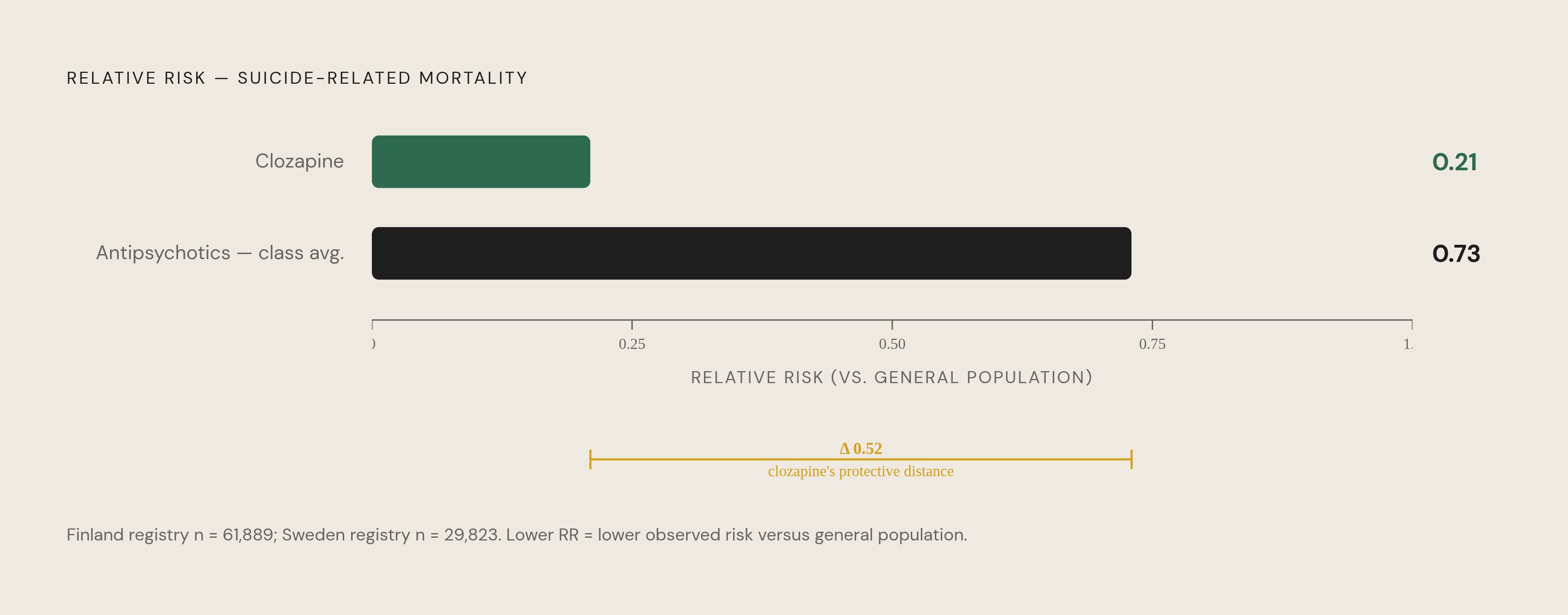
Two large registry-based cohort studies, one in Finland covering 61,889 patients, one in Sweden covering 29,823, both found clozapine was the only antipsychotic associated with reduced suicide mortality in schizophrenia. Among patients with more chronic, established illness, clozapine-treated patients had a relative risk of suicide-related mortality of 0.21, against 0.73 for antipsychotics as a class. Sit with that gap for a second: it's a substantial difference, pointing to a benefit that no other antipsychotic in these registries came close to matching.
A separate meta-analysis pooling 5,424 clozapine-treated patients against 56,548 controls found clozapine significantly reduced the odds of suicide in psychotic disorders, with an odds ratio of 0.46 and a p-value of 0.007. Over the long run, clozapine's association with lower overall mortality seems to run largely through this suicide reduction, plus better symptom control that heads off the psychosocial deterioration that so often precedes a crisis.
So when only about 4.8% of people with schizophrenia are currently taking clozapine, that number isn't just a prescribing statistic. It's unaddressed suicide risk, sitting inside a population that already carries some of the highest mortality rates in psychiatry.
How drastically clozapine is underused, and how long that has been true
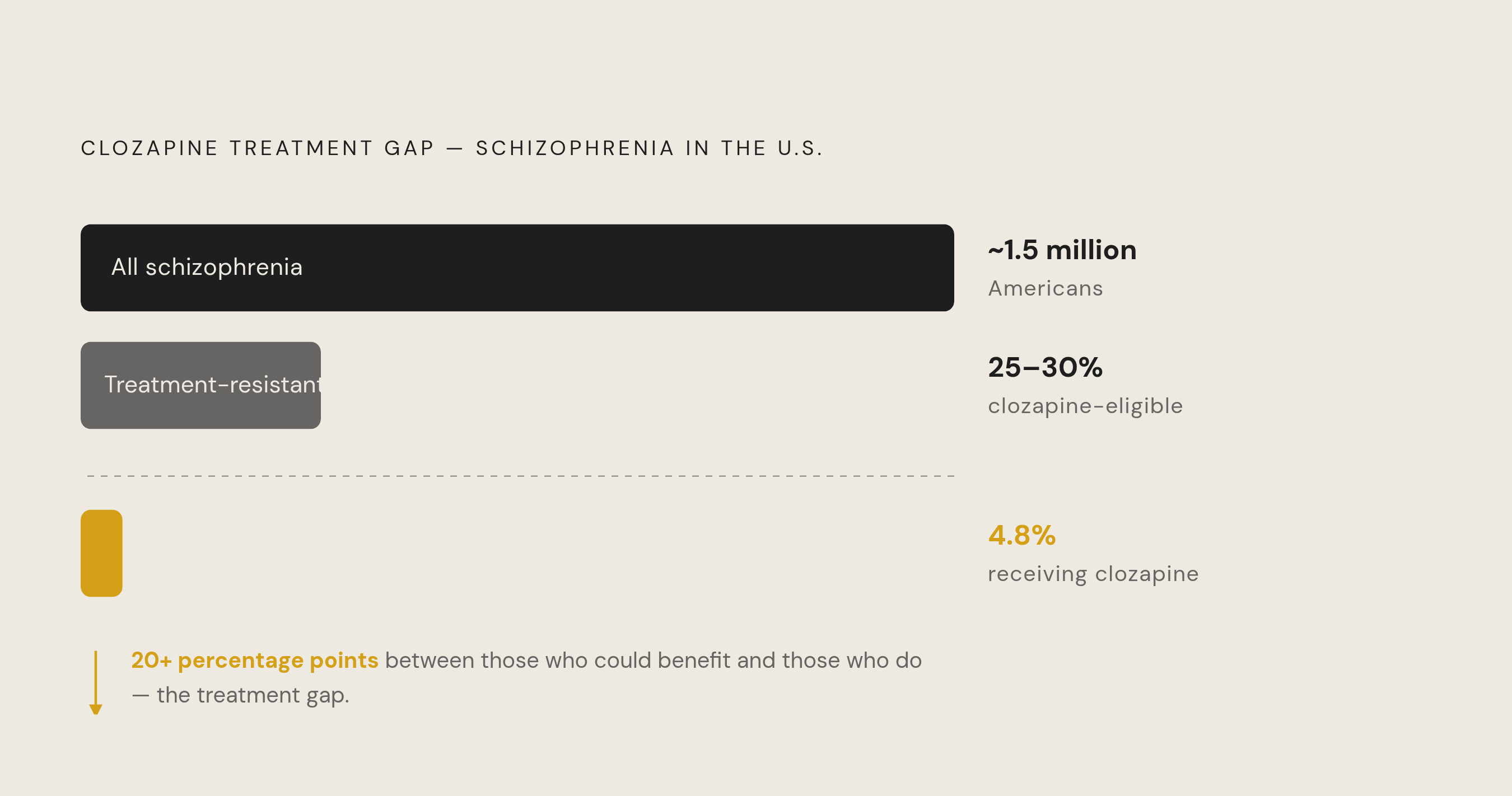
Set that 4.8% against the estimated 25% to 30% of patients who could benefit, and the gap is stark. It has persisted for decades, through a steady pile-up of trial data, registry studies, and guideline updates that all point the same direction, while prescribing rates just haven't caught up. Why does a gap this well-documented stay open this long? Part of the answer is delay, plain and simple.
Research by Howes and colleagues found the average theoretical delay between meeting criteria for treatment resistance and actually starting clozapine ran around four years. In New Zealand, that delay stretched closer to ten. The delay carries a real cost: starting clozapine earlier after identifying TRS is associated with meaningfully better odds of response. Call it what it is, a clinical failure with a body count, one where the window for the best possible response closes while a patient sits and waits for someone to move.
Geography compounds it. In the U.S., only six states reported more than 10% of Medicaid-eligible patients with schizophrenia receiving clozapine. That kind of concentration points to something structural: expertise, infrastructure, and institutional comfort with clozapine cluster in a handful of places and are mostly absent everywhere else. Clinicians and guideline committees broadly agree on clozapine's role, at least on paper. The disagreement, if you can even call it that, doesn't show up in journals. It shows up in who actually gets access.
The monitoring demands and side-effect profile that make clozapine hard to sustain
Clozapine's biggest historical safety concern is severe neutropenia, a dangerous drop in white blood cell count that leaves patients vulnerable to infection. That risk is what built the entire mandatory blood monitoring apparatus around the drug for over three decades. Beyond neutropenia, the side-effect list runs longer than most antipsychotics: seizures, myocarditis, severe constipation that can turn medically serious, orthostatic hypotension, drooling, sedation, and often significant weight gain.
With proper dosing, consistent monitoring, and targeted management of side effects as they come up, most of that risk and burden can be brought down substantially. But "proper" is carrying a lot of weight in that sentence. It requires clinical infrastructure that shows up reliably, week after week, and a patient who can engage with that infrastructure just as reliably, which is exactly where things start falling apart for people already managing housing instability or a daily life that refuses to hold still.
There's also a specific inequity baked into the monitoring history, one that's easy to state clinically and harder to sit with once you work through what it actually meant for patients. Benign ethnic neutropenia, a naturally lower baseline white blood cell count found among people of African or Middle Eastern ancestry, historically triggered monitoring thresholds calibrated for the general population rather than for these patients specifically. That meant people got flagged as at-risk, or pulled off clozapine entirely, based on a lab value that never reflected their actual clinical danger. It's about as clean an example as you'll find of biology, monitoring protocol, and racial inequity colliding inside a single blood test.
And the monitoring burden itself, regardless of whose blood is being drawn, has worked as an access barrier all on its own. Frequent blood draws require transportation, time off from whatever else fills a person's day, and a level of schedule stability that a lot of TRS patients simply don't have.
What the FDA's 2025 REMS elimination changes — and what it doesn't
As of early 2025, the FDA no longer requires prescribers, pharmacies, and patients to participate in the clozapine REMS program or report absolute neutrophil count results before the drug can be dispensed. The agency's reasoning was that medical training and health system protocols have absorbed the relevant safety information over time, and the REMS program's marginal safety contribution no longer justified its access burden.
The concrete effect is real. Roughly 30% of local pharmacies weren't previously registered with the clozapine REMS program, which meant patients in those areas had to find a registered pharmacy or go without. Those pharmacies can now dispense clozapine without that registration step, a genuine cut in administrative friction for prescribers who found the REMS paperwork onerous, for pharmacies that had stayed out of the program, and for patients who used to route around a thin pharmacy network just to fill a prescription.
The reform touches the administrative enforcement layer sitting on top of clozapine's monitoring requirements. ANC monitoring is still recommended under the drug's product labeling, so the clinical standard of care hasn't moved an inch. Prescriber training gaps haven't closed. The social and logistical barriers facing TRS patients, the same ones that made showing up for blood draws hard in the first place, sit entirely untouched by a regulatory change at the federal level. Removing paperwork doesn't create a ride to the pharmacy. It doesn't create a stable place to live, either.
Who is most likely to be left out even when clozapine is technically available
So who does the REMS elimination actually reach, and who does it leave behind? Start with the patients affected by benign ethnic neutropenia: Black and Middle Eastern patients who were historically, and sometimes still are, incorrectly flagged as ineligible for clozapine or pulled off it because of a monitoring artifact rather than a real safety signal. A looser federal monitoring requirement doesn't automatically fix clinical judgment calls that were miscalibrated to begin with.
Then there's geography again. That earlier figure, only six states with more than 10% Medicaid clozapine utilization, points to clinical expertise concentrated in specific regions, likely urban academic centers with established psychiatric infrastructure already in place. Rural areas and underserved urban neighborhoods face the widest gaps, and pharmacy deregulation doesn't build a psychiatric monitoring program where none exists.
Social determinants stack directly on top of clozapine's logistical demands, and they compound rather than just add up. Housing instability makes it hard to keep any appointment on a regular schedule, let alone one that recurs weekly or biweekly. Transportation gaps decide whether someone can physically reach a blood draw or a pharmacy pickup. Food insecurity interacts badly with a medication known for causing weight gain and metabolic shifts; someone without reliable access to food has fewer tools available to manage that side effect. And a lot of patients in this population don't have one consistent person around who can track appointments, notice side effects, or step in before things go sideways.
Put together, the patients who stand to gain the most from clozapine are often the same patients for whom staying on it is hardest. Treatment resistance and social disadvantage tend to travel together, and the REMS elimination strips away a bureaucratic layer, which counts as real progress. But the cost of bus fare, the instability of a shelter bed, and the absence of anyone checking in remain exactly where they were before February 2025.
Why staying on clozapine requires more than a willing prescriber
Adherence to clozapine was never going to be passive, before REMS elimination or after it. It demands regular blood monitoring, dependable pharmacy access, an understanding of what side effects look like and when they've crossed into serious, and a willingness to actually report problems instead of quietly stopping the medication and telling no one.
Prescribers carry their own version of this weight. Limited training in managing clozapine specifically, fragmented mental health services that don't talk to primary care or to each other, and difficulty even identifying which patients meet criteria for treatment resistance in the first place, all of it slows down initiation before a patient ever sees a prescription. Optimizing clozapine use takes close collaboration between psychiatrists, pharmacists, and broader care teams, according to the clinical literature. Most community mental health settings don't have that kind of integrated structure sitting around waiting to be used.
For someone managing serious mental illness while also navigating housing instability, food insecurity, or unreliable transportation, the organizational weight of clozapine treatment can tip from difficult to genuinely insurmountable, absent some active support filling the gaps. Trust shapes all of this quietly, in the background, in ways that don't show up on a chart. A patient who doesn't trust their care team is less likely to report a troubling side effect, more likely to miss a scheduled blood draw, and more likely to just stop the medication without telling anyone why.
The clinical evidence for clozapine is about as solid as psychiatric evidence gets. What's often missing is the social infrastructure that keeps a person on the medication long enough for that evidence to mean anything in their actual life. That's where the gap between "clozapine works" and "patients stay on clozapine" turns into people dying who didn't have to.
How peer support addresses the trust and logistics gap that clinical care leaves open
If pharmacy access and prescriber training alone can't close that gap, what does? The barriers that most often derail clozapine adherence, missed appointments, fear of side effects, isolation, sheer logistical overload, are exactly the barriers peer support was built to handle, by design rather than as an afterthought.
Someone who has personally navigated serious mental illness can meet a patient in the moments clinical care doesn't reach: at home before a blood draw, in the middle of a crisis, after an appointment that left someone discouraged or scared off entirely. That presence matters because trust sits at the center of clozapine adherence. For a population that has often experienced coercive or dismissive treatment inside the mental health system, a peer who shares that lived experience can open a door that a clinical encounter, however well-meant, often can't.
The practical support runs in a few directions: getting someone to a blood draw or pharmacy pickup when transportation is the obstacle, helping a patient figure out which side effect needs a call to the prescriber versus which one can wait, connecting people to housing or food resources that make adherence something they can actually sustain, checking in often enough to catch a quiet discontinuation before it turns into a crisis.
Firsthand works in this exact space. Its Guides and STRIVE Specialists bring their own lived experience of serious mental illness or substance use disorder into the communities they serve, offering the kind of sustained, on-the-ground presence that a one-time referral doesn't provide. The helpinghand platform, which carries HITRUST r2 certification, gives that work secure infrastructure to coordinate and document, so health plans and provider systems can fold peer support into care delivery around high-need medications like clozapine, an approach that too often stays an informal, unpaid add-on that happens only if a patient gets lucky.
The clinical case for clozapine has been settled for decades. What's been missing is the sustained human support that turns that evidence into something a person can actually live with, day to day, through the blood draws and the side effects and everything else the guidelines don't account for.