Why Stable Housing Is a Mental Health Intervention
Housing stabilization interrupts the stress cycle that worsens mental illness and reduces mortality.

Stable housing is not a precondition for treating serious mental illness. It functions as treatment itself, and the evidence for that claim is now specific enough to act on.
How housing instability damages mental health
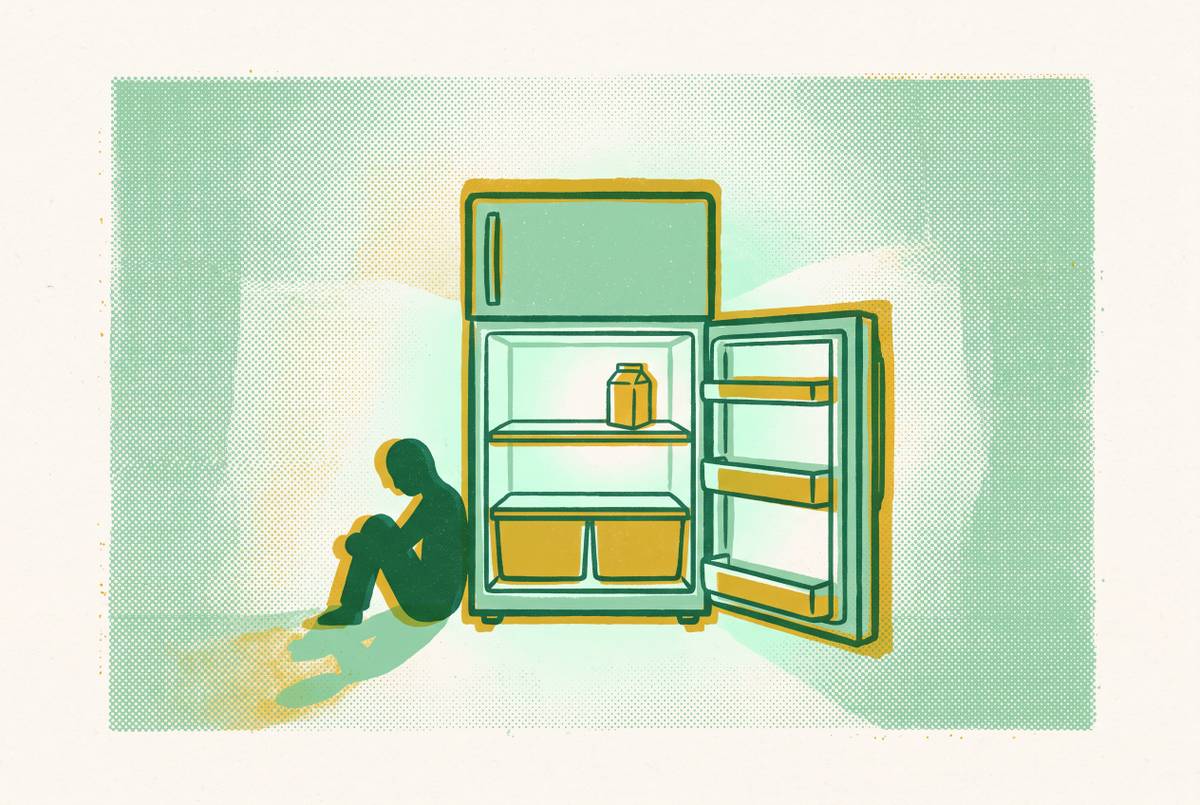
Picture the daily arithmetic housing instability forces on a person: pay rent this month or buy groceries, fill a prescription or keep the heat running through winter. CDC Utah's 2026 overview names this toll in exact terms: sleepless nights, the repeated loss of social ties that comes with every forced move, and the corrosive sense that control over one's own life has slipped away. A person lying awake calculating which bill goes unpaid is running a stress response that does not shut off when morning comes, and that response has measurable effects on mood, attention, and the capacity to plan more than a day ahead.
This is where the biology connects to the behavior. The relationship runs in both directions at once. Poor mental health makes a lease harder to keep current, a job harder to hold, a landlord relationship harder to sustain, and each of those failures feeds back into worse mental health. It is a closed loop, and understanding that loop matters because every intervention described later in this piece aims at breaking it somewhere.
Children who live through housing instability show you that same pattern in a different form. A household under housing strain is not a contained hazard that stops at the adult managing the budget. It extends into the next generation's development, a reason housing researchers increasingly treat instability as a family-level exposure.
When instability escalates into full homelessness, the damage sharpens. HUD's position on this is direct: mental illness does not cause homelessness. And the ultimate marker of that harm, mortality, confirms the stakes. People experiencing homelessness face a much higher risk of dying than housed people of the same age and demographic background. That single fact is the reason the next section's evidence matters so much.
Housing First as a direct health intervention
Treat the mortality figure above as the baseline to measure against. The largest causal study on this question comes from economist Sydney Costantini, who drew on a large national sample of unhoused, mentally ill veterans. There was no sobriety requirement, no treatment-completion benchmark, no waiting period tied to clinical compliance. Just housing, provided first.
The contrast case is just as informative. Treatment First programs require stabilization before you get housing, and they produced improvement while participants lived inside the program's facilities, but those gains did not hold after exit and did not lead to better long-term health outcomes. That is the clearest evidence available that treatment delivered without housing stabilization behind it does not stick. The sequence matters as much as the content.
A randomized controlled trial tested Housing First combined with Assertive Community Treatment, and it adds detail at the individual level. The Urban Institute research cited in CDC Utah's 2026 overview reinforces the same pattern at a program level: Housing First produces higher housing stability, higher psychological well-being scores, and improved quality of life across the populations it serves.
None of this means Housing First is a complete answer by itself, and the honest version of the evidence says so. That finding does not undercut the logic of housing first as a sequence. It points toward something the later sections of this piece build on directly: mental health and substance use treatment need to arrive as companions to housing once it is secured.
There is also a financial argument, and it changes how the intervention gets discussed in budget conversations. Housing First saves money while improving the outcome it was built to improve.
Why housing alone is not sufficient
Housing is the anchor, not the whole structure.
Start with medication. A person with serious mental illness who cannot reliably afford or access medication continues to lose ground even with a stable address, because the instability driving non-adherence was never only about housing to begin with.
Transportation works the same way. Transportation barriers make chronic poor mental health far more likely than episodic poor mental health. That distinction carries weight. An episodic difficulty is something a person can move through and recover from. A chronic one compounds, extends, and becomes harder to treat the longer it persists, and transportation barriers are one of the mechanisms that pushes someone from the first category into the second.
Food security shows a parallel pattern. Like housing, food security shifts a person from survival mode into something closer to a recovery posture, where attention and energy become available for things other than the next meal.
The mechanism tying all three together is simple to state even though it is hard to fix. When you spend most of your mental and physical energy meeting basic survival needs, you have little left to engage with health care, follow a treatment plan, or build the stability recovery actually requires. That is why food, medication access, and transportation work as co-determinants alongside housing, not as secondary concerns.
The health system itself is beginning to treat these factors as clinical variables. Separately, the 2025 IPPS Final Rule expanded SDOH diagnosis codes related to housing instability from non-CC to CC status. That reclassification means those codes now directly affect hospital reimbursement, which is as close as billing policy gets to declaring housing instability a medical fact.
Gaps in current Medicaid housing support for SMI
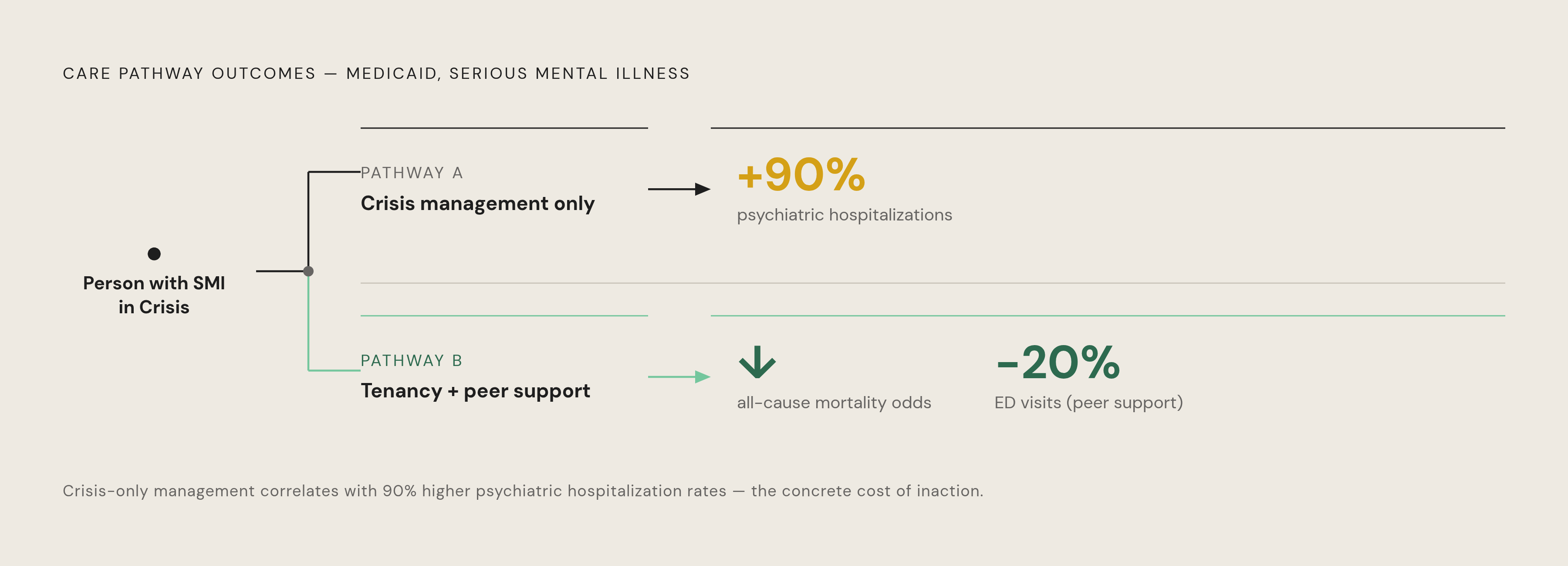
Medicaid housing support is already producing results where it reaches people with serious mental illness, and a 2025 Health Affairs study of Medicaid housing support services for enrollees with SMI or substance use disorder found that tenancy support services were associated with substantially lower odds of all-cause mortality. The same study found peer support was associated with meaningfully reduced emergency department use. Both findings point in the same direction: stabilization services work when they are actually delivered.
That same study also carries the sharpest warning in the current evidence base. Crisis management alone, without any accompanying housing stabilization, was associated with a 90% increase in psychiatric hospitalizations. Read that figure against the tenancy support findings: crisis response absorbs resources and drives utilization upward without making anyone healthier, while housing stabilization lowers utilization and improves health.
Access to these services is not distributed evenly. Social isolation and a lack of social and emotional support were the most commonly reported social determinants of health nationally, and both were more prevalent among non-Hispanic American Indian or Alaska Native, Black or African American, Native Hawaiian or Pacific Islander, multiracial, and Hispanic or Latino adults than among non-Hispanic White adults. That gap sits inside a Medicaid system where state agencies increasingly want to treat housing as a health driver for people with SMI and substance use disorder, and many states are building programs that bring physical, behavioral, and social services together in community settings. Willingness at the state policy level has not yet become consistent reach at the point of care.
That space between stated intent and lived access is the structural problem the rest of this piece addresses. Housing support that exists on paper does not automatically become housing stability for the people who need it most, and closing that space requires a delivery mechanism built on something other than policy language. That mechanism is peer support, and it is where the argument turns next.
Peer Support and the Trust Gap
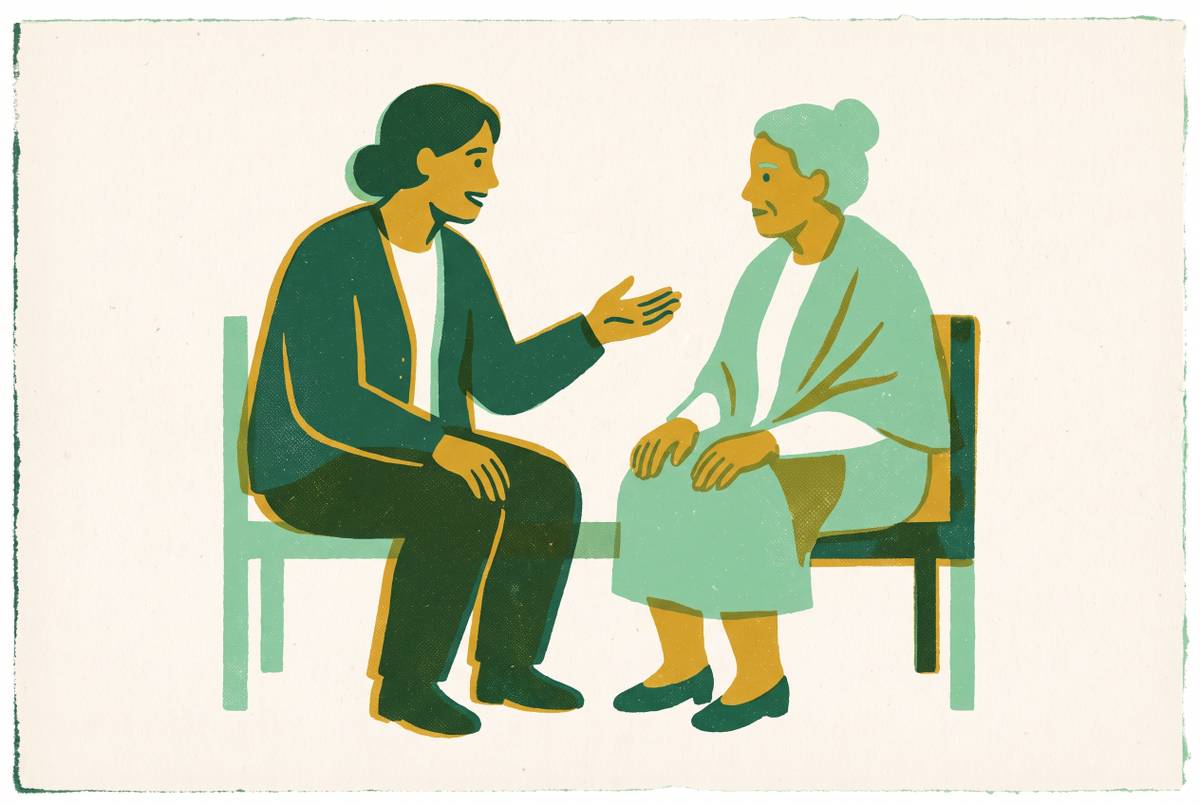
Peer support operates on a different footing than clinical care, because the person providing it has lived through a comparable experience. That shared history closes a trust gap that treatment-first clinical models often fail to bridge, particularly for people with serious mental illness who have already had difficult encounters with formal systems. A clinician can be competent and still be a stranger asking someone to disclose their worst moments on a schedule set by an intake form. A peer specialist starts the conversation from inside the experience you are discussing.
The outcome data supports what the mechanism suggests. Research on peer support services for people with serious mental illness documents an increased sense of control, an improved ability to make changes, and decreased psychiatric symptoms among participants, outcomes that compound further when housing stability is also present. Peer support also lowers the overall cost of mental health services by reducing rehospitalization rates and the number of days spent in inpatient care. The same 2025 Health Affairs study found peer support was associated with a 20% reduction in emergency department use. One peer coaching program saw dramatic reductions in hospitalization after participants were paired with a peer coach, and another peer support program showed a substantial decrease in average acute inpatient days per month. Beyond the utilization numbers, peer support promotes socialization, recovery, self-advocacy, the development of natural support networks, and community living skills, which are precisely the capacities that housing instability erodes first.
The stakes are sharpest for veterans, where suicide and death ideation rates run more than double those of non-veterans living with serious mental illness. Within the VA system, peer specialists must themselves be veterans, and the VA treats its peer specialist workforce as a vital part of mental health recovery services.
firsthand builds its model around this exact mechanism. Its network of Guides and STRIVE Specialists bring lived experience into direct, community-based work with people managing serious mental illness, supported by the HITRUST r2-certified helpinghand platform that lets health plans and provider systems track and coordinate that work. firsthand partners with those systems to deliver support on the ground that treats housing, food, transportation, and behavioral health as one connected problem rather than separate referrals, which is the holistic posture the earlier sections of this piece argue for directly.
Coverage of peer support still lags its promise. Reaching the people who need it is a separate problem, and it is the subject the next section takes on directly.
The peer support workforce as the bottleneck
What if the limiting factor here is not whether peer support works, but whether the system can pay for it consistently enough to keep people doing it? The infrastructure to answer yes already exists. Supply is not the shortage. There are willing workers ready to do this work.
The constraint is financing, and it is structural. A study in Psychiatric Services confirmed how uneven the landscape is: among states with Medicaid coverage for substance use disorder peer support, credentialing requirements vary considerably, training requirements range from 30 to 80 hours, and prior work experience requirements range from 40 to 1,000 hours. That spread makes it hard for a certified peer specialist to move between states or for health systems to build a consistent hiring standard.
This is an unusual position for a healthcare workforce to be in. Most workforce shortages in behavioral health trace back to too few trained people. Peer support has the opposite problem: a surplus of willing, trained workers constrained by an administrative and financing structure that has not caught up to the evidence supporting their work.
Washington State's 2025 legislation, known as 2SHB 1427, gives you one concrete model for closing that gap. The goal is to move peer specialists off grant-dependent funding and onto a sustainably insured footing, which is the same shift the next section argues health plans and provider systems need to make more broadly.
Making Housing Support Reimbursable
The regulatory groundwork for reimbursing this kind of care is no longer new. CMS recognized peer services as evidence-based and Medicaid-reimbursable back in 2007. As of 2026, a large majority of states reimburse peer support services through Medicaid. The authorization to pay for this work is largely in place.
What remains complicated is the credentialing and billing pathway itself, which is involved enough in practice to discourage providers and health plans from operationalizing reimbursement even where it is technically available to them. That gap between what is allowed and what is actually built is an administrative problem, and administrative problems can be solved with the right operational partner and the right systems.
The 2025 Health Affairs study makes the financial case directly; it does not leave that case to inference. Tenancy support and peer support cut mortality and emergency department use in Medicaid populations with serious mental illness, but when crisis management ran without housing stabilization, hospitalization went up. The argument for investing in housing support is grounded in that comparison, not in a forecast.
Building this in practice means assembling community-based infrastructure that addresses housing, food, medication access, and transportation alongside behavioral health care, delivered as one coordinated model rather than scattered across referrals to separate agencies, and delivered where people actually live. firsthand operates exactly this model, pairing its Guides and STRIVE Specialists with the helpinghand platform to give health plans and provider systems a single, credible operational partner for this work.
Health plans face a plain choice now that the evidence is this consistent. Continue routing members with serious mental illness through crisis systems that generate high utilization without producing lasting outcomes, or invest in the housing-anchored, peer-delivered model the data in this piece has laid out section by section. The evidence no longer leaves much room to call that choice uncertain.
Sources
- Impact Of Housing Support Services For Medicaid Enrollees With Serious Mental Illness, Substance Use Disorder
- CDC Utah
- Helping to secure stable housing first among homeless individuals can improve mental health and quality of life
- Peer Support Services for Individuals With Serious Mental ...
- Housing First or Treatment First? Evidence from the VA’s homelessness programs
- Housing First: A Review of the Evidence
- Social Determinants of Health: Housing
- Impact of Peer Specialist Services on Residential Stability and Behavioral Health Status Among Formerly Homeless Veterans With Cooccurring Mental Health and Substance Use Conditions - PubMed