Nocturnal Panic Attacks Causes and Management
Sleep attacks strike during deep non-REM transitions, not dreams.
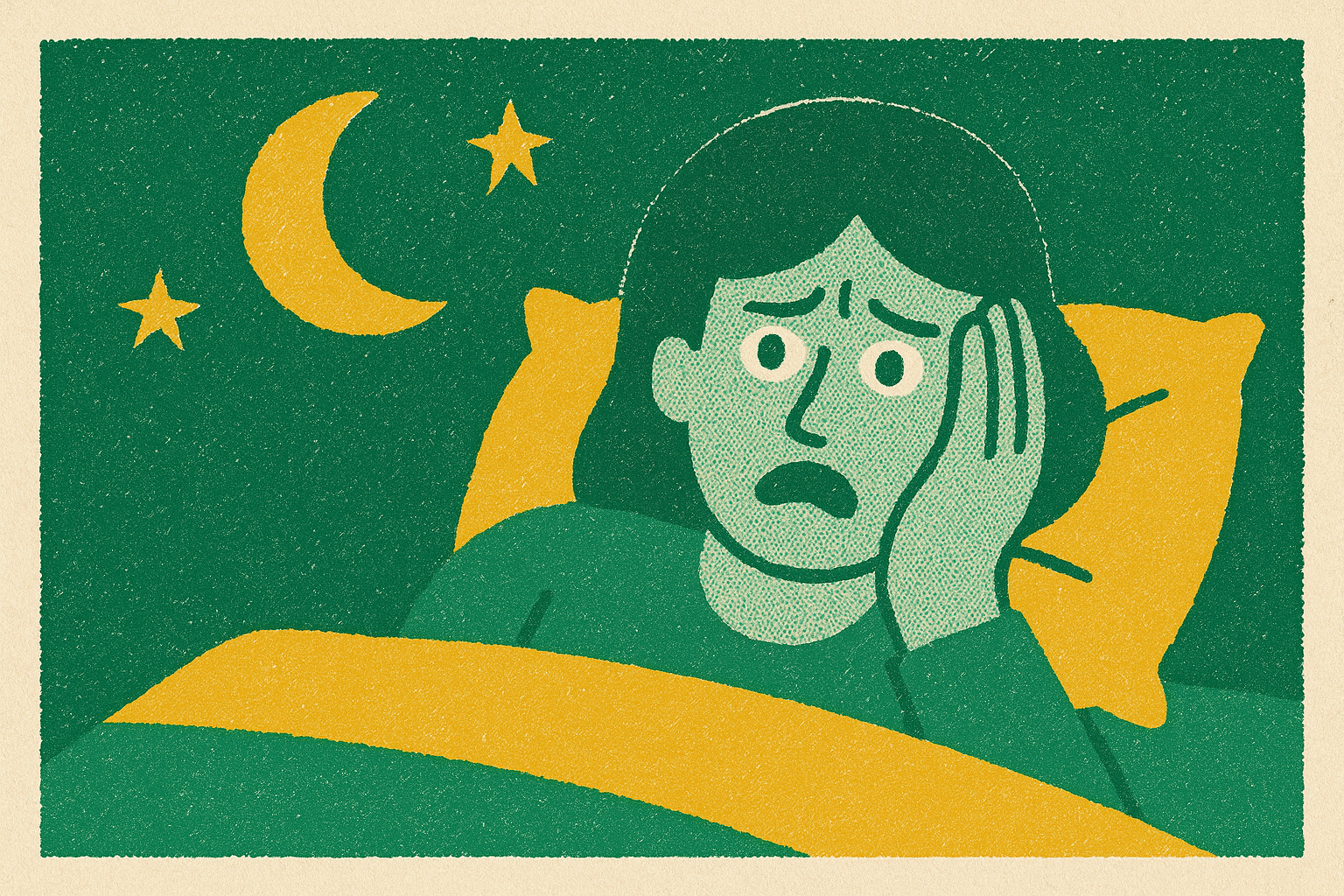
Nocturnal panic attacks pull someone out of sleep with a racing heart, tight chest, and a wave of dread that has no obvious cause. No noise, no nightmare, no external threat, just the body slamming into fight-or-flight while the mind is still catching up. That absence of a trigger is a defining feature of understanding the condition. It's the defining feature.
Clinically, a panic attack (day or night) requires meeting a recognized symptom threshold to count, per the DSM-5. The list is long: racing or pounding heartbeat, trembling, dizziness, nausea, numbness or tingling, chills or hot flushes, shortness of breath, a choking sensation, chest pain or tightness, a sense of impending death, derealization, dread, and a feeling of losing control. Most episodes peak within 10 minutes then start to fade, but the aftermath, racing thoughts, the fear of falling back asleep, can drag on much longer than the attack itself. Mayo Clinic notes the symptoms mimic a heart attack or another medical emergency closely enough that many people end up in an ER before anyone mentions the word "panic." Frightening, yes. Dangerous, not in the way it feels. The rest of this piece works to earn that reassurance rather than just assert it.
How common nocturnal panic attacks are, and who experiences them
Panic disorder itself isn't rare. A nationally representative sample from a specific country. study put 12-month prevalence at 2.7% and lifetime prevalence at 4.7%, and among primary care patients, that rate climbs to somewhere between 4 and 8 percent. Zoom out globally, and anxiety disorders touch as many as 301 million people (about 4.05% of the world's population), with panic disorder specifically landing around 2 to 5 percent. Widen the lens further and about 11% of Americans report at least one panic attack in a given year, a much bigger group than those who meet the full criteria for panic disorder.
Within that population, nighttime panic isn't a footnote. Estimates put nocturnal episodes at 44 to 71% of people with panic disorder reporting at least one, and a meta-analysis published in PLOS Mental Health put the figure above 50%. Cleveland Clinic frames it even more starkly: 7 in 10 people with recurrent panic attacks also experience them at night. Up to two-thirds of people with panic disorder get both day and night versions, and a smaller but real slice gets nocturnal attacks exclusively, never during waking hours.
The demographics complicate any tidy story. Panic disorder overall skews female, and research suggests women are more likely than men to experience panic disorder overall. Yet nocturnal-only attacks, the subgroup that never panics during the day, show up more in men over 40. Adolescents aged 13 to 18 carry a 2.3% prevalence rate, higher among girls. Cross-national data puts lifetime prevalence for panic disorder at 1.7%, with a median onset age of 32, and 80.4% of people with lifetime panic disorder also carry at least one comorbid mental health condition. So nocturnal panic rarely shows up alone. It tends to travel with something else.
Why nocturnal panic attacks feel different from daytime attacks, and how they differ from night terrors
Same symptom list as a daytime attack, but the setup is different enough to change how it lands. There's no waking lead-up, no situational cue the brain can point to and say "that's why." The body goes from asleep to full fight-or-flight in seconds. Cleveland Clinic notes nocturnal episodes may involve more severe breathing symptoms, shortness of breath, that choking feeling, than a typical daytime attack, and the Sleep Foundation flags the choking sensation specifically as more common at night. Neither source claims this is settled; more research is needed to fully characterize the difference, and that qualifier matters.
A 2022 study in the Journal of Anxiety Disorders (Smith, Bauer, Capron) found something that complicates the "purely biological" story: research examining daytime and nocturnal panic symptom networks found that the overall structure of panic symptoms did not differ substantially between the two groups. That finding is worth sitting with. The similarity in symptom architecture suggests that waking into panic, rather than building toward it, engages much the same psychological machinery.
The daytime-versus-nocturnal split comes down to trigger. Daytime attacks usually have an external stressor or a recognizable environment behind them. Nocturnal attacks arise with no such anchor, which makes them harder to explain to a doctor, harder to anticipate, and harder to feel in control of.
Night terrors get confused with nocturnal panic often enough that the distinction deserves its own space. In a nocturnal panic attack, the person wakes fully, is aware of the symptoms as they happen, and remembers the episode afterward, and that memory is exactly what fuels the fear of going back to sleep. Night terrors work almost the opposite way: the person may appear awake, even scream or move around, but isn't conscious, can't be easily roused, and typically has no memory of it the next morning. Night terrors are most common in children under 5. Nocturnal panic attacks span childhood through adulthood. Both produce a racing heart, sweat, and fast breathing, but the awareness and the recall are what separate them clinically.
When in the night nocturnal panic attacks occur and what sleep stage produces them
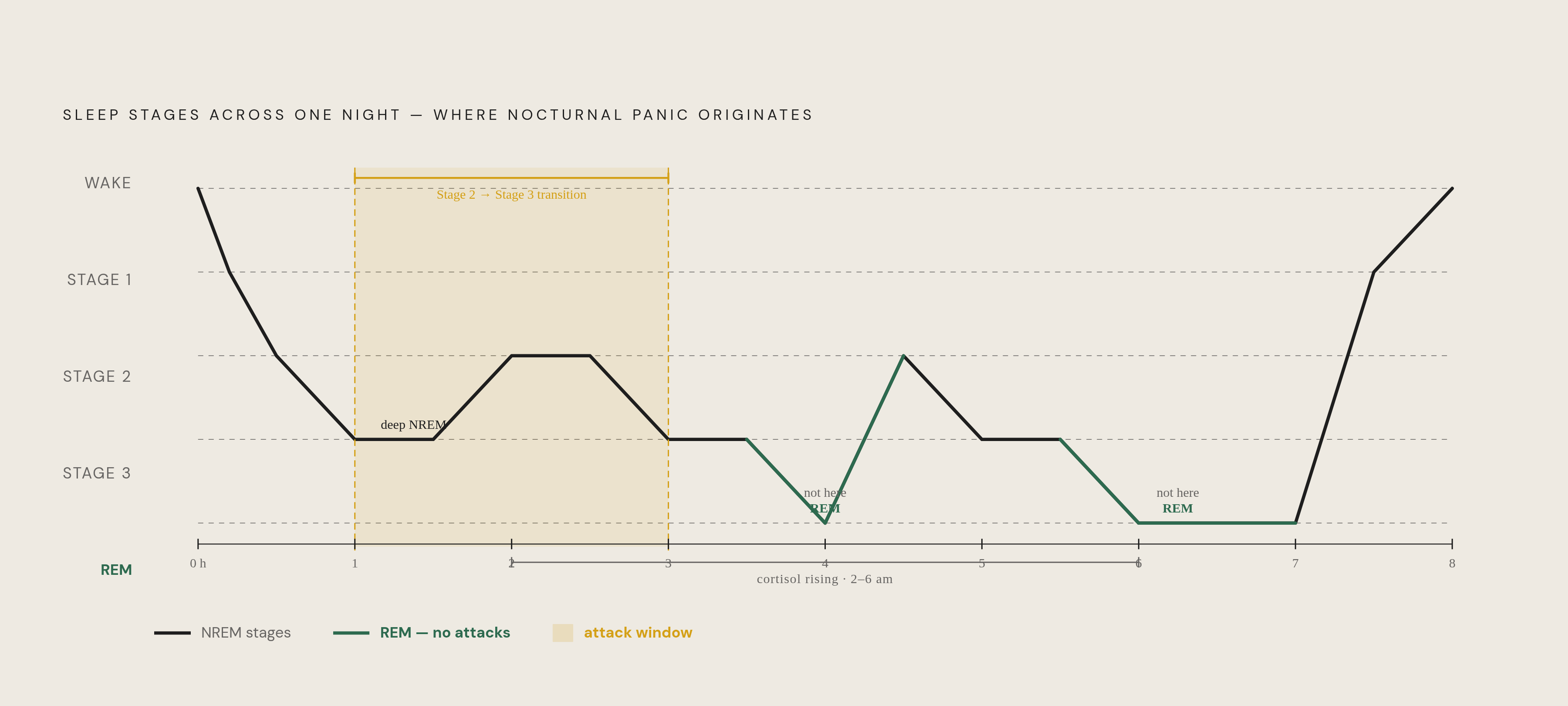
Polysomnographic research from Nakamura and colleagues in 2013 tracked exactly where in the sleep cycle these attacks originate: the transition from Stage 2 to Stage 3 non-REM sleep, mostly in the first third of the night, within one to three hours of falling asleep. Not during REM. Not during dreaming. That single detail rules out a whole category of explanations, this isn't a nightmare that spills over into waking terror, and it isn't tied to the vivid, narrative-heavy mental activity that defines REM sleep.
The Sleep Foundation backs this up, describing nocturnal panic as more common in the first half of the night, right around the transitions between light and deep sleep. Why does the timing matter so much? Stage 2 to 3 non-REM sleep is a period with minimal cognitive activity, the brain isn't running a storyline or processing emotion the way it does during REM. That's part of why researchers have leaned on purely biological arousal theories for nocturnal panic specifically, rather than reaching for a "bad dream" explanation.
Cortisol adds another layer. The body's cortisol naturally rises through the early morning hours, peaking around 8 or 9 a.m., and for people already prone to anxiety, that rising curve may prime the nervous system during the vulnerable window between roughly 2 and 6 a.m. Clinically, the sleep-stage finding is as useful for what it rules out as for what it confirms: not dreaming, not an external noise or disturbance, which points investigators toward internal, physiological triggers instead.
The leading neurobiological theories for why the sleeping brain triggers panic
No single theory has won this argument yet, and that fact deserves to be stated rather than smoothed over.
The oldest and most debated is Donald Klein's false suffocation alarm theory, first proposed in 1993. The idea: the brain runs a kind of suffocation monitor, and in some people, it misfires, triggering an evolved alarm system meant for real suffocation when none is actually happening. Carbon dioxide sits at the center of this. Rising arterial CO₂ during sleep is a natural signal of possible suffocation, and people with panic disorder appear to retain higher CO₂ levels during sleep even without sleep apnea in the picture. After three decades of study, after decades of study, anomalies in respiratory control, including how the body senses CO₂, are now widely regarded as central to panic disorder. Panic attacks can even be triggered experimentally through CO₂ inhalation in people with panic disorder, and it takes a noticeably higher concentration to produce the same effect in people without the disorder, which supports the idea of differential sensitivity. Still, the theory has real critics: at least one published analysis concluded there's neither solid empirical evidence nor a convincing mechanism behind the "suffocation alarm" or the CO₂ monitor as Klein described it. The debate hasn't closed.
A newer line of research points somewhere else entirely: the locus coeruleus and norepinephrine system. A 2024 study identified a brain circuit outside the amygdala, the lateral parabrachial nucleus in the pons, as a likely alarm center for panic. This region produces large amounts of PACAP (pituitary adenylate cyclase-activating polypeptide), a neuropeptide found throughout the brain and described as a master regulator of the body's stress response. During a panic episode, PACAP-expressing neurons fire and signal to the dorsal raphe, a pathway researchers are now eyeing as a possible target for future drug treatments.
A third model looks past neurochemistry toward conditioning. Chronic hypervigilance, a nervous system stuck in low-level alert, doesn't fully power down during sleep in people with anxiety disorders. Once someone has had one nocturnal attack, the fear of sleep itself becomes a trigger: anticipatory dread at bedtime raises baseline arousal, which in turn raises the odds of another attack. Research has found nocturnal panic especially common among people with trauma histories, which fits neatly into this conditioned-arousal picture. And the symptom-network research mentioned earlier is relevant here too: the psychological dimensions of panic are clearly active once the person wakes, not just a chemical cascade running on autopilot.
There's a fourth, more mechanical possibility worth naming: breathing instability during sleep-stage transitions. In someone already primed for panic, physiological disruptions to respiratory rhythm may register as choking or suffocation, kicking off the same alarm cascade Klein's theory describes.
None of these four explanations cancel each other out. They may all be describing different pieces of the same malfunction.
Who is at higher risk and what conditions raise the threshold for nocturnal panic
The single strongest predictor is simple: having panic disorder or daytime panic attacks already. Cleveland Clinic notes that people who panic during the day are substantially more likely to also panic at night. Layer on a comorbid mental health condition, depression, another anxiety disorder, OCD, alcohol or substance use disorder, and both the risk and the severity climb.
Medical conditions matter here too, especially ones tied directly to breathing during sleep. Sleep apnea alters respiratory patterns overnight, which raises the odds of a CO₂-related arousal given the theories above. Trauma history sensitizes the nervous system in a way that lowers the threshold for conditioned arousal, and there's a lifespan thread worth flagging too: adults who deal with nocturnal panic attacks show higher rates of childhood sleep terrors, suggesting some continuity between the two conditions even though they're clinically distinct.
Lifestyle plays its part as well. Irregular sleep schedules and poor sleep hygiene disrupt the exact sleep-stage architecture where nocturnal panic tends to originate. Heavy caffeine or alcohol use shifts arousal thresholds in ways that make an attack more likely, and major life stress or grief keeps the nervous system in a sensitized state for longer than most people expect.
Hormones round out the picture. Menopause and thyroid disorders both raise risk. Pregnancy adds a specific mechanism worth spelling out: hormonal shifts during pregnancy may alter respiratory sensitivity in ways that raise the odds of a panic-triggering arousal during non-REM sleep in someone already predisposed to it.
What happens when nocturnal panic attacks go unaddressed over time
The most immediate cost is sleep itself. After an attack, the mind tends to replay what just happened, which keeps arousal elevated and makes falling back asleep harder, sometimes for hours. The Sleep Foundation notes that people with nocturnal panic attacks are more likely to end up chronically short on sleep, and that sleep debt then compounds the anxiety that caused the problem in the first place.
That sets up a loop that's hard to break without help. After enough repeated episodes, bedtime itself starts to carry dread. Lying down becomes the trigger, not because anything is happening in the room, but because the body has learned to associate sleep onset with danger. That's a conditioned fear response, and it feeds on itself.
People with nocturnal panic attacks appear to carry a broader psychiatric symptom load than those who only panic during the day, and the comorbidity patterns described above suggest this burden is rarely limited to panic alone. Recall too that 80.4% of people with lifetime panic disorder carry at least one other lifetime mental health diagnosis. Left alone, nocturnal panic doesn't tend to stay in its lane.
For people already managing serious mental illness, the sleep disruption and added psychiatric burden from nocturnal panic can chip away at things that hold daily life together: housing stability, medication adherence, the ability to show up for work or treatment consistently. This carries real weight. Nocturnal panic isn't just an unpleasant thing that happens at 3 a.m.; it's a clinical pattern with real downstream costs, and, worth emphasizing again, one that responds to treatment.
Evidence-based treatment options and what each addresses
Mayo Clinic, in guidance updated December 2024, points to the same two treatment paths used for daytime panic: cognitive behavioral therapy, medication, or a combination of both, applied to this specific nighttime context.
CBT works by helping someone identify what's feeding their panic and retrain how the brain interprets physical arousal, so a racing heart stops automatically reading as "emergency." Mayo Clinic notes CBT can make attacks less intense and less frequent over time, and improve sleep in the process. It's also the most direct answer to the conditioned fear-of-sleep loop described above: exposure-based techniques can chip away at the anticipatory dread that raises nighttime arousal in the first place. And the 2022 Smith, Bauer, Capron finding, that cognitive symptoms run more severe in nocturnal panic than a purely biological model would predict, makes a strong case for why cognitive intervention matters here, even though the experience feels overwhelmingly physical in the moment.
Medication offers a second lever. SSRIs and SNRIs reduce both the frequency and intensity of attacks over time, though Cleveland Clinic notes they can take six to eight weeks to reach full effect, which matters for setting expectations early. Benzodiazepines work faster and can ease acute symptoms, though they come with their own considerations around dependence that a prescriber needs to weigh against the severity of someone's episodes.
Between therapy that addresses the conditioning and medication that addresses the underlying chemistry, most people find real relief. The two approaches aren't competing explanations so much as complementary angles on a condition that, as the research above shows, has both a biological engine and a psychological one running at the same time.
Sources
- Nocturnal Panic Attack: Causes and Tips for Relief | Sleep Foundation
- Nighttime panic attacks: What causes them? - Mayo Clinic
- Nocturnal Panic Attack: Anxiety, Panic Disorder & Night Terrors
- pubmed.ncbi.nlm.nih.gov
- Comparing symptom networks of daytime and nocturnal panic attacks in a community-based sample - ScienceDirect
- Assessment and treatment of nocturnal panic attacks - ScienceDirect
- Nocturnal Panic Attacks: Symptoms, Causes, Impacts, and Treatment - Olympic Behavioral Health
- ncbi.nlm.nih.gov