Mania vs Hypomania Distinguishing Features and Diagnosis
Duration, impairment, and psychosis—not symptoms—determine if it's mania or hypomania.
Mania and hypomania share the exact same symptom list under the DSM-5: the same seven B-criteria, the same minimum count required to qualify. Two people can describe identical racing thoughts, identical reduced need for sleep, identical grandiosity, and walk away with different diagnoses entirely. Three things separate them, none of which appear on the symptom checklist, and missing them is what actually costs people years of untreated illness.
The three non-symptom criteria that actually separate mania from hypomania under DSM-5
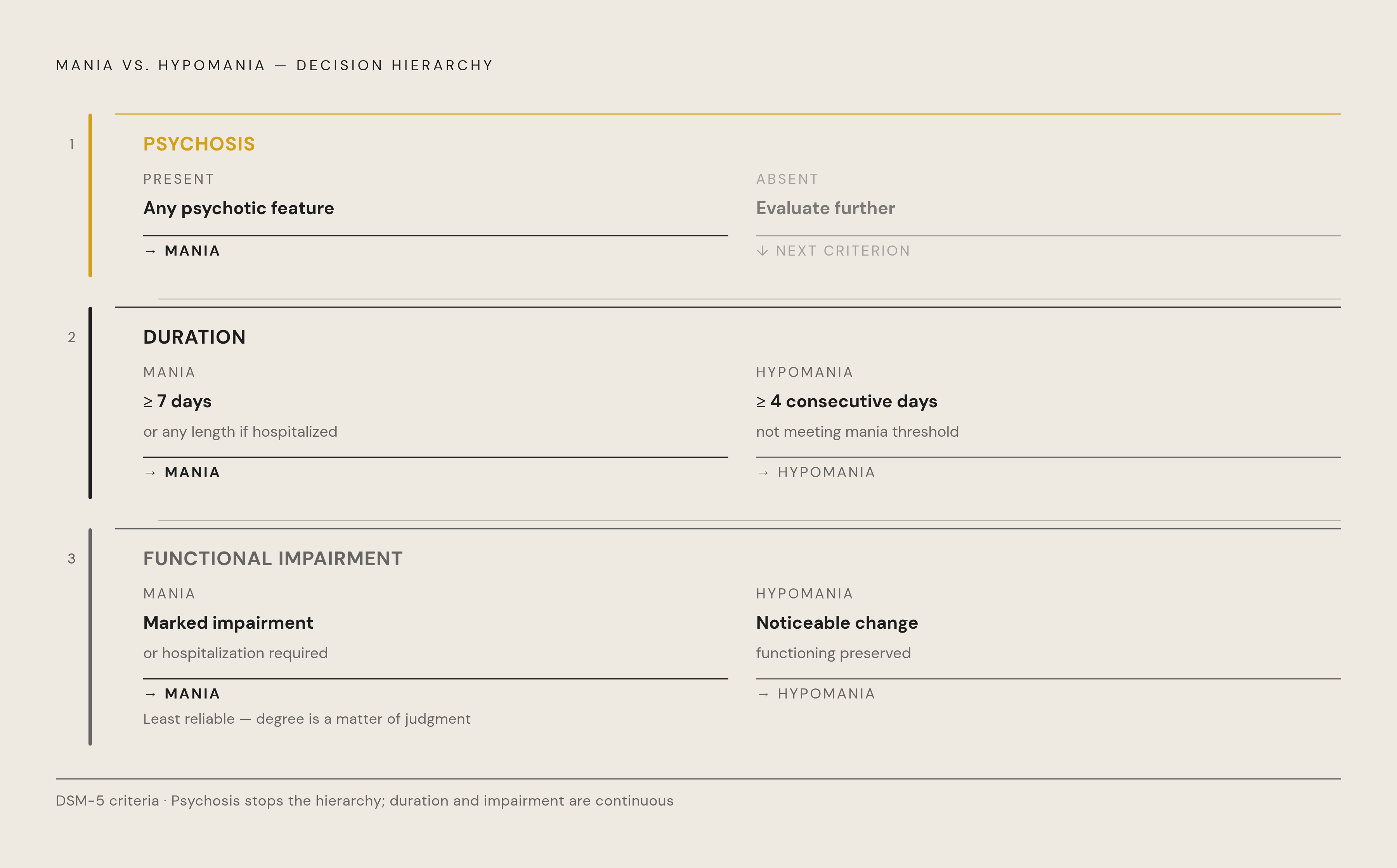
Duration is the first divide, and it's mechanical rather than a matter of clinical judgment. Mania requires an elevated or irritable mood lasting at least seven days, or any length at all if the person ends up hospitalized. Hypomania requires just four consecutive days, present most of the day, nearly every day. Fall short of four days, no matter how intense the symptoms, and the criteria simply aren't met. Three days isn't much on a calendar, but in diagnostic terms it separates two different disease categories.
Functional impairment does similar work, though it's messier to apply, and this is where most missed diagnoses actually happen. Mania causes marked impairment at work or in relationships, often serious enough to require hospitalization. Hypomania is noticeable (family members and coworkers pick up on it), but it doesn't wreck the person's ability to function. Some people function better during hypomania: more energy, more output, more social confidence. That's precisely what makes impairment such an unreliable marker to lean on, and it's the criterion clinicians should trust least when the other two are ambiguous. Judging what counts as "marked" impairment runs into cultural variation and resists consistent measurement across patients, so two clinicians looking at the same person can land in different places, and neither is obviously wrong.
Psychosis is the one clean line in the sand, and it should carry the most weight whenever duration or impairment is ambiguous. If delusions or hallucinations show up, the episode is mania, full stop. Hypomania cannot include psychotic features by definition. Every other distinction here is a matter of degree, but this one functions like a switch, and it's the criterion worth reaching for first when a case feels genuinely unclear.
Those three criteria, not the symptom list, decide which diagnosis a person receives. Hypomania paired with at least one major depressive episode, absent any full manic episode, points to Bipolar II. And in Bipolar II, hypomania is the rare event buried inside a much longer stretch of depression, which raises the question the rest of this piece has to answer: how does anyone catch the rare thing when it barely shows up?
How DSM-5's revision to Criterion A changed what counts as a qualifying episode
Under DSM-III and DSM-IV, mood alone did the gatekeeping. Elevated, expansive, or irritable mood was Criterion A, the single symptom that had to be present for an episode to count at all. Increased energy or activity was just one of seven optional B-criteria, useful but not required.
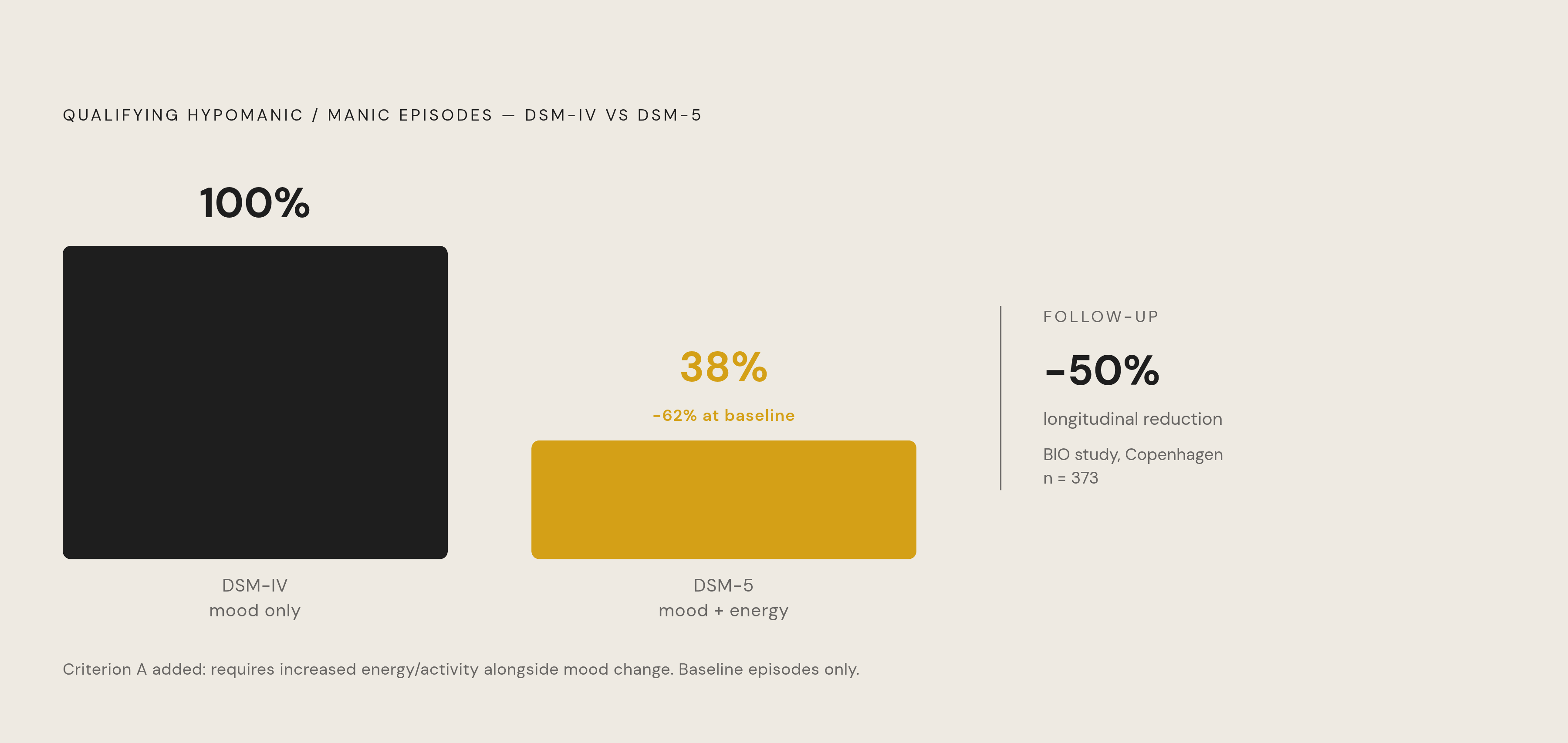
DSM-5 changed that. Increased energy or activity now has to show up alongside the mood change for an episode to qualify as Criterion A. That sounds like a technical adjustment. It isn't, and the data on what it filtered out makes the stakes clear.
The Copenhagen Affective Disorders Research Centre ran a prospective study, called BIO, tracking 373 newly diagnosed bipolar patients, published in the International Journal of Bipolar Disorders in 2021. Applying the stricter DSM-5 Criterion A cut the number of patients found to have a hypomanic or manic visit by 62% at baseline, compared to what DSM-IV's older criterion would have caught. During longitudinal follow-up, the drop was 50%. The episodes that still qualified scored higher on the Young Mania Rating Scale, so the filter isn't wrong, exactly. It's narrower: fewer episodes get caught, but the ones that do are more severe.
That narrowing is the tradeoff worth sitting with, and it's the part of the DSM-5 revision that deserves more scrutiny than it's gotten. A patient whose hypomania shows up mostly as mood change, elevated or irritable, without an obvious spike in energy or activity, may no longer meet Criterion A under DSM-5, even though the same presentation would have qualified a decade earlier. That's a plausible mechanism for longer diagnostic delays, particularly for patients whose hypomanic presentation skips the psychomotor piece. The upcoming ICD-11 has raised similar concerns among clinicians, though this remains an active debate rather than a resolved one. Worth remembering: DSM-III's original decision to put mood ahead of energy and activity was itself a choice made decades ago, not a law of nature, and it's a choice the field is now re-examining rather than treating as settled.
Why hypomania is so often missed, and why patients may not report it
Hypomania often doesn't feel like illness. It feels like clarity, energy, a burst of productivity, a run of good conversations. Why would someone report a state that feels better than their baseline? Patients frequently and sincerely deny past hypomanic or manic episodes when asked directly, not because they're hiding anything, but because the state never registered as a problem while it was happening.
There are practical barriers too, and they matter more than they get credit for. Psychiatric Times has noted that patients in an activated state may miss appointments, cancel them, forget they were scheduled, or simply decide not to go. The state that most needs observing is often the state during which the person is least available to be observed. Call it a structural flaw baked into how psychiatric care gets scheduled: the appointment cadence assumes a patient who shows up consistently, and hypomania is exactly the condition that breaks that assumption.
Combine that with the 39:1 ratio of depressive to hypomanic episodes in Bipolar II, and a pattern emerges. Patients show up in depression, almost always. Hypomania becomes something a clinician has to ask about after the fact, a retrospective question rather than a presenting complaint. Hirschfeld et al. (2003) found roughly a 10-year gap, on average, between a first mood episode and an eventual bipolar diagnosis. Some of that gap is hypomania getting waved off as personality, as a stress response, as just a good week.
Mood elevation that's purely reactive, triggered by an argument or a stressful stretch, doesn't meet criteria for hypomania on its own. But telling the difference between a reactive bump in mood and an autonomous hypomanic episode takes a careful history, the kind a single 30-minute appointment can't reliably reconstruct. Layer on top of that the overlap with borderline personality disorder, which shares mood instability, and ADHD, which shares impulsivity and distractibility, and the misattribution problem compounds. Each of these confounds can delay an accurate bipolar diagnosis by years, and none of them get resolved by a sharper checklist. The checklist was never the bottleneck. Access to the person during the window that matters, that's the bottleneck, and no amount of refining Criterion A changes that.
What collateral information and longitudinal tracking add that a single appointment cannot
Family members frequently spot the early signs of an episode before the patient does. A spouse notices the sleep dropping to four hours a night. A sibling notices the spending. Psychiatric Times points out that someone who knows the patient well can often confirm whether a discrete episode happened at all, and how long it lasted, in ways self-report during a single visit cannot. Collateral information isn't a nice-to-have here, and treating it as optional is arguably where a lot of diagnostic delay actually originates. A clinic that skips it is working with half the record.
Longitudinal tracking adds a second layer. Duration has to be documented across multiple settings and multiple points in time, not reconstructed from memory months later. Decreased need for sleep, a hallmark of mania and hypomania alike, has to be distinguished from ordinary insomnia, which is a different phenomenon with a different meaning. And the mood change itself needs to be traced back to its trigger, or lack of one: did it appear on its own, or only after a specific stressor? That distinction between autonomous and reactive elevation is one of the most diagnostically important judgments a clinician makes, and it's nearly impossible to make from a single snapshot.
The same four days of activated mood mean something different depending on what surrounds them. An elevation that appears out of nowhere, unconnected to any life event, reads as a different clinical signal than the same elevation following a breakup or a job loss. Structured tools like the Young Mania Rating Scale help formalize this tracking across visits, which is part of why the BIO study used YMRS scores to characterize its patients.
None of this happens without a relationship that persists past one appointment. A person who trusts the people around them, family, peer supporters, care staff, is more likely to let those people report what they've witnessed, and more likely to accept, after the fact, that something notable happened during a stretch they didn't recognize as unusual at the time.
The diagnostic stakes: how misclassifying hypomania as mania, or missing it entirely, changes what happens next
The classification is not a filing exercise. It decides the treatment plan, and the two possible errors are not equally common or equally dangerous to treat as a toss-up. Call mania hypomania, and a patient in the middle of psychosis may go undertreated or reach a hospital later than they should have. That happens. But it isn't the failure mode driving most of the damage, and treating both errors as symmetrically likely is where a lot of clinical training goes wrong.
The more common error runs the other way, and it deserves far more worry: missing hypomania entirely, so the patient carries only a depression diagnosis. That matters enormously, because treating unrecognized bipolar depression with antidepressants alone, without a mood stabilizer, can trigger or speed up manic cycling. The 10-year average delay between first episode and diagnosis isn't a rare outlier case. It's the pattern, and it's the one clinicians should be built around watching for.
The cost of that pattern is measured in years of life. People with serious mental illness die somewhere between 10 and 25 years earlier than the general population, across multiple research teams' estimates, and bipolar disorder specifically carries a 9-to-13-year gap (Shen, 2018). Suicide risk sharpens the point further: the suicide rate among people with bipolar disorder runs 20 to 30 times higher than the general population. Delayed or inaccurate diagnosis here isn't a paperwork problem. It's a mortality problem, and a fairly direct one.
Overdiagnosis carries its own cost too, and it shouldn't get waved off just because missed diagnosis is the more frequent failure. A patient whose presentation actually reflects borderline personality disorder, or a mood reaction to a specific stressor, can end up mislabeled as bipolar, prescribed medications with real side effects they didn't need, and carrying a diagnosis that shapes how every future clinician treats them. And because judging "marked functional impairment" varies by social and cultural context, the threshold for diagnosis isn't applied the same way across every patient or population. That inconsistency lands hardest on communities already underserved by mental health care.
How peer support and trusted relationships reach people that clinical criteria alone cannot
The DSM's criteria assume something they cannot guarantee: a patient willing to self-report honestly, observed over enough time, with someone else around to confirm what happened. When any one of those three pieces is missing, and often all three are missing at once, the criteria stop being useful no matter how precisely they're written. No revision to Criterion A fixes a problem that's fundamentally about access and trust, not wording. A sharper definition was never going to solve this on its own, and expecting the next DSM revision to close this gap misreads what's actually broken.
Peer support exists in exactly that gap. Research on peer support has found that it improves clinical outcomes, psychosocial functioning, and recovery-oriented measures for adults facing serious mental health challenges. The UPSIDES trial, a multicentre RCT published in The British Journal of Psychiatry, found peer support effective as part of recovery-oriented care across high-, middle-, and low-income country settings alike.
Why does lived experience carry diagnostic weight, not just therapeutic value? Someone who has been through a hypomanic stretch themselves recognizes the early signs in someone else without needing a checklist, and can ask about it the way a friend would, not the way an evaluator does. The appeal of hypomania, the energy, the sense of being unusually capable, is something a peer supporter may understand from direct experience, which makes it easier to name without the other person getting defensive about it.
firsthand's model runs on that premise directly. Guides and STRIVE Specialists who have navigated serious mental illness or substance use disorder themselves meet people in their own communities, over time, with a consistency a once-a-month clinical visit can't replicate. The helpinghand platform, HITRUST r2 certified, supports secure documentation of what's observed across those encounters, building exactly the longitudinal record the research keeps pointing to as necessary.
Housing instability, food insecurity, unreliable transportation: all of it makes consistent clinical contact harder to sustain, and inconsistent contact is precisely what makes accurate bipolar diagnosis so hard to reach in the first place. Peer support that addresses those barriers directly isn't a side benefit. It's part of what makes the diagnosis possible at all. Credentials alone rarely convince someone to say "I think I was manic last month" or to let a family member describe what they saw. Trust does that, and trust gets built the slow way, through consistency and shared experience, one visit at a time.
Sources
- Impact of modification to DSM-5 criterion A for hypomania/mania in newly diagnosed bipolar patients: findings from the prospective BIO study
- Impact of modification to DSM-5 criterion A for hypomania/mania in newly diagnosed bipolar patients: findings from the prospective BIO study | International Journal of Bipolar Disorders | Springer Nature Link
- Mania and Hypomania: Latest Thinking on Diagnosis and Duration of Episodes | Psychiatric Times
- cambridge.org