Bipolar 1 vs Bipolar 2 Key Differences
Mania versus hypomania determines diagnosis, risk, and why treatment must differ.
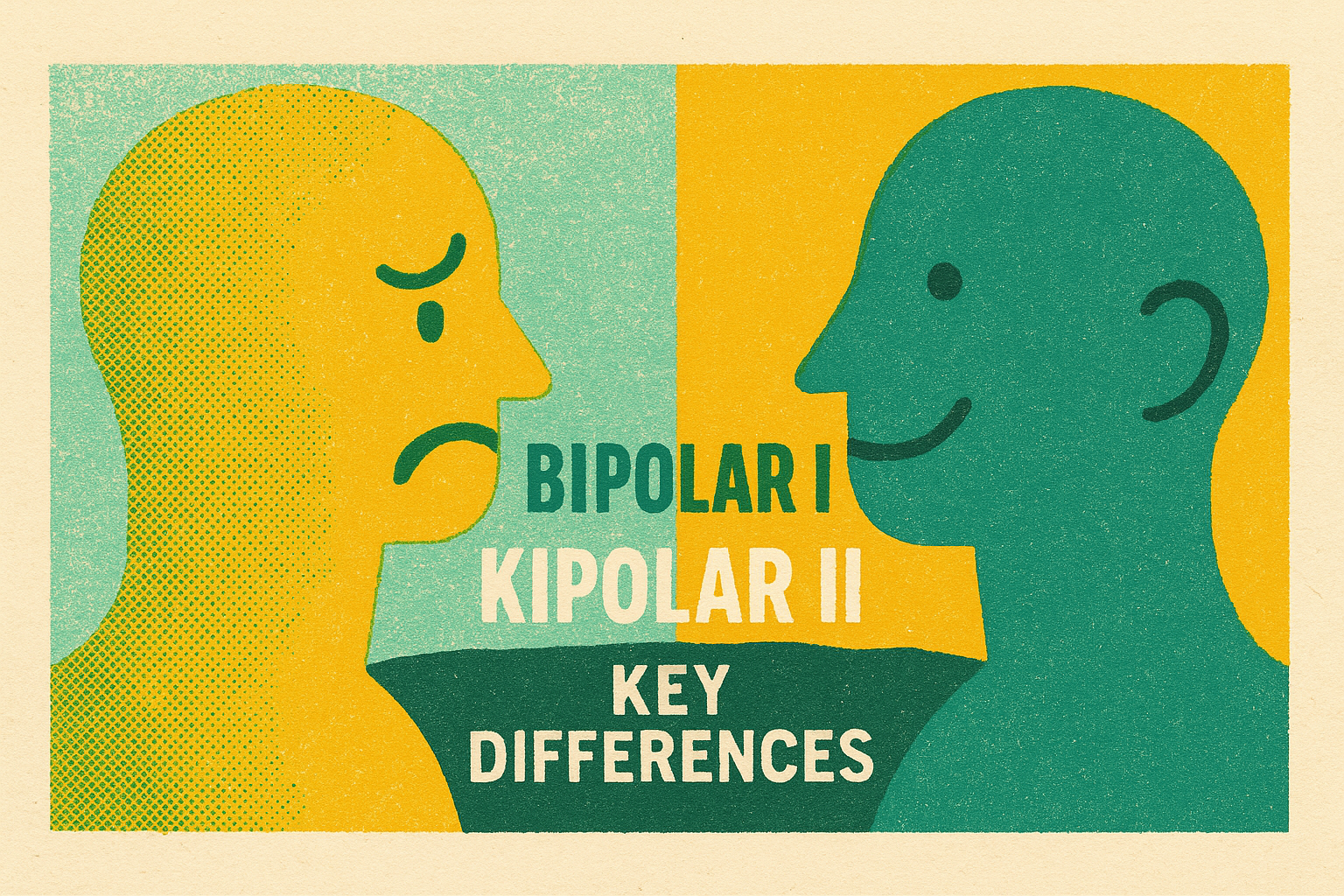
The line between Bipolar 1 and Bipolar 2 comes down to one thing: what happens during the "up" episode. Mania versus hypomania, and that single distinction drives diagnosis, risk, and treatment in ways that catch even seasoned clinicians off guard. Bipolar 2 didn't exist as its own diagnosis until 1994, and psychiatry, in a lot of ways, is still paying for that late arrival. Once you see what actually separates a manic episode from a hypomanic one, the rest starts to make sense: why misdiagnosis is so common, why neither subtype is a watered-down version of the other, and why treatment has to diverge depending on which one you're actually looking at.
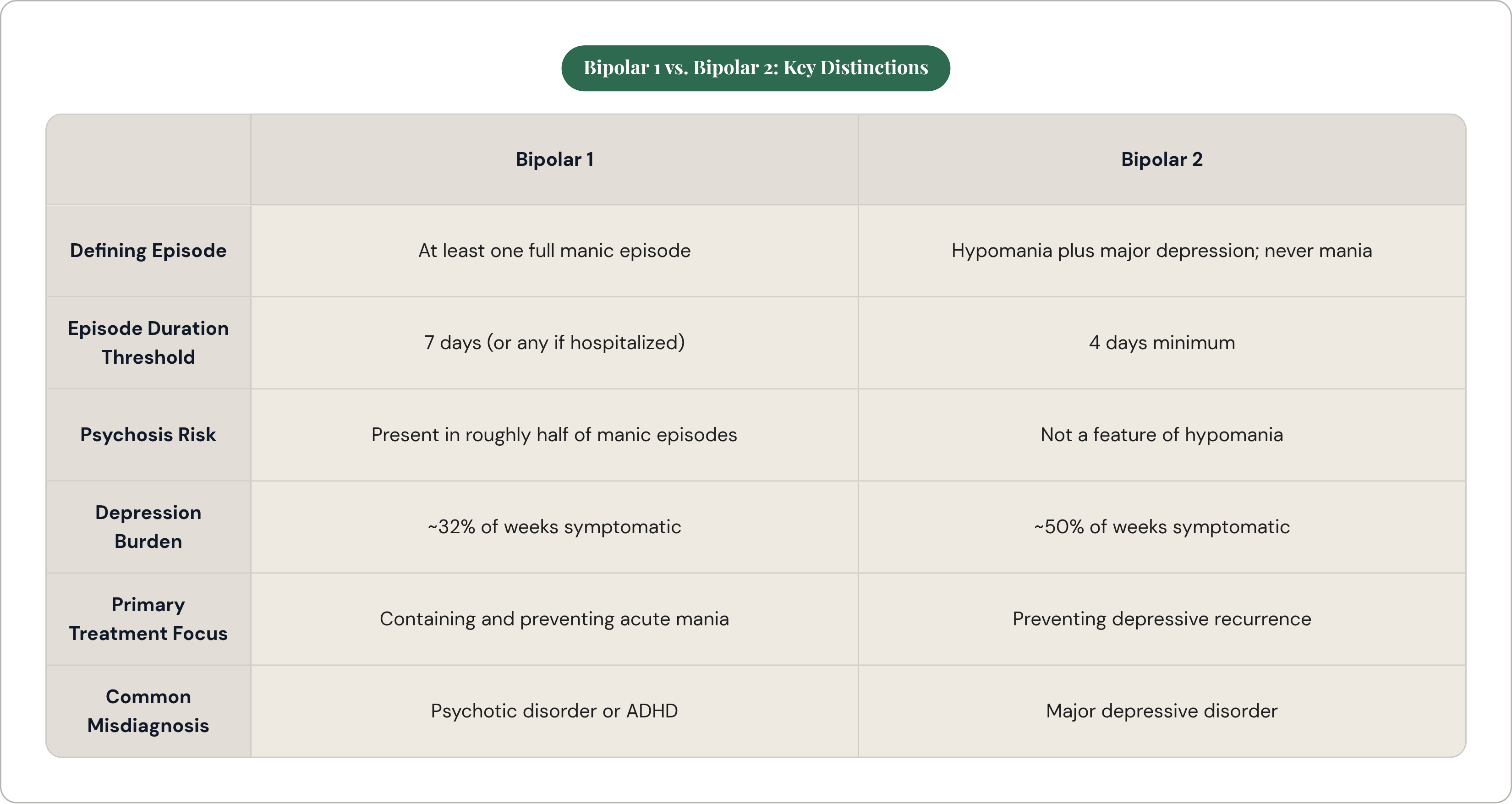
The DSM-5 draws the line at a specific question: has this person ever had a full manic episode? Bipolar 1 requires at least one, lasting a week or longer, or any length at all if it lands someone in the hospital. Bipolar 2 requires at least one hypomanic episode plus a major depressive episode, but never mania. Cross that line once, even a decade into a Bipolar 2 diagnosis, and the diagnosis flips to Bipolar 1, with no exceptions and no partial credit.
How mania and hypomania differ in practice, not just on paper
On paper they read like cousins: elevated mood, more energy, less sleep, thoughts moving faster than usual. The resemblance falls apart once you ask what each state does to a person's grip on what's actually real.
Psychosis, hallucinations, delusions, a full break from consensus reality, shows up in roughly half of Bipolar 1 manic episodes. Insight is what collapses, and that's the part that does the damage. Someone in a manic state might be convinced they've solved a problem nobody else can see, or that sleep is optional now, or that wiring their savings into a stranger's business plan is obviously, self-evidently correct. And they'll act on it, with total conviction, because from the inside it doesn't feel like a symptom.
Hypomania doesn't erase that awareness the same way. Most people going through a hypomanic episode still sense, somewhere in the back of their mind, that something's off, even if they'd rather not interrupt it. Functioning often shifts in ways that look good from the outside: sharper, more social, oddly productive. It doesn't shatter the way full mania can.
The duration cutoffs track this gap almost exactly. Hypomania needs four days minimum; mania needs seven, or any length if hospitalization becomes necessary. Psychosis risk and hospitalization risk cluster around mania specifically, which is why a single manic episode, just one, is enough to move someone's chart from Bipolar 2 to Bipolar 1. The label change reflects a genuinely different risk profile.
These aren't two points on the same dial, with mania as hypomania turned up louder. They're different states, with different consequences, and treating them as a matter of degree is where a lot of the confusion starts.
The depression burden that the mania-focused framing tends to obscure
Both subtypes involve depressive episodes, but Bipolar 2 carries a heavier one, and the numbers make the case better than any description could.
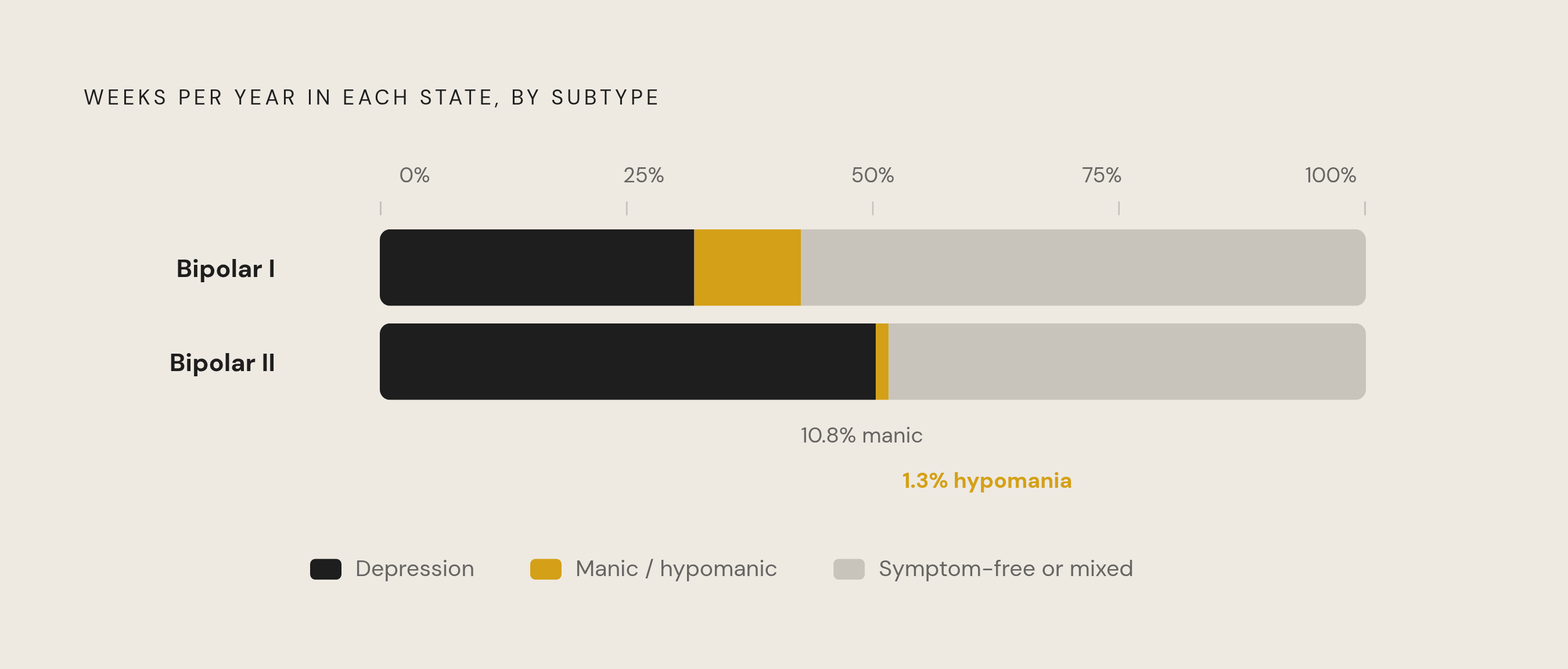
People with Bipolar 2 spend about 50.3% of weeks in a depressive state, against 31.9% for Bipolar 1. One longitudinal study tracked Bipolar 2 patients for up to 20 years and found them symptomatic 54% of the time overall, with depression accounting for 50% of those weeks. Hypomanic symptoms accounted for a mere 1.3%.
The episode that technically defines Bipolar 2, hypomania, is nearly a rounding error next to what people actually live through day to day. Depression fills the calendar; hypomania barely dents it.
Bipolar 1 carries its own depression burden too, and the ratio of depressive to manic or hypomanic episodes runs around 3 to 1 there. Depression dominates in both subtypes, just less overwhelmingly in Bipolar 1. So why does the popular image of Bipolar 2 still lean toward "the mild one"? Probably because hypomania is the visible, nameable symptom, and depression, however long it drags on, doesn't announce itself as a bipolar marker the way an elevated state does. It just looks like depression, because, day to day, it is.
Why "which type is more serious" is the wrong question
It's tempting to rank them. Bipolar 1 has the dramatic episodes, the hospitalizations, the psychosis risk, the kind of disruption to jobs and relationships that shows up over and over in clinical writeups from places like the Cleveland Clinic. Bipolar 2 has the depression that eats half a calendar year, every year, without fail. So which one's worse?
That question assumes severity sits on a single axis. Bipolar 1's mania is more acute and more likely to demand immediate intervention, worth taking seriously on its own terms. Bipolar 2's depressive chronicity carries a different kind of weight, one that accumulates rather than erupts, and that accumulation does real damage too, just slower, over years instead of over a hospitalization.
Suicide risk is where the ranking impulse gets hard to defend. People with bipolar disorder overall face a suicide risk 10 to 30 times higher than the general population, regardless of subtype. A 2024 systematic review and meta-analysis in the Journal of Affective Disorders found Bipolar 2's suicide risk doesn't fall meaningfully short of Bipolar 1's; some of the researchers involved suggest it might run higher, given how much time patients spend submerged in depression rather than cycling in and out of it. The findings aren't unanimous, some studies point one way and some the other, and neither subtype comes out looking like the safe one.
Life expectancy tells a similar story. Both subtypes are linked to a reduction of roughly 9 to 13 years compared to the general population, and that gap doesn't seem to care much which label sits on the chart. These are different risk profiles, built differently, not two rungs on the same ladder.
How often the wrong diagnosis is made, and what causes it
Misdiagnosis in bipolar disorder isn't the exception. It's closer to the norm, and the numbers back that up clearly. A survey from the National Depressive and Manic-Depressive Association found 69% of patients with bipolar disorder were initially misdiagnosed, and more than a third stayed misdiagnosed for a decade or longer. The average gap between first symptoms and an accurate diagnosis runs somewhere between 5 and 10 years. That's a decade of someone's life spent in the wrong treatment lane.
Bipolar 2 gets misdiagnosed more often, almost always as major depressive disorder. The mechanism is almost boringly simple: people show up at a clinic when they're suffering, and depression is what brings them through the door. Hypomania doesn't send anyone running for help, because it can feel good. Productive, sharper, more energy, a sense of finally being on top of everything, none of it registers as cause for concern. So it goes unmentioned, sometimes because the patient never thought to bring it up, sometimes because they never registered it as a symptom in the first place. A clinician who doesn't specifically ask about past elevated states sees depression, and treats depression.
Bipolar 1 gets misread too, mistaken for a primary psychotic disorder, or for ADHD, or written off as substance-induced. But full mania tends to be dramatic enough, disruptive enough, that it forces an evaluation fairly fast. Bipolar 2's quieter presentation doesn't create that same urgency, so it just lingers.
There's a structural piece underneath the individual blind spots too. Bipolar 2 has only existed as a formal diagnosis since 1994, and clinical training around recognizing hypomania has lagged behind that recognition ever since. A retrospective study of 808 patients found that those with Bipolar 2 waited longer for appropriate treatment and were exposed more often to antidepressants early in the illness. Which leads straight into the next problem.
Why antidepressants alone can make Bipolar 2 worse, not better
Depression walks into a clinic, and the reflex is an antidepressant. That's the right call for unipolar depression, but it can be badly wrong for depression that's actually one pole of an undiagnosed bipolar cycle.
Antidepressants given without a mood stabilizer can push a bipolar patient into hypomania or a mixed episode, and they've been tied to worsening rapid cycling rather than calming it down. Somewhere between 30% and 40% of bipolar patients treated with antidepressants carry a documented risk of manic induction. This shows up again and again in the clinical literature, study after study.
A patient with undiagnosed Bipolar 2 gets treated for depression, gets the antidepressant, and instead of leveling out, starts cycling faster. The clinical picture gets murkier instead of clearer, which makes the correct diagnosis harder to reach, which delays the correct treatment even further. Years can pass this way before anyone catches it.
This is why the mania and hypomania distinction matters outside a textbook. Get it right, and the treatment plan stabilizes someone's life. Get it wrong, and the very treatment meant to help can push a person further off balance.
How treatment strategies diverge once the correct subtype is identified
Once the subtype is settled, treatment for both becomes a long game aimed at steadiness across the whole cycle, not just putting out today's fire.
For Bipolar 1, the central job is controlling and preventing full manic episodes. Mood stabilizers, lithium, valproate, lamotrigine, form the base, and combination therapy tends to beat single medications by a wide margin: lithium paired with an antipsychotic prevents around 80% of manic relapses, against roughly 40% for lithium alone. Single-medication approaches fail in something like 70% of Bipolar 1 cases, which is exactly why combination therapy became the standard instead of the exception. Acute mania sometimes requires hospitalization, and the broader plan gets built around heading that off well before it happens.
Bipolar 2 treatment points somewhere else. The priority shifts toward preventing depressive recurrence, since that's where most of the functional damage piles up over the years. Mood stabilizers still anchor the plan, but the logic behind dosing and selection changes when the target is chronic recurring depression instead of acute mania. Antidepressants aren't banned outright, but they get introduced carefully, alongside a mood stabilizer, never alone as first-line treatment. Rapid cycling, four or more mood episodes in a year, shows up more often in Bipolar 2 and adds a layer of complexity a standard episodic plan isn't built to handle on its own.
Psychotherapy runs alongside medication for both, and it carries real weight of its own. Cognitive behavioral therapy works on the thought patterns feeding into mood shifts, while interpersonal and social rhythm therapy focuses on keeping daily routines steady, since disrupted sleep and irregular schedules can trigger episodes in either direction. DBT and ACT have shown real benefit too, particularly for the emotional volatility that rides along with either subtype.
The split in treatment traces back to the same distinction this piece opened with. Mania calls for containment, for crisis prevention, for a plan built around the real chance of acute breakdown. Hypomania calls for pattern recognition, for watching the long horizon, for catching the slow drift toward depression before it swallows half the year again.
What both subtypes share: prevalence, onset, and the reality of living with a cycling condition
Step back from the differences for a second, because the overlap matters just as much. Bipolar disorder affects an estimated 2.8% of U.S. adults in a given year, with lifetime prevalence around 4.4%. That's a meaningful share of the population. A 2024 analysis in the Journal of Affective Disorders put lifetime prevalence of Bipolar 1 and Bipolar 2 at roughly 1% each, meaning the two are close to evenly split rather than one being a niche variant of the other.
Onset tends to land young. Clinical features typically show up around age 15, with a median onset near 20, and more than 70% of people show signs before turning 25. This is, overwhelmingly, a condition that begins in adolescence or early adulthood, not midlife. Bipolar 1 appears at roughly equal rates across men and women, while Bipolar 2 shows up more often in women, which tracks with the higher rate of rapid cycling researchers have observed in women as well.
Whichever subtype someone lives with, the work doesn't stop between episodes. Medication adherence, sleep regulation, stress management, watching for early warning signs before a cycle turns; these run continuously, for Bipolar 1 and Bipolar 2 alike, for as long as the condition is being managed. Neither one lets a person clock out for good.
Both carry real weight, just distributed differently. Bipolar 1 through the acute disruption of full mania, the hospitalizations, the strain on jobs and relationships that comes with an episode severe enough to upend a life overnight. Bipolar 2 through the slower grind of chronic depression and a form of elevation, hypomania, quiet enough that the people closest to someone living with it often never register it as illness at all.
Where someone lands on this line isn't a verdict on how much they suffer. It's closer to a coordinate, one that points toward the treatment approach actually built for the person in front of you rather than a generic one. Knowing which subtype you're dealing with is the first step. Getting care that matches it, instead of years of care that doesn't, is the one that actually changes how the next decade goes.