ADHD Testing in Adults Evaluation Process Explained
A clinical diagnosis requires multiple evidence sources, not a single test.
About 15.5 million U.S. adults carried an ADHD diagnosis in 2023, and more than half, 55.9%, got that diagnosis as adults rather than as kids. That figure alone should retire the old assumption that ADHD is something doctors catch in second grade or miss for good. For most diagnosed adults, the evaluation happened well after high school, sometimes well after their own kids were born, and the process that got them there is rigorous and, for most people walking in, largely unfamiliar.
Why now? Telehealth access widened during the pandemic and never fully retracted, so an adult who once faced a six-month wait for an in-person psychiatric intake can sometimes get a virtual appointment within days. Social media did its own work too, surfacing descriptions of inattentiveness and emotional dysregulation that a lot of adults had spent years filing under "personality flaw" or "just lazy." And then there are the life transitions: a new job with less structure, a return to school, a first child, a promotion that suddenly demands executive function skills a person never had to build because their old routine papered over the gap.
The stakes reach past any one person's relief at finally having a name for the struggle. Adult ADHD carries an estimated $122.8 billion annual societal cost in the U.S., a figure that still undersells the personal toll of years spent on misattributed failure, strained marriages, jobs left or lost. Most adults approaching an evaluation have no idea what the process actually involves, and that uncertainty alone delays people, or talks them out of starting at all. Worth mapping out, then, stage by stage, what a real evaluation looks like, and worth saying plainly where the common assumptions go wrong.
What the evaluation is actually trying to establish
Start with the fact that trips up most first-time patients: there is no blood test for ADHD. No brain scan lights up a region and confirms anything. No fifteen-minute questionnaire spits out a definitive yes or no. Diagnosis is a clinical judgment, built by a trained provider weighing several independent sources of evidence against a specific set of criteria. Treating it like a single-test result is the first mistake most people make.
The diagnostic criteria are more exacting than most people expect. A diagnosis requires symptoms of inattention and/or hyperactivity-impulsivity that are persistent, show up across multiple settings, and critically, cause measurable functional impairment. Trouble focusing during a boring meeting doesn't meet the bar. Missing deadlines, losing jobs, or damaging relationships because of chronic inattention does.
This rigor exists because ADHD symptoms overlap heavily with anxiety, depression, bipolar disorder, sleep disorders, and thyroid disease, among others. Restlessness, poor concentration, low motivation: these show up across a dozen different diagnoses, and the structured framework exists precisely to stop a clinician from mistaking one for another.
Adult diagnosis is genuinely harder than diagnosing a seven-year-old, whatever the stereotype about kids being the "real" cases suggests. Kids present with fairly recognizable patterns; adults present with something messier, sanded down by decades of compensatory habits and elaborate systems built to mask executive dysfunction. Add comorbid conditions, a trauma history, maybe past substance use, and clinicians are untangling a genuinely complicated picture. Even specialists disagree on exactly where the symptom threshold should sit, which is part of why this section matters more than the marketing around ADHD screening tends to let on.
The evaluator builds a case, piece by piece, from multiple independent data streams. Patient and provider are running something closer to a shared investigation than a test to pass or fail.
Who conducts the evaluation and how to find one
Three kinds of providers commonly do this work, and picking the wrong one for a given situation wastes months, sometimes longer. Psychiatrists can diagnose and prescribe medication, which makes them a common first stop for adults who suspect they'll want pharmacological treatment. Psychologists can diagnose and, in many states, administer full neuropsychological testing, though they generally can't prescribe. Some primary care providers screen and diagnose too, but a rushed fifteen-minute primary care screen covers a lot less ground than the fuller evaluation described in the sections below, and treating that screen as equivalent to a specialist workup is exactly the kind of shortcut that leads to a missed comorbidity.
For complicated cases, neuropsychologists are worth seeking out specifically rather than settling for whichever provider has the shortest wait list. A suspected learning disorder, a history of brain injury, or one prior inconclusive evaluation: any of these is reason enough to find a specialist rather than repeat the same general workup a second time.
Virtual evaluations follow the same clinical standards as in-person ones, and roughly half of adults with ADHD have used telehealth for ADHD-related services at some point. In regions where in-person psychiatric appointments run months out, a virtual intake can happen within a week. Some practices have moved toward a hybrid model: an initial in-person intake, followed by virtual follow-ups for medication management.
A worry stops adults before they even book the appointment: what if there are no report cards, no childhood evaluations, nothing from the school years to hand over? That worry doesn't hold up. Clinicians build developmental history through the interview itself and through collateral sources, covered in detail further down. Old records help. Their absence has never been grounds to turn a patient away.
The clinical interview: the center of the entire evaluation
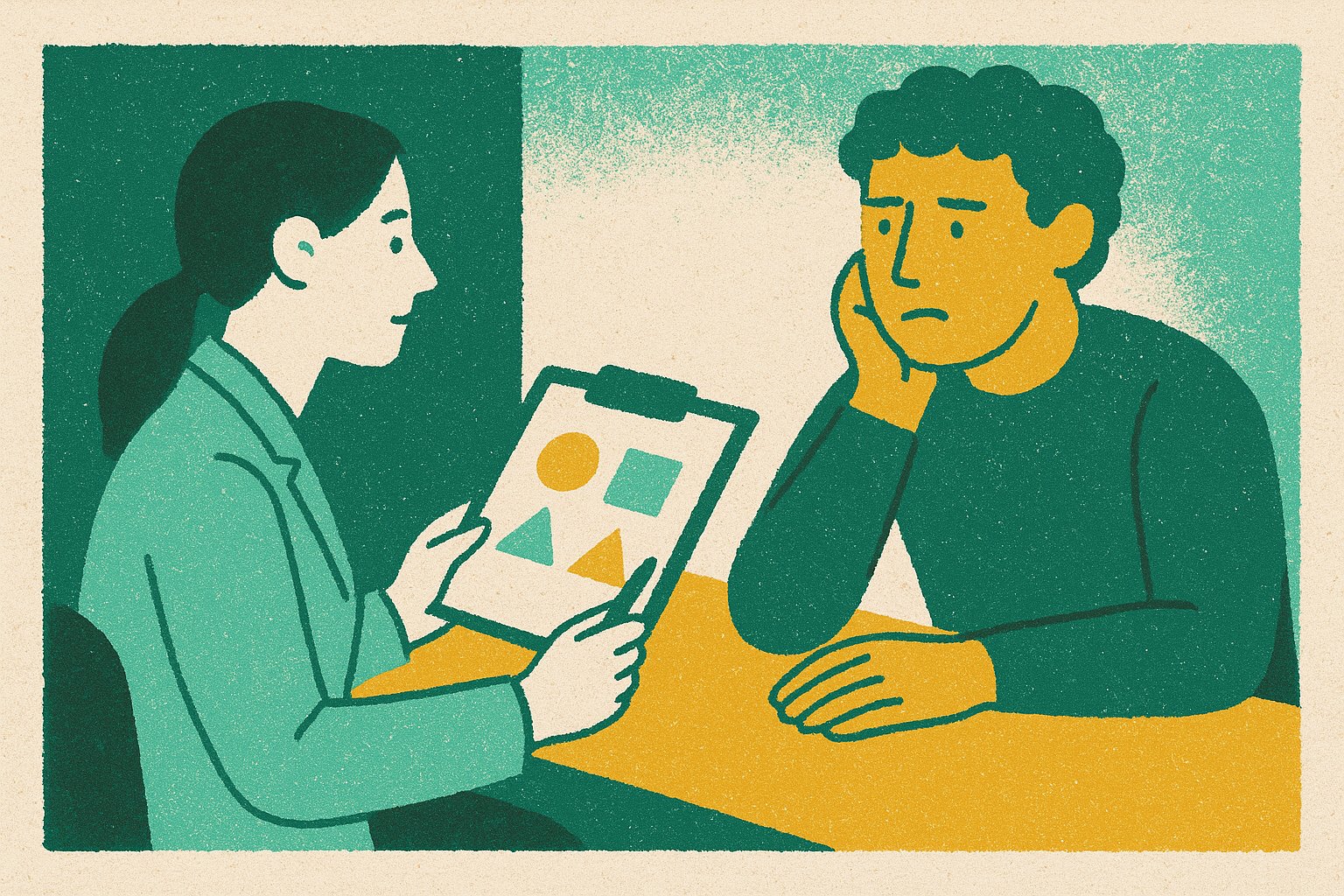
This is where the real diagnostic work happens, and it typically runs 30 to 90 minutes, longer than most people expect from a single medical appointment. It moves like a conversation, shaped by follow-up questions rather than a fixed script, which is part of why no online quiz can substitute for it no matter how many DSM-5 items it borrows.
The clinician wants to know what current symptoms look like day-to-day, in which settings they appear, and how long they've been part of the person's life. Then the conversation moves backward: what was school like, did any teacher ever flag attention or behavior problems, how did this person function before the demands of adulthood forced the issue. From there it moves through occupational history (patterns of reliability, task completion, conflict at work), academic history (grades, dropped classes, accommodations sought), and functional impairment across finances, relationships, and basic household management.
Adult evaluations pay particular attention to executive function and emotional regulation, and there's a reason for that emphasis. Childhood hyperactivity often quiets by adulthood, replaced by something less visible: difficulty planning, chronic procrastination, emotional reactivity that seems outsized for the situation. These domains are frequently where adult ADHD shows itself most clearly, precisely because the loud, external symptoms of childhood have gone underground.
Beyond the content of the answers, the clinician is listening for consistency. Does the impairment show up everywhere, or only in one narrow context? Are there signs pointing toward a different explanation entirely? This listening-between-the-lines is arguably the real skill being exercised here, more than any specific question on the list.
Building a rough timeline beforehand, a loose map of school, jobs, and relationships over time, makes the appointment go further. Trying to reconstruct fifteen years of history cold, in real time, under a clinician's gaze, is harder than it sounds, and it shows.
Standardized rating scales and what they measure
Interviews are rich but subjective. Rating scales add a standardized, reproducible measure of how often and how severely symptoms occur, benchmarked against known populations.
Several instruments show up repeatedly in practice. The Adult ADHD Self-Report Scale, or ASRS, is the most widely used self-report screener; a six-item version screens for probable ADHD in general community settings, an 18-item version offers fuller symptom coverage, and an updated version aligned with DSM-5 criteria, the ASRS-5, is now in circulation. Conners' Adult ADHD Rating Scales, or CAARS, measure symptom severity and include versions completed by an outside observer rather than the patient. The Diagnostic Interview for ADHD in Adults, DIVA, is a structured interview built directly around DSM-5 criteria. The Brown Attention-Deficit Disorder Symptom Assessment Scale zeroes in specifically on executive function.
How much weight should a single score carry, though? Less than most people assume, and this is the point where a lot of self-diagnosis conversations online quietly go wrong. The ASRS shows strong internal reliability, with a Cronbach's alpha around 0.90, yet its sensitivity sits only around 69%. That gap matters: a negative screening result does not rule ADHD out, and no responsible clinician treats a rating scale score as a verdict rather than a data point. A fifteen-minute questionnaire with a printed score, taken in isolation, amounts to a screening rather than a full evaluation, full stop.
Some instruments build in validity checks, embedded items designed to catch inconsistent responding or exaggeration. That's quality control running underneath the evaluation, quiet infrastructure most patients never notice.
These scales cannot establish causation, rule out a competing diagnosis, or replace clinical judgment. They function as evidence submitted into the case, weighed alongside everything else.
Collateral information and why providers ask for outside perspectives
Collateral information means exactly what it sounds like: input from a partner, parent, sibling, close friend, or coworker who has watched this person function over time. There's a specific, almost paradoxical reason this matters so much in adult ADHD evaluations.
Adults are often unreliable narrators of their own attention and behavior, not because they're lying but because impaired self-monitoring is itself part of the condition. A person who has spent thirty years normalizing chronic lateness or scattered follow-through may genuinely not register it as a pattern worth mentioning. Someone else in their life usually does, which is exactly why a self-report questionnaire alone will miss what a coworker or spouse would flag in one sentence.
Collateral input gathered across different settings, home versus work versus social life, helps the provider figure out whether symptoms are pervasive or confined to one context, which loops directly back to the multi-setting requirement covered earlier. This can take a few forms: a short questionnaire filled out by someone close to the patient, a brief phone call between that person and the clinician, review of old records like report cards or prior psychological evaluations, or some combination of all three.
When no collateral source is available, the evaluation still proceeds; self-report and clinical interview carry it forward on their own. Collateral information strengthens the case, but it's rarely a hard requirement, and being asked for it is not a signal that the provider doubts the patient's account. It's standard practice in a careful evaluation, nothing more pointed than that.
Neuropsychological testing: when it is added and what it contributes
Not every evaluation includes formal neuropsychological testing, and that's by design, not by oversight. When it does get added, it contributes objective, standardized data on specific cognitive functions: working memory, processing speed, sustained attention, executive control.
One example is the Test of Variables of Attention, or TOVA, which measures sustained attentiveness and produces results that can inform the clinical picture. Computerized cognitive batteries more broadly can produce objective readouts on memory and reasoning that supplement the more subjective interview and rating scale data.
Here's the limitation, and it's the one most patients get wrong going in: no single neuropsychological test, and no combination of them, has enough sensitivity and specificity to diagnose ADHD on its own. These tools add the most value in specific circumstances, functioning as one input among several, not as a tiebreaker. That means when the clinical picture stays ambiguous after the interview and rating scales, when a learning disorder or broader cognitive impairment might be tangled up with the ADHD symptoms, when a complicated psychiatric history is muddying the differential diagnosis, or when a patient needs formal documentation to request academic or workplace accommodations. Anyone expecting a testing session to settle the question outright is going to be disappointed by what the data can actually support.
A high score on an attention task doesn't rule ADHD out, either. Adults with strong cognitive ability frequently compensate during a short, structured testing session in ways that don't reflect how they function across a messy, unstructured workday. The lab setting rarely mirrors the demands of daily life, and any clinician relying on neuropsychological testing knows that gap well.
Ruling out other conditions before confirming the diagnosis
Inattention, restlessness, and poor concentration are not owned by ADHD. They show up across a genuinely wide range of conditions, which is exactly why differential diagnosis takes up real time in a thorough evaluation. Skip it, and the fastest likely outcome is the wrong treatment plan built on the wrong diagnosis.
Anxiety disorders consume cognitive bandwidth through chronic worry in ways that closely mimic inattentive-type ADHD. Depression brings its own version of poor concentration and low motivation, alongside executive dysfunction that can look nearly identical from the outside. Bipolar disorder introduces another wrinkle: the elevated, distractible stretches of hypomania or mania can be mistaken for ADHD symptoms if a clinician doesn't look closely at the pattern over time. Sleep disorders, whether chronic sleep deprivation or untreated sleep apnea, produce attention and memory deficits that overlap heavily with ADHD presentations. Thyroid disease, particularly hyperthyroidism, can generate restlessness, inattention, and irritability. Trauma history, including PTSD, brings hypervigilance and concentration trouble that shares real territory with an ADHD presentation.
A large majority of adults with ADHD carry a documented co-diagnosis of another mental health condition, so the real task is figuring out what else is present alongside ADHD, weighing multiple diagnoses together rather than treating them as mutually exclusive. Physical health conditions frequently co-occur with ADHD in adults, adding further complexity to the diagnostic and treatment picture.
So when a clinician spends twenty minutes asking about sleep quality or mood history during an ADHD evaluation, that questioning serves the ADHD assessment directly. It's the differential diagnosis process doing exactly what it's supposed to do.
How the provider pulls everything together into a diagnosis
Eventually all of it, the interview, the rating scales, any collateral input, any neuropsychological testing, and the differential diagnosis review, gets weighed together against DSM-5 criteria. This synthesis step is where the provider decides what the whole case actually adds up to, and it's precisely the step that gets skipped when an evaluation is rushed, which is also the step patients should ask about directly if a workup feels thin.
A formal diagnosis specifies which presentation applies: different presentations depending on which symptom clusters dominate. It assigns a severity level based on how much symptoms interfere with daily functioning. And it accounts for whatever co-occurring conditions surfaced during the evaluation, describing how they interact with the ADHD presentation rather than treating them as separate, unrelated findings.
Sometimes the conclusion is not ADHD at all. A thorough evaluation might determine that anxiety, or a sleep disorder, or something else entirely, explains the symptom pattern better. That outcome reflects the process working correctly, since the entire point is redirecting care toward whatever will actually help.
Whatever the conclusion, a responsible provider walks through the reasoning behind it clearly, covers the treatment options on the table, medication and behavioral interventions, and makes referrals if the evaluation surfaced needs outside their own scope. In comprehensive evaluations, especially neuropsychological ones, this all gets written up in a formal report, useful later for ongoing treatment planning.
Barriers that keep adults from completing an evaluation
Here's the number that should sit uncomfortably alongside everything above: 36.5% of U.S. adults with ADHD received no treatment at all, no medication, no counseling, in the past year. Diagnosis is the prerequisite for all of it, so every barrier to evaluation is also, functionally, a barrier to treatment, and these two problems move together far more than most people assume.
Long wait times for psychiatry and neuropsychology appointments remain common in a lot of regions, sometimes stretching months. Cost compounds the problem; comprehensive neuropsychological evaluations in particular can run expensive and are inconsistently covered by insurance, leaving patients to weigh out-of-pocket costs against the value of a more thorough workup. Add basic logistical friction on top, time off work, childcare, finding a provider actually accepting new patients, and it's clear why so many adults who suspect they have ADHD never make it past the first phone call.
These barriers don't make the underlying condition less real, or the eventual diagnosis less worth pursuing. They explain, plainly, why the gap between suspicion and confirmation stays so wide for so many adults. Knowing what an evaluation actually involves, and why each stage exists, is the piece within a person's control.