Panic Attack vs Heart Attack Distinguishing Features
Knowing the differences between these two medical crises can prevent dangerous delays in treatment.
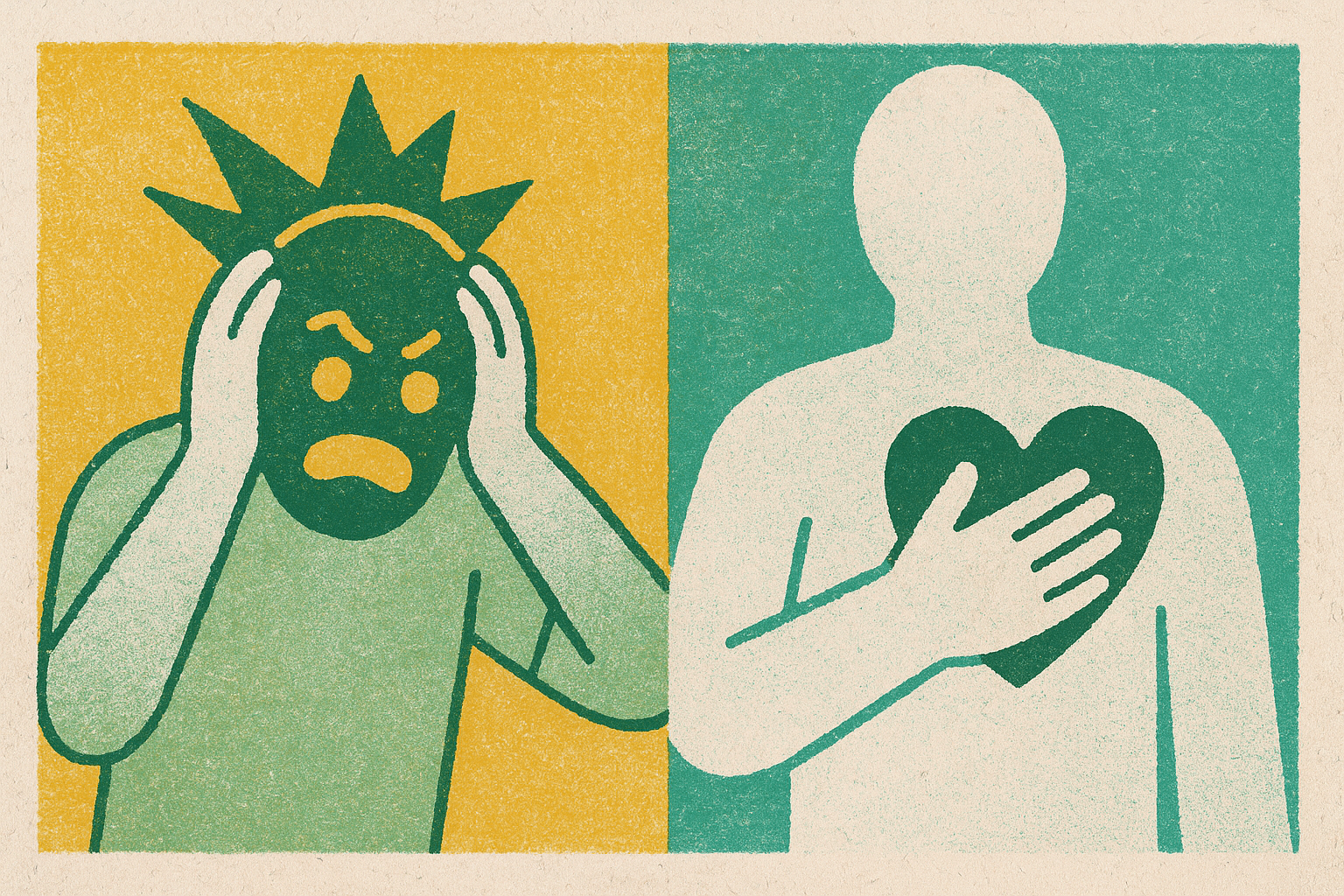
Panic attacks and heart attacks can feel almost identical from the inside: chest pain, a pounding heart, sweating, a wave of dread that something is badly wrong. That overlap isn't a coincidence or a failure of self-awareness, it comes from shared biology. But the two conditions diverge sharply in pain quality, timing, triggers, and risk profile, and knowing where can be the difference between calling 911 and waiting it out at home when waiting is the wrong move.
What each event actually is, and what is happening inside the body
A heart attack, or myocardial infarction, is a plumbing problem. Blood flow to part of the heart muscle gets blocked, usually by a clot, and oxygen stops arriving where it's needed. Without that oxygen, heart tissue starts to die. It's structural, it's progressive, and it does not resolve on its own. That last part matters more than almost anything else in this piece: there is no version of a heart attack that just passes if you wait long enough.
A panic attack works on entirely different machinery. It's a surge of adrenaline set off by the autonomic nervous system, the same network that governs heart rate, breathing, and blood pressure without any conscious input. No blockage. No dying tissue. The body is reacting to a threat that isn't physically present, but the chemical flood it produces (the racing pulse, the tight chest, the shallow breathing) mimics a blocked artery closely enough to fool the person going through it.
That shared wiring is the entire reason this gets confusing. Panic attacks aren't rare: research puts their lifetime prevalence at 22.7%, and panic disorder, meaning attacks that recur, affects nearly 3% of U.S. adults in a given year and close to 5% over a lifetime, according to NIMH figures. Neither condition deserves to be dismissed. A panic attack won't kill someone by itself, but it's genuinely disabling for people who live with it, while a heart attack is an emergency where outcomes are measured in minutes, not hours.
How the chest pain differs in character and location
If there's one clue worth weighing before any test gets run, it's what the pain actually feels like, not just where it registers on a 1-to-10 scale.
Heart attack pain tends to feel like pressure. Squeezing. A weight sitting on the chest. Dr. Mistyann-Blue Miller at Cleveland Clinic describes it as feeling "like an elephant sitting on your chest," and some patients describe it more as a dull ache or a burning sensation close to heartburn. Panic pain runs sharper. Dr. Bailee Blackburn of Piedmont notes that "a lot of people describe their chest pain in panic attacks as more of a sharp or shooting pain," a meaningfully different sensation from pressure, even though both get filed under "chest pain" when someone's trying to explain it to a 911 dispatcher.
Location tells the second half of the story. Heart attack pain often radiates outward: to the left arm, the jaw, the neck, the back, sometimes the stomach. As Dr. Miller puts it, "with a heart attack, pain radiates to other areas like the arm, jaw or neck." Panic pain usually stays put in the chest. Some numbness in the arm can show up during panic, but pain that actually travels from the chest to the jaw or the back leans hard toward cardiac, and that's a distinction worth trusting.
Neither clue settles anything on its own. Pain quality and location are inputs, not answers. The value comes from stacking them against everything else in this piece.
How onset, duration, and trajectory separate the two events
Timing might be the single most useful clue available in the moment, mostly because it takes no special training to notice.
Panic attacks come on fast, typically lasting between 5 and 20 minutes, a genuine crescendo. Heart attacks are usually slower burns: symptoms build gradually, tightening and intensifying rather than exploding all at once. That slow build is itself a signal, and it's one people tend to underrate because panic feels like the more dramatic experience in the moment.
Duration follows the same pattern. A panic attack typically runs 5 to 20 minutes, peaks around the 10-minute mark, and is usually over within 20 to 30 minutes. Heart attack symptoms don't behave that way, because there's no mechanism for a blocked artery to clear itself without medical help. Symptoms hold steady, get worse, or ease briefly only to come roaring back.
That last pattern, the fluctuation, is the trajectory clue doctors point to most often. Dr. Andrew Mathias of University of Rochester Medicine Cardiac Care puts it plainly: "If you're an anxious person or you've had a panic attack before, sit down and take some deep breaths or do some calming exercises. If the symptoms ease, it may more likely be a panic attack." Improvement without medical intervention leans toward panic; steady, worsening, or cyclical symptoms need to be ruled out as cardiac, immediately. Worth flagging, though: easing after a few calming breaths is reassuring, not conclusive. Some cardiac events genuinely ebb before they get much worse, so an early dip in intensity is a data point, not a discharge.
What triggered the episode, and what the setting reveals
Context does more work here than most people give it credit for.
Heart attacks show up classically after physical exertion: shoveling snow, climbing a few flights of stairs, any kind of sustained effort. Dr. Miller notes that "a heart attack might happen after shoveling snow or walking up a long flight of stairs." But they also happen at rest, and sometimes during sleep, where a silent heart attack can occur with no noticeable symptoms at all, which is its own argument for not assuming exertion is a prerequisite.
Panic attacks are usually tied to emotional triggers: stress, fear, an intrusive thought, a specific situation that sets off dread. Sometimes there's no identifiable trigger whatsoever, which is its own kind of unsettling. Panic attacks also happen during sleep more often than people assume. Nocturnal panic attacks do wake people up, and any chest symptoms during sleep warrant careful evaluation regardless of the time of day.
A useful shortcut for the middle-of-the-night scenario: waking up with chest symptoms and no history of panic attacks leans cardiac. Waking up with chest symptoms and a known history of panic leans more ambiguous. Both situations call for evaluation, but the history shifts the odds meaningfully.
Exercise muddies things further. A panic attack during or after physical activity generally needs an emotional stress trigger riding alongside the exertion, per Dr. Miller, not exertion by itself. So pure physical exertion followed by chest pain, with no accompanying emotional spike, points away from panic and toward something the heart is trying to say. That's the pattern to take seriously, not the reverse.
Accompanying symptoms that shift the odds toward cardiac
Some symptoms carry more diagnostic weight than others, and it's worth being blunt about which ones actually move the needle.
Radiating pain, to the left arm, jaw, neck, upper back, or stomach, is one of the strongest cardiac signals available outside a hospital. Panic pain rarely spreads that way. Research published in PMC on panic attacks presenting to emergency departments found circulatory symptoms in 65.2% of cases, respiratory symptoms in 57.6%, numbness or paralysis in 33.7%, dizziness in 19.6%, gastrointestinal symptoms in 14.1%, and autonomic symptoms in 12.0%. That's a wide spread, and it underscores how much overlap exists between the two conditions on paper. The distinguishing power comes from the combination, never any single item on that list.
Symptoms clustering toward cardiac: squeezing chest pain, radiation to the jaw or arm, cold sweats, nausea, onset tied to physical exertion. Symptoms clustering toward panic: sharp or stabbing chest pain, a heart rate that spikes fast and then plateaus, trembling, a sense of unreality or detachment from one's own body, a known history of prior attacks. Shortness of breath, sweating, and nausea show up in both conditions, so alone they don't discriminate much; their value only shows up in combination with everything else.
Women face a blind spot here worth naming directly, and it's not a minor one. Women are more likely than men to present with atypical cardiac symptoms, meaning shortness of breath, nausea, or jaw and back pain, without the classic chest pressure. Research has flagged that women are systematically undertreated for heart attacks, and according to the American Heart Association, women are seven times more likely than men to have a heart attack misdiagnosed as anxiety. That's not a small gap. It's a pattern with a body count.
How a person's age, history, and risk factors shape the probability
Age and history do more predictive work than almost any symptom checklist, full stop. As Dr. Sam Torbati, chair of Emergency Medicine at Cedars-Sinai, puts it: "The best predictors as to whether symptoms are due to panic attack versus heart attack are the patient's age and previous history of panic attacks."
Someone under 40, in good health, with a documented history of panic attacks sits in a lower-probability category for cardiac events. Panic is more likely there, though it should never be assumed outright just because the age checks out. Someone middle-aged or older, carrying any combination of hypertension, diabetes, obesity, high cholesterol, a smoking history, a family history of coronary artery disease, or diagnosed coronary artery disease already, sits in a much higher-probability category. HCA Florida Healthcare flags women 55 and older and men 45 and older as carrying elevated heart attack risk by age alone.
Here's where the picture gets genuinely complicated: panic disorder and heart disease are not mutually exclusive, and treating them as an either/or is the actual mistake most people make. People with panic disorder may carry an elevated likelihood of coronary artery disease compared to the general population. Research has found that a notable share of ED patients with panic disorder have a concurrent history of coronary disease. A known panic history doesn't grant immunity from a simultaneous cardiac event. If anything, it raises the stakes for careful evaluation rather than lowering them, which cuts directly against the instinct to wave off chest pain in a longtime panic patient as "just anxiety again."
There's also a narrower, sharper misdiagnosis risk worth flagging: supraventricular tachycardia, or SVT. SVT gets misdiagnosed as panic disorder in more than half of cases, according to research on the condition, because both start the same way, abrupt rapid palpitations, shortness of breath, chest discomfort. Telling them apart requires cardiac event monitoring, not guesswork, and definitely not a symptom checklist read off a phone screen.
What happens when the wrong call is made, misdiagnosis in both directions
Getting this wrong cuts both ways, though the two directions are not remotely equivalent in cost, and pretending they are is its own kind of error.
Missing a heart attack because it's mistaken for panic is the catastrophic direction, no real competition. Delayed treatment lets permanent damage accumulate in heart muscle, and that damage can mean lasting disability or death. Dr. Torbati's phrase for this, "time is muscle," is not an exaggeration: every additional minute without intervention is tissue that doesn't come back. Women bear a disproportionate share of this risk, given the seven-times-higher misdiagnosis rate documented by the American Heart Association. That's not an abstract statistic sitting in a paper somewhere. It's a systemic bias with real consequences attached to it.
The reverse error carries real costs too, and it's more common than people assume. As diagnostic tools have become increasingly sensitive, clinicians have noted that myocardial infarction can be over-identified as well as missed. People with panic disorder often cycle through emergency departments repeatedly, absorbing unnecessary cardiac workups while the actual underlying condition, the panic disorder itself, goes untreated. That's not a victimless outcome either. It's prolonged suffering dressed up as caution, and it delays the treatment that would actually help.
A narrative review published in Frontiers in Psychiatry in May 2024 argues for a biobehavioral approach that folds psychological and medical evaluation together rather than running them as separate tracks. The review zeroes in on six somatic symptoms as most critical for differential diagnosis: non-cardiac chest pain, palpitations, dyspnea, dizziness, abdominal distress, and paresthesia. Even with that framework in hand, there's no clean fix available at the bedside in the middle of an actual episode. Which is the real argument for seeking evaluation every time, rather than trying to self-diagnose off a symptom list, however detailed that list gets.
What doctors actually use to tell them apart
None of the pattern-matching in this piece replaces an actual test, and that's worth saying plainly rather than letting the reader assume otherwise. Dr. Joy Gelbman, a cardiologist at NewYork-Presbyterian/Weill Cornell Medical Center, explains it this way: "We can use tools like blood tests and electrocardiograms, along with context of the symptoms, to help rule out a heart attack."
The electrocardiogram, or EKG, measures the heart's electrical activity and can flag ischemia or arrhythmia within minutes. Troponin blood tests can detect markers of heart muscle injury. Both tools, used alongside the clinical context of symptoms, give physicians a much clearer picture than symptom patterns alone, though it comes with the tradeoff mentioned earlier: the possibility of results that require careful clinical interpretation. The HEART score is a clinical decision tool that combines patient history, EKG findings, age, risk factors, and troponin levels into a single risk stratification. Coronary computed tomography angiography, or CCTA, gives doctors direct imaging of the coronary arteries, used increasingly now that the imaging technology has improved enough to make that kind of discrimination reliable.
Dr. Blackburn's assessment cuts through any illusion that this is easy, even for trained professionals: "It can be difficult even for medical providers to tell the difference just on hearing your symptoms, so additional cardiac or lab testing is usually indicated to make sure we get the correct diagnosis and ultimately, treatment." If it's genuinely hard for a cardiologist listening to a patient describe symptoms in real time, self-diagnosis from home isn't a reasonable bar to hold anyone to. The clues in this piece raise or lower probability. They don't replace a test, and nobody should be treating them as a substitute for one.
How to respond in the moment, and when to call 911 without hesitation
The standing rule, consistent across every source cited here including University of Rochester Medicine Cardiac Care, is this: if chest pain lasts more than a few minutes, gets worse, or doesn't improve with rest, call 911. No exceptions carved out for people who feel confident it's "just anxiety," because that confidence is exactly the failure mode this entire piece has been describing.
For someone with a known history of panic attacks who suspects that's what's happening, the response is fairly concrete. Sit down. Slow the breathing down deliberately. Try grounding techniques, naming what can be seen, heard, felt, smelled, tasted, one at a time, and layer in progressive muscle relaxation along with the simple reminder that the episode will pass. If symptoms ease within several minutes, panic becomes more likely. But a first-time episode, or one that drags on longer than expected, still needs urgent evaluation regardless of how confident anyone feels in the moment. Anti-anxiety medication prescribed in advance for exactly this situation is fine to use, but that's a plan built with a doctor beforehand, never something improvised on the spot mid-episode.
Cedars-Sinai's guidance on when to go straight to the ER or call 911 covers new chest pain, especially anything that feels like tightness, squeezing, or heaviness, alongside shortness of breath, sweating, lightheadedness, pain radiating to the jaw or arm, or a ripping sensation in the chest or back. Anyone carrying known cardiac risk factors should treat these symptoms as urgent regardless of panic history. Older adults and people with cardiovascular risk factors in particular should err toward emergency care even when panic feels like the likely explanation, because the cost runs so unevenly between the two possibilities: waiting out a panic attack that turns out to be nothing costs twenty uncomfortable minutes, while waiting out what turns out to be a heart attack costs heart muscle that never comes back.
Sources
- The difference between a panic attack and a heart attack
- Panic Attacks vs. Heart Attacks: Understanding the Differences
- How to Tell the Difference Between a Heart Attack and a Panic Attack
- Anxiety attacks vs. heart problems: How to tell the difference | HCA Florida
- Heart Attack or Panic Attack: How to Tell the Difference | Cedars-Sinai
- How to tell the difference between a heart attack and panic attack | American Heart Association
- Panic Attack or Heart Attack? How to Tell the Difference | Health Matters | NYP
- ncbi.nlm.nih.gov