Rural Health Disparities in the United States
Rural mortality gaps have widened sevenfold as hospitals close and services vanish.
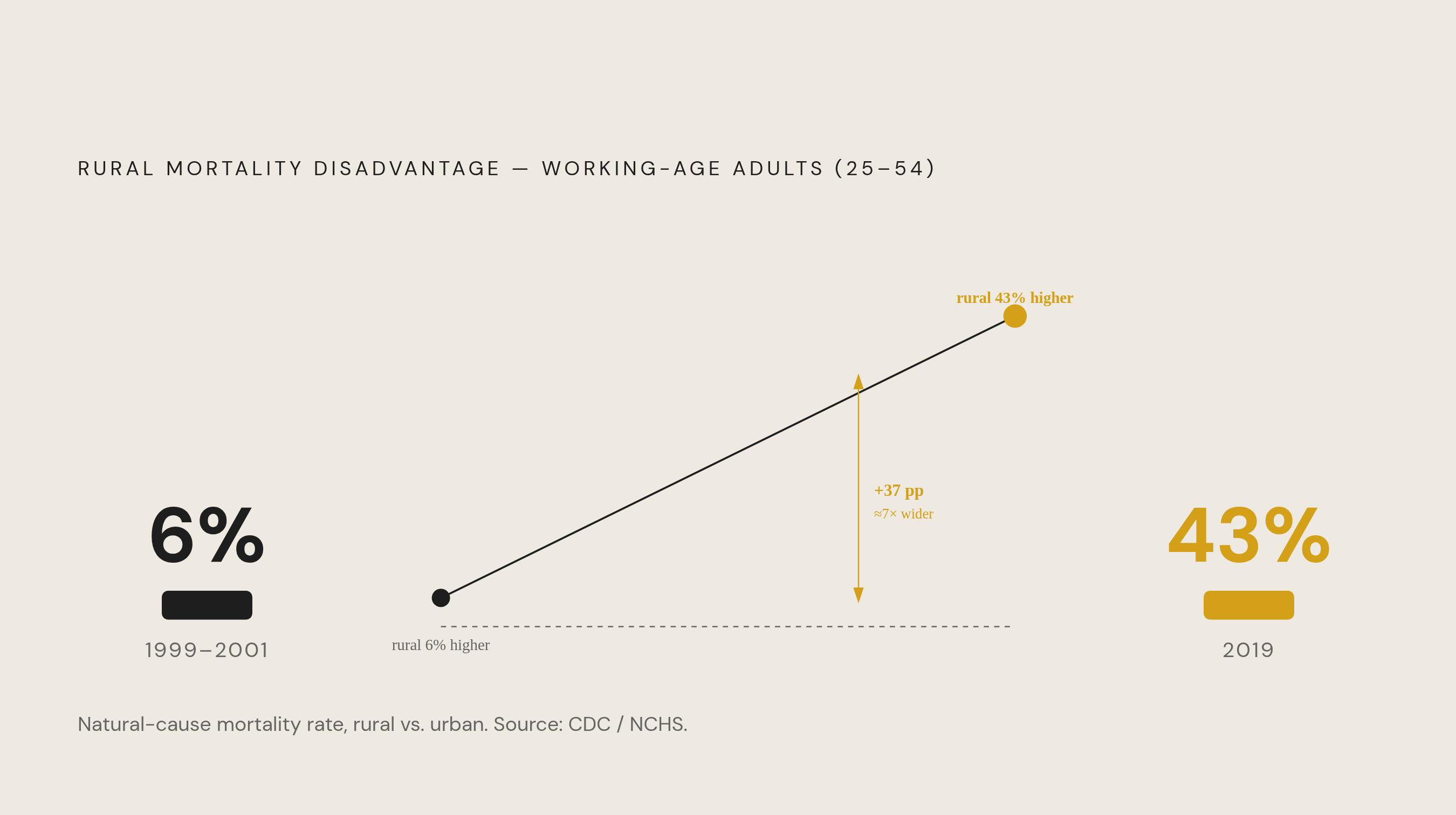
From 1999 to 2001, natural-cause mortality rates for working-age adults between 25 and 54 ran only 6% higher in rural areas than in urban ones. By 2019, that figure had climbed to 43% (Thomas et al., 2024). A near-sevenfold increase in relative disadvantage, accumulating across two decades while the policy conversation recycled the same familiar remedies.
I want to sit with that number for a moment, because it is strange. A 6% gap is a rounding error in the context of public health policy; it is the kind of difference that gets absorbed into confidence intervals and footnoted away. A 43% gap is not a statistical artifact. It is a signal that something structural changed, kept changing, and was not corrected. The question worth pressing is not simply what caused it, but what made the trajectory so resistant to arrest.
Rural populations carry higher rates of premature death across all five leading causes: heart disease, cancer, unintentional injury, chronic lower respiratory disease, and stroke. A burden concentrated in one disease category might be addressable by a targeted intervention. A disparity distributed across every major killer suggests something upstream: a systemic deficit in prevention, early detection, and chronic disease management rather than any discrete pathology of rural life. The gradient within rural America sharpens that picture further. The more remote the county, the steeper the mortality increase (Thomas et al., 2025). Isolation, in this framework, is not a quality-of-life variable. It is a clinical one.
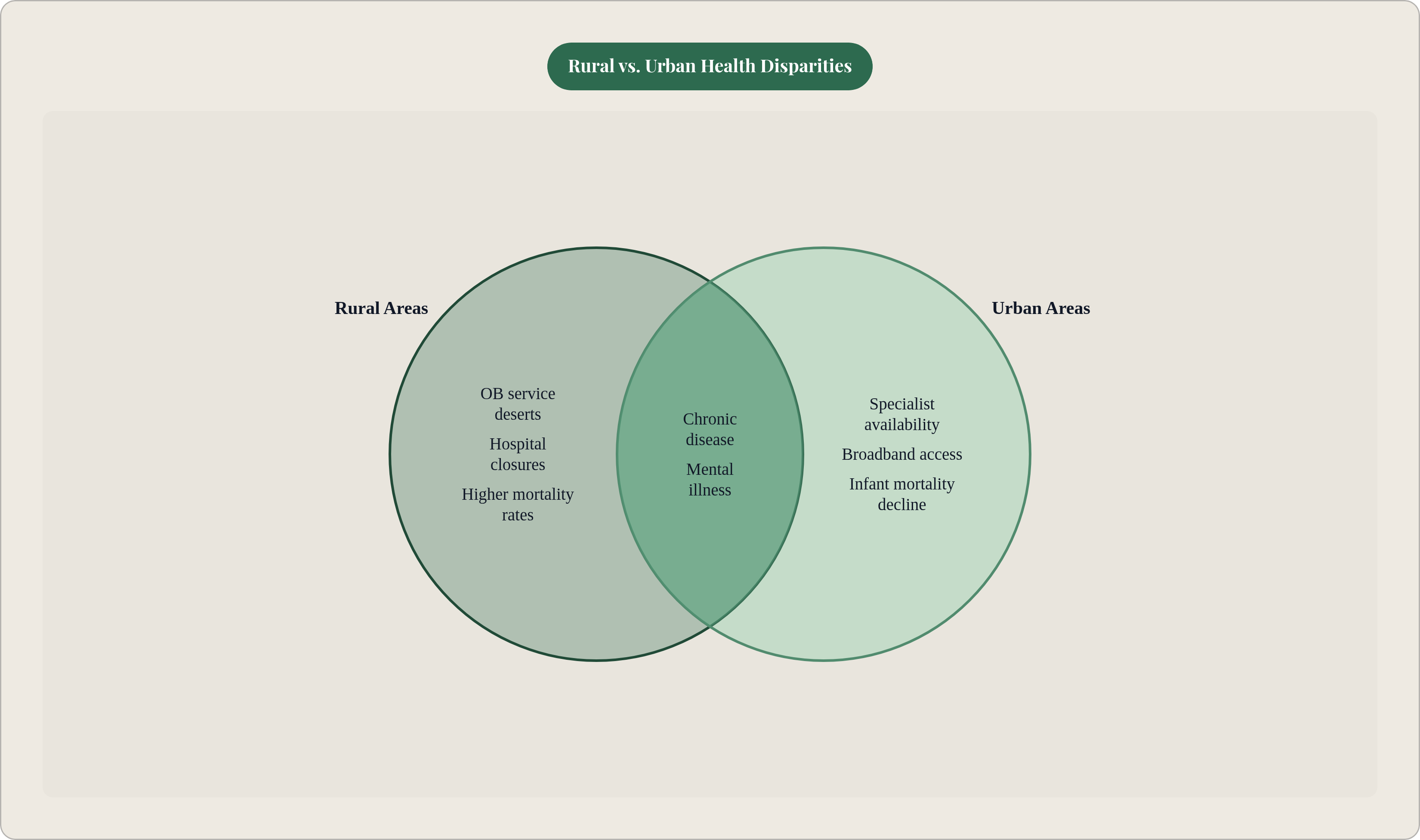
CDC data from 2025 show chronic illness rates diverging from urban counterparts since the mid-twentieth century. The mortality gap is, in significant part, the long-delayed expression of a chronic disease gap that was building for generations before anyone started counting the deaths systematically. Infant mortality adds another dimension: rural counties saw essentially no improvement from 2014 through 2023, while large metropolitan counties recorded a 6% decline. The gap spans the full life course.
What the numbers cannot do on their own is explain themselves. That requires tracing structural forces that, operating simultaneously, have produced an outcome no single factor could generate alone.
The Hospital Closure Wave and What Disappears with a Rural Hospital
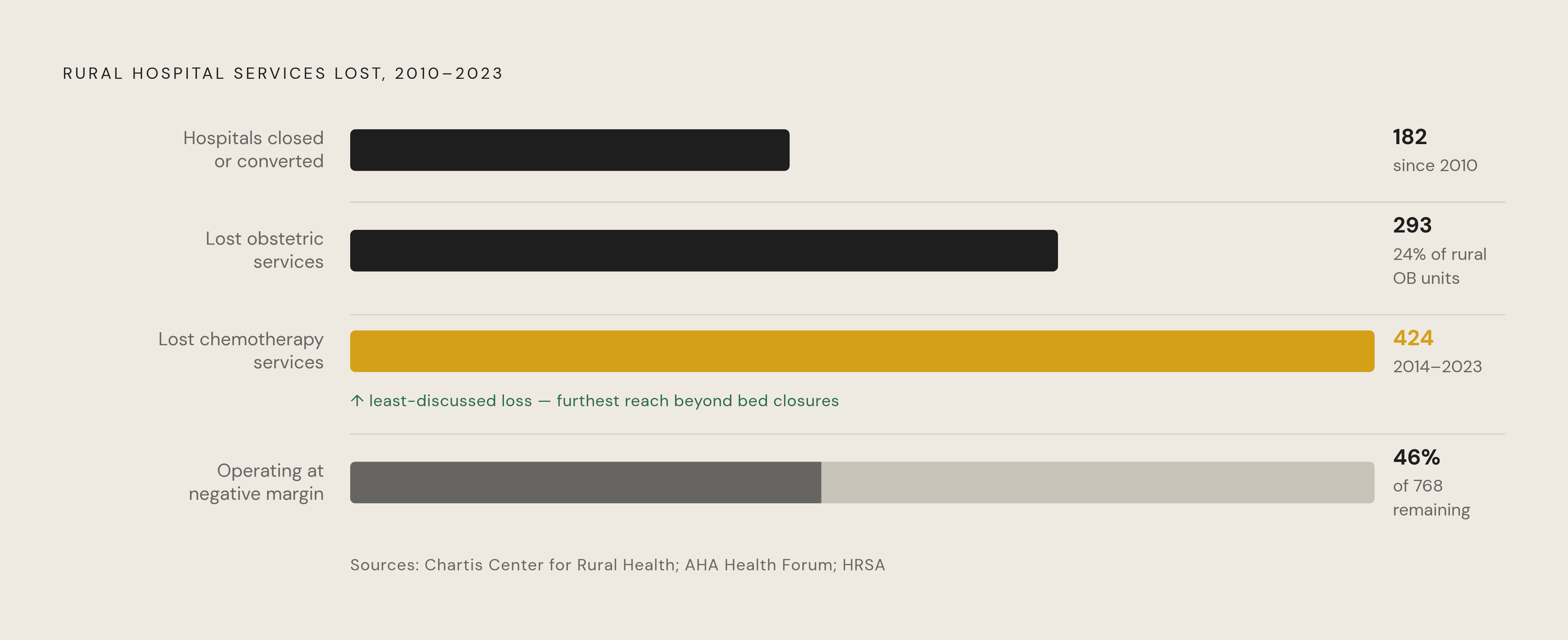
Since 2010, 182 rural hospitals have closed or converted away from inpatient care, with 18 closures in just the past year (Chartis, 2025). The backward-looking count understates the pressure. As of early 2025, 46% of rural hospitals operate with a negative operating margin; 432 are considered vulnerable to closure, and 768 are at risk in total, with 315 at imminent risk (Chartis, 2025; Healthcare Brew, March 2025).
The financing problem tends to get narrated as a simple story about Medicare and Medicaid reimbursement rates, and that narrative is not wrong so much as it is incomplete. The deeper structural issue is what happens to a hospital serving a predominantly Medicare and Medicaid population in a low-income rural county when private insurers, who hold almost all the negotiating leverage, are largely absent from the equation. The financial fragility that results is a predictable outcome of applying a market-rate reimbursement model to a market that cannot, by definition, generate market-rate volumes. A Center for Health Quality, Payment, and Reform analysis estimated that roughly $5 billion annually would be sufficient to increase payments enough to prevent at-risk closures. The problem, in other words, has a legible price tag. The absence of that investment is harder to rationalize.
What disappears with the hospital extends well beyond inpatient beds, and this is where the closure story gets consistently undercounted. Between 2011 and 2023, 293 rural hospitals stopped providing obstetric services, representing 24% of all rural OB units nationally (Chartis, 2025). Nearly 60% of rural hospitals no longer deliver babies. Between 2014 and 2023, 424 rural hospitals stopped providing chemotherapy services (Chartis, 2025). These are not peripheral amenities. They are the services that determine whether a rural resident with cancer or a complicated pregnancy can access care without traveling distances that most urban residents would find unthinkable on a routine basis and catastrophic in an emergency.
A rural hospital is also an economic anchor. Critical access hospitals generate an average of $7.1 million in total wages and $1.8 million in taxable retail sales annually. Remove the hospital and you remove a major local employer, a tax revenue source, and an institution that supports adjacent businesses. The health consequences of closure and the economic consequences are not separable, and treating them as separate is part of why single-lever interventions keep underperforming.
The federal policy response in the current legislative cycle includes the Rural Health Transformation Program, allocated within H.R. 1 at $50 billion. CMS stipulates, however, that no more than 15% of those funds can go to hospitals or direct patient care, a structural constraint that limits the program's relevance precisely where the physical infrastructure crisis is most acute. Meanwhile, the expiration of enhanced premium tax credits at the end of 2025 could cost rural hospitals an additional $1.6 billion in patient revenue, compounding pressure on institutions already operating in the red. Fifty billion dollars sounds like a serious commitment until you examine where it is actually permitted to go.
The Physician Shortage That Predates — and Outlasts — Any Single Hospital Closure
Roughly 21% of Americans live in rural areas. About 10% of working U.S. physicians practice there. That imbalance is not a recent disruption; it is the foundational condition of rural health, the baseline against which every other failure described here compounds.
As of June 2024, 7,501 primary care Health Professional Shortage Areas exist nationally, covering roughly 75 million residents, with 66.5% of those in rural areas. In 2023, primary care physician supply met only about 69% of demand in rural areas. Ninety-two percent of rural counties carried a shortage designation that year; in the rural South and West, the figure reached 97%. Forty-three million rural residents, more than half the total rural population, lived in primary care shortage areas.
HRSA projects a national shortfall of 87,150 full-time-equivalent primary care physicians by 2037. A separate 2024 analysis projects a deficit of 58,000 primary care clinicians, including nurse practitioners and physician assistants, by 2040. To eliminate all current shortage designations today, HRSA estimates 13,075 additional physicians are needed immediately. That number is a floor, not a ceiling.
The connection between this shortage and the mortality data is not inferential. It is mechanistic. Delayed or foregone primary care means conditions are diagnosed later, managed less consistently, and referred for timely imaging less reliably. The chronic disease rates and excess mortality visible in the epidemiological literature are, in substantial part, the downstream expression of a system in which half the rural population lacks adequate access to the clinician who would catch hypertension early or notice a suspicious finding. The shortage concentrates in communities that already carry the highest chronic disease burden, which is precisely what makes it self-compounding.
The economics reinforce the dynamic. A single rural primary care physician supports 26.3 jobs and generates nearly $1.4 million in labor income locally. Physician loss is workforce loss in a context where the local economy can rarely absorb it. The Resident Physician Shortage Reduction Act of 2025 proposes 14,000 new Medicare-funded training positions over seven years beginning in 2026, a bipartisan measure with real merit. But adding training slots does not guarantee that trainees will choose rural practice once their options are open. That last mile has been where rural workforce policy loses ground, and the current proposals have yet to convincingly solve it.
Mental Health Access, Where the Structural Gaps Are Even Wider
Roughly 23% of nonmetropolitan adults have been diagnosed with a mental illness, compared with about 20% of urban adults. The prevalence difference is modest. The treatment difference is not. Rural residents are far less likely to receive care from specialized mental health professionals, meaning a slightly elevated prevalence rate combines with substantially lower treatment rates to produce unmet need that aggregate statistics consistently understate. As of 2024, 7.2 million nonmetropolitan adults reported any mental illness, and 1.7 million reported serious thoughts of suicide in the past year (2024 National Survey on Drug Use and Health).
As of September 2024, a large majority of Mental Health Professional Shortage Areas were in rural areas. The specialist pipeline for psychiatry and clinical psychology is thinner to begin with; training is heavily concentrated in urban academic medical centers, and rural practice offers fewer professional development opportunities and less peer consultation than practitioners trained in high-volume institutions have come to expect. Many rural hospitals that remain open have reduced or eliminated inpatient psychiatric services, shrinking an already inadequate infrastructure.
The demand side is equally complicated. Rural life generates pressures that do not map neatly onto urban mental health frameworks: financial instability tied to agricultural cycles, persistent economic decline, the particular weight of geographic isolation. These are not exotic stressors. They are the texture of daily life in many of these communities, and they accumulate without a comparable infrastructure to absorb them.
Stigma operates differently in small communities in ways that access statistics cannot fully capture. A patient who believes that seeking care will become common knowledge in a town where everyone shops at the same two stores may decline to seek it regardless of whether a provider is technically available. The gap between prevalence and treatment is wider than shortage numbers alone can explain.
Telehealth expanded options meaningfully during and after the pandemic, but broadband gaps and vehicle dependence in remote areas limit its reach in practice. A community without reliable internet, or where the nearest provider requires a two-hour round trip and time off work, faces barriers that no online directory resolves. The infrastructure problem and the access problem are, in this domain as in others, the same problem with a different face.
Maternal and Infant Health as a Measure of Where All These Gaps Converge
Rural maternal mortality ratios were more than 50% higher than in large urban areas before the pandemic, per the 2025 Commonwealth Fund report. That disparity predates any single policy shock and has persisted through multiple legislative cycles. One might argue that targeted obstetric funding could close the gap. The evidence resists that framing. The problem is not a single missing resource. It is the simultaneous absence of several interlocking ones, and the record of adding back one without the others has historically failed to move the numbers.
Maternal Mortality Review Committees have identified substance use and other behavioral health conditions as accounting for more than one-fifth of maternal deaths nationally. This connects the mental health access gap directly to maternal mortality through a causal chain that is neither speculative nor complicated: inadequate behavioral health infrastructure in rural areas produces undertreated conditions in pregnant women, and those conditions kill. The preterm birth rate in rural areas was 8.3%, compared with a slightly lower rate in urban areas; in the rural South it reached 9.6%. These numbers reflect geography and poverty compounding biology in ways that clinical intervention alone, absent structural change, cannot fully address.
Half of all rural counties have no hospital obstetric services. A precipitous delivery, an unexpected hemorrhage, a fetal heart rate demanding immediate intervention: these situations do not wait for a two-hour drive, and no amount of careful prenatal planning makes that drive shorter when the moment arrives.
Maternal health is useful as a synthesizing case precisely because it requires primary care, obstetric services, behavioral health integration, and economic stability simultaneously. The absence of any one of them degrades outcomes. Rural communities are often missing several at once. That is why maternal and infant outcomes function as a reliable composite indicator of where all the structural gaps described in this article converge in a single clinical encounter.
The Economic and Social Conditions That Make Structural Repairs So Difficult
Rural poverty, lower insurance coverage rates, and economic dependence on industries in long-term decline, agriculture, coal, manufacturing, create a baseline of financial stress that shapes health-seeking behavior independent of whether care is nominally available. A patient who cannot afford a copay, lacks paid leave, or has no reliable transportation faces barriers that no expansion of provider supply alone resolves.
The cycle is self-reinforcing in ways that make it structurally durable. Economic decline reduces the tax base that funds local health infrastructure. Infrastructure loss accelerates economic decline by removing employers, reducing property values, and deterring the in-migration that might otherwise supply workforce. Each turn of the cycle makes the next intervention harder to sustain.
Poor nutrition underlies the chronic disease rates driving the mortality gap. Restricted availability of healthy food is a recognized public health challenge in rural communities, per CDC data from 2025. Low rates of leisure physical activity are similarly documented, and in many rural areas this reflects a built-environment problem: the sidewalks, parks, and recreational facilities that urban public health frameworks treat as baseline infrastructure simply do not exist in many of these places. It is also worth pausing on the time and energy problem. A person working two jobs to cover household expenses has limited capacity for leisure physical activity regardless of what infrastructure is theoretically available. That distinction matters, because one implies a capital investment and the other implies something harder to solve with a funding stream.
Workforce recruitment, seen from this angle, is not primarily a salary problem. Providers avoid rural practice for reasons that extend well beyond compensation: amenities, professional development, spousal employment prospects, school quality. Economic underdevelopment is itself a driver of workforce shortage, which is why financial incentives alone have historically underperformed. Workforce programs in rural health have demonstrated a $3.50 return for every dollar spent, suggesting the investment is economically rational, not merely humanitarian. That framing matters for policymakers whose primary language is return on investment, and it is underused in the advocacy literature.
What the Pattern of Compounding Disadvantages Means for the Path Forward
No single gap fully explains the rural health disadvantage. The workforce shortage alone is insufficient, as are behavioral health access deficits, maternal care gaps, and poverty taken in isolation. Each structural failure reduces the community's capacity to absorb the next one, which is why the aggregate outcome is consistently worse than any single factor would predict. The compounding is the mechanism. Intervening on one layer while the others remain intact has a demonstrated tendency to be absorbed by the surrounding conditions without producing durable change.
Adding training slots matters. Stabilizing hospital finances matters. Expanding telehealth infrastructure matters. These are not trivial interventions. But the mortality trajectory offers an honest accounting of what targeted, sequential programming has produced so far: a 6% gap in 1999 through 2001 grew to 43% by 2019, despite two decades of incremental program expansions and targeted funding streams. The divergence did not arrest. The candid response to that record is not more confident advocacy for any single tool. It is real uncertainty about whether the policy instruments currently available are scaled to the problem they are being asked to solve.
The $50 billion Rural Health Transformation Program is large in nominal terms. The cap limiting hospital and patient care spending to 15% constrains its reach precisely where the physical infrastructure crisis is most severe. Scale of investment matters. So does the structure of its distribution, and the two are not currently aligned.
Aggregate statistics consistently obscure the most severe pockets of disadvantage: the rural South, the most remote counties, tribal lands, communities where the physician shortage, the OB desert, the mental health gap, and the economic decline are all happening simultaneously and without a functioning institution left to catch the overflow. Policy designed around the average rural county will underserve the most vulnerable ones. In practice, this is how programs get designed, funded, and declared successful while conditions in the hardest-hit places continue to worsen and researchers start the count again.
The research base is not thin anywhere within this literature. What remains thin is the policy response commensurate with the structural complexity that research describes. Two decades of widening mortality data raise a question I find difficult to answer: at what point does the gap between documented mechanism and scaled response stop being a failure of political will and start being a failure of imagination about what kinds of interventions are even possible within existing institutions? I do not have a clean answer. But I think that is the right question to be sitting with, and the data suggest we have not been sitting with it long enough.