Schizophrenia Diagnosis Criteria and Common Misconceptions
Public confusion about schizophrenia delays treatment and fuels stigma rooted in myth, not medicine.
Schizophrenia has a clear diagnostic definition in the DSM-5, and almost nothing the public believes about it lines up with that definition. That gap costs real people real time: delayed treatment, families who don't know what they're looking at, policy built around fear instead of clinical fact. I've spent enough years around this diagnosis, in clinics and in conversations with people living it, to know exactly where the myths start cracking under weight. So let's go through it, piece by piece, starting with what the manual actually says.
What the DSM-5 actually requires for a schizophrenia diagnosis
No blood panel catches schizophrenia, and no scan lights up a region and settles the question the way an X-ray settles a fracture. Diagnosis is clinical, built entirely from a pattern of symptoms a trained clinician has to piece together like a case file, and that ambiguity is probably part of why public understanding has drifted so far from the textbook version. Vague things invite caricature, and people fill in gaps with whatever's most cinematic.
Here's what the DSM-5 actually asks for. Five symptom domains exist: delusions, hallucinations, disorganized speech, grossly disorganized or catatonic behavior, and negative symptoms like flattened emotional expression or avolition, which is a marked trouble getting yourself to start and follow through on goal-directed activity. A diagnosis needs at least two of these five, present for a significant chunk of a one-month stretch, and at least one has to come from the first three: delusions, hallucinations, or disorganized speech. Negative symptoms by themselves, no matter how severe, don't get you there, because they overlap heavily with depression and autism spectrum presentations, among other things, and the anchor keeps schizophrenia tethered to the psychotic features that actually separate it from its neighbors.
Duration matters, too, and people underestimate this part. Active symptoms need a month; the broader disturbance, counting prodromal and residual phases, needs to span six months total. There also has to be a real, measurable drop in work, relationships, or self-care, since symptoms alone aren't enough; something has to have visibly broken in how the person functions. And before any of this gets written down, a clinician has to rule out other causes: a brain tumor, a thyroid problem, a bad amphetamine binge, any of these can produce psychosis that looks identical on the surface. Diagnosis is as much elimination as pattern-matching.
What's missing from all of this? No required number of hallucinations, no mandated behavior, no script. The clinical picture varies enormously person to person, which is exactly why one Hollywood archetype could never hold it.
Who develops schizophrenia and what the risk factors actually look like
Onset clusters in a specific window, mid-teens through mid-30s, with the peak landing in the early-to-mid 20s for men and a bit later, late 20s, for women. That timing isn't a footnote. It lands right on top of the years people are finishing school, starting careers, building the relationships that anchor an adult life, so an illness that disrupts all of it at once carries a cost that outlasts the acute episode by years.
What causes it? No single thing does, and I'd be suspicious of anyone who tells you otherwise. Genetics plays a real role without being deterministic: a child with a parent who has schizophrenia carries something like a 10 to 15% chance of developing it themselves. That's well above the general population rate, but it also means 85 to 90% of those same children never develop the condition. Neurobiological factors matter too, which is part of why antipsychotic medications have anchored treatment for decades. Environmental factors, prenatal complications, early-life stress, function more as triggers in people who already carry the genetic vulnerability than as standalone causes.
Put it together and you get an interaction model, genes and environment working in tandem, neither one sufficient alone, no clean inheritance pattern and no single switch to flip. NIMH puts prevalence across U.S. household surveys and clinical records between 0.25% and 0.64%. That's a narrow band, and it's worth sitting with how uncommon this diagnosis actually is next to how enormous it looms in film and news coverage.
The "split personality" myth and where it came from
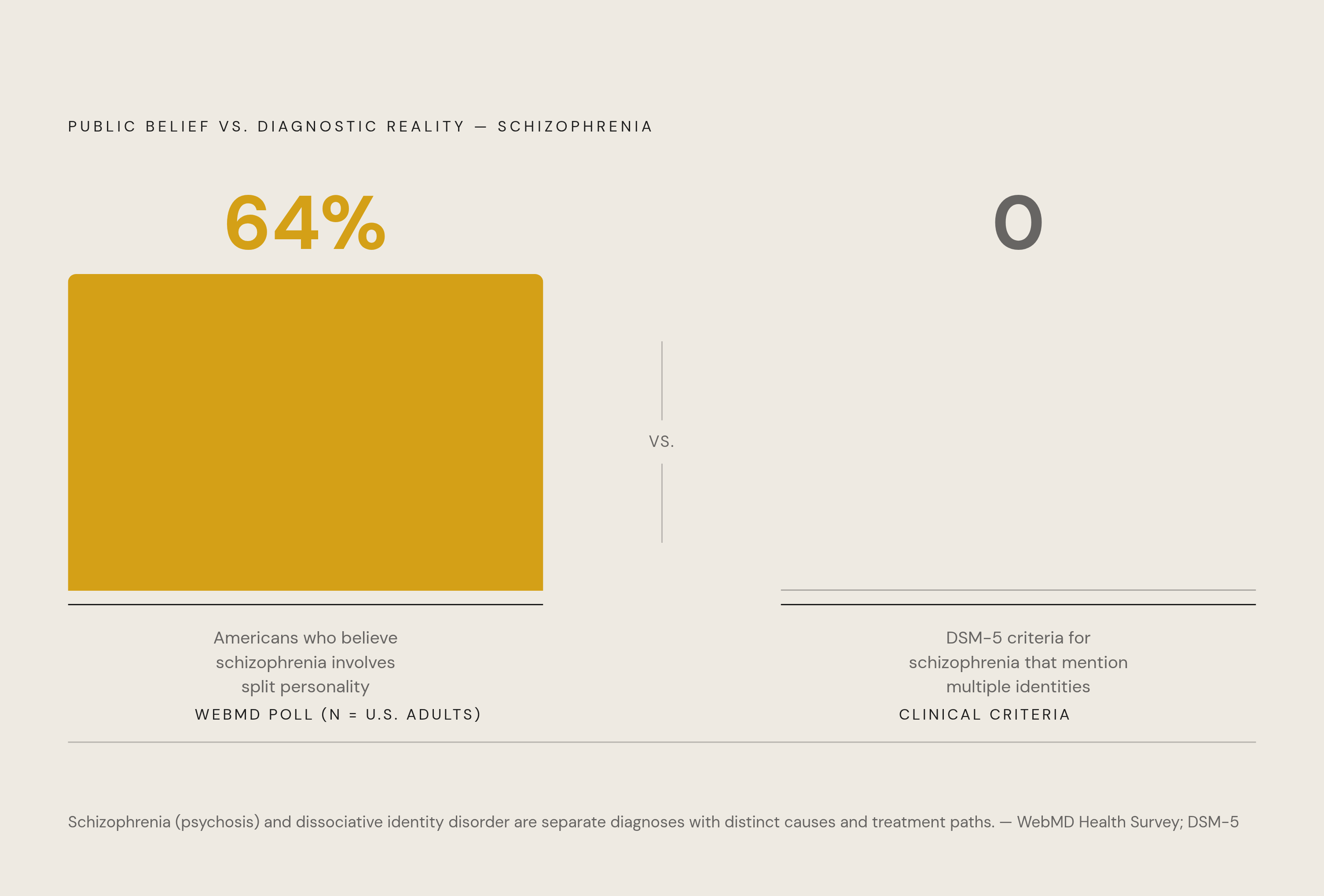
This might be the most stubborn misunderstanding attached to the illness, and it's almost entirely a language problem. A WebMD poll found 64% of Americans believe schizophrenia involves something like dissociative identity disorder (what used to be called multiple personality disorder), where a person shifts between separate identities. That's a conflation of two completely different diagnoses, different symptom profiles, different causes, different treatment paths entirely. Nothing in the DSM-5 criteria for schizophrenia says anything about multiple identities, nothing at all.
Blame the name. Swiss psychiatrist Paul Eugen Bleuler coined "schizophrenia" in 1910, joining the Greek "schizo" (split) with "phren" (mind) to describe a fragmentation among thought, emotion, and behavior. Reasonable choice for what he was describing clinically, but words outlive the intentions of whoever coins them, and "split mind" was too tidy a phrase for popular culture to leave alone. It fused with an entirely separate diagnosis that just happened to share a surface resemblance, and the fusion stuck.
Why does this matter beyond correcting trivia? Because it redirects sympathy and curiosity toward a condition that isn't the one in front of you, leaving the actual person with schizophrenia misrepresented by a myth that was never about them.
The violence myth — what the evidence shows and what it leaves unaddressed
The cultural image is stark: schizophrenia as shorthand for danger, the disheveled figure muttering on a street corner in every crime procedural ever filmed. What does the evidence say? Most people with schizophrenia are not violent, and most violence in society comes from people with no psychiatric diagnosis at all. The public narrative runs nearly backward from the data.
Here's what usually gets left out: people with schizophrenia are more likely to be victims of violence than perpetrators of it. When aggression shows up, it's frequently rooted in fear, not predation; someone acting on a delusion or reacting to a hallucination in a state of genuine terror looks nothing like the calculated menace the myth implies.
The suicide numbers tell you where the actual danger sits. Between 5 and 6% of people with schizophrenia die by suicide, and roughly 20% attempt more than once over the course of the illness. The primary threat this condition poses is to the person carrying it.
So why does the violence myth stick around? Drama travels, and this myth is nothing if not dramatic. But it costs something real: it keeps people from seeking help before a crisis hits, it corrodes trust inside families who've absorbed the same story everyone else has, and it feeds policy, involuntary commitment especially, that treats a person as a containment problem instead of someone who needs care.
Why schizophrenia is not caused by bad parenting, personal weakness, or trauma alone
Underneath the louder myths sits a quieter, older one: that schizophrenia comes from bad parenting, a chaotic childhood, or some failure of willpower. There's no real scientific backing for this, and it does damage in a specific direction, shifting blame onto patients and families instead of onto the illness and the systems meant to treat it.
The genetics covered above make clear that biology carries weight no parenting style can override. That 10 to 15% risk figure holds regardless of how the child was raised. Trauma and chronic stress can act as triggers, sure, but only in people who already carry the underlying vulnerability, and even then they're contributing factors, not root causes. They don't explain every case, and they were never supposed to.
The stakes here aren't abstract. Someone who's absorbed the message, spoken or not, that their illness reflects a character flaw or a family failure is less likely to seek treatment and less likely to trust whoever's offering it. Shame piles on top of an already demanding illness, and the myth of moral causation is exactly what supplies that shame. Delayed help-seeking, family estrangement, internalized stigma: all avoidable costs, all still being paid.
What schizophrenia actually looks like day to day — beyond hallucinations and delusions
Public imagination fixates on the dramatic material: vivid hallucinations, elaborate delusions, whatever translates well to film because it's visual and filmable. But the DSM-5 also names something that rarely makes it into fictional portrayals: negative symptoms, which are often just as disabling as the positive ones, sometimes more so.
Avolition is one of the harder ones to sit with. It's a genuine difficulty starting or sustaining goal-directed activity, which from the outside can look like laziness but has nothing to do with motivation the way most people use that word. Diminished emotional expression shows up as a flatter face, a flatter voice, a narrower range of gesture, and none of it means the person feels nothing on the inside. Add reduced communication, social withdrawal, and cognitive symptoms (memory trouble, impaired attention, slowed processing) and you've got a set of impairments that stick around and interfere with daily life even once the psychosis itself is well controlled by medication.
Two people with the identical diagnosis can present in ways that barely resemble each other, respond differently to the same drug, and run into completely different obstacles day to day. A 2024 study in the South African Journal of Psychiatry found that people with schizophrenia often describe feeling ill-informed about their own condition, unable to tell which thoughts and impulses belong to the illness and which are simply theirs. That finding alone reframes education as a form of direct support, not an afterthought to it.
The narrow image of schizophrenia as nonstop voice-hearing leaves negative and cognitive symptoms underrecognized, and those are frequently the exact symptoms keeping someone from holding a job, sustaining a relationship, or following through on treatment.
The myth that schizophrenia means a life without work, independence, or recovery
Of everything covered here, this myth might carry the highest stakes, since it shapes how someone understands their own future the moment the diagnosis lands. Research consistently shows that a substantial share of people with schizophrenia see positive outcomes when they have access to the right treatment. Sit with that number for a second; it directly contradicts the fatalism baked into how most people picture this illness.
People with schizophrenia hold jobs. They maintain relationships, finish degrees, live independently, sometimes with extra support in place and sometimes without. High unemployment in this population is well documented, but that statistic is a mirror held up to the systems around the diagnosis, not a measure of what people are actually capable of. Employer discrimination, thin support infrastructure, hiring stigma: these explain the unemployment far better than the illness itself does.
Research published in Schizophrenia Bulletin in November 2024 frames recovery from a first psychotic episode as an individual, ongoing process: making sense of what happened, then gradually regaining self-efficacy and autonomy over time. Not linear, not a fixed finish line, something closer to iterative, and different for every person walking through it. The research base has leaned more and more on first-person narratives, real accounts from people who lived through psychosis and came out the other side, as evidence for what recovery looks like when the right support shows up at the right moment.
Which leaves an open question worth sitting with: the evidence says recovery is possible. Whether the systems around a given person actually make it reachable is a separate matter entirely.
How the social conditions around a person shape whether recovery is reachable
A correct diagnosis and a treatment plan mean very little if the person walking out of that appointment doesn't know where their next meal is coming from, or whether they'll have somewhere stable to sleep tonight, and everything downstream depends on this.
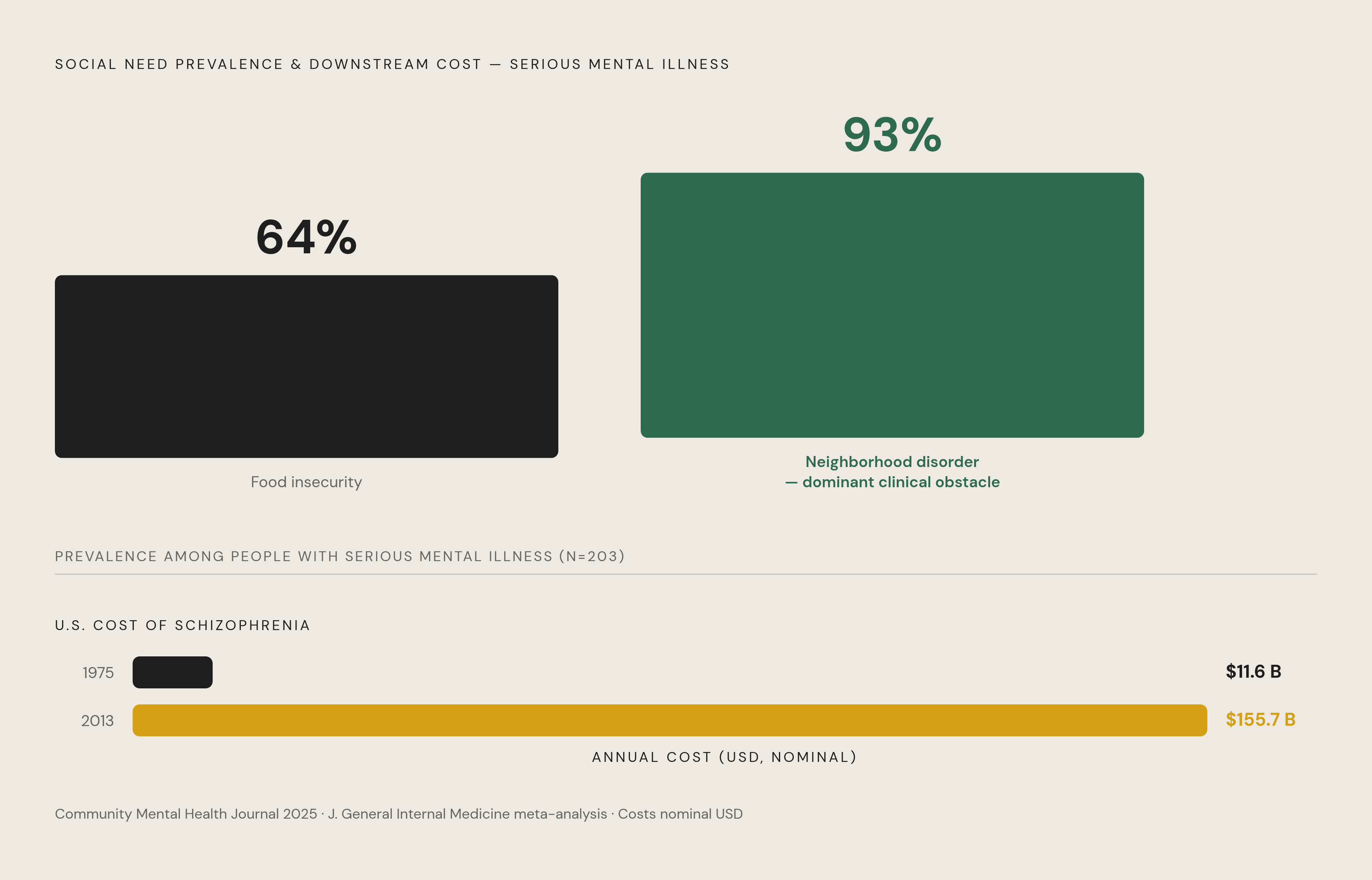
A 2025 study in the Community Mental Health Journal, drawing on 203 clients at a community mental health clinic, found food insecurity at 64% and neighborhood disorder at 93% among people with serious mental illness. Those numbers describe conditions that make consistent engagement with any treatment plan extraordinarily hard, no matter how well-designed the plan looks on paper. A meta-analysis in the Journal of General Internal Medicine found clear associations between food insecurity, housing instability, and reduced medication adherence. Makes sense once you actually think about it: someone managing day-to-day survival doesn't have spare bandwidth left over for a medication schedule.
Transportation to appointments, housing stable enough to allow actual sleep and routine, consistent food access: these aren't extras; they're prerequisites for the kind of stability recovery requires in the first place. And the scale of what happens when none of this gets addressed is staggering: costs associated with schizophrenia in the U.S. climbed from $11.6 billion in 1975 to $155.7 billion in 2013, a trajectory that reflects, in part, what happens when the social scaffolding isn't there to catch someone before they fall through it.
For a lot of people, fixing the social determinants isn't adjacent to schizophrenia treatment. It's the condition that makes treatment possible at all.
Why peer support is particularly well-suited to closing the gap between diagnosis and real recovery
Clinical models are built to treat symptoms, and within that scope, they do the job reasonably well. What they're not built to handle is the trust deficit, the isolation, and the sheer logistical friction that keeps people from engaging with care in the first place. A prescription doesn't fix a broken bus schedule, and a diagnosis doesn't hand back a sense of hope that years of internalized stigma wore down to nothing.
Clinical authority alone rarely breaks through that kind of stigma. A white coat and a diagnostic manual carry real expertise, but not lived experience, and that's the exact gap peer support exists to close. Someone who's personally been through psychosis, hospitalization, housing instability, or the sheer grind of managing medication over years speaks from shared ground instead of from behind a clipboard. That changes what kind of trust is even possible in the room.
Trust built on "I've been where you are" is the precondition for the sustained engagement that makes medication adherence, appointment-keeping, and reconnecting with people actually achievable over time. SAMHSA's crisis response framework, built around "someone to call, someone to respond, a place to go," points at exactly this: presence and relationship as the operating principle, running alongside clinical care rather than replacing it.
firsthand works this way in practice. Its Guides and STRIVE Specialists carry their own lived experience with serious mental illness into the work, meeting people where they already are instead of expecting them to navigate a system that wasn't built with them in mind. Housing, food, medication, medical access, these get handled as one connected relationship instead of scattered referrals across different offices nobody has the energy to chase down. Given the ongoing shortage in the U.S. behavioral health workforce, peer specialists aren't a nice-to-have add-on; they're a practical answer to a gap between how much need exists and how much clinical capacity is actually available to meet it.
Every myth this piece has worked through, split personality, violence, bad parenting, a life sealed off from work or independence, points back to the same underlying failure: seeing the caricature instead of the person. Correcting the record matters, but the harder, longer work is building the systems, clinical and social both, that meet people where the myths never bothered to look.