Panic Attack vs Anxiety Attack Clinical Distinctions
Panic attacks have a clinical definition; anxiety attacks don't—and the confusion costs lives.
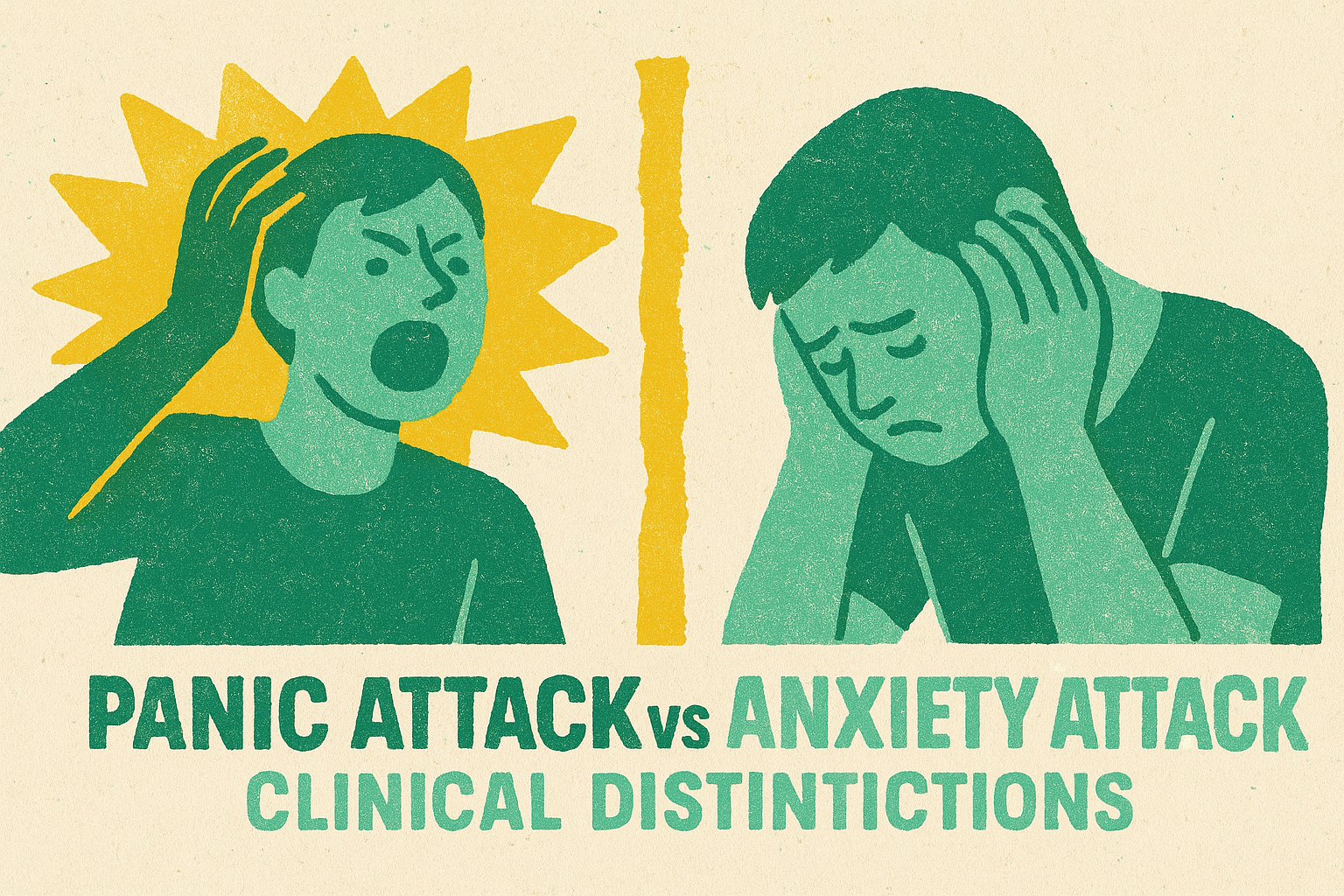
I've spent enough years around emergency departments and psych intake forms to know that "anxiety attack" and "panic attack" are not the same event wearing two names. One is a defined clinical entity with thirteen possible symptoms and a hard time cutoff; the other is a phrase patients invented because they needed something to call the feeling, and it stuck around long after clinicians should have retired it. Mixing them up in a doctor's office isn't a semantic quibble. It changes what gets tested, what gets prescribed, and sometimes whether a real cardiac event gets caught in time.
I want to walk through where these terms actually diverge, because the gap matters more than most people realize once you're the one sitting in the waiting room trying to describe what just happened to you.
What the DSM-5 actually requires to call something a panic attack
The bar is higher than most people guess. You need at least four of thirteen named symptoms, peaking within minutes: palpitations or a pounding heart, sweating, trembling, shortness of breath, a choking sensation, chest pain, nausea, dizziness or faintness, chills or heat flashes, numbness or tingling (paresthesia), derealization or depersonalization, fear of losing control or "going crazy," and fear of dying.
Count them and something jumps out. Eleven of the thirteen are physical or perceptual, and only two touch the catastrophic thinking most people actually picture when they hear the word "panic." That imbalance isn't incidental; it's a huge part of why panic attacks get mistaken for heart attacks in emergency rooms, and why real heart conditions occasionally get waved off as "just anxiety."
There's a second tier too, symptoms the DSM labels culture-specific: tinnitus, neck soreness, headache, uncontrollable crying. They can ride along with an attack, but none of them count toward the required four, which surprises people who assume the manual is more expansive than it is.
The DSM also splits attacks into two kinds. Unexpected attacks arrive with no obvious trigger, and clinicians tend to flag these as harder to live with, since the unpredictability itself becomes a source of dread. Expected attacks get cued by something identifiable, a phobia, a place, a situation the person already knows to avoid.
Here's the wrinkle that trips up a lot of patients and more than a few clinicians: panic attack is a specifier, not a standalone diagnosis. It can attach to panic disorder, sure, but also to PTSD, major depression, other anxiety disorders. Panic disorder sits at a different, higher bar entirely: at least one attack, followed by a month or more of persistent worry about having another, or a real behavioral shift, skipping the gym, avoiding new places, tied directly to what happened last time. Clinicians are supposed to rule out substance use, hyperthyroidism, and cardiopulmonary disease before landing on panic disorder as the answer. That overlap between psychiatric presentation and genuine physical illness sits underneath most of the misdiagnosis problem, which I'll get into later.
How onset, duration, and triggers separate the two experiences in practice
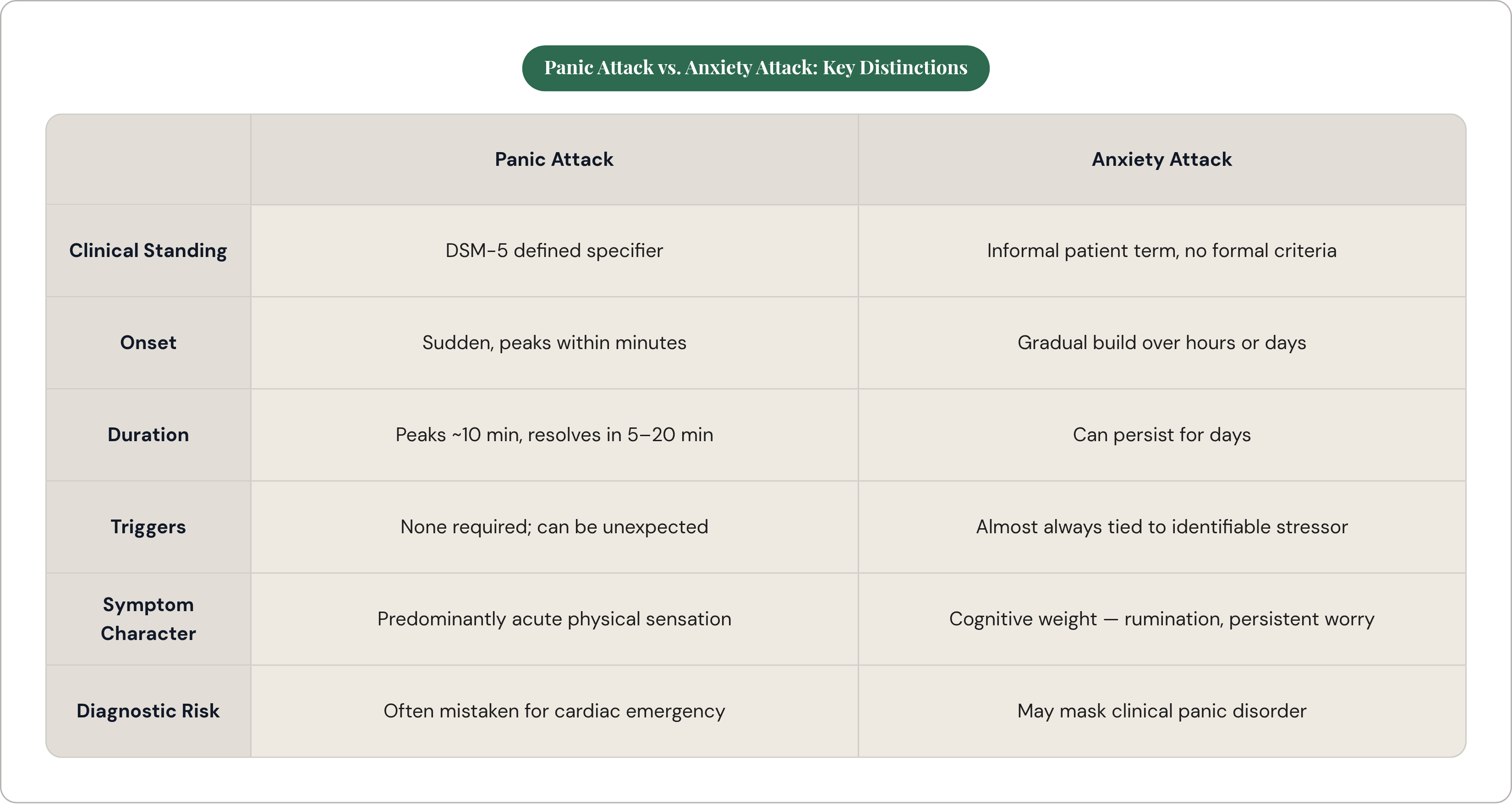
Onset draws the cleanest line of all. Panic attacks arrive suddenly, sometimes while someone's just sitting on the couch doing nothing that looks remotely stressful, while what people call an anxiety attack tends to build instead, piling up over hours or days while some unresolved stressor sits there and the dread compounds.
Duration follows a similar shape on a different clock. Panic symptoms peak around the ten-minute mark, and most episodes resolve within five to twenty minutes, whereas anxiety can drag on for days, especially when whatever triggered it never actually gets resolved.
Triggers split the two further, though this is where the line gets blurriest. Panic attacks can have no cause at all (the unexpected type), or they can be cued by something specific. Anxiety attacks, as people use the phrase casually, almost always trace back to something identifiable: a hard conversation looming, a deadline closing in, a health scare that won't quit.
Symptom character rounds it out, though "rounds it out" undersells how much this one distinction matters in an intake room. Panic runs on acute physical sensation, which is exactly why the DSM criteria lean so heavily physical, while anxiety carries more cognitive weight: rumination, worry that won't switch off, a heaviness rather than an explosion. So what does it actually tell a clinician when a patient says "I had an anxiety attack"? Could be a textbook panic attack. Could be a rough stretch of worry that never spiked into anything physical, or could be somewhere in between. The label by itself carries almost no diagnostic weight, and that's the whole problem in one sentence.
How common panic attacks actually are, and how rarely they become panic disorder
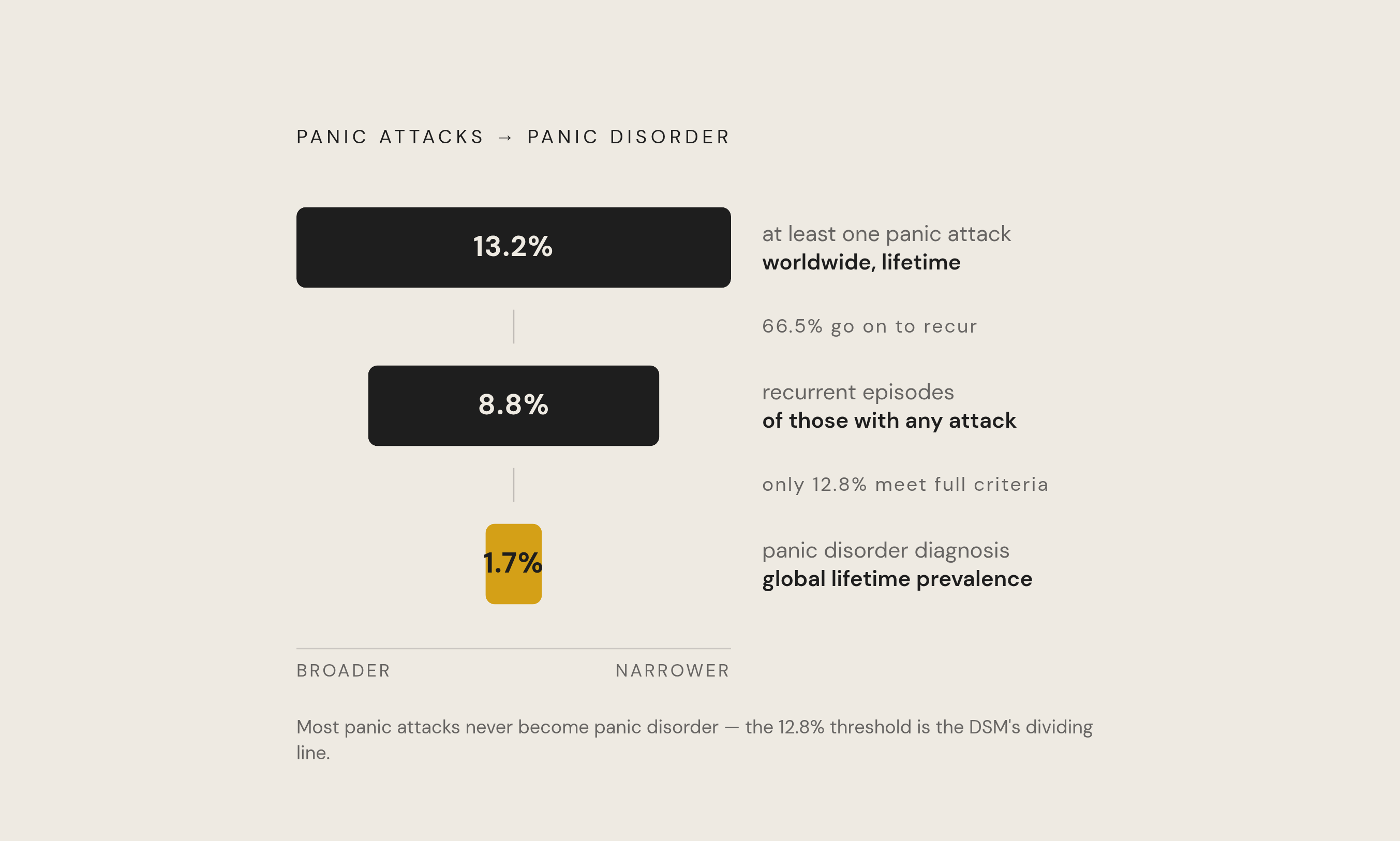
A World Health Organization survey spanning nearly 143,000 adults across 25 countries put lifetime prevalence of panic attacks at 13.2%. That's a sizable chunk of the adult population having at least one at some point. Among those who did, 66.5% had recurrent episodes, which pushes back on the popular image of panic as a one-off scare. A single isolated attack is the exception; once it happens, it tends to come back.
Here's the number that flips the whole framing on its head: only 12.8% of people who ever had a panic attack went on to meet full criteria for panic disorder. Most attacks never become a diagnosable condition, and running that forward, global lifetime prevalence of panic disorder lands around 1.7%. In the U.S., panic disorder affects roughly 6 million adults, a 12-month prevalence of 2.7% and lifetime prevalence of 4.7%.
That gap between attack and disorder is exactly why the DSM treats them as two separate entries instead of one sliding scale. Zoom out further and more than 40 million U.S. adults live with some anxiety disorder. Panic disorder is one specific, bounded slice of a much larger category, not a synonym for it.
Panic disorder shows up about 2.5 times more often in women than men, and anxiety disorders broadly affect 23.4% of women versus 14.3% of men. Hold onto that gap, because it matters again once we get into how symptoms get read, or misread, in emergency departments.
What the brain is doing differently during a panic attack versus sustained anxiety
The amygdala sits at the center of both experiences, working as the brain's threat detector. During a panic attack it fires the fear network even when nothing in the room actually threatens anyone, and what makes panic feel so distinctly physical is that the amygdala runs two responses on two separate clocks at once.
The fast pathway fires within milliseconds. It flips on the sympathetic nervous system, dumps epinephrine into the bloodstream, and produces that sudden electric jolt: racing heart, tight chest, the sense that it came from nowhere. The slow pathway activates the HPA axis, which takes several minutes to flood the body with cortisol. So the neurobiology has an arc built into it already, an instant spike followed by a second hormonal wave arriving minutes later, and that two-speed structure is part of why an attack can feel like it has a beginning, a worse middle, and a slow unwind at the tail end.
A 2025 systematic review pointed to the brainstem, amygdala, hippocampus, parahippocampal gyrus, thalamus, insula, and prefrontal and cingulate cortices as the regions driving panic disorder, with the sharpest hypersensitivity concentrated in the brainstem and amygdala. Sustained anxiety runs on a slower clock entirely: prolonged, anticipatory, the nervous system braced rather than firing all at once. Chronic HPA axis activity reshapes brain structure over time, particularly the amygdala, hippocampus, and prefrontal cortex, which goes some way toward explaining why anxiety disorders tend to deepen on their own instead of sitting still.
A 2024 PRISMA review covering 33 peer-reviewed studies found altered GABA-A and serotonin receptor binding in the amygdala specifically among people with panic disorder. That's a concrete neurochemical target, not a vague catch-all "dysregulation," and it's worth sitting with for a second: panic attacks carry a biological signature of their own, distinct from ordinary anxiety just turned up louder. That distinction is most of why the DSM gives panic its own specifier instead of folding it into general anxiety.
Why panic attacks are frequently misidentified, by patients and clinicians alike
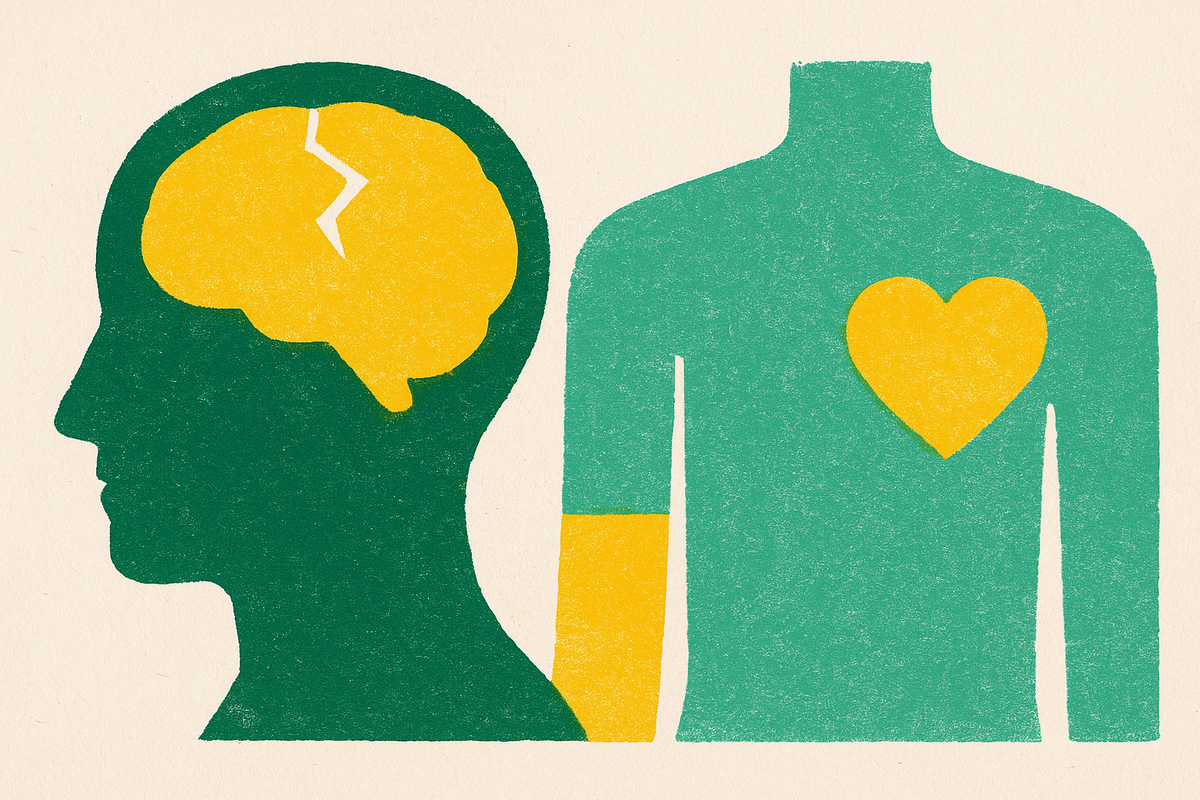
The physical symptoms of a panic attack overlap heavily with several genuine medical emergencies. Chest pain, shortness of breath, palpitations, tingling in the limbs: these show up in acute coronary syndrome, pulmonary embolism, cardiac arrhythmia, stroke. Emergency departments run into this overlap constantly, and the error cuts both directions. Chalk chest pain up to anxiety too fast and a real cardiac event slips through the net; miss panic disorder for what it is, and a patient cycles through repeat cardiac workups while the actual psychiatric condition sits there untreated.
One number makes the reverse error concrete. Patients with supraventricular tachycardia, a treatable heart rhythm condition, get misdiagnosed with panic disorder in more than half of cases. The cardiac condition looks psychiatric on presentation often enough to fool experienced clinicians, not just the occasional overworked resident at 3 a.m.
Gender compounds it. Women presenting with cardiac symptoms are disproportionately likely to walk away with a panic diagnosis instead of a cardiac workup, a pattern rooted partly in real symptom overlap and partly in older assumptions about how women express distress. The harm to cardiac outcomes here is documented, not speculative.
Then there's the access problem underneath all of it. Only 38.3% of people with panic disorder ever seek medical attention for it at all. Among those who do, many who do seek help still leave without any diagnosis whatsoever. Vocabulary plays into this too, more than people expect: a patient who says "anxiety attack" may not trigger the same workup as one who describes symptoms mapping cleanly onto the DSM panic specifier. The words picked at intake shape what happens next in that room, for better or worse.
Panic disorder also rarely shows up alone. It carries high comorbidity with depression, generalized anxiety disorder, social phobia, agoraphobia, PTSD, substance use disorder. Avoidance behavior, the kind that builds quietly after a few unexpected attacks, can shrink someone's daily life well before they ever get around to seeking treatment for any of it.
How panic disorder is treated once correctly identified
Once panic disorder gets properly separated from general anxiety, the treatment path is fairly well established. SSRIs sit as first-line pharmacotherapy, and other medication classes are also used depending on clinical presentation. Worth knowing going in: medication response takes time, which catches people off guard often enough that some quit before it gets a fair shot at working.
Cognitive Behavioral Therapy is widely used on the psychotherapy side. CBT for panic leans on a few distinct mechanisms, and they're worth naming individually because they do different jobs. Cognitive restructuring goes after the catastrophic interpretations people attach to physical sensations, that leap from "my heart is racing" to "I am dying." Interoceptive exposure targets the fear response through structured, controlled practice. A behavioral component addresses the avoidance that piles up after unexpected attacks, the quiet narrowing of someone's world that happens before they've even noticed it happening.
This is where calling it an "anxiety attack" can do real damage, even when nobody means it that way. Someone who frames the experience that way often reaches for general stress tools instead: breathing exercises, better sleep, less caffeine. Those genuinely help with everyday stress, but they don't touch clinical panic disorder, and that mismatch costs people time they can't easily get back.
Panic disorder carries a high number of medical visits among anxiety disorders, with a meaningful burden on the healthcare system that follows from that. Getting the diagnosis right early saves both suffering and money. General anxiety treatment overlaps with panic treatment on the basics; both lean on CBT and SSRIs. But the panic-specific tools, interoceptive exposure especially, only get deployed once the right diagnosis actually lands on the chart.
How to describe symptoms accurately when seeking help
The words someone picks to describe an episode shape where the conversation goes next. Say "anxiety attack" to a clinician and the visit may head somewhere different than if the same person described symptoms mapping directly onto the DSM panic specifier.
A few questions sharpen the picture before the appointment even starts. Did it come on suddenly, or build over hours? How long did the worst of it actually last, minutes or something longer? Was there an identifiable trigger, or did it seem to come from nowhere? Which physical symptoms showed up, and were they the main event or more of a side effect of the worry itself? Has it happened more than once, and did anything change afterward, avoiding certain places, skipping things that used to feel routine?
None of this is trivia for its own sake. The DSM criteria map almost directly onto what a clinician is already trying to work out, so walking in with a rough sense of the answers means walking out with something more useful than a shrug and a prescription pad.
One thing matters above everything else here. Chest pain, severe shortness of breath, or neurological symptoms like facial drooping, sudden arm weakness, or trouble speaking need emergency evaluation first, before anyone reaches for panic as the explanation. The misdiagnosis risk runs both directions, and erring toward medical evaluation costs far less than erring the other way.
And for anyone noticing a pattern, recurrent unexpected attacks, persistent worry in between them, behavior shifting quietly to dodge the next one, that pattern deserves a real evaluation for panic disorder, not a reassuring pat on the back that it was "only anxiety." Telepsychiatry and other remote options have made structured assessment easier to reach over the past several years, which matters given that well over half of people with panic disorder never seek care for it at all. Better language gets someone in the door, and better access is what happens after they walk through it.