Bed Bug Infestation Risks in Shelter and Low-Income Housing
Income inequality, not hygiene, determines where bed bug infestations take root and persist.
Bed bug infestations in shelters and low-income housing are not a hygiene problem. They are a public health pattern that tracks income, eviction rates, and crowding with startling consistency, and the damage they do goes far past the itch of a bite. A study covering 2,372 apartments across four New Jersey cities, published in the Journal of Medical Entomology, found an overall infestation rate of 12.3%, with individual buildings ranging from 3.8% to a striking 29.5%. In Toronto, a landmark study published in Emerging Infectious Diseases found active infestations in 31% of 65 homeless shelters surveyed. These numbers describe a population-level pattern, not a string of bad luck or bad housekeeping, and that distinction is the spine of everything that follows.
Bed bugs do not start in poverty. They travel in luggage, secondhand furniture, and clothing, and they show up in five-star hotels as readily as in a rooming house. But poverty determines where they persist once they arrive, and persistence is the real problem. In the New Jersey study, 49% of infestations were only caught through systematic monitoring, meaning residents had no idea the bugs were there until researchers went looking. That invisibility matters because it means most infestations in low-income housing are already advanced by the time anyone acts on them. Add in the fact that homeless individuals face a much higher risk of insect bites and skin infestations than housed people, and shelters end up absorbing a level of exposure that follows people in rather than starting there. Multi-unit buildings compound the risk further: bed bugs move through walls, wiring conduits, and shared laundry rooms regardless of how clean any single tenant keeps their unit. That's a structural fact about apartment construction, not a verdict on anyone's habits.
How income, eviction, and crowding predict where infestations take hold
An analysis of more than 56,000 Chicago housing inspections conducted between 2006 and 2018 found that low-income households were 8 to 12 times more likely to have a bed bug infestation than high-income households. Neighborhood median income was the single strongest predictor in that dataset. Eviction rate and crowding mattered too, but their effects were smaller once income was accounted for, which suggests income itself is doing most of the explanatory work, whether through what it buys in terms of housing quality, or what it forecloses in terms of treatment options.
A 2020 study in the journal People and Nature described bed bug infestations as offering "unique empirical evidence of the disproportionate allocation of public health burdens upon neighbourhoods facing multiple dimensions of disadvantage." That's a dense sentence, but the idea underneath it is simple: the same neighborhoods dealing with contaminated water and elevated asthma rates, as reporting on the Chicago data in the Washington Post noted, are also the neighborhoods carrying the heaviest bed bug burden. These are not separate problems occurring in the same zip codes by coincidence. They are symptoms of the same underlying disinvestment.
Three things keep infestations going once they start. Professional eradication costs are prohibitive for most affected households, a problem detailed further below. Tenant-blaming culture treats infestation as a personal failure, and residents are sometimes threatened with eviction if they can't pay for treatment themselves, even though bed bugs have nothing to do with cleanliness. And landlords managing multi-unit buildings sometimes hire the cheapest pest control option available, which tends to suppress a population temporarily rather than eliminate it, setting up a rebound.
Race enters the picture too. In the New Jersey study, African American residents showed a proportionally higher infestation rate than white residents, and given how closely income and race track together in American housing patterns, treating these as separable variables misses the point. What emerges is a loop that feeds itself: poverty creates conditions where infestations take hold and stay, and the infestations that result then drain money, time, and stability from households that had little to spare in the first place.
What living with an infestation does to the body
Among 319 New Jersey residents who reported symptoms following bed bug exposure, 90% reported pain, 20% reported itchiness, 13% reported welts, and 8% reported insomnia. Women were more likely than men to report bite symptoms in the same study, a difference researchers have not fully explained but consistently observe.
The disease question is where things get genuinely uncertain, and worth sitting with rather than glossing over. Multiple potential human pathogens have been identified in connection with bed bugs, and experimental studies suggest the insects are capable of transmitting certain pathogens, including Bartonella quintana and Trypanosoma cruzi, with more limited evidence pointing to Borrelia recurrentis as well. A 2023 study of a shelter in southern France found that 81% of collected bed bugs carried DNA from Wolbachia bacteria, and one sample tested positive for Coxiella burnetii, the organism responsible for Q fever. None of this proves bed bugs are driving disease outbreaks at the population level. But it does mean the question of what these insects carry in congregate shelter settings, where turnover is high and living quarters are close, deserves more attention than it currently gets.
Insomnia shows up in the physical symptom data, but treating it purely as a sleep problem understates what it actually does to a person over time. That's where the next section picks up.
The psychological weight infestations place on already-stressed residents
Ask researchers what the worst part of a bed bug infestation is, and the answer is rarely physical. It's psychological, and the numbers back that up. An analysis of 135 online postings from people describing their experience with bed bugs found that 81% reported psychological effects, with a mean PTSD checklist score of 13.25. The symptom cluster researchers describe, nightmares, flashbacks, hypervigilance, insomnia, anxiety, avoidance behavior, personal dysfunction, tracks closely with how PTSD presents clinically.
A 2025 study published in BMC Public Health, drawing on the Montreal Housing Survey, found the odds of anxiety were significantly higher among those exposed to bed bugs, with an odds ratio of 1.72. Depression showed an odds ratio of 1.83, and the combined odds of anxiety and/or depression came in at 1.69. The study's authors concluded that the findings "reinforce the significant social inequalities in exposure to bed bugs and contribute to growing evidence that bed bug exposure is a risk factor for psychological symptoms." That's a careful, academic way of saying something quite direct: living with bed bugs makes people more anxious and more depressed, and it does so at rates that show up clearly in population data, not just anecdote.
Qualitative accounts fill in the texture behind those numbers. People describe social isolation, a loss of self-worth, and stigma that makes them hide the problem from friends, coworkers, and even family. Qualitative and survey research consistently finds sleep disturbance, emotional distress, anxiety, and stress attributed directly to the presence of bed bugs.
None of this happens in a vacuum. For someone already managing poverty, housing instability, or a serious mental illness, an infestation doesn't arrive as an isolated inconvenience. It stacks on top of whatever instability already exists, and it can undo progress that took months to build. For people supported by community behavioral health programs, sleep loss and hypervigilance driven by an infestation can directly interfere with recovery goals, and care workers who visit clients at home face their own difficult calculus about how to deliver care safely in a space that's actively infested.
How infestations cut off older low-income residents from the services they depend on
A 2024 qualitative study published in Perspectives in Public Health, led by Sheppard, Roche, Austen, and Hitzig, found bed bugs to be a widespread problem among low-income older adults, one made worse by physical, mental, social, and financial limitations that made it hard for residents to prepare their units for treatment or follow through on multi-step protocols. Bed bug treatment isn't passive. It usually requires the tenant to bag clothing, move furniture away from walls, strip and wash bedding at high heat, and vacate the unit for hours at a stretch. For an older adult with mobility limitations or cognitive decline, that list of tasks can be functionally impossible without help.
Research published in Perspectives in Public Health found something almost paradoxical: awareness of bed bugs was low among the low-income older adults studied, yet 45% of their units were infested. Even after an infestation was identified, older tenants struggled to comply with treatment because of limited money and physical disability. What happens next compounds the problem. Home health aides and social service workers sometimes refuse to enter infested units, which cuts residents off from care they may have no other way to access. And the 2024 study found that the avoidance strategies providers use to protect themselves end up generating additional stigma for the very tenants who need help most.
The authors of that study called for what they describe as "an urgent need to increase public health funding to support older adults with the costs of bedbug elimination and to enhance pest-management strategies through partnerships with health and social service agencies." Put plainly: disability prevents treatment compliance, which extends the infestation, which drives providers away, which deepens isolation, which worsens health outcomes overall. Each link in that chain reinforces the next.
Why professional eradication is financially out of reach for the households that need it most
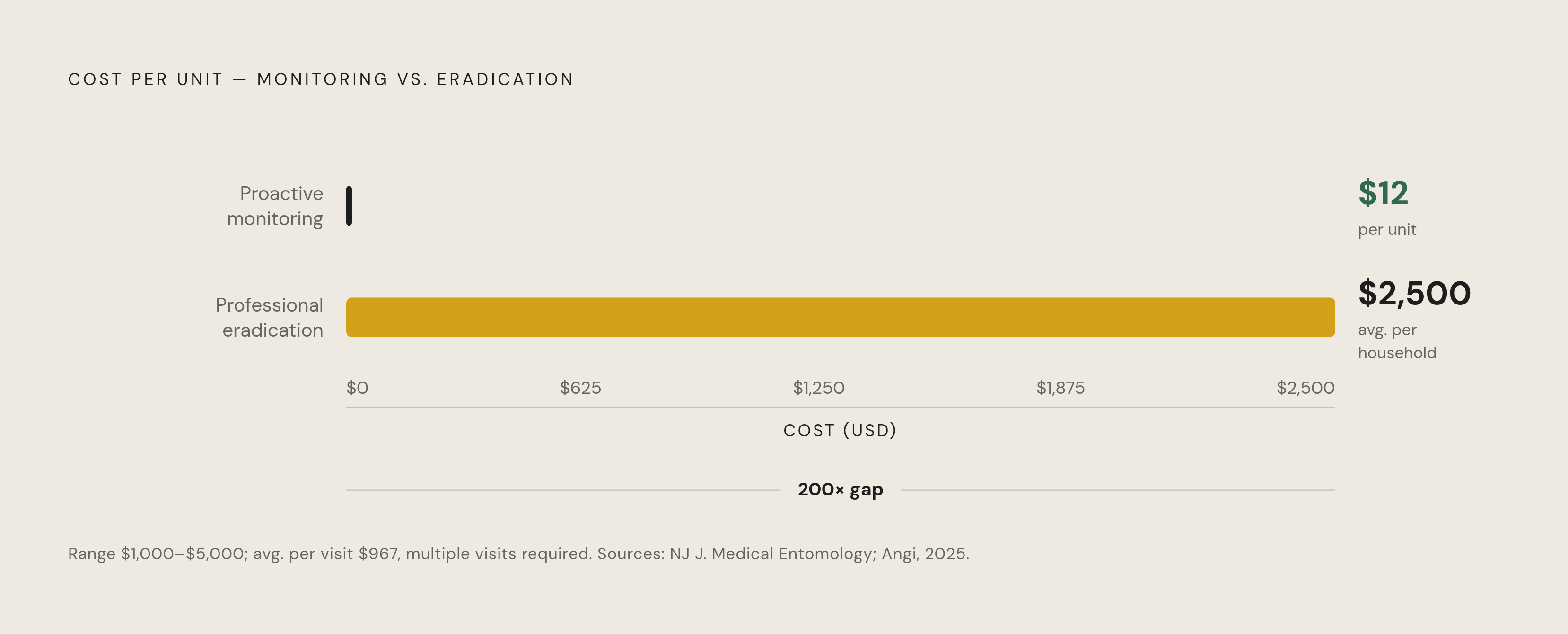
Professional bed bug extermination in that country runs anywhere from $300 to $5,000 as of 2025, depending on severity, treatment method, and the size of the home. Angi puts the average treatment cost at $2,500, with a typical range of $1,000 to $4,000. On a per-visit basis, the PCT 2024 State of the Bed Bug Control Market report found the average residential treatment charged by pest management companies was $967 for a single visit, and most effective protocols require more than one visit to fully break an infestation's life cycle.
Set that figure against a minimum-wage paycheck or a fixed income, and one visit alone becomes a financial emergency. Multiple visits, which is what actual eradication tends to require, are simply out of reach. That gap in what households can afford is part of why housing management teams in low-income buildings often turn to the cheapest available pest control contractor, and cheap treatment tends to suppress a population rather than eliminate it, which sets the stage for the infestation to rebound.
The scale problem isn't unique to that country. either. A 2023 report from ANSES found that bed bug eradication cost French households a combined 230 million euros between 2017 and 2022, and the average cost per household in Paris ran close to 1,200 euros in 2023. Even in a wealthy country with a strong social safety net, bed bug eradication functions as a public finance problem, not simply a matter of individual spending choices.
What makes the cost gap especially frustrating is how cheap early detection is by comparison. The building-wide monitoring protocol used in the New Jersey Journal of Medical Entomology study cost an average of $12 per apartment. Twelve dollars for monitoring against thousands of dollars for late-stage eradication is not a marginal difference. It's the entire argument for catching infestations early, and it's the argument that gets ignored most often in under-resourced housing.
Pesticide resistance and the limits of standard chemical treatment in chronically infested buildings
A study published in PLoS ONE looking at lower-income housing found that ineffective heat treatments, new bed bugs being introduced from outside, populations spreading between units, and high rates of pyrethroid resistance combined to produce infestations that kept coming back no matter what was tried. Pyrethroids happen to be the cheapest and most commonly used class of bed bug pesticide, which means the treatment most likely to get deployed in affordable housing is also the one bed bugs are most likely to have already evolved resistance against.
That's not a small irony. It means the cheapest-option pest control approach isn't just inadequate, it's arguably counterproductive: spraying a resistant population with the same pyrethroid formula is unlikely to eliminate the infestation, since resistance allows survivors to persist and continue reproducing.
The evidence-based alternative is integrated pest management, or IPM, which combines ongoing monitoring, heat treatment, changes to resident behavior around clutter and clothing storage, and chemical treatment only as a last resort rather than a first response. IPM works, but it demands sustained funding and coordination across an entire building, which is exactly the kind of investment most affordable housing programs don't have budgeted. HUD issued interim guidance in 2019, clarifying an earlier 2012 housing notice, that explicitly calls for a property-wide IPM approach. That guidance affirms that HUD's Model Lease requires landlords to provide extermination services, and it instructs HUD field staff to deny or rescind any lease addenda that try to shift treatment costs onto residents, unless specific circumstances shift responsibility to the tenant. The policy exists. Whether it gets enforced on the ground is a separate question, and the evidence suggests implementation is uneven at best.
Treating bed bug infestations as a public health responsibility rather than a tenant problem
Put the pieces together: infestation rates concentrated by income and race, a structural cause rooted in building design and disinvestment, measurable psychological harm including elevated odds of anxiety and depression, older adults cut off from home care because providers won't enter infested units, eradication costs that put treatment out of reach for the households that need it most, and standard pesticides that fail against resistant populations in exactly the buildings where cheap treatment is most common. None of that adds up to a case that individual households can solve one at a time.
Stigma sits underneath all of it, and it's worth naming directly. Nothing in the scientific literature ties bed bug infestation to poor housekeeping, yet the social assumption that it does persists, and that assumption drives underreporting, delayed treatment, and the kind of isolation described earlier. Public health messaging has real work to do here, correcting a belief that shapes behavior in exactly the wrong direction.
Some of the tools to fix this already exist, they're just underused. HUD's landlord-responsibility framework and its 2019 IPM guidance are already on the books and need enforcement, not reinvention. Public health funding to help older adults and low-income households cover eradication costs was flagged as urgent in the 2024 Perspectives in Public Health study, and that funding gap remains open. Routine, proactive inspection in HUD-assisted properties, the kind of monitoring that cost $12 per apartment in the New Jersey study, is dramatically cheaper than waiting for a full-blown infestation and then paying for extermination. And partnerships between pest management companies, housing agencies, and health and social service organizations, which the 2024 study highlights as important to effective response, remain the exception rather than the rule.
For organizations delivering community-based care, including peer support programs working with people managing serious mental illness, recognizing bed bugs as a social determinant of health changes how a symptom gets read. Sleep disruption, hypervigilance, or sudden social withdrawal in a client might not be a sign the recovery plan needs adjusting. It might be a sign of what's happening in the walls of the apartment they go home to every night, and the right response in that case is connecting someone to housing advocacy and remediation resources, not treating the symptom in isolation from its cause.
Bed bugs are a solvable problem. The science on how to detect and treat them is well established, and the cost comparison between early monitoring and late-stage eradication makes the financial case for prevention almost self-evident. What's missing isn't technology or knowledge. It's the institutional will to treat housing conditions as a shared public health responsibility rather than a private failure that falls on whichever tenant happens to be living with the consequences.
Sources
- Bed Bugs: Prevalence in Low-Income Communities, Resident’s Reactions, and Implementation of a Low-Cost Inspection Protocol | Journal of Medical Entomology | Oxford Academic
- New Introductions, Spread of Existing Matrilines, and High Rates of Pyrethroid Resistance Result in Chronic Infestations of Bed Bugs (Cimex lectularius L.) in Lower-Income Housing - PMC
- HUD Provides Interim Guidance on Bed-Bug Provisions in Model Leases
- Bed bugs among public health problems of poverty - The Washington Post
- 2023 Paris bedbug infestation - Wikipedia
- sciencedirect.com
- Socioeconomic drivers of urban pest prevalence
- besjournals.onlinelibrary.wiley.com