Stages of Flu Recovery and What to Expect Each Day
Day-by-day recovery milestones show when antiviral drugs matter and why lingering fatigue is normal.
Roughly 8% of the U.S. population catches the flu in a given season, according to CDC estimates, and the 2024-2025 season alone produced somewhere between 43 million and 73 million symptomatic illnesses. That range is wide because flu recovery doesn't run on one timetable; it moves along a fairly predictable arc, but where a person lands on it depends on age, immune status, underlying health, and which strain is circulating. This piece walks through that arc day by day. Most people manage flu wrong at exactly two points: they treat day 1 as a wait-and-see moment when it's actually the narrow window where antivirals matter most, and they treat the fatigue that lingers for weeks afterward as a red flag when it's normal physiology doing exactly what it's supposed to do.
The timing matters more this season than most. The 2025-2026 flu year is dominated by influenza A(H3N2), subclade K, a variant identified after that season's vaccine had already been formulated. Reduced vaccine effectiveness against this subclade means more people will likely ride out the full symptom course rather than get a blunted version of it. That makes the day-by-day map below more relevant now than in a season where vaccine and circulating strain line up more neatly.
The incubation window: why you can feel fine and still be spreading flu
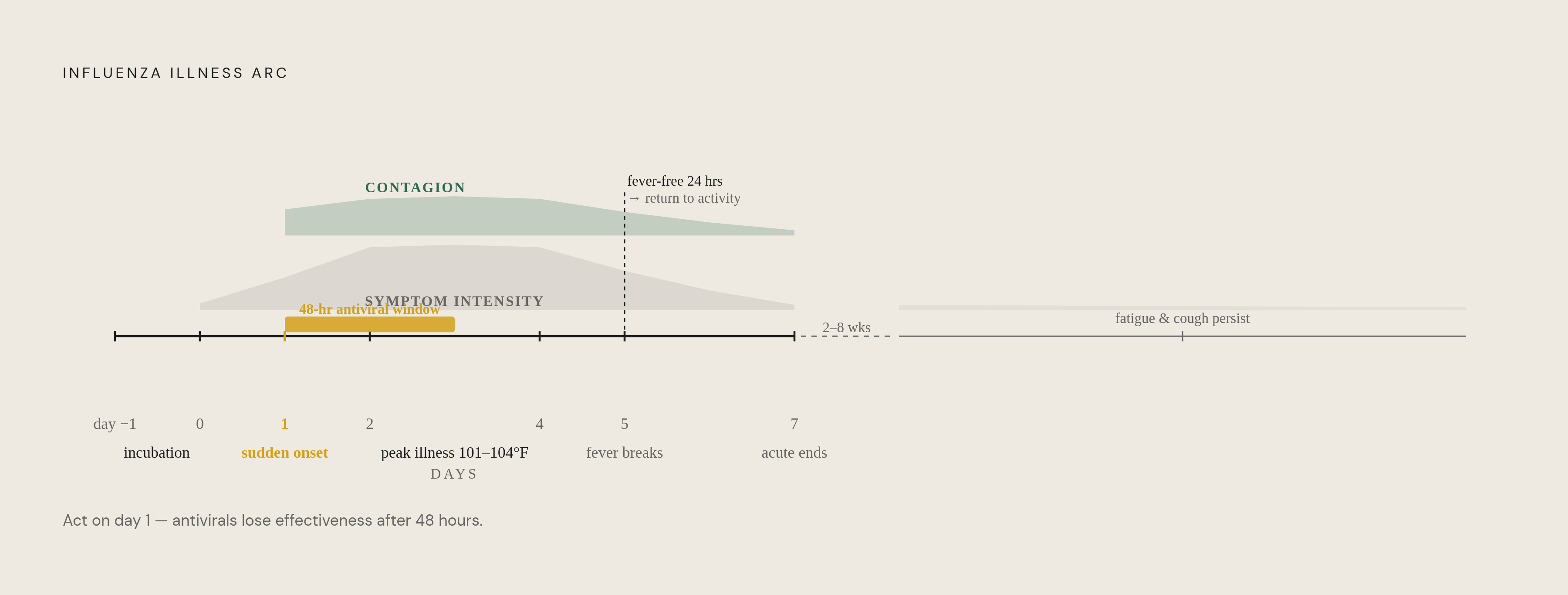
Before any symptom shows up, the flu virus is already at work. The incubation period, the stretch between exposure and the first sign of illness, runs about one to four days. During that window a person feels completely normal: no fever, no fatigue, nothing that would prompt a second thought. Meanwhile the virus is replicating inside the respiratory tract, and contagion actually begins about a day before symptoms appear.
That single fact explains a lot about how efficiently flu moves through households, offices, and classrooms. Contact tracing for flu is notoriously hard, and this is why: the most common story people tell, "I wasn't even sick yet when I was around them," describes exactly how influenza is built to spread.
There's no action to take during incubation; there are no symptoms yet to respond to. But the phase is worth sitting with anyway, because it reframes what happens next. Once flu symptoms show up, they don't ease in. They arrive all at once.
Day 1: the sudden onset that distinguishes flu from a cold
Ask anyone who's had both, and the difference between a cold and the flu comes down to timing more than symptoms. A cold builds over a couple of days: a scratchy throat Monday, a stuffy nose Tuesday, maybe a cough by Wednesday. Flu doesn't do that. Symptoms hit within hours, not days, which is exactly why "sudden onset" shows up in nearly every clinical description of influenza.
Day 1 typically brings a sudden fever, chills, a severe headache, body aches, sore throat, a dry cough, and fatigue heavy enough to stop someone mid-task. Some of that fatigue is the virus itself, but a meaningful part of it is the immune system doing its job; the inflammatory response that fights the infection also happens to be exhausting to run.
Day 1 is the day that matters most for anyone considering antiviral treatment, and this is the point most people get backwards: waiting to see if symptoms are "bad enough" to justify a call to the doctor burns the exact window when treatment does something. Drugs like oseltamivir (Tamiflu) work best started within 48 hours of symptom onset, and there's a biological reason that window is narrow. Viral shedding, meaning how much virus a person is producing and spreading, peaks at 24 to 48 hours into the illness. Started within that window, Tamiflu can shorten the illness by roughly 12 to 24 hours. That sounds modest on its own, but for people who are already high-risk, the real benefit isn't the shortened timeline; it's the reduced risk of severe outcomes.
That distinction deserves its own weight. Older adults, people who are immunocompromised, and those managing chronic conditions like COPD or heart disease should not wait to see if day 1 turns into something milder. In the 2024-2025 season, adults 65 and older accounted for 57% of flu hospitalizations. That's not a statistic to file away; it's the reason this group can't afford to treat day 1 as a mild inconvenience that might resolve on its own.
Days 2–4: peak illness and what "worst" actually feels like
Symptoms crest between days 2 and 4 for most people. Fever often climbs into the 101-104°F range, fatigue becomes total (getting up to refill a water glass can feel like a genuine project), and muscle aches, sweats, and appetite loss settle in alongside a cough that's now worse than it was on day 1.
How bad is "worst," exactly? Harder to pin down than it sounds, because bodies respond to influenza differently enough that there's no single checklist to measure against. One person's day 3 might be objectively rougher than another's day 2. That's exactly why symptom tracking works better day-over-day, comparing today to yesterday, rather than measuring against some universal flu script that doesn't actually exist.
Days 2 through 4 are also when contagiousness peaks, especially while fever is still present. If isolation matters at any point in the illness, it matters most here.
There's no shortcut through this phase. Rest, fluids, and fever management are the tools available, and they're the same tools that have always been available; nothing accelerates past peak illness. What's worth watching for instead is anything that doesn't fit the peak-flu pattern: difficulty breathing, chest pain that doesn't let up, confusion, or an inability to keep fluids down. None of those are standard peak-day symptoms, and any of them warrants a call to a clinician rather than a wait-it-out approach.
Days 4–6: fever breaks, but recovery is not linear
Fever usually starts to drop around day 4 or 5 in healthy adults. That's the good news. The complicating news is that a cough and sore throat can actually get louder right as the fever fades, which tends to alarm people who expect linear improvement. That louder cough reflects the body clearing inflammation from the airway, a process that doesn't sync neatly with the fever curve, rather than a relapse.
This is also the stage where people start feeling well enough to think about going back to work or school, often by day 5. That instinct is premature more often than not. The immune system is still spending real resources cleaning up remnants of the infection, and pushing too hard here, a full workday, a workout, a long commute, can set recovery back rather than speed it up.
The standard clinicians point to for returning to normal activity is being fever-free for at least 24 hours without fever-reducing medication like acetaminophen or ibuprofen. That's not an arbitrary rule. Someone whose fever is only staying down because of medication is still actively contagious, and flu transmission risk generally extends five to seven days from when symptoms first appeared. Feeling better and stopping the spread are two different milestones, and they don't arrive together.
Appetite coming back and moving around more freely are genuinely encouraging signs. They just aren't the finish line yet.
Days 6–7 and the end of the acute phase for most healthy adults
Most healthy adults clear the acute phase of flu within five to seven days, and the broader population, factoring in some variability, lands somewhere in the 7 to 10 day range. By day 6 or 7, fever is gone, appetite has largely returned, and energy is climbing. The acute illness, in the clinical sense, is over.
That doesn't mean it feels over. A specific kind of frustration sets in here: "almost better" but not quite normal, with a low hum of tiredness that won't fully clear. That plateau is an expected part of the timeline, not a sign that something's gone wrong, even though people often read it that way.
Children, adults over 65, pregnant people, and those with chronic conditions frequently take longer than this. Their recovery can stretch past two weeks, consistent with how flu behaves in populations with less immune reserve to draw from.
Lingering fatigue, a mild cough, or sinus pressure at this stage shouldn't trigger alarm on their own. Which raises the obvious next question: if those symptoms are still around, how long is too long?
Why fatigue and cough outlast every other symptom by weeks
Here's where the arc gets less intuitive, and where the second common mistake shows up: treating a lingering cough at day 20 as evidence the flu never really left. According to Johns Hopkins Medicine, fever and body aches typically resolve within three to seven days, but fatigue and cough can stick around for two weeks or more. That's a longer tail than most people expect from a flu that "already broke."
The fatigue has a specific mechanism behind it. The body continues recovery work even after the fever resolves, and that ongoing effort comes at a cost to energy and appetite. That's easier to see why fatigue is often both the first symptom to show up and the last one to leave.
Cough follows a similar logic through a different pathway. Airway inflammation doesn't disappear the moment the virus clears, which is why coughing spells can persist even after the acute infection has resolved. A cough lasting up to eight weeks after a flu infection falls within documented normal range, longer than most people would guess without being told.
Post-flu fatigue generally resolves within one to three weeks after acute symptoms clear. In some cases, cough and fatigue can extend out to three, even eight, weeks past the original infection. Wide window, and in most cases it reflects the tail end of repair rather than any ongoing infection.
When lingering symptoms cross into warning signs that need a clinician
So where's the line? A normal post-flu tail looks like gradual, if uneven, improvement: a residual cough, episodic tiredness, occasional sinus pressure, all trending better over time even when the trend isn't perfectly smooth.
What doesn't fit that picture is fatigue showing no improvement after two weeks, new or worsening shortness of breath, chest pain, confusion or any change in mental clarity, or an inability to keep fluids down. One pattern deserves specific attention: a second fever that shows up after the person had already started feeling better, especially when accompanied by new or worsening respiratory symptoms, is a signal to contact a clinician rather than continue waiting it out.
Worth restating for high-risk groups, because it bears repeating: older adults, people who are immunocompromised, and those managing chronic illness should have a lower threshold for calling a clinician, even when the symptoms in question look normal on paper. What reads as an unremarkable lingering cough in a healthy 30-year-old can mean something different in a 72-year-old with COPD.
None of this is meant to induce anxiety at every cough that lingers past day 10. The arc described here holds for most people, most seasons, and knowing where a given day falls on it is itself useful. It separates a rational decision to rest one more day from an unnecessary trip to urgent care, and it separates a truly concerning symptom from one that's simply how influenza resolves.