Bed Bug Bites Identification and Health Risks
The clustered bite pattern is your most reliable clue, but what you do after matters more.
Bed bugs bite in a pattern most people never learn to spot, and that gap in knowledge is what turns a two-week nuisance into a two-month infestation. I've spent enough time around pest control folks and a stack of dermatology literature to know the identification problem deserves as much attention as the bite itself. Get the ID wrong and you keep sleeping in the same bed, getting bitten, and writing it off as mosquitoes. Get it right early and you save yourself weeks of unnecessary exposure, plus whatever health complications tend to pile on when scratching gets involved.
Why does this happen so consistently? Start with the biology. A feeding bed bug injects an anesthetic along with an anticoagulant, so you feel nothing during the three to ten minutes it spends drawing blood. That numbing effect does quiet damage on its own: you don't know it happened, and by the time a reaction shows up, sometimes as late as 14 days out according to a 2023 NIH clinical review, the bug is long gone. Between 10 and 30% of people show no skin reaction at all, per that same review. The absence of visible bites tells you nothing, and 84% of pest control professionals report getting called in for a different pest before anyone correctly named bed bugs as the cause. Symptoms alone rarely point people the right direction.
What bed bug bites typically look like across different skin tones and reaction types
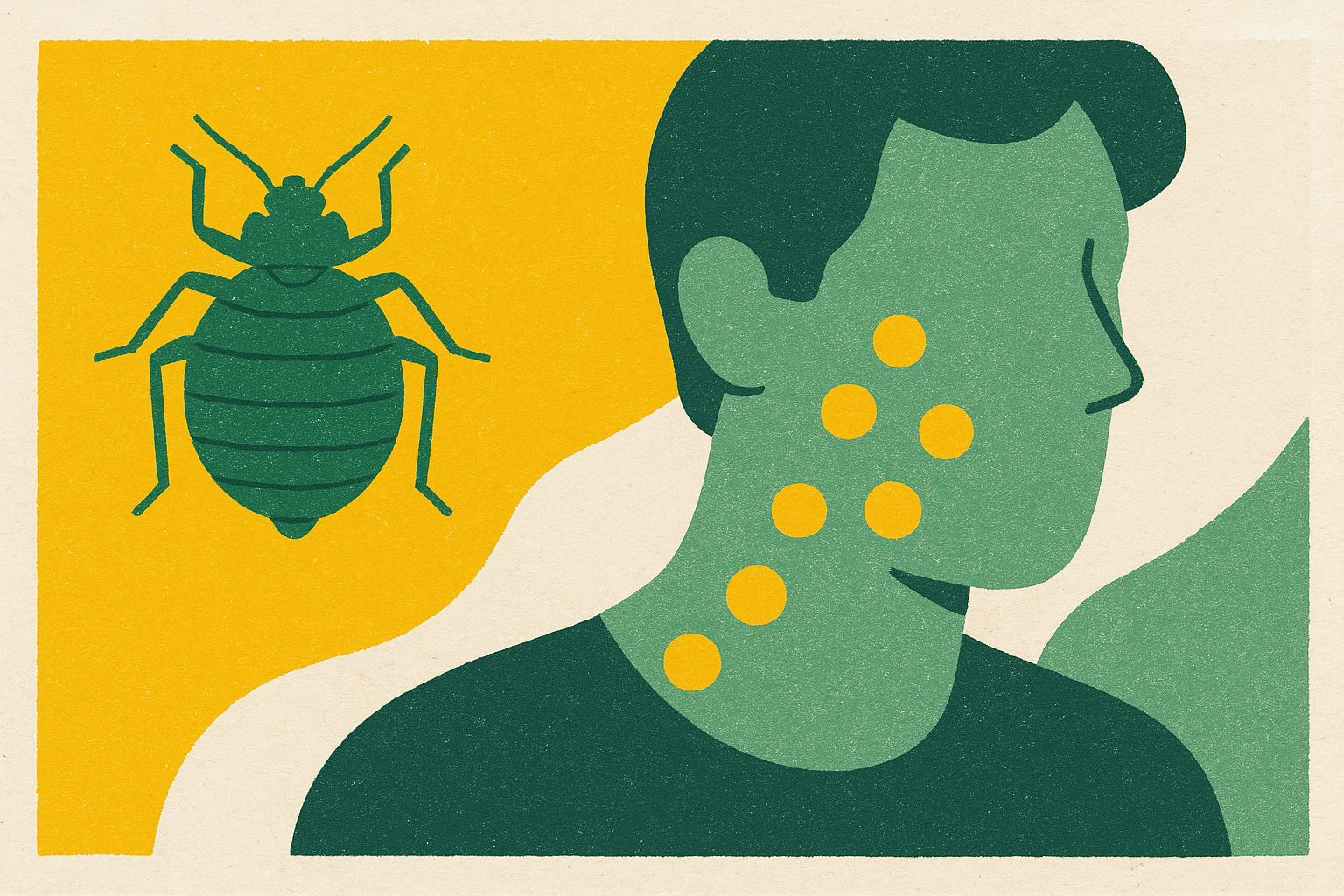
Clustering is the one clue that actually holds up. Bed bugs tend to bite in groups of three to five, arranged in a line, a loose zigzag, or a rough cluster. Pest control folks call it "breakfast, lunch, and dinner": the bug feeds, gets interrupted, shuffles over an inch, tries again. I heard that phrase from a technician years ago and it stuck, mostly because it's more useful than any textbook description of an individual bite. The pattern carries more diagnostic weight than any single bite's shape, since the shape itself varies wildly from person to person.
Some people get a raised bump that reads almost like a pimple, dark red in the center and fading at the edges. Others get a clear fluid-filled blister, what dermatologists call a vesicle, or a bulla if it's larger. Still others break out in something closer to hives: a raised, swollen patch studded with smaller bumps around it. The 2023 NIH clinical classification also lists nodules, eczema-like lesions, and lesions caused by scratching rather than the bite itself. One insect, four or five different presentations depending on the person. "What does a bed bug bite look like" barely functions as a question when the honest answer is "it depends."
Skin tone changes the picture, and most clinical materials gloss over it. On lighter skin, the reaction tends to read red, sometimes with a visible flare ringing the center. Darker skin can show that same reaction as purple or dusky, and it's harder to catch early while swelling is still minimal. Default to "redness" as the universal descriptor and a real chunk of affected people are left without a visual reference that matches their own arm.
Location narrows things down further. People run roughly 60% more likely to get bitten on the upper body than the lower, with the face, neck, arms, and hands taking the brunt since those spots stay exposed overnight. Timing is its own mess: some people break out within hours, others take days. That inconsistency is frustrating if you want one clean rule, but it's informative in its own right, because it tells you no single bite appearance holds true across everyone. Pattern, location, and timing together tell you more than any one bump does up close.
How to tell bed bug bites from flea bites, mosquito bites, and common skin conditions
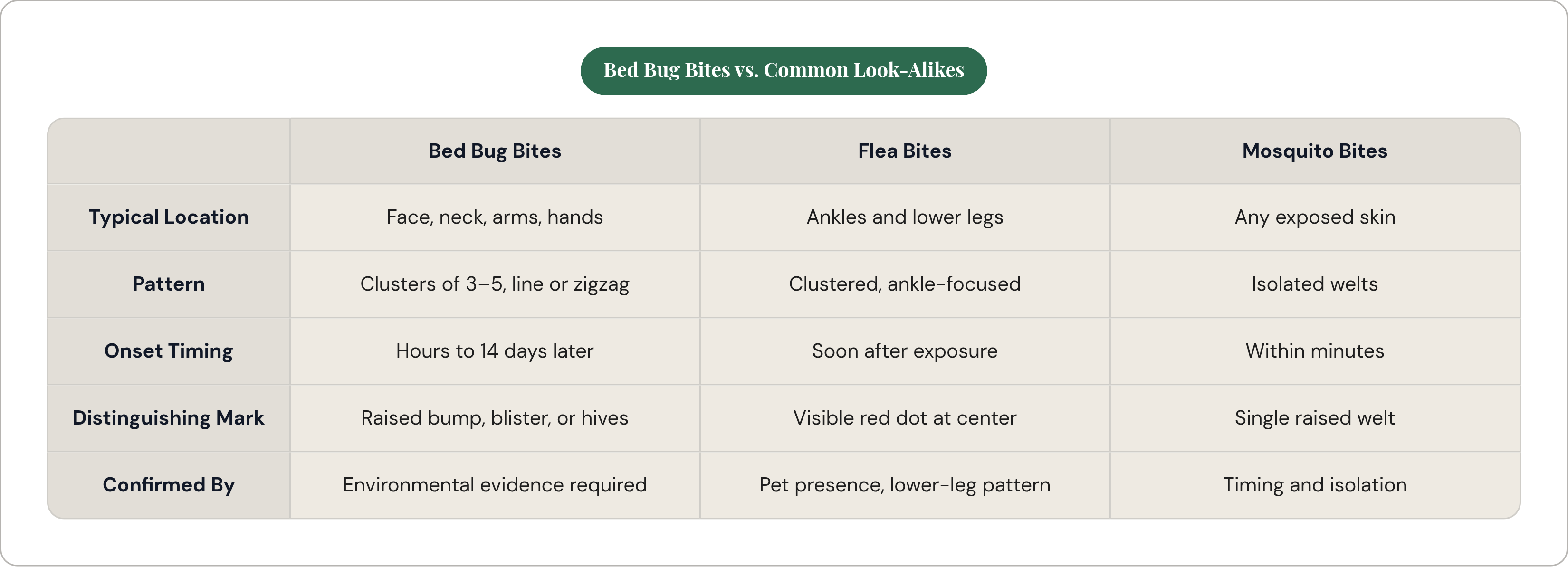
No lab test confirms a bed bug bite. None exists. The CDC and most dermatology sources agree diagnosis works mostly by elimination: rule out the likelier culprits until bed bugs are what's left. The comparison game becomes the whole exercise, whether anyone likes that or not.
Flea bites cluster around the ankles and lower legs, roughly the mirror image of the upper-body pattern bed bugs favor, and they itch intensely with a visible red dot dead center. Mosquito bites run on a different clock entirely, showing up within minutes rather than hours or days, and they tend to appear as isolated welts instead of tight clusters. Then there are the look-alikes with nothing to do with insects at all. Hives and certain fungal infections can mimic a bite cluster closely enough that a physician needs to weigh in, especially once a thorough search turns up no actual bugs anywhere.
The American Academy of Dermatology points to the clustered pattern as the single most reliable distinguishing feature, which matters given how much any one bite's look can swing. A 2023 NIH differential diagnosis review adds a wrinkle, though: certain autoimmune and immune-mediated skin conditions can present almost identically, clusters and all. At that point the bite pattern runs out of road, and the environment becomes the deciding vote.
So what actually confirms it? Rust-colored stains on bedding or mattress seams, usually crushed bugs or digested blood. Dark fecal spots on fabric or nearby walls. Shed exoskeletons from the several molts a bed bug goes through on the way to adulthood. A sweet, musty smell in a heavily infested room. Live bugs tucked into seams or furniture joints. Finding any of this takes a flashlight and the willingness to strip the bed down and actually look, which most people skip until the problem's already bad. Treat the bite as a hypothesis, and let the environment confirm or kill it.
The most common health outcomes: irritation, itching, and the risks that come from scratching
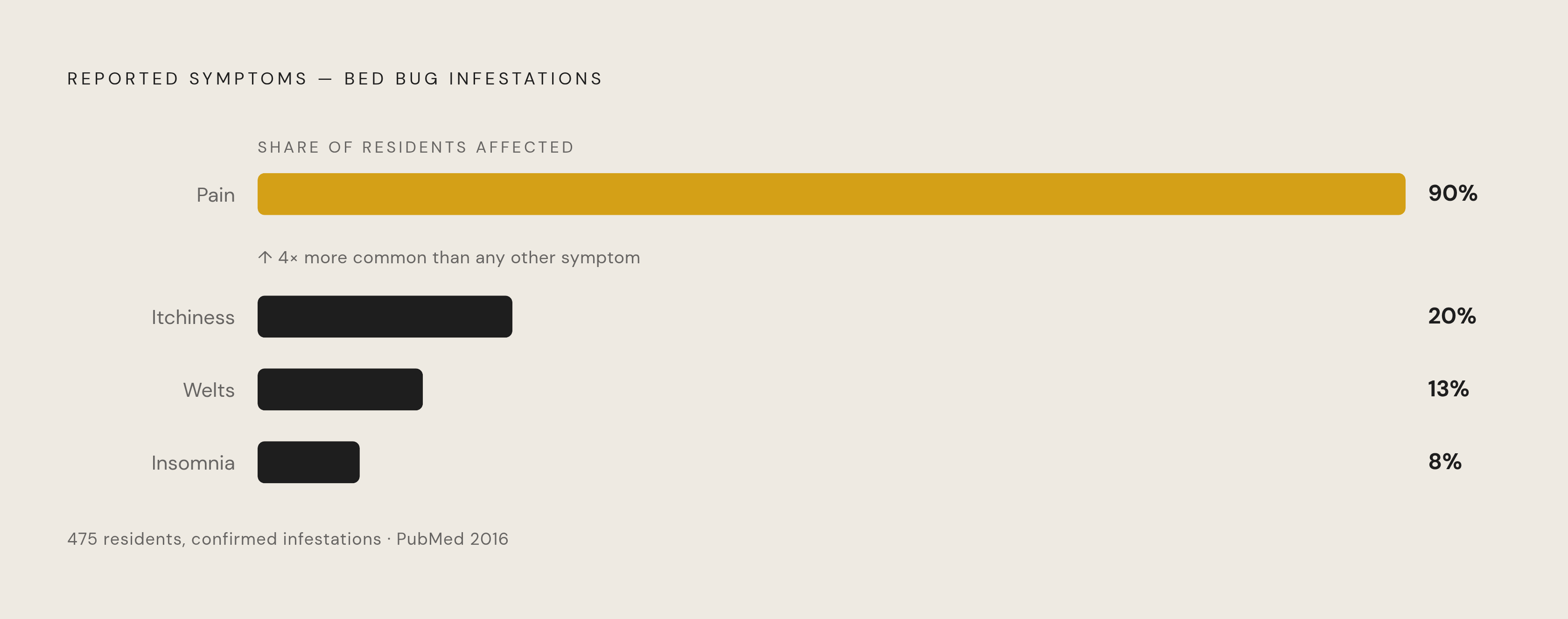
Here's a detail that cuts against the story most people carry around in their heads. A 2016 low-income housing study on PubMed, covering 475 residents with confirmed infestations, found the most commonly reported symptom was pain, at 90%, while itchiness came in at 20%, welts at 13%, and insomnia at 8%. That order throws people off, because the cultural shorthand for bed bugs has always been "itchy bumps." Pain topping the list by that margin suggests the physical discomfort runs broader and stranger than the itch-only story most people assume.
Beyond the bite itself, the real damage often comes from what people do about the itch.
Scratching breaks the skin barrier, and once that barrier's open, bacteria walk right in. Staphylococcus aureus and Streptococcus are the usual suspects behind skin infections generally, and here they're no different. That can produce impetigo, blistering sores, or ecthyma, a deeper and uglier version of the same thing. It can progress to cellulitis, meaning redness, swelling, and pain spreading well past the original bite. Neglected cases can push further into lymphangitis or, rarely, sepsis. Dermatologists warn about the same itch-scratch-infect cycle with poison ivy or eczema, but people take it less seriously here because it's "only a bug bite," which is exactly the kind of thinking that lets a small problem become a dermatology visit.
Washing the site and leaving it alone is the actual first line of defense here. It's not glamorous advice, but it's the one that stops a chain of events that starts small and doesn't reliably stay that way.
Allergic reactions to bed bug bites, from localized swelling to anaphylaxis
Allergic reactions sit on a range, and most people never leave the mild end of it. Mild reactions look like an enlarged, tender bite with some localized swelling, nothing an ice pack and a little patience won't handle. Moderate reactions widen into hives or urticaria spreading beyond the bite site, a sign the immune system's responding to more than just the puncture. Severe reactions go systemic: trouble breathing, facial swelling, an irregular heartbeat. That's anaphylaxis, and it's a medical emergency no matter what triggered it.
The documented cases are worth sitting with for a second. In one case reported through Ohio State research on ResearchGate, a subject who let 40 to 50 bed bugs feed on him developed facial swelling, widespread wheals, heavy sweating, and lethargy within eight minutes. Symptoms resolved over the next five hours, but only after systemic prednisone and antihistamines got involved. A second case from the same research involved chest tightness and breathing trouble severe enough that it belonged in an ER, not a wait-and-see plan at home.
Anaphylaxis from bed bug bites is rare, but the mechanism behind it, repeated exposure sensitizing the immune system over time, means the risk climbs the longer an infestation goes unaddressed. Difficulty breathing, a swollen tongue, or an irregular heartbeat after a suspected bite calls for immediate help, not overnight monitoring.
This is also where identification and allergy risk actually cross paths. People who miss the early bites keep sleeping in the same infested bed, keep getting bitten, and keep priming an immune system that may already be leaning toward overreaction. Catch it earlier and the exposure window shrinks. Shrink the window, and the odds of tipping from mild to ER-worthy drop right along with it.
What bed bugs do not transmit — and where the science remains genuinely unsettled
The CDC states plainly that bed bugs are not known to transmit disease to humans, which surprises people who assume any blood-feeding insect must work like a mosquito or a tick. That's the established consensus, and it's worth taking seriously precisely because it isn't the scarier headline.
There's real nuance underneath it, though. Bed bugs can carry certain pathogens in their bodies, but nobody has actually demonstrated transmission of those pathogens to a human through a bite. That's a narrower claim than "bed bugs are harmless," and the gap between the two matters more than it looks at first glance. A white paper from a Florida State University summit on the subject found the evidence around serious health risks from bed bugs is thin and mixed, not settled in either direction. Some researchers draw a comparison to cockroaches, another household pest long suspected of contributing to allergen exposure and respiratory effects that stay understudied relative to how common the exposure actually is.
What does that mean day to day? Disease transmission isn't a reason to panic. The harms that are well documented, though, secondary infection from scratching, allergic reactions running from hives to anaphylaxis, disrupted sleep, are serious enough on their own to justify moving fast. That insomnia figure from the 2016 housing study, 8% of symptomatic residents, gets buried under the more dramatic allergy cases, but chronic sleep disruption compounds over weeks, even for people who never develop a visible skin reaction at all.
Overstate the disease risk and credibility collapses the moment someone reads the CDC's own language for themselves. Understate the documented risks and people walk into an infestation underprepared for what's actually coming. Neither mistake is free, and the evidence doesn't hand you a tidy resolution either way.
How widespread misidentification delays response — and what the gap looks like in practice
Only 29% of Americans can correctly identify a bed bug, according to a 2025 NPMA and Harris Poll survey of 2,099 U.S. adults. Everything covered so far, the clustering, the differential diagnosis, the health outcomes, only helps if people can actually put it to use. Right now, fewer than a third can. That's a strange kind of failure for an insect this common and this well studied.
The backdrop isn't small either. An estimated 20% of Americans have personally dealt with an infestation or know someone who has, and bed bugs have turned up in all 50 states at this point. This is a pest that travels through luggage, furniture, and shared walls, so the identification gap has room to cause damage almost anywhere it wants.
The 2016 housing study captured what that gap looks like on the ground: 49% of confirmed infestations were in units where residents had no idea they were infested at all. That's the direct, unglamorous result of bites getting written off as mosquitoes and rashes getting written off as allergies, while the actual cause quietly multiplies somewhere in the mattress seams. Bed bugs are patient, and left unrecognized for a few weeks, an infestation doesn't stay the size it started at.
There's a travel angle worth pausing on, too. Only 28% of Americans check their hotel room for bed bugs before settling in, which means most travelers skip the exact inspection, mattress seams, headboard, luggage rack, that would catch a problem before it hitches a ride home in a suitcase. That one skipped step is how infestations jump from household to household without anyone connecting the dots until much later, sometimes months later.
The misidentification gap has a real cost, measured in how long someone stays exposed, how far the infestation spreads before anyone notices, and how much health risk piles up along the way. Everything above, the clustering, the upper-body distribution, the environmental confirmation signs, exists to close that gap.
What to do after identifying a likely bed bug bite — treatment and when to involve a professional
Once a bite looks likely, the first moves are simple enough to do at home. Wash the area with soap and water; that alone cuts infection risk meaningfully. Resist scratching, since the secondary infection pathway covered earlier is real and mostly avoidable with a little discipline. Over-the-counter antihistamines or a topical corticosteroid handle most of the itching, and a cold compress takes the edge off any swelling.
Some situations call for actual medical attention instead of home care. Expanding redness, warmth to the touch, pus, or pain that keeps getting worse instead of better are signs of secondary infection and deserve a look. Any systemic symptom, trouble breathing, swelling in the throat or tongue, a heartbeat that feels off, needs emergency care right away, not overnight tracking at home. A bite that just won't improve after several days is reason enough on its own to get it checked.
The step most people skip is confirming the source at all. A bite by itself proves something bit you, nothing more specific than that. Go back to the environmental evidence: mattress seams, headboard, nearby furniture, checking for the rust stains, fecal spots, shed skins, and live bugs described earlier. If those signs stay ambiguous, a professional inspection is the reasonable next move, not a stubborn holdout. Ninety-seven percent of pest control professionals report treating bed bugs within the past year, and most confirmed infestations get identified by a professional rather than the resident alone. That tells you something about how well these insects hide and how much training it actually takes to catch the early, subtle signs before they turn into an obvious problem.
If it gets to that point, Moxie Services handles bed bug inspections and targeted treatment, from a single room exposed after a trip to a full-blown whole-home infestation. Worth a call once the DIY identification process has run its course and the environmental evidence backs up the suspicion.
Treating the bite handles the symptom, while treating the infestation handles the cause, and the second one only becomes possible once someone has actually named what they're dealing with. The distance between "I have some itchy bumps" and "I know exactly what this is" is where most of the real damage happens, and it's a distance most people can close faster than they think.