Street Outreach Services for Unhoused Populations
Building trust with unsheltered people matters more than the services themselves.
Homelessness in 2024 hit 770,000 people on a single night, the highest count on record, and more than a third of them were unsheltered: sleeping in cars, doorways, encampments, places never built for anyone to live in. Street outreach is the field built to reach that specific group. This piece argues that what makes outreach work has less to do with the services on offer and more to do with something harder to put a number on: trust, and specifically, whether the person delivering a service has any standing to be believed.
Rents rose 18% between 2020 and 2024, and the country is short 7.3 million affordable rental homes for the people who need them. Inflation, discrimination in housing markets, and a fraying safety net all did their part, and the damage touched nearly every subgroup, individuals, families with kids, unaccompanied youth, older adults, people of color. One group moved in the opposite direction. Veterans saw real gains, with nearly 90,000 veteran households connected to stable housing through HUD-VASH in 2024, the largest number on record. That's a data point with weight. It's the clearest operational proof available that sustained, coordinated, adequately funded investment aimed at a defined population produces measurable movement, and it's worth holding onto, because the rest of this piece keeps circling back to what made that investment work.
The scale here says something about where outreach workers actually operate. They're meeting people well short of the edges of a strained housing system. They're meeting people at the point where that system has already failed them completely.
Who is actually living on the street, the behavioral health reality outreach workers encounter
Twenty-one percent of individuals experiencing homelessness report a serious mental illness, and 16% report a substance use disorder, according to the 2022 Annual Homelessness Assessment Report. Narrow the lens to unsheltered individuals specifically, and one HUD point-in-time count found the serious mental illness rate climbing to 60%. Sixty percent.
Los Angeles offers a useful street-level picture. In the city's Service Planning Area 6, roughly 14,000 people were experiencing homelessness as of 2024, a quarter of them with a reported serious mental illness, 22% with a reported substance use disorder. Layer those two conditions on top of homelessness and the outcomes don't add, they compound. A person managing psychosis without shelter is solving a fundamentally different, harder problem than either psychosis or homelessness would represent alone.
People experiencing homelessness face substantially elevated rates of disability, and unsheltered individuals routinely go extended periods without seeing a primary care provider. So what happens when a mental health crisis actually hits? More than 70% of people who went through one sought help of some kind, but fewer than one in five used a formal service like the 988 hotline or a mobile crisis team. Formal crisis services like the 988 hotline or mobile crisis teams reach fewer than one in five people who go through a crisis, leaving most to turn to whatever is immediately at hand.
Put that together and here's who outreach workers are walking toward: not someone waiting for a pamphlet, but someone with earned distrust of institutions, active symptoms that usually go untreated, and needs no single referral could fix. Which raises the obvious question. If the people who need help most are also the hardest to reach through any conventional channel, clinic intake, ED referral, a phone number, what actually gets them to engage?
What street outreach actually involves, from first contact to ongoing connection
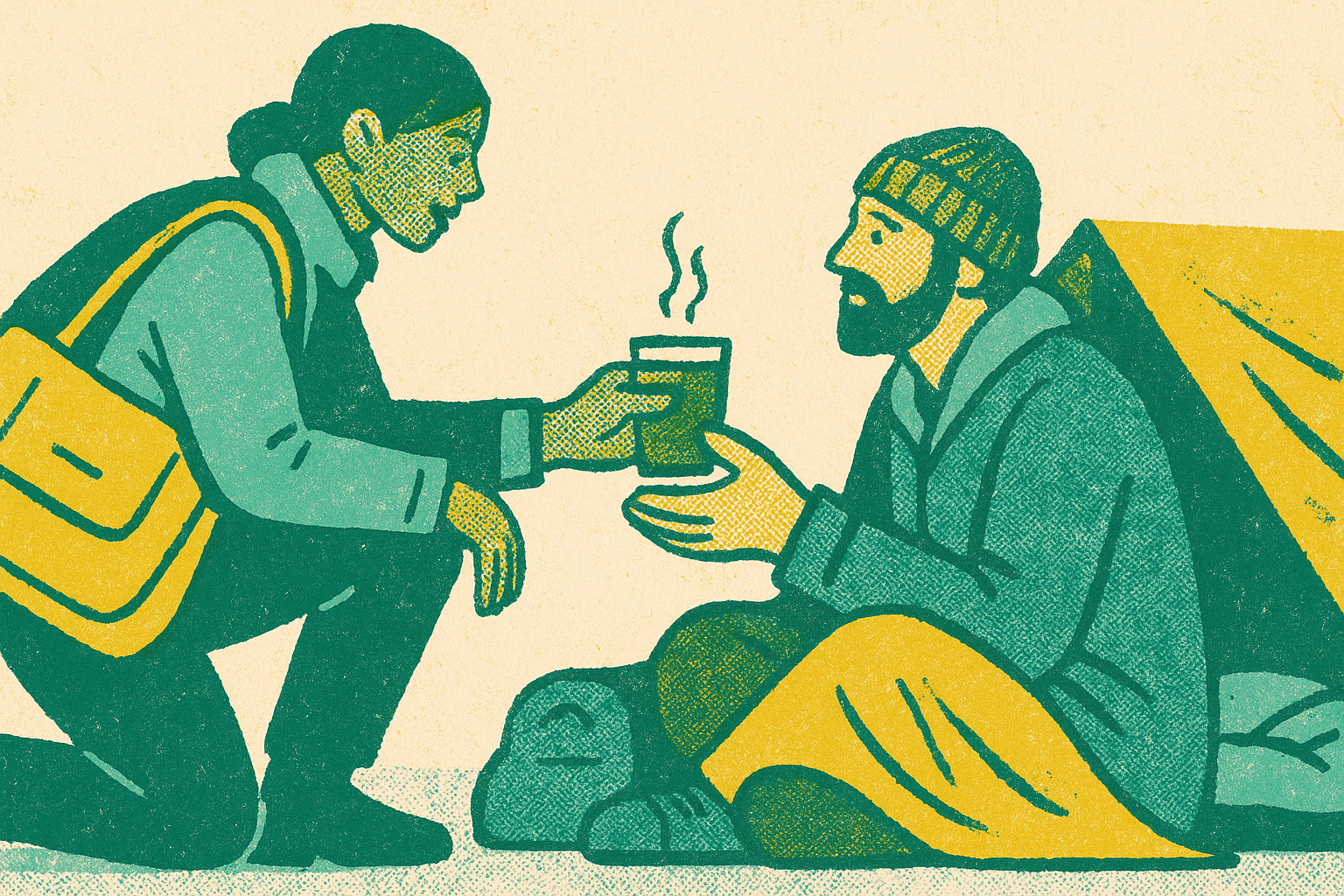
Outreach flips the standard model of care delivery. Instead of waiting for someone to walk into a clinic, workers go to encampments, transit stations, doorways, wherever people actually are. The daily work is unglamorous and repetitive by design: showing up in the same area on a consistent schedule, handing out harm-reduction supplies and basic necessities, doing welfare checks, building enough name recognition that a face stops being a stranger's face.
None of this moves fast, and it shouldn't. Research on engaging people with serious mental illness describes them as more severely impaired, carrying more unmet basic needs, less motivated toward treatment on anyone else's timeline, and slower to engage than people contacted in other settings. What does slower look like in real numbers? One city's daytime outreach teams, working a street population in the thousands, recorded 99 people voluntarily accepting shelter through mid-August of 2024, 26 voluntarily accepting a hospital assessment, and 24 transported involuntarily for psychiatric evaluation. New York State's 11 Safe Options Support teams, launched in 2022, helped roughly 200 people out of about 2,000 living on streets or in the subway system secure housing placement.
Read those numbers as a failure rate and the program looks weak. Read them as a conversion rate against a population defined by distrust and impairment, and they look like exactly what honest outreach produces. This is not a one-visit handoff. Workers often carry a relationship for months before anything resembling a formal service connection happens, and along the way the work spans housing navigation, food access, medication linkage, transportation, because survival needs have to be handled before any behavioral health goal is even reachable.
That sets up the real argument here. The services on the table aren't what determines whether someone gets better. What determines that is whether the relationship exists that makes someone willing to take the service at all.
Why trust is the actual mechanism, not a soft precondition
Consider what an unsheltered person with serious mental illness has usually already lived through: involuntary hospitalization, repeated law enforcement contact, shelters that felt unsafe rather than protective. Distrust, in that context, is a rational response to a pattern. It's a rational, learned response to a track record.
Trust doesn't get built by explaining what services are available. It gets built by consistent, low-demand presence, showing up without asking for anything, not disappearing after the third or fourth visit. Go back to that research finding about people with serious mental illness taking longer to engage, being less motivated, more impaired. What's that really describing? A trust deficit measured in clinical language. The depth of the distrust is what the clinical presentation is picking up, not some fixed unwillingness to accept help.
Without trust, the services sitting right there on paper stay functionally out of reach. Someone who won't step into a van, won't walk through a shelter door, won't disclose a psychiatric history to a stranger, cannot be connected to housing or medication or treatment, no matter how well-funded that program is. And trust doesn't stop mattering once someone's housed. A person placed into an apartment with no one they trust to call when the plumbing floods or the anxiety spikes is at real risk of losing that placement within months.
The veteran outcomes from the opening fit here too. What moved the numbers was sustained, coordinated, adequately funded investment aimed at a defined population, the same formula the rest of this piece keeps returning to. Trust is the delivery mechanism. Housing, medication, transportation, food, all of it is cargo. None of it moves if the mechanism doesn't work.
How lived experience changes what trust-building looks like in practice
Peer specialists are generally understood as people who have personally navigated mental health or substance use conditions and now support others through nonclinical work: advocacy, resource navigation, relationship building, goal setting. The definition sounds administrative. On the street, it changes everything about how a first conversation goes.
A worker who can say some version of "I've been where you are" isn't reaching for a rhetorical gesture to seem relatable. They're demonstrating, in the most concrete way available, that stability and recovery are actually possible for someone standing exactly where the person in front of them is standing. That's a different kind of evidence than a clinician's reassurance, and it lands differently, because it can't be faked.
Peer specialists work in a support role rather than a clinical one, and on the street specifically, that distinction carries real weight, because clinical authority is often exactly what's been used against unsheltered individuals before: the diagnosis that led to involuntary commitment, the assessment that justified a police response. Peers show up without that institutional weight attached. Lived experience isn't a soft credential tacked onto a resume. It closes a specific gap, between someone who knows about a situation and someone who has lived inside it, and that gap doesn't close through formal training, no matter how good the training is.
In a clinic, shared experience is a nice-to-have. On the street, where a person can simply turn and walk away at any moment, it may be the one thing keeping the conversation going long enough for anything else to happen. Peer workers also serve a bridge function that's easy to underrate: helping clinicians see a situation from the person's actual point of view, especially when behavior that reads as noncompliant to a clinician makes complete sense once someone understands what that person has survived.
Organizations built around this principle, firsthand among them, staff outreach teams with people who have personally navigated serious mental illness or substance use disorder. Framing that as a hiring preference misses what it actually is: a mission requirement, and the operational bet that lived experience is the fastest, and sometimes only, way to close the trust gap this population brings into every single interaction.
What outreach workers are actually trying to address: housing, food, medication, and the social conditions that determine health
Housing, food, and transportation are core parts of health care. They're the floor health care has to stand on. CMS once required hospitals to screen for exactly these health-related social needs, housing instability, food insecurity, transportation barriers, utility difficulties, interpersonal safety, under the Hospital IQR Program. The FY 2026 IPPS Final Rule removed those screening measures. The policy infrastructure for even asking the question isn't fixed in place, and that instability matters more than it might sound like it should.
For someone unsheltered, the hierarchy is blunt. Until food, safety, and shelter are handled, behavioral health treatment is largely out of reach, and outreach workers navigate that hierarchy in real time, one conversation at a time, not according to some tidy sequential plan. Transportation belongs on this list too: barriers to getting around directly limit someone's ability to make appointments, access routine care, or reach a grocery store with real food, and all of it worsens without a stable address or income to fall back on. Medication adherence runs into the same wall, since it's hard to sustain without stable housing, a consistent pharmacy relationship, and someone trusted to help troubleshoot when a prescription lapses or a pharmacy closes without notice.
The Florida Medicaid pilot, which followed about 1,300 enrollees from December 2017 through June 2024, quantifies what happens when these needs get addressed together instead of in sequence. Among enrollees who received housing support services, stable or permanent housing rose from 4% at the start to 59% at the 24-month mark. Among those who received no services, the same measure moved from 1% to just 33%. At the average follow-up point of fourteen months, half of the service recipients had stable or permanent housing, compared with 23% of those who got nothing.
The implication isn't subtle, and it cuts against how most programs are still structured. Outreach that treats housing, food, and medication access as things to handle at the same time, not as rewards unlocked after some behavioral health milestone, is what produces housing outcomes solid enough to make behavioral health progress possible in the first place. Sequencing it the other way around, stabilize first, house later, gets the order backwards and the data shows it.
The specific evidence for peer support as an outreach model, including where it shows up in outcomes data
Peer-run programs show up repeatedly in the literature as effective for improving recovery outcomes, cutting readmissions to acute care, and chipping away at the stigma that keeps people from seeking treatment in the first place. Research on peer-supported care after acute crisis episodes has found meaningful reductions in readmission compared with usual care.
The meta-analytic picture backs this up without overselling it. A 2022 meta-analysis found peer support associated with mental health outcome improvements at a standardized mean difference of 0.32, and a 2021 Cochrane review put the figure around 0.4. From the Florida pilot specifically comes a number that speaks directly to health system costs: peer support was associated with a 20% reduction in emergency department use among enrollees with serious mental illness or substance use disorder. That's a hard recovery metric that earns the rigor it claims. That's utilization data a health plan's finance team would recognize on sight.
Peer recovery support has emerged as a promising approach for care among people experiencing homelessness, a population where standard treatment retention is chronically difficult. Community-based interventions tend to show up in the research tied to better housing stability and stronger program retention.
None of this is friction-free, though, and here's where the field's own funding structure works against it. Medicaid billing coverage for peer services varies by state, documentation requirements are often restrictive, and reimbursement rates tend to run low, which makes it genuinely hard to sustain the intensive, flexible, relationship-heavy work peer outreach requires. When peer roles get reimbursed at a fraction of what more clinical, more billable roles bring in, the workforce gets treated as less essential than the evidence says it is, and retention suffers for it. That gap, between what the data says peer support does and how the funding system treats it, is one of the real structural reasons this kind of outreach stays under-resourced. Sitting with that contradiction for a second: the intervention with some of the best readmission data in this entire field is also the one states are stingiest about paying for.
What separates outreach programs that produce durable results from those that don't
Some programs move the needle. Others spin their wheels covering the same ground, year after year, with little to show for it. What's the actual difference?
Sustained geographic presence is one answer. Programs that keep the same workers in the same areas over time let a kind of ambient familiarity build before formal engagement even starts, so that by the time a real conversation happens, the population already knows who these people are. Low-demand entry is another. Early contact that asks for nothing, no assessment, no documentation, no referral on the first pass, resists the institutional pull toward measuring and processing before trust exists. That resistance takes real discipline, because funders and reporting requirements often push in exactly the opposite direction, rewarding programs for counting contacts rather than building them.
Multidisciplinary reach matters too. Food, housing navigation, medication access, crisis support, all of it needs to be reachable through one relationship. Splinter those into separate systems that each require their own intake and their own trust-building, and the people who distrust institutions most get lost in the gaps between them. Peer-led or peer-integrated staffing shows up again here, because the evidence keeps pointing the same direction: lived experience accelerates trust, and programs that treat it as a supplemental feature rather than a central design choice are leaving its main function on the table.
Housing First orientation counts as well. Research on community-based interventions consistently favors programs that prioritize getting someone into housing immediately over ones that demand housing "readiness" first, since the former shows better retention and better health outcomes. Housing is the platform everything else gets built on, not a reward that arrives after other goals are met. And the relationship can't stop at the door of a new unit. In the Florida pilot, tenancy support was associated with 51% lower odds of all-cause mortality, a number that says something blunt and real about what sustained support after placement does for someone's odds of survival.
SAMHSA's August 2025 announcement of $19 million in supplemental funding through the Community Mental Health Services Block Grant, aimed specifically at the overlap between homelessness and serious mental illness, signals that this combination, presence, low-demand entry, multidisciplinary reach, peer staffing, housing first, follow-through, is starting to get recognized federally as something needing dedicated funding rather than piecemeal grants. Programs that fall short tend to share one flaw: they treat engagement as a problem to solve quickly instead of a relationship to build slowly. That approach ends up reaching the people who were probably going to engage eventually anyway, not the people the whole model exists to reach in the first place.
What health systems and plans can do to support outreach that actually reaches the hardest-to-reach
The Florida pilot's structure offers a working template, and naming exactly why it worked matters more than treating it as one more case study. Statewide Medicaid Managed Care plans partnered directly with community-based housing organizations to deliver peer support, transitional housing assistance, tenancy support, and mobile crisis management, tested regionally in Medicaid Regions 5 and 7 rather than rolled out statewide all at once. That's outreach built into the managed care contract itself, not bolted on as a side grant that disappears the moment a funding cycle ends.
Health plans serious about outreach that actually works need to protect peer support from the billing pressures that would otherwise strip out the flexible, high-touch, relational parts of the job that make it effective in the first place. The 20% reduction in ED use tied to peer support in the Florida pilot is the argument here, and it's a cost argument as much as a quality-of-care one. Health Affairs' policy recommendation follows directly from this: embed housing support services inside managed care contracts and line them up with broader care coordination strategy, a path to sustainability that doesn't depend on whichever grant happens to renew this year.
Crisis management investment deserves its own caveat, though, and this is the part easiest to misread. In the Florida data, crisis management was associated with an increase in ED visits and psychiatric hospitalizations, which most likely reflects appropriate escalation for a genuinely high-acuity population rather than a program failing its job. Reading that number as a program failure would get the interpretation backwards. Peer workforce infrastructure needs investment that goes past the reimbursement rate line item too: training, supervision, and retention support for workers carrying real emotional weight, day after day, with a population that has, for entirely good reason, learned not to trust easily.
None of this is complicated to state. It's just slow, relational, and hard to bill in the way health systems are built to bill for things. That mismatch, between what actually works and what the funding architecture is designed to pay for, is the real story behind why so much outreach still doesn't reach the people it was built for.
Sources
- Impact Of Housing Support Services For Medicaid Enrollees With Serious Mental Illness, Substance Use Disorder | Health Affairs
- Mental health crises and help-seeking among US adults in 2024-2025 | Health Affairs Scholar | Oxford Academic
- Building Health Access for People Experiencing Homelessness: Street Medicine Rooted in Outreach Programs - Center for Health Care Strategies
- comptroller.nyc.gov