Workplace Wellness Programs and Preventive Health Outcomes
Billions in spending on workplace wellness programs lack rigorous evidence of real health gains.
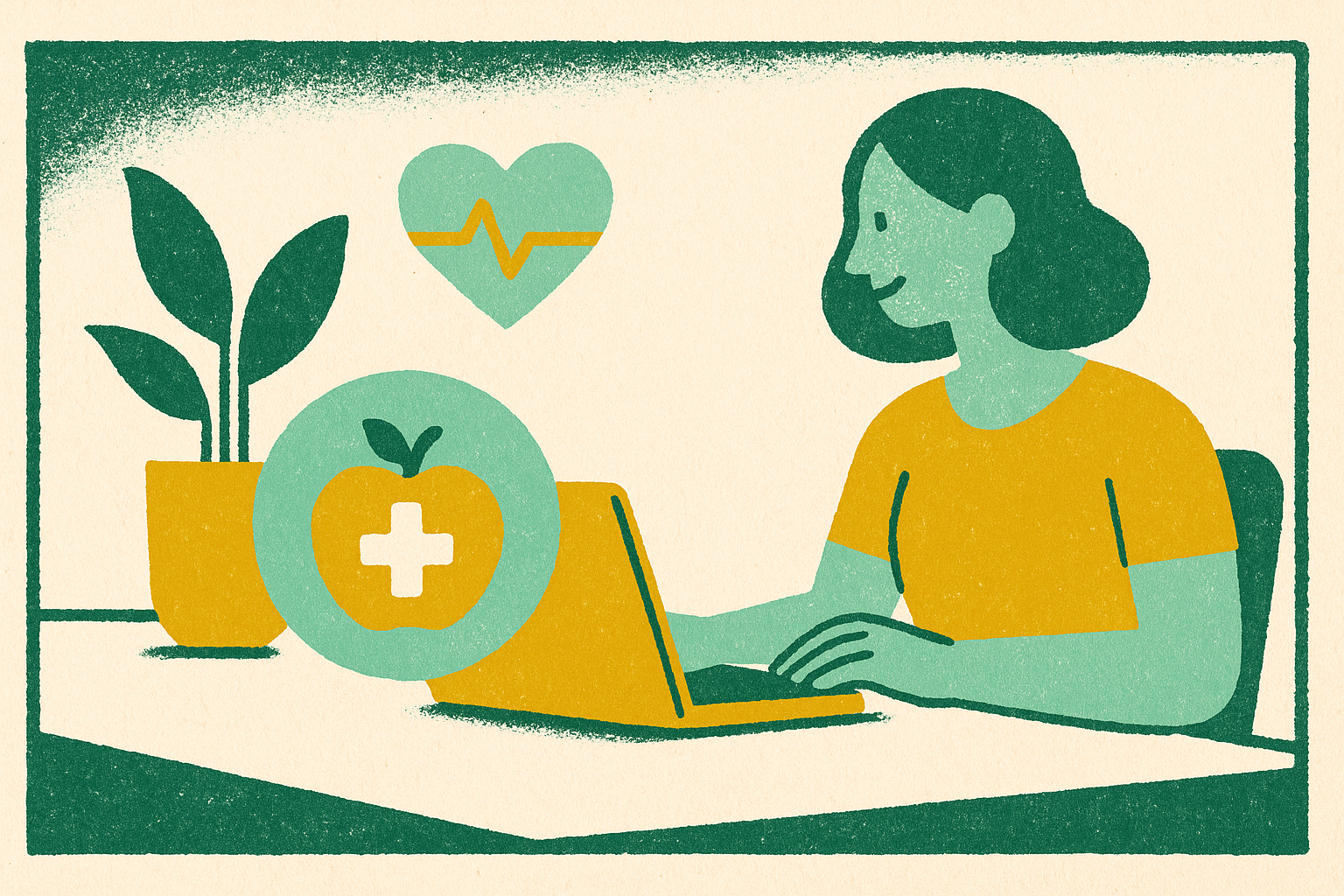
Employers now spend somewhere in the tens of billions of dollars a year on corporate wellness programs, depending on which research firm you ask, and both camps project the market roughly doubling by the mid-2030s. That much money moving in one direction usually signals confidence. Here, though, it signals something messier: a bet on outcomes that the best research only partly backs up, and in a few places actively complicates.
Fortune Business Insights puts the global market at $68.41 billion in 2025, headed toward $118.21 billion by 2034. Market Research Future starts from a different baseline, $88.8 billion in 2024, and projects $236.66 billion by 2035. The gap isn't really a disagreement about direction; it's a disagreement about what counts as "wellness" in the first place, whether you're folding in biometric screening vendors, mental health apps, gym reimbursements, financial coaching, or all of it at once. Everyone agrees the line goes up. North America holds about 40% of the global market as of 2025, and RAND survey data puts wellness program adoption at roughly half of U.S. employers already.
Why now? Mercer's 2024 National Survey of Employer-Sponsored Health Plans found health benefit costs approaching $16,000 per employee, rising faster than inflation, and 67% of CFOs at large organizations call healthcare costs a significant or very significant concern. Money follows fear here: 96% of insurance brokers surveyed by Wellable in 2024 expected clients to hold steady or increase wellness spending. The spending is also getting more targeted. Employer spending on health risk assessments more than doubled, from 7% to 15% of programs between 2023 and 2024, and 40% of employers increased weight management spending in the same window. Mental and financial wellness are close to standard now too, showing up in 92% and 77 to 83% of employer offerings respectively, per Macorva's 2024 data.
So the scale is real, the urgency is real, the money is real. I've spent years poking at the research behind these numbers, and what's less settled, every time, is whether health outcomes match the enthusiasm. That's the thread this piece pulls: what the ROI numbers really measure, what screenings actually find and change, where randomized trials complicate the survey data, why mental health programs in particular seem to be falling short, and what separates the programs that work from the ones that just look busy.
The financial returns employers cite and what the ROI numbers actually measure
The number everyone reaches for comes from a Harvard meta-analysis: medical costs fall by about $3.27 for every dollar spent on workplace wellness, and absenteeism costs drop by roughly $2.73 per dollar. It's a good number. It's also from 2010, which matters more than it sounds like it should, because it predates a wave of randomized controlled trials that would later push back hard on those figures. Johnson & Johnson's often-cited $2.71 return, measured from 2002 to 2008, tells a similar story: real, but self-reported, from a single employer studying its own program.
More recent data keeps the trend going. Wellhub's 2024 Return on Wellbeing Report, built on responses from over 2,000 HR leaders, found 95% of companies measuring ROI report positive returns, up from 90% the year before; nearly two-thirds report at least $2 back for every $1 spent. Ninety-one percent said healthcare benefit costs dropped because of their wellness program, up from 78% in 2023. Vitality's 2024 survey landed on an average savings of $462 in annual medical claims per engaged employee.
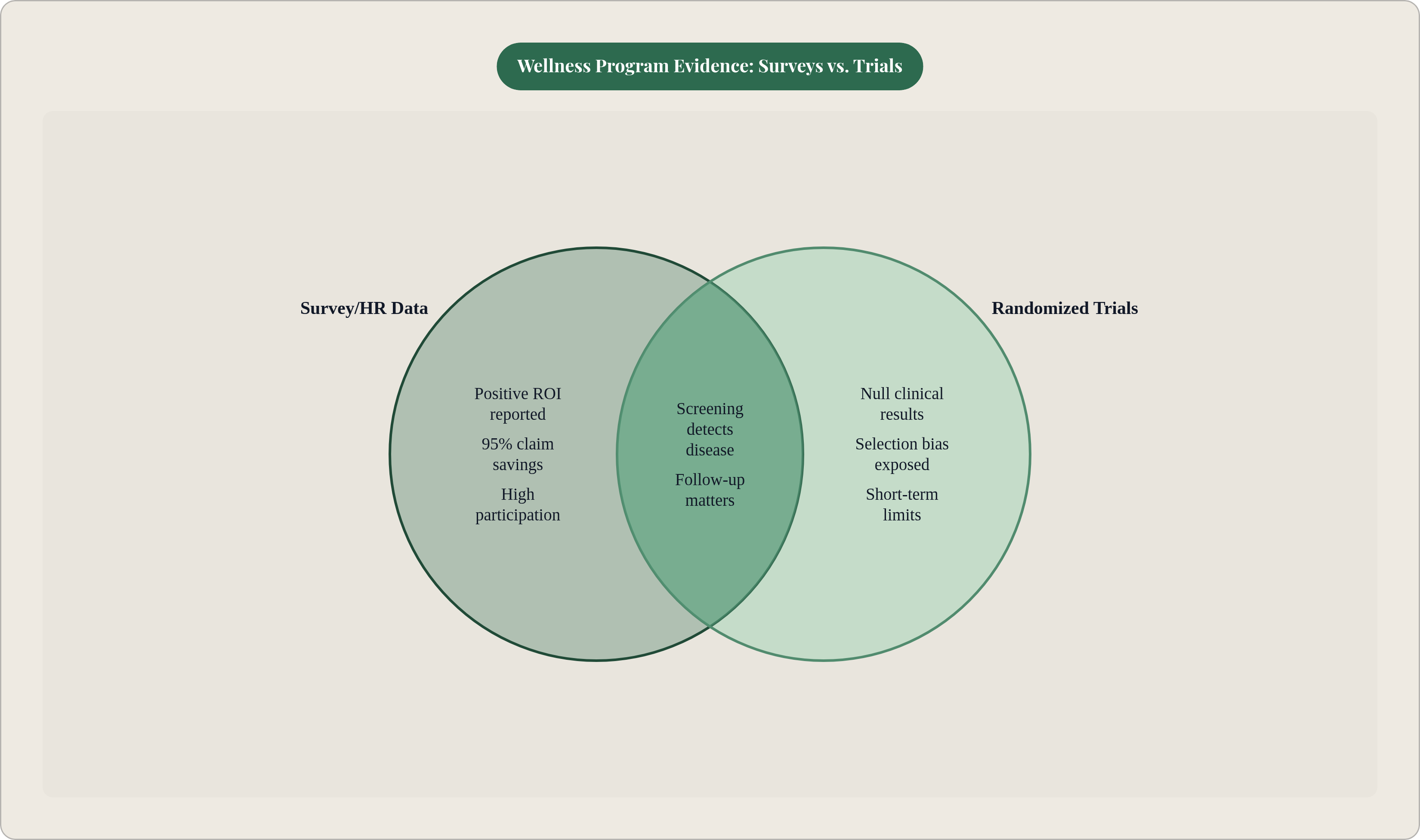
None of that comes from a controlled trial, though. Nearly all of it comes from surveys of HR leaders or from employer case studies built around people who chose to join the program in the first place, and people who choose to join a wellness program tend to be healthier before they ever walk in the door. That's selection bias, and it inflates just about every "we saved money" claim built on comparing participants to non-participants rather than randomly assigning people to one group or the other. If the fittest quarter of your workforce signs up for the step challenge, that group was probably going to post lower claims anyway. It's a basic confound, and it should have been priced into these numbers a decade ago.
Some employers already sense this. The International Foundation of Employee Benefit Plans found nearly 70% of surveyed organizations shifting from pure healthcare-cost ROI toward what's called VOI, value on investment: morale, engagement, job satisfaction. Part of that shift is philosophical, a move toward valuing the whole employee rather than just the claims line. Part of it, more honestly, is that isolating a clean financial return from a wellness program is genuinely hard, and organizations know it by now. Positive ROI is plausible. The precision attached to it deserves some skepticism, though, and the stronger case for these programs, as the next sections show, probably rests on clinical outcomes rather than dollar figures.
What preventive screenings and health risk assessments measurably detect and change
Biometric screening is one of the more common wellness tools employers use, offered by 24% of small firms and 45% of large firms according to a 2022 Employer Health and Benefits survey. On pure detection, the case is strong, maybe the strongest in the whole wellness literature. One large employer population health screening, published in AJMC, found that per 10,000 people screened, roughly 1,185 had previously unrecognized prediabetes, 287 had undiagnosed diabetes, 73 had chronic kidney disease nobody knew about, and 669 tested positive on colorectal screens.
Twenty-eight percent of participants with lab evidence of diabetes had never been diagnosed. Eighty-nine percent of those with evidence of chronic kidney disease didn't know they had it. These aren't cosmetic conditions caught a little early; they're diseases where a year or two of unmanaged progression can change the whole clinical trajectory, often for good. Nobody in this field seriously disputes that screening finds real, hidden disease. What actually divides researchers is what happens after the result comes back, and that's where I'd push anyone reading these numbers to slow down.
The Community Preventive Services Task Force looked at that question directly and found strong evidence that health risk assessments, when paired with actual health education, coaching, classes, and tailored follow-up, move biometric numbers in the right direction: a median systolic blood pressure drop of 2.6 mm Hg, a median total cholesterol reduction of 4.8 mg/dL, and documented improvement in tobacco use. These are population-level, middle-of-the-pack effects rather than dramatic individual transformations, and they depend on what happens after the screening, not the screening itself.
Elevance Health's internal 2024 program data backs this up in practice. Ninety-eight percent of eligible associates earned at least one wellness reward, roughly four in ten hit the maximum baseline reward, and participants were more likely to meet quality measures like appropriate screenings and, among members with diabetes, controlled blood pressure and blood sugar. A separate 2019 study of employees with moderate to high cardiovascular risk enrolled in a comprehensive program found nearly half improved their risk profile relative to what their baseline predicted. That's published research, not a company patting itself on the back. Screening plus real follow-through has genuine clinical support behind it. The ceiling on those gains is set almost entirely by how seriously the follow-through part gets taken, and in my experience that's the part employers skip.
Where randomized trials find the evidence much thinner than surveys suggest
Now for the part that should make anyone citing the Harvard $3.27 figure a little uneasy. The Song and Baicker study, published in JAMA in 2019, is widely considered the most rigorous workplace wellness trial done to date: tens of thousands of employees at a large U.S. retailer, tracked for 18 months, with actual randomization. Employees in the program reported more regular exercise and more active weight management, a real behavioral signal. On everything else, other health behaviors, clinical measures, healthcare spending, absenteeism, the trial found no significant effect.
A separate RCT out of the University of Illinois found similarly weak overall health impact, and added a wrinkle worth sitting with: incentive-based wellness programs might work less as health interventions and more as sorting mechanisms, pulling in employees who were already healthy rather than reaching the people who'd actually benefit. If the people who need a program most are the least likely to join it, the program's real-world value shrinks no matter what the participation numbers say. That's not a small caveat. It undercuts the whole premise of measuring success by enrollment.
Harvard researchers who responded to these trials made a fair point in their own defense: short-term RCTs run on basic, bare-bones programs don't necessarily generalize to mature, comprehensive programs built into a strong company culture over years. HERO, the Health Enhancement Research Organization, made a similar argument specifically about Song and Baicker, noting the study captured only the first 18 months of a fairly basic program, and that best-practice programs combining evidence-based design with leadership buy-in run on a different timeline entirely.
I don't think that tension gets resolved by picking a side. The programs simplest to study with a clean RCT design, discrete, time-limited, narrowly scoped, are rarely the programs wellness advocates are actually defending when they cite ROI numbers. A 2025 meta-review in JMIR covering digital wellness programs found general support for efficacy and acceptability, but flagged real gaps in evidence about whether outcomes last and what's actually driving the behavior change to begin with. A wellness program existing on paper guarantees nothing by itself. Design, employee population, and how well it's actually run decide whether anything clinical moves at all.
Why mental health interventions in particular are underperforming their promises
Mental health support is close to universal now, present in 92% of employer wellness programs according to Macorva's 2024 data, and the demand case writes itself: a 2024 Deloitte study found 77% of employees report having experienced burnout at least once. Employers built for that demand. Whether what they built actually helps is a separate question, and a much harder one to answer.
An Oxford study led by researcher William Fleming, published in the Industrial Relations Journal in 2024, analyzed tens of thousands of British employees across over 200 companies and looked at 90 distinct wellness offerings. The common stuff, mindfulness training, meditation apps, on-site massages, general wellness apps, showed no significant improvement in employee well-being. Out of all 90 interventions tested, exactly one showed a measurable benefit: employee involvement in charity work or volunteering. Read that number twice. Ninety tried, one worked.
Fleming's read on this is blunt, and worth taking seriously: the problem might not be fixable through individual-level tools at all. If the actual sources of strain are workload, inflexible schedules, and how performance reviews are run, handing someone a meditation app doesn't touch any of that. It treats a symptom while leaving the underlying condition, the job itself, unchanged.
But how does that square with the fact that plenty of employees swear these tools helped them? A 2022 study in JAMA Network Open found that workplace mental health programs reduced depression and anxiety symptoms in nearly 70% of participants, a real clinical result in a targeted population. Population-level well-being surveys and clinical symptom measures among people who actually enroll in a targeted program are measuring different things. A meditation app rolled out to an entire workforce, most of whom never open it, can easily show zero population-level effect while still helping the smaller group who use it consistently and had a diagnosable condition going in.
For employers pouring money into mental health apps and mindfulness subscriptions, the implication is uncomfortable: those tools may be treating symptoms of a work environment problem, one subscription at a time, without touching the environment itself. Mental health is arguably where early intervention pays the biggest downstream dividend for physical health too, given how tightly the two are linked. It's also, right now, the exact place where the evidence for the most common program formats is weakest, and that gap between spend and proof is the widest one in this entire field.
What distinguishes programs with real health outcomes from those without
The CDC lays out five criteria for what counts as a comprehensive workplace wellness program, and research out of the University of Rochester Medical Center, published in Healthcare in November 2024, found that outcome variability tracks closely with whether a program actually meets that standard. That reframes the whole debate. The real question was never whether wellness programs work; it's whether a given program meets the bar for comprehensive, evidence-based design, or whether it's a scattered pile of perks wearing a wellness label.
A few design features keep showing up in the research on programs that actually move the needle. Screening alone doesn't cut it: the CPSTF's finding that HRAs only improve outcomes when paired with follow-on education shows up as a theme across nearly every study in this space. Leadership buy-in and cultural embedding matter too, and HERO pointed to a lack of organizational integration as the core weakness in programs that flopped in trials like Song and Baicker. Programs that address multiple dimensions at once, physical, behavioral, environmental, consistently outperform single-lever interventions in the studies that do show positive results. Targeting matters as well; the University of Illinois finding on incentive programs pulling in already-healthy employees means program design has to work actively to reach people at higher risk, not just the people already inclined to show up.
Duration is its own factor, separate from all of that. An 18-month RCT showing null results is entirely consistent with a well-run, multi-year program showing real improvement later on. The evaluation window itself can simply be too short to catch the mechanism doing the work. Apply Fleming's finding constructively here, rather than as a reason to give up on mental health benefits altogether: they should sit alongside job design changes, flexibility, workload, manager quality, not stand in as a replacement for them. Those levers sit within an employer's direct control and carry real health consequences on their own.
VOI metrics like morale, retention, and engagement aren't just a softer fallback when hard ROI proves elusive. They capture intermediate signals that show up years before a health measure like blood pressure or a claims number would register a change. On the digital side, that 2025 JMIR meta-review found real support for efficacy and acceptability but flagged durability gaps, which suggests digital tools work best as an access layer, a way to keep people engaged, rather than a standalone fix. Which components, for which employees, backed by how much organizational support, over what stretch of time: that's the actual question worth asking, once you stop treating "does wellness work" as a yes-or-no proposition.
How employers can use the evidence to make better program decisions now
Start where the evidence is strongest: detection. Biometric screening and health risk assessments carry the most solid research behind them in this entire field, and the sheer volume of previously unrecognized prediabetes, diabetes, and kidney disease turning up in screened employer populations means the first real return is simple. You get to actually know your workforce's health profile instead of guessing at it.
From there, connect the screening to something. The CPSTF evidence is explicit that HRAs only move outcomes when paired with education and follow-through, and a screening result that dead-ends without a next step, coaching, a clinical referral, a behavior-change program, is exactly where the whole effort stalls out. I've seen this happen more than once: a company runs a biometric screening event, hands people their numbers, and does nothing else. That's not a program. That's a data collection exercise with a lab coat on it.
Measure what actually changes, not just who shows up. The gap between the 95% of HR leaders reporting positive ROI in Wellhub's 2024 survey and the null clinical results from randomized trials is, in large part, a measurement problem. Participation counts and clinical outcomes tell two different stories, and only one of them is really about health.
Treat mental health as an environmental issue as much as an individual one. Fleming's findings argue for auditing job design, workload, flexibility, and manager quality right alongside rolling out an app subscription. A program that skips that audit is medicating a symptom while leaving the underlying condition untouched. Thinking in multi-year cycles rather than annual ones matters just as much: an 18-month evaluation window catches early adoption fine, but it misses the slower mechanisms that actually drive lasting clinical change.
Platforms built around identifying health risk, delivering programming tailored to that risk, and actually measuring outcomes with data, rather than bundling a pile of disconnected perks, reflect what the strongest research in this space supports. Companies like Wellhub and Personify Health, formed from the merger of Virgin Pulse and Personify Health, compete in that integrated space, alongside comprehensive managed care and benefits approaches from providers like Elevance Health. Any employer evaluating a vendor should ask directly which pieces of the CDC's five-point comprehensive standard the platform actually covers, and what clinical outcome data, not engagement metrics dressed up to look like outcomes, it can actually produce.
I keep coming back to the same conclusion after working through all of this: wellness isn't a category that simply works or doesn't. It's a design and implementation problem, full stop. The employers who screen with a real follow-up plan, who fix job design instead of outsourcing it to an app, who measure clinical results instead of participation, are the ones for whom the ROI case actually holds up once someone checks the math.