Childhood Immunization Schedules and Vaccine Hesitancy
Transparency about how vaccines earn their place on the schedule could defuse parental distrust.
The childhood immunization schedule is one of the most scrutinized documents in American medicine, and also one of the least understood. Most parents encounter it as a laminated wall chart or a printout tucked into a folder from a well-child visit. It arrives without context, without authorship, without any visible account of how it came to say what it says. That invisibility is not a minor communications failure. It is, after years watching this debate play out in clinical settings and policy rooms alike, what I have come to believe is the primary engine of parental distrust.
The argument I want to make is not that hesitancy is irrational, nor that the schedule is beyond scrutiny. Both positions would be wrong, and the data makes them harder to hold with each passing year. What I want to explore is something more specific: that the schedule's evidentiary foundation is far more rigorous, far more dynamic, and far more publicly accessible than the average parent is ever shown, and that closing that gap is the most defensible and most direct response to hesitancy we have.
How a Vaccine Earns a Place on the Schedule, and How Timing Is Set
The body responsible for constructing the schedule is the Advisory Committee on Immunization Practices, known as ACIP. It is an independent federal advisory committee composed of physicians, immunologists, and public health scientists who convene in public meetings, publish their deliberations, and vote on recommendations that the CDC then formally adopts. The 2025 schedule, approved at ACIP's October 2024 meeting, covered vaccines for children and adolescents through age 18 and included updated guidance on COVID-19, Hib, influenza, and meningococcal B. As of the most recent pre-overhaul version, the CDC recommended immunizations against 17 diseases for all children.
The core evaluative questions ACIP applies to any candidate vaccine are consistent and rigorous: What is the disease burden on the population? What is the vaccine's efficacy? What does the safety profile look like across age groups? How does immunogenicity, the immune system's capacity to mount and retain a durable response, vary by age? And what is the population-level impact of vaccination versus non-vaccination? These are not rhetorical questions. They drive the evidentiary record that precedes any vote.
Timing, which is among the most common sources of parental concern, is the product of two converging considerations. The first is immunological: a vaccine is scheduled at the age when the immune system can mount a durable, protective response. The second is epidemiological: the schedule prioritizes the developmental windows during which exposure risk and disease severity are highest. Early infant doses for pertussis are not there arbitrarily. Infants face the highest mortality risk from whooping cough precisely because they are too young to have built any immunity and too small to tolerate the physiological stress of severe infection.
The multi-dose series that draws so much parental concern, the sense that the schedule asks "too much too soon," reflects a deliberate immunological logic. Initial doses prime the immune system; subsequent doses boost and consolidate memory. Each dose in a series is doing different work. The schedule is not administering the same signal repeatedly out of bureaucratic inertia; it is building a layered immune architecture. Across vaccines for diphtheria, tetanus, pertussis, Hib, pneumococcal disease, polio, MMR, HPV, and varicella, scientific consensus among peer nations is essentially uniform. These are not contested recommendations. They represent the accumulated weight of decades of trial data, post-market surveillance, and independent replication.
The HPV recommendation is worth examining closely, because it illustrates something the schedule's critics rarely grant it: the capacity for self-correction. When accumulating evidence showed that a single dose produced protection comparable to the two-dose series, the CDC revised its guidance downward and aligned with peer nations that had already made that adjustment. The schedule moved because the evidence moved. That is the system working as designed, and it is the kind of example most parents hear about only rarely because the revision did not generate the controversy that drives media coverage.
What parents almost never see is the published clinical commentary that accompanies each ACIP recommendation. These documents explain the reasoning behind specific timing decisions, outline catch-up schedules for children who fall behind, and detail contraindications for edge cases. They are publicly available. They are also written in a register that assumes clinical training, which is its own problem, but the information is there for any parent who knows to look for it.
Where the U.S. Schedule Sits Relative to Peer Nations, and Why Comparison Is Harder Than It Looks
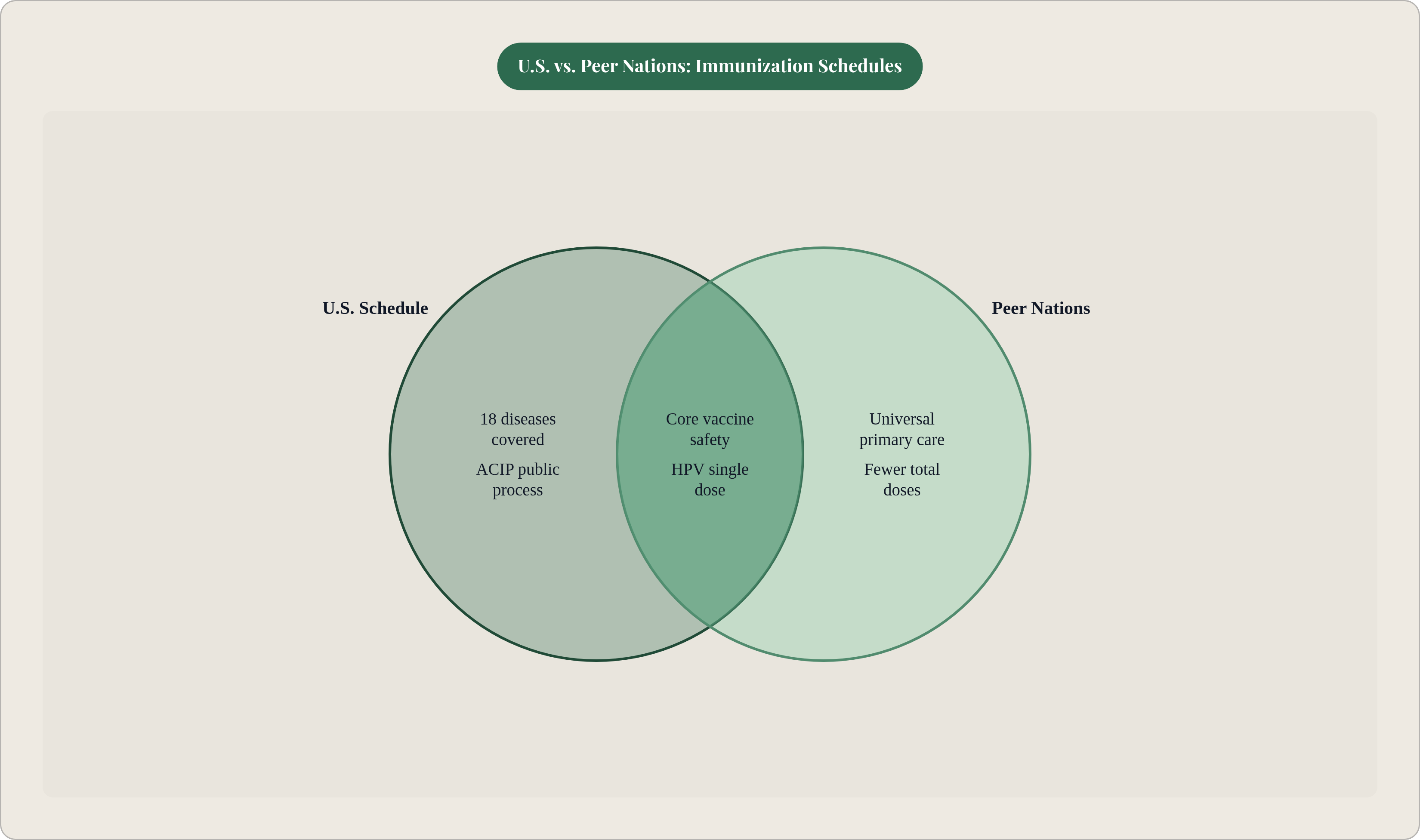
A comparison of roughly twenty peer developed nations found that the United States recommended more childhood vaccines than any counterpart, and more total doses than several European counterparts. Denmark, at the lower end of the peer distribution, recommends vaccines against ten diseases; the U.S., as of 2024, recommended coverage for eighteen. That gap has been cited frequently in public debate, and it is not an invalid observation. What is invalid is treating the raw count as self-explanatory.
Robert Hopkins, MD, of the National Foundation for Infectious Diseases, has noted that comparing the U.S. schedule to Denmark's ignores fundamental differences in population size, diversity, healthcare access, and infectious disease risk. These are not deflections; they are structural variables that materially affect what a rational national immunization program looks like. The U.S. serves a population far larger and more heterogeneous than Denmark's, with greater variation in infectious disease risk across geography, income, and healthcare access. A universal primary care infrastructure, like those operative in most European comparator nations, allows for different delivery assumptions, more consistent follow-up, more reliable catch-up. The U.S. cannot assume those conditions hold uniformly across its population.
None of that makes the comparison useless. It is legitimately useful for a specific, bounded question: whether every vaccine in the U.S. schedule needs to be universal rather than risk-stratified. That is a real and unresolved policy debate, and one worth having. But it is a separate question from whether the vaccines themselves are safe or whether the process that produced the schedule is sound. Those questions get collapsed in public discourse in ways that generate more heat than clarity.
The figure that further complicates the raw count is this: higher vaccine counts have not produced commensurately higher vaccination rates. Some analysts have used this observation to argue that the schedule's breadth may be counterproductive to public trust, that more recommendations generate more resistance. That is a plausible hypothesis and worth taking seriously. It does not, on its own, tell us which vaccines to remove or by what process such decisions should be made.
What Changed with 2026 Federal Overhaul
On January 5, 2026, HHS Deputy Secretary Jim O'Neill, acting as CDC Acting Director, signed a memorandum implementing a significant revision to the federal childhood immunization schedule. The revision reduced universal recommendations from eighteen diseases to eleven, moving vaccines for hepatitis A and B, meningococcal disease, rotavirus, influenza, and RSV into risk-based or shared decision-making categories.
The procedural break was stark. The revision did not go through ACIP deliberation in a public meeting. It was not accompanied by new safety or efficacy data justifying the changes. The evidentiary infrastructure that ordinarily produces a schedule recommendation was bypassed entirely.
The response from the medical community was rapid and organized. The American Academy of Pediatrics maintained its own 2026 schedule covering eighteen diseases, formally endorsed by twelve medical associations including the AMA and the Infectious Disease Society of America. Twenty-eight states, including Washington, D.C., announced they would follow AAP guidance. Others announced partial adoption or state-level requirements to follow the federal revision. The result was a patchwork in which a child's recommended immunizations varied depending on which state they lived in and which guidelines their provider was following.
In March 2026, a district court stayed the new federal schedule, finding it likely constituted arbitrary and capricious agency action under the Administrative Procedure Act. The operative schedule reverted to the June 2024 version. The government appealed in April 2026.
The episode is instructive beyond its immediate legal outcome. What it demonstrated is that the ACIP process is not bureaucratic friction. It is the mechanism that gives a schedule its evidentiary legitimacy and, ultimately, its public defensibility. When that process was circumvented, even vaccine-supportive physicians and parents found themselves unable to answer a basic question: where is the evidence for this change? The inability to answer that question was not a failure of the science. It was a failure of process. Process is not separate from trust. It is how trust is built and maintained over time.
Where Vaccination Coverage Stands Now and What the Exemption Data Actually Shows
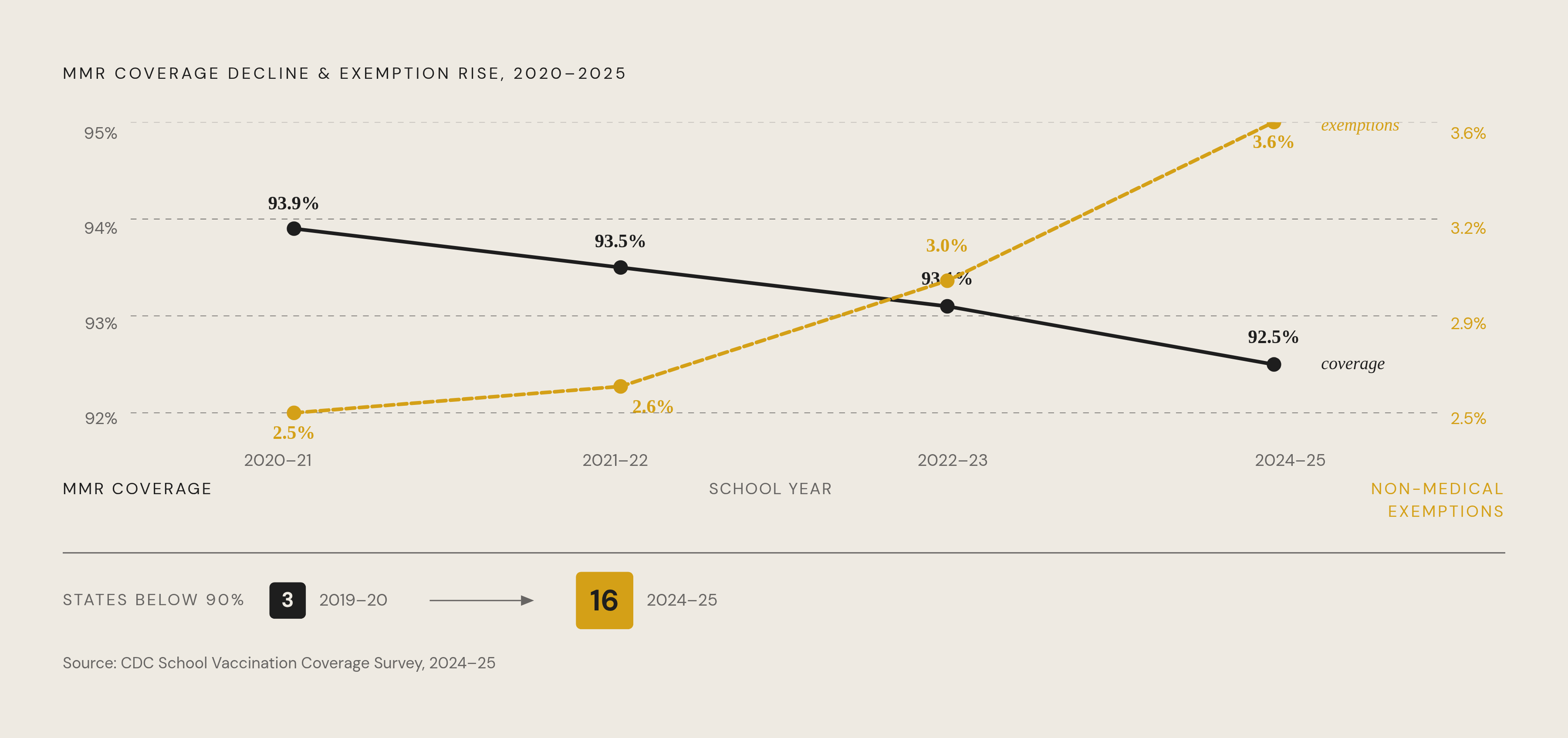
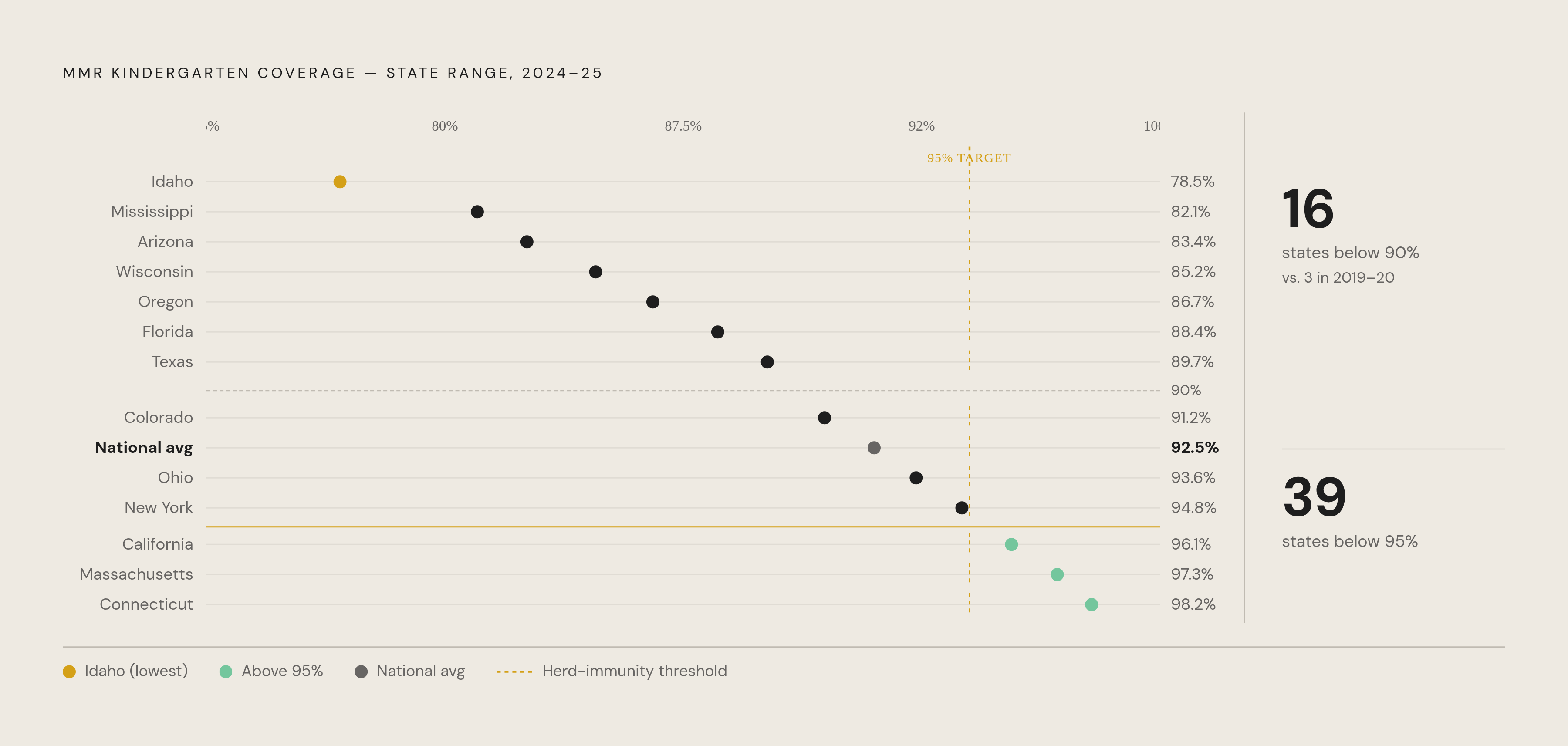
MMR coverage among kindergartners in 2024-25 was 92.5%, well below the 95% threshold generally required to prevent measles transmission through herd immunity. Only ten states had MMR coverage above 95%. Thirty-nine states fell below that target; sixteen reported rates below 90%, compared to only three states below 90% in 2019-20. The state-level range, from 78.5% in Idaho to 98.2% in Connecticut, reflects policy and culture as much as it reflects access. DTaP and polio coverage tracked similarly, both below pre-pandemic levels.
The exemption data is the sharper signal. Non-medical exemptions reached 3.4% in 2024-25, with 3.6% of kindergartners holding at least one exemption, approximately 138,000 children nationally. Medical exemptions held steady at 0.2%, meaning the entire rise is driven by choice, not clinical contraindication. Exemptions rose in 36 states and Washington, D.C. Seventeen states reported exemption rates exceeding 5%. Idaho's exemption rate reached 15.4%. In 2020-21, 2.5% of entering kindergartners held an exemption; the climb to 3.6% over just four school years represents a meaningful acceleration.
Forty-five states allow religious exemptions; fifteen of those also permit philosophical or personal-belief exemptions. The policy landscape shapes how readily hesitancy converts to non-vaccination. Where the legal barrier to opting out is low, the conversion rate from doubt to exemption is predictably higher.
What the aggregate numbers conceal is geography. Exemptions cluster. A state average of 5% may contain a county or school district where exemption rates are dramatically higher, and where local herd immunity has already eroded. The aggregate hides pockets of real outbreak risk that the state-level figure does not convey.
Who Hesitates and Why, and Why Hesitancy Is Not One Thing
The World Health Organization has classified vaccine hesitancy, defined as the delay in acceptance or refusal of vaccines despite availability, as one of the most pressing threats to global public health. That framing is useful because it separates hesitancy from outright refusal and acknowledges that the phenomenon is not monolithic.
The COVID-19 pandemic altered the hesitancy landscape in ways that are still resolving. Objections to COVID-19 vaccine mandates appear, based on CDC survey data from 2024, to be transferring into broader resistance to school immunization requirements. During a nine-month window in 2021-2022, the share of parents hesitant about pediatric COVID-19 vaccines rose sharply, illustrating how quickly hesitancy can shift in response to a novel policy context. The policy response to a new vaccine, not just the vaccine itself, can generate lasting distrust of the surrounding infrastructure.
The demographic patterns are counterintuitive and deserve careful attention. Pediatric COVID-19 vaccine hesitancy, per 2021-2022 National Immunization Survey data, was more prevalent among parents of White children than among parents of Black or Hispanic children, and was substantially higher in rural than urban areas. By contrast, hesitancy toward routine childhood immunizations ran higher among parents of Black children than among Hispanic or White parents. These two patterns have entirely different etiologies. The former is shaped significantly by COVID-era mandate fatigue and distrust of government intervention. The latter is rooted in a distinct and documented history of medical exploitation and institutional racism that no amount of schedule transparency alone will repair.
Core drivers in the peer-reviewed literature include misinformation circulating on social media, distrust of public health institutions, and a specific risk calculus in which the perceived danger of vaccine side effects looms larger than the perceived danger of the disease itself. That last pattern is not irrational on its face; it is the product of vaccination's own success. Parents who have never seen a child paralyzed by polio or hospitalized by Hib meningitis are making risk calculations with incomplete priors.
Qualitative research among educated, hesitant parents reveals a specific and recurring pattern: they actively downgrade the authority of their pediatrician, elevate alternative information sources, and report a felt sense that the schedule was not designed with their individual child's risk profile in mind. That felt sense is worth taking seriously, not because it is clinically accurate, but because it tells us something about what these parents are actually looking for. They want an account of the reasoning, not just an instruction.
A blanket reassurance campaign fails two populations simultaneously. The rural parent skeptical of mandates needs a clear account of the distinction between a federal recommendation and a legal requirement, and a straightforward explanation of what happens to local disease dynamics when coverage falls. The parent whose distrust is rooted in institutional harm needs community-based messengers, shared decision-making frameworks, and a demonstrated commitment to acknowledging historical wrongs, not a poster that says vaccines are safe and effective.
Why Transparency About the Schedule-Building Process Is the Most Direct Response to Hesitancy
The 2026 controversy exposed something that was structurally true but rarely stated plainly: process transparency is not a bureaucratic value. It is trust infrastructure. When the federal schedule was revised without ACIP's public deliberative process, physicians who had spent careers defending vaccine recommendations found themselves unable to answer a basic question: where is the evidence for this change? That inability was not a failure of the science. It was a failure of process. The two are not as separable as we sometimes pretend.
What hesitant parents most often lack is not access to safety data. Safety data is abundant and, for anyone willing to search, accessible. What they lack is a legible account of how decisions are made: who evaluated what, on what timeline, under what constraints, with what safeguards for revision when new evidence emerges. They lack, in short, a view of the process.
The schedule's dynamism is a trust-building asset that remains almost entirely unused in public communication. The HPV dose revision is a clean example. The annual ACIP cycle, with public meetings and published deliberations, is a transparency mechanism that most parents encounter rarely, if at all. The catch-up schedule tables, which show how ACIP thinks about children who fall behind, demonstrate a flexibility and individualization that the "one-size-fits-all" critique does not account for. These features exist. They are simply not communicated.
The current policy environment compounds the problem. The federal schedule is under court stay. The AAP counter-schedule is operative in many states. State-level variation in which schedule providers are legally obligated to follow creates a practical information burden for parents who are simply trying to understand what their child should receive and why. Confusion is fertile ground for misinformation, and the structural confusion of 2026 has been exceptionally fertile.
The clearest thing a parent can be given is not a revised schedule or a more forceful public health campaign. It is an account, rendered accessible, of the evidence and reasoning behind each recommendation: the same information ACIP uses, translated out of the clinical register. Not because that will resolve every objection, but because trust built on understanding is durable in a way that trust built on deference is not. Deference erodes the first time an authority stumbles. Understanding is more resilient, because it gives people the tools to evaluate new information rather than simply accept or reject it.
I have watched the schedule defended, attacked, revised, litigated, and circumvented. What I have come to believe, with more conviction than I expected, is that the schedule itself is neither the problem nor the solution. The problem is the gap between what the process produces and what parents are shown. Closing that gap is slower, harder, and less satisfying than a mandate or a messaging campaign. It is also, based on everything the hesitancy literature and the exemption data and the 2026 debacle have taught us, the only intervention that holds.