Colorectal Cancer Screening Options Compared
Five screening options exist, but cost, discomfort, and compliance rates vary widely.

Colorectal cancer screening works. That has been settled for decades. What hasn't settled is why nearly a third of eligible adults still haven't done one of the several tests that qualify. This piece walks through what those tests actually detect, how often each needs repeating, and what it costs a patient in money, time, and, frankly, dignity, because let's be honest, nobody enjoys talking about their stool.
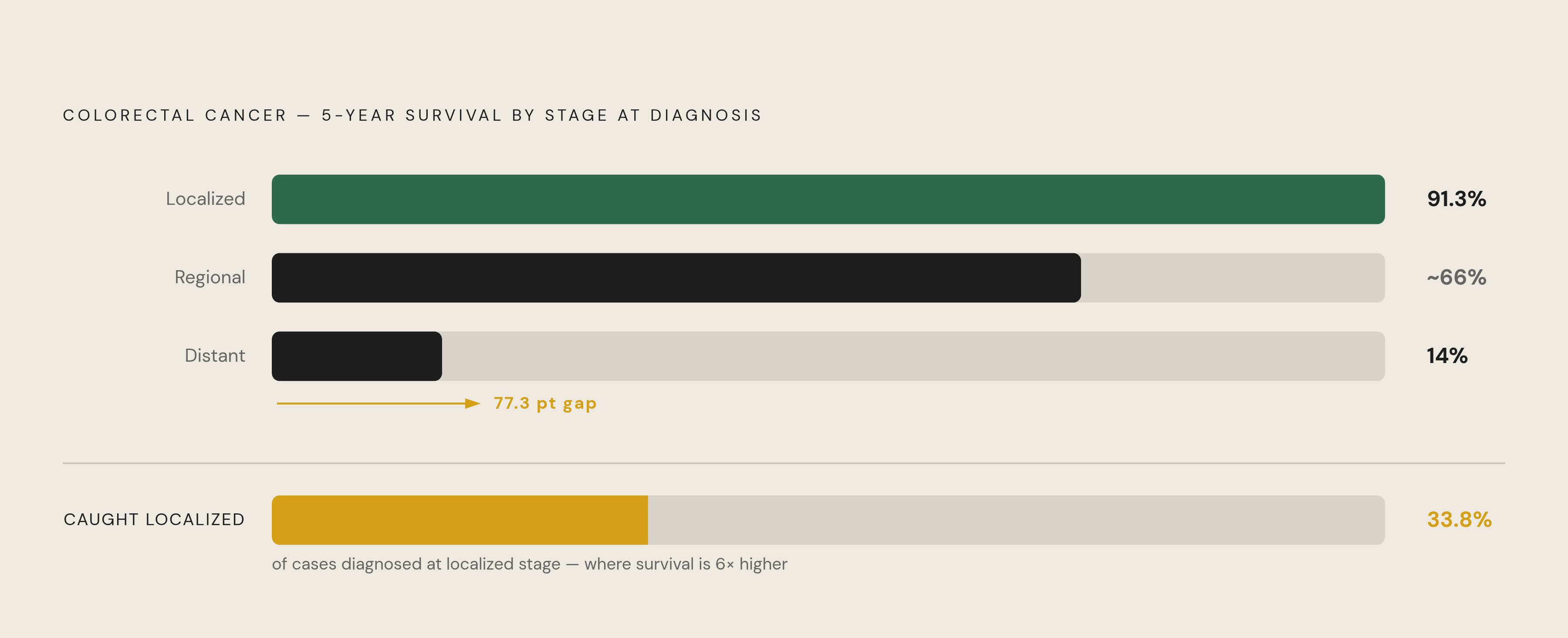
Look at the numbers, because they're stark enough to sit with for a second. Projections put 2026 at roughly 158,850 new colorectal cancer cases and 55,230 deaths in the U.S. Five-year survival for localized disease runs 91.3%, against just 14% for distant-stage disease. Only 33.8% of cases get caught at that favorable local stage, which tells you screening works when used but remains badly underused across the eligible population. Between 1970 and 2020, the CRC death rate dropped 57%, driven by screening, earlier detection, and better treatment working together, and that happened with tools cruder than what we have now.
There's a demographic wrinkle that makes this more urgent. Incidence in adults 20 to 49 is climbing about 3% a year, and 0.4% a year in those 50 to 64, even as it falls 2.5% a year in adults over 65. The share of cases in adults younger than 55 nearly doubled, from 11% in 1995 to 20% in 2019. The sections below keep circling back to that fact, because it changes who should be reading this piece in the first place.
Who should be screened and when guidelines say to start
The U.S. Preventive Services Task Force updated its guidance in 2021, and the headline is the age threshold. Adults 50 to 75 get a Grade A recommendation, the strongest tier the USPSTF hands out. Adults 45 to 49 get a Grade B: still firm, just newer, and still underrecognized by patients who grew up hearing that screening starts at 50 and never got the memo that it moved.
The data backs up that lag. Screening rates among 45-to-49-year-olds rose from 25.6% in 2021 to 51.7% in 2024, which is real progress by any measure, though it's still the lowest completion rate of any eligible age group. Overall completion reached 70.8% in 2024, up from 61.8% in 2021, against a target of 80% set by the National Colorectal Cancer Roundtable. The gap is closing, but a meaningful distance remains before that target is met.
None of these thresholds apply if you're not average risk. Anyone with a personal or family history of CRC or polyps, inflammatory bowel disease, or a hereditary syndrome like Lynch syndrome needs to screen earlier and more often. Figuring out exactly how much earlier is a job for a clinician, not a chart you found online. Everything else in this piece describes the average-risk pathway, because elevated risk changes the math entirely, and no amount of general guidance substitutes for that specific conversation.
Access tracks closely with who actually gets screened, and the pattern isn't subtle. Asian Americans screen at roughly 50%, uninsured adults at just 21%. Income matters too: completion rises from 56.7% among adults below the federal poverty level to 74.9% among those at 200% of that level or above. Past 75, the USPSTF stops giving a blanket recommendation and asks patients and clinicians to work it out together, based on health status, screening history, and what the patient actually wants, which is really how this should work at every age.
How the available tests are organized before comparing them individually
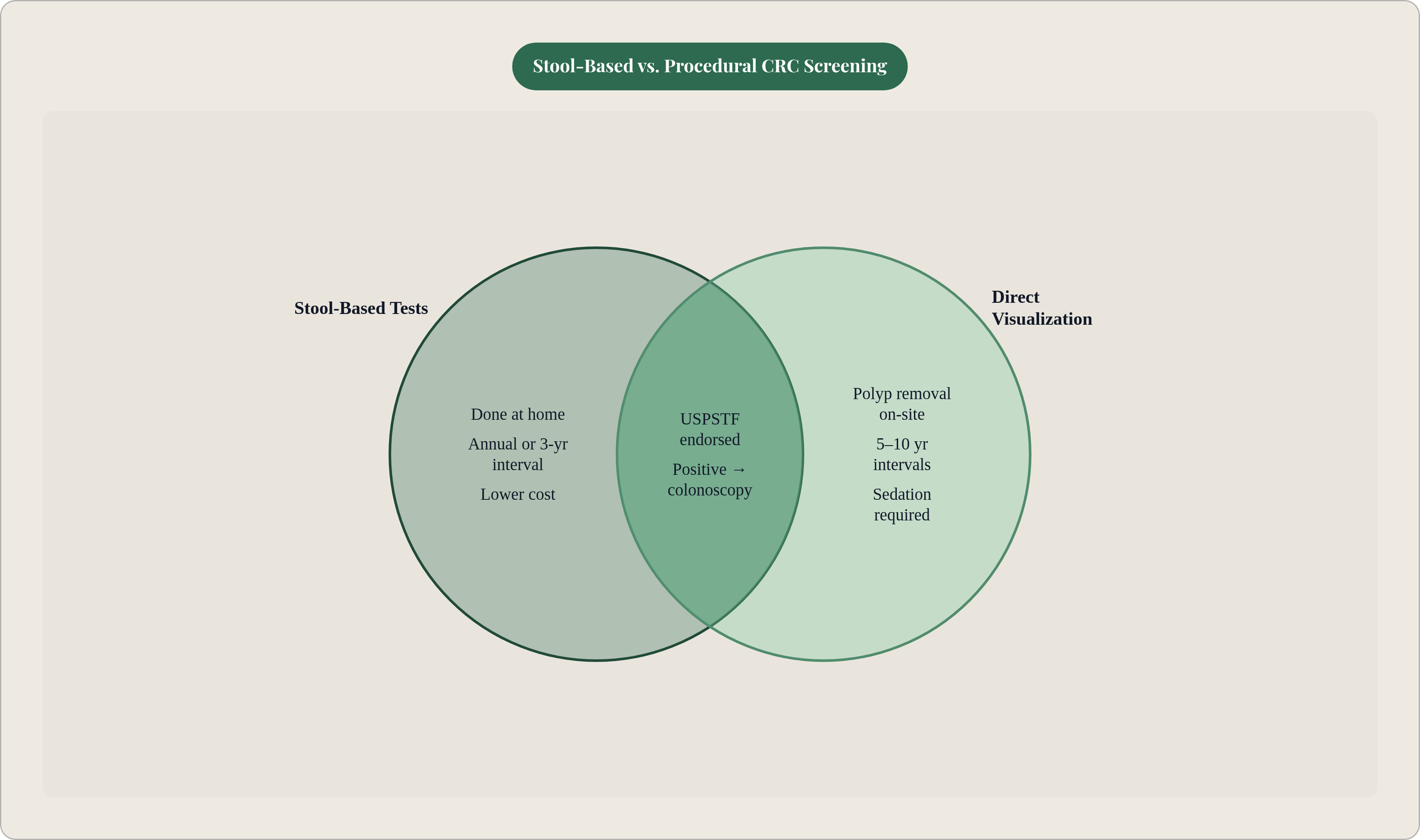
There are two families, roughly speaking. Stool-based tests are non-invasive, done at home, and repeated often. Direct visualization tests are procedural, done in a clinic, and spaced much further apart. That's the whole map before you zoom in.
A handful of questions separate the options within and across those families. What does the test actually detect, blood, DNA markers, structural abnormalities, some combination of the three? Can it remove a polyp on the spot, or does a positive result just buy a second procedure down the road? And how often does it need repeating, given what that repetition demands in prep, discomfort, and cost over a decade or more?
Every test the USPSTF endorses counts as an acceptable choice. This is genuinely a menu, with several correct answers depending on the patient sitting across from you. The right item is whichever one a patient will actually complete and keep completing, on schedule, because here's the catch that runs under everything below: a positive result on anything other than colonoscopy triggers a follow-up colonoscopy anyway. Every stool-based and blood-based test in this piece is a two-step process wearing a one-step disguise.
Colonoscopy: what makes it the reference point for everything else
Colonoscopy is the only screening test that detects and removes polyps in the same sitting. It interrupts the path to cancer by cutting out precancerous growths before they turn into something worse, catching roughly 95% of colorectal cancers. For an average-risk adult with a clean result, it's recommended once every ten years.
That ten-year interval is the trade for a demanding day: dietary restriction, a laxative regimen most people describe with some version of "never again," sedation, a ride home arranged in advance, usually a day off work. Ask anyone who's put off scheduling one, and this logistical list is almost always why, not fear of the procedure itself.
Safety-wise, it's strong but not risk-free. Perforation, the serious complication, happens at a low rate per 10,000 procedures across a large international review, and that rate climbs meaningfully past age 80. Cost gets complicated too: the Affordable Care Act mandates full coverage for screening colonoscopies, but anesthesia fees, facility fees, and pathology costs when a polyp gets biopsied can still generate a surprise bill even when the core screening is covered.
What earns colonoscopy its reference-standard status is the modeling behind it. At 100% participation, colonoscopy and FIT both produce more than a 70% reduction in CRC incidence and more than a 75% reduction in CRC deaths. Everything else gets measured against that ceiling. In practice, colonoscopy is already the dominant method, with 63.1% of screened U.S. adults in 2021 relying on it, though that share reflects historical default and physician habit as much as it reflects what patients would pick if handed the whole menu upfront and asked to choose cold.
FIT: the annual stool test that trades convenience for frequency
The fecal immunochemical test, FIT, looks for hidden blood in a stool sample. There's no bowel prep, no sedation, and no clinic visit required. The whole thing happens at home, which makes it arguably the lowest-barrier screening option on the list.
Sensitivity for CRC sits roughly in the mid-70s across large studies, specificity in the low-to-mid 90s. Plainly: it catches most cancers, at the cost of some false positives that need a follow-up look. FIT doesn't detect polyps directly. Instead, it detects blood those polyps or tumors may shed, so its power to actually prevent cancer, rather than just find it after the fact, depends on catching something that's already started bleeding.
Frequency is what makes or breaks this test, and the real variable is whether someone actually does it every single year, without skipping a cycle because life got busy. A single FIT test is a fairly weak tool on its own. A decade of annual FIT tests is a different animal entirely; consistency is what turns a snapshot into an actual surveillance system.
Cost is low, typically in the tens of dollars, and it's reliably covered as preventive care. Yet only 10.1% of up-to-date screened adults in 2021 used FIT or the older FOBT, a strikingly small share given how accessible it is. Modeling actually shows FIT beating less-frequent blood-based alternatives on both quality-adjusted life-years and cost-effectiveness, even in scenarios where the alternative wins on patient uptake. The annual rhythm is the entire point of the test, not a burden layered on top of it.
Multitarget stool DNA tests: higher sensitivity, higher complexity
Stool DNA testing, best known under the brand name Cologuard, combines hemoglobin detection with detection of DNA markers shed by abnormal cells from tumors and polyps. Like FIT, it's done at home with no bowel prep, though it asks for a full stool sample mailed to a lab rather than the smaller sample FIT needs.
The original Cologuard, FDA-approved in 2014, showed clearly higher sensitivity for CRC than FIT in a head-to-head study of thousands of patients. Yet it caught fewer than half of large advanced adenomas, the precancerous polyps a colonoscopy would simply remove on the spot, which caps how much it can prevent cancer compared to colonoscopy rather than just detect it later. Its specificity runs lower than FIT's too, meaning more false positives: a notable share of positive results shows up in someone who doesn't have cancer.
Cologuard Plus, the next-generation version the FDA approved in 2024, was tested in the BLUE-C trial with tens of thousands of participants and showed better detection of advanced precancerous lesions than both the original version and FIT. Specificity still lands in the low 90s, and it's recommended every three years, a middle ground between FIT's annual cadence and colonoscopy's decade. A positive result triggers the same follow-up colonoscopy any other positive stool or blood test does; there's no version of this test that skips that step.
Cost sits well above FIT per test. Only 8.3% of up-to-date screened adults in 2021 used FIT-DNA testing, though that figure predates Cologuard Plus, so whether that share climbs is genuinely an open question. Higher single-test sensitivity comes bundled with more false positives, and a patient who tests positive and then gets a clean colonoscopy has still absorbed the cost, the anxiety, and the procedural risk for nothing. It's worth walking through with a doctor who knows your actual risk profile, not something to decide from a mailer.
Blood-based screening tests and what the emerging options add
The newest category here is cell-free DNA blood testing, sometimes called liquid biopsy, which looks for tumor-derived DNA fragments circulating in the blood. There's no bowel prep and no stool sample, just a blood draw in a clinic, which is about as low-friction as screening gets.
Shield, made by Guardant Health, got FDA approval in mid-2024 as a primary screening option for average-risk adults 45 and older, and picked up Medicare reimbursement along with it. It's the first blood-based CRC screening test to clear both bars, a genuinely significant milestone in the field.
Why does that matter beyond novelty? Because it answers the two objections patients raise most often: dislike of colonoscopy's prep and sedation, and discomfort handling a stool sample for FIT or Cologuard. A blood draw sidesteps both at once, and the hope, still unproven at scale, is that it pulls in patients who've been avoiding screening entirely rather than just shuffling people between tests they were already willing to consider.
Still, the evidence base is young next to the decades behind colonoscopy and FIT. Sensitivity and specificity figures are still being refined, and the ideal repeat interval and long-term population effect are still under study. As with every non-colonoscopy test here, a positive blood test means a follow-up colonoscopy comes next, and patients need to understand that two-step path before signing on. Major guideline bodies support it as an option for average-risk adults right now, but nobody's calling it preferred over colonoscopy or FIT yet, and that distinction matters enough to raise directly with a clinician who actually knows your history.
Other direct visualization tests: CT colonography and flexible sigmoidoscopy
CT colonography, sometimes called virtual colonoscopy, uses a CT scan to image the colon after a bowel prep. No sedation is needed, and it's recommended every five years, though it can't remove a polyp if it finds one. A positive finding still sends the patient to a standard colonoscopy afterward, which raises a fair question: how much did the first test actually save you?
The "less invasive" pitch gets complicated here. CT colonography requires the same bowel prep as a full colonoscopy, so the logistical burden most people are trying to dodge doesn't shrink much at all. There's also a low but real dose of radiation per exam worth factoring in.
Flexible sigmoidoscopy only examines the lower part of the colon, and it's recommended either every five years alone or every ten years paired with annual FIT. Less sedation and less prep than a full colonoscopy sounds like a clear win on paper. The catch is that it misses lesions in the proximal, or upper, colon, and that region accounts for a meaningful share of colorectal cancers. That blind spot has driven a real decline in sigmoidoscopy's use across the U.S., even though guidelines still fully endorse it.
Both tests fit patients with specific reasons to avoid a full colonoscopy: sedation risk, anticoagulation therapy that complicates polyp removal, or plain preference. In current practice, though, they make up a fairly small slice of actual screening next to colonoscopy, FIT, and stool DNA testing.
How to think about the trade-offs when choosing between options
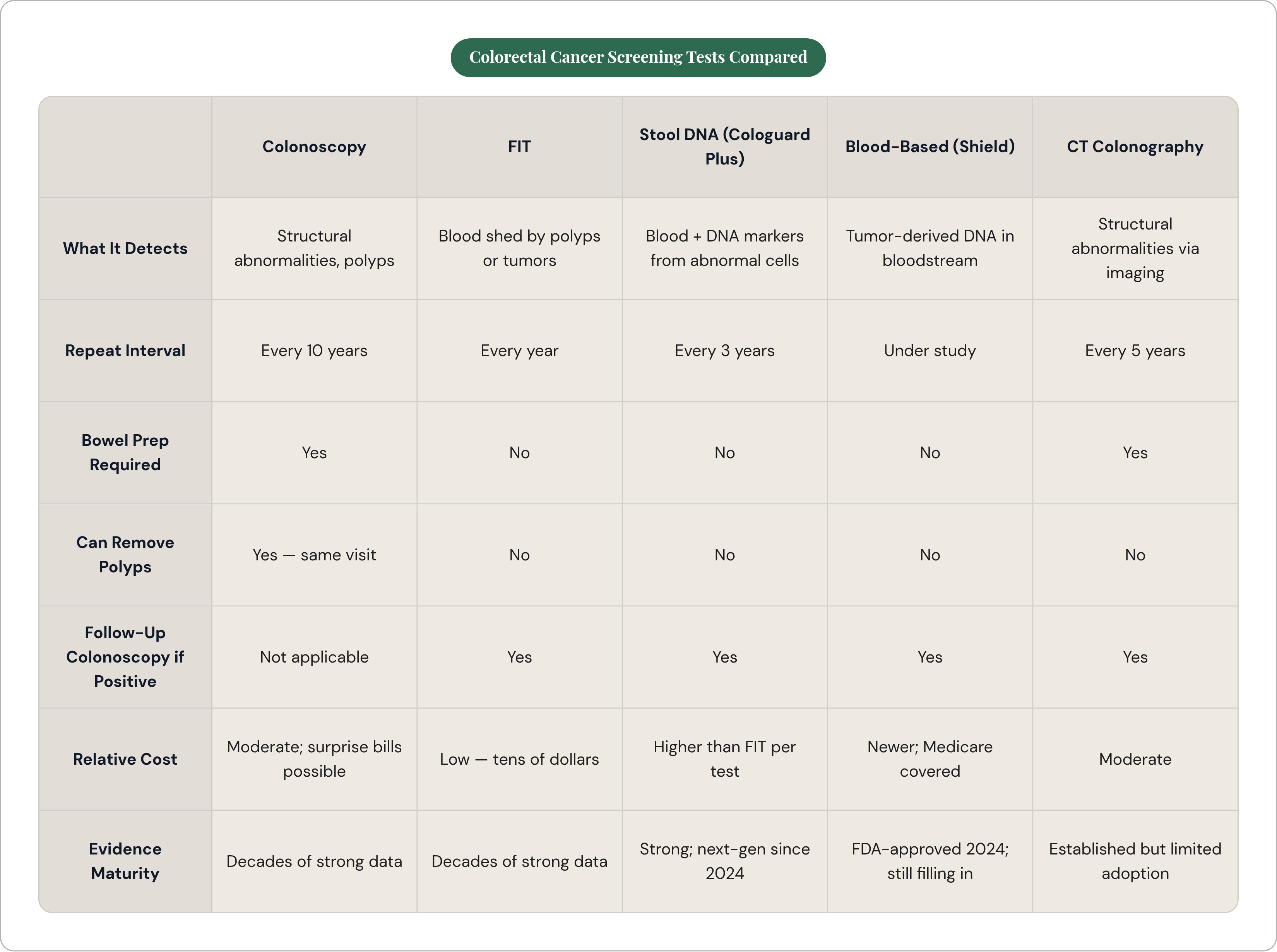
No single test is right for everyone, and that's exactly why the USPSTF endorses multiple methods instead of picking a favorite. Risk levels, access, and tolerance for procedures vary enough across the population that one answer would leave plenty of people unscreened entirely.
If one variable matters more than any sensitivity or specificity number discussed above, it's adherence. A test done consistently, year after year or decade after decade depending on the interval, beats a more sensitive test done once and then quietly abandoned in a drawer somewhere. Convenience and patient tolerance carry as much practical weight as the clinical performance numbers, maybe more.
So how does someone actually weigh these against each other? A patient who wants the most thorough exam available and can handle the prep and sedation gets colonoscopy every ten years, the standard everything else gets measured against. A patient who'd rather skip a procedure, or who's facing real access barriers, gets the strongest long-term evidence among stool-based options from annual FIT, at the lowest cost by a wide margin. Stool DNA testing offers higher sensitivity on any single exam, at the cost of more false positives and a higher price tag. And for a patient who's ruled out stool-based testing and has specific concerns about sedation or prep, blood-based testing now offers an FDA-approved path, with the caveat that its evidence base is newer and still filling in.
One group doesn't belong in this decision tree at all. Anyone with a family history of CRC, a personal history of polyps, or a hereditary syndrome shouldn't be picking from this menu solo; guidelines point that group toward earlier, more frequent colonoscopy, and working out the specifics is a job for a clinician, not a comparison chart.
Whichever test gets picked, remember the two-step reality underneath all of them: a positive result on anything other than colonoscopy means a follow-up colonoscopy is coming. Incomplete follow-through on that second step shows up repeatedly as a documented gap in real-world screening programs, and this undercuts the value of the first test almost entirely when it happens.
What actually gets in the way of screening and what helps
Progress is real, but the gap is still wide enough to matter. Overall completion reached 70.8% in 2024 against an 80% national target, and among 45-to-49-year-olds, completion more than doubled in a few years but still leaves roughly half that age group unscreened.
Cost and coverage explain part of it, though not all. Stool-based tests are the cheapest and most widely covered options out there, and even colonoscopy carries ACA-mandated coverage as a preventive service. Unexpected ancillary billing, particularly around anesthesia, remains a documented barrier for some patients even when the core procedure is fully covered, which feels like a solvable problem that just hasn't been solved yet.
Access and representation gaps run deeper than cost alone. Asian Americans, uninsured adults, and lower-income individuals all screen at meaningfully lower rates, reflecting a structural problem more than a preference problem. Expanded stool-based and blood-based options could chip away at this simply by removing the procedural requirement colonoscopy carries with it, though "could" is doing real work in that sentence; it hasn't fully happened yet.
What moves the needle most consistently, based on the data available, is a conversation with a clinician. A provider recommendation dramatically raises the odds a patient follows through, regardless of which test they end up choosing. Patient navigation programs and reminder systems at health centers have produced measurable gains too: the number of patients screened at U.S. health centers reached 3,617,246 in 2024, up from 3,306,873 in 2023. That's a real jump, and it shows what organized outreach does when it's actually funded and staffed, rather than left as a line item nobody prioritizes.
Walk into the appointment already knowing the options, maybe with a preference or a specific objection already worked out in your head. That's what makes the visit a decision you're part of, rather than something that happens to you while you nod along.