Community Health Worker Programs Expanding Across States
States fund community health workers to reduce costs and reach underserved patients.
The community health worker is not, at bottom, a clinical role. That distinction matters more than it might appear. CHWs are members of the communities they serve, selected for the trust and cultural fluency that credentials cannot confer. Their core functions, health education, navigation to services, social support, advocacy, and health coaching, have existed in informal and community-organized forms for decades. What has changed is the policy architecture around them. The Department of Labor now classifies CHW as a distinct occupation. State Medicaid programs are building reimbursement infrastructure to fund them. Certification programs are proliferating. The Bureau of Labor Statistics counted roughly 65,100 CHW jobs in 2024 and projects 11 percent growth through 2034, with approximately 7,800 annual openings expected, a pace faster than the average across all occupations.
The operative principle of the work is deceptively simple: find and meet people where they are. That means reaching people who don't show up at clinics, navigating the non-clinical barriers that determine whether someone actually manages their diabetes or fills their prescription, addressing housing instability, food access, transportation gaps, language and cultural distance from the health care system. It is work that no amount of clinical capacity can substitute for, which is precisely why the policy world has started paying serious attention. CHWs sit at the intersection of two problems that every state Medicaid director is trying to solve: inadequate primary care access and rising costs tied to preventable chronic disease. That intersection is where the current expansion is being built.
The evidence base states are drawing on to justify CHW investment
The most frequently cited figure in state-level policy discussions is a return-on-investment calculation from Milbank Fund research: well-established CHW programs have delivered $2.47 for every Medicaid dollar invested. That figure carries weight in budget negotiations, and it should. But what if that figure is being applied too broadly? ROI at that level depends on program design, the population being served, how far downstream you measure savings, and which costs you're counting. The figure is not a guarantee; it's a result that well-designed programs have achieved.
The underlying clinical evidence is more granular and arguably more useful for program design purposes. Randomized controlled trial data on CHW programs working with Medicaid beneficiaries managing chronic diseases show reductions in hospitalizations and estimated savings of approximately $2,500 per enrollee annually. The broader research body is consistent: improved chronic disease control, better mental health outcomes, higher rates of primary care participation, fewer emergency department visits. The direction of effect is clear across studies.
What the evidence doesn't resolve is the replication problem. Most well-powered studies examine programs that have been running long enough to develop the trust networks and workflow integration that actually drive outcomes. A state standing up a new CHW program, or a small community organization filing Medicaid claims for the first time, is not starting from the same baseline as the programs being studied. The ROI case is defensible enough to justify investment; it is not self-executing. The same data that supports expansion also implies that implementation fidelity is the variable states should be watching most carefully.
How Medicaid reimbursement became the central policy lever
Three Medicaid pathways have emerged as the main routes for CHW reimbursement: State Plan Amendments, Section 1115 waivers, and expenditures through managed care organizations. SPAs have become the dominant mechanism. As of April 2025, 20 states had Medicaid state plan amendments for CHW reimbursement in effect. CMS approved five in 2023 alone, covering Arizona, Kansas, Kentucky, Michigan, and New York, followed by New Mexico in 2024 and Washington in 2024. A separate but related expansion: community-based organizations in more than 24 states will be able to file for Medicaid reimbursement as of January 2026, broadening who can bill, not only which services qualify.
Payment rates across these states vary widely and consequentially. Fee-for-service rates range from just over $18 to $50 per 30 minutes as of early 2025. The variation is not arbitrary; it reflects different administrative assumptions about program cost, prevailing wages in different labor markets, and the political constraints of state budget processes. South Dakota's experience makes the stakes concrete. After slow uptake following initial launch, the state raised its rates to the equivalent of $64.86 per hour. Rate-setting is a live policy variable, not a technical formality decided once at program launch.
The 2024 Medicare Physician Fee Schedule introduced Community Health Integration and Principal Illness Navigation billing codes, and several states, including California, Minnesota, and Washington, have begun incorporating these into their Medicaid programs. Washington's SPA is particularly notable: it is the first to build its CHW reimbursement policies and data analysis architecture entirely around these codes. That choice is consequential because billing infrastructure shapes program scope in ways that aren't always visible from the outside. The codes that providers can bill determine which services get delivered, how CHW time is tracked, and what data is available for program evaluation. Washington is, in effect, running a test of whether standardized federal billing codes can serve as a durable organizational spine for state CHW programs.
Reimbursement authority authorizes billing. It does not guarantee utilization. That distinction becomes one of the more important empirical puzzles in this expansion story, addressed directly below.
How certification frameworks shape who can work as a CHW and who can bill
As of April 2025, 33 states had CHW certification programs. Certification is now the majority-state norm. For reimbursement purposes, certification often functions as a gatekeeper: many SPAs and state billing rules require credentialing as a condition of payment. Colorado's SPA, effective July 2025, requires credentialing through the state Department of Public Health and Environment. The logic is straightforward: payers want some assurance that the person delivering services has demonstrated core competencies.
The proponents' case for certification rests on three pillars. It establishes professional identity. It gives employers and payers a common standard for evaluating qualifications. And it creates the kind of formal workforce infrastructure that makes reimbursement systems function, because billing requires documentation, and documentation requires that workers have defined roles with defined scopes of practice.
The opposition's case is equally serious, and I don't think it gets enough weight in state-level policy discussions. Standardization can erect barriers for exactly the populations that CHWs are supposed to represent. The distinguishing value of a CHW is that they come from the community being served; that trust cannot be credentialed into existence, and formal training requirements can screen out the most effective candidates if those candidates lack access to training programs. Whether certification actually improves service quality is a question the research has not resolved. One might argue that the very act of formalizing CHW roles risks eroding the community embeddedness that makes them effective in the first place.
California offers a cautionary data point. The state had articulated a goal of substantially expanding its CHW workforce, established a certification program, and allocated significant funding. Then the 2024 Budget Act left the responsible state agency with approximately $12 million in one-time resources, and the state eliminated or rolled back most of the infrastructure it had built. The sequence illustrates a specific vulnerability: certification programs require sustained investment to function as intended, and when fiscal conditions shift, they can collapse before the workforce they were meant to develop has actually materialized.
Getting certification policy wrong in either direction creates problems. Too restrictive, and you undermine the community representativeness that makes CHWs effective. Too informal, and you provide insufficient professional infrastructure for the reimbursement system to operate reliably. The calibration matters as much as the decision to certify at all.
How state models differ in practice: grant funding, alternative payment, and managed care routes
Tennessee took a sequenced approach. The state issued two waves of two-year grants to 14 provider organizations across safety-net hospitals, FQHCs, community-based clinics, home care, dental, mental health, and birth services. Funding was tied to milestones: strategic planning, CHW hiring, training, and accreditation. The design reflects a recognition that provider organizations need to build capacity before they can participate in a reimbursement system. Rather than approving a SPA and waiting to see who bills, Tennessee invested in the readiness infrastructure first.
Maine embedded CHW engagement in payment incentives rather than treating it as a separate billing category. The Primary Care Plus Initiative provides a higher per-member per-month rate for whole-person care, and eligible practices were required to engage CHWs starting in 2024. The difference from a fee-for-service reimbursement model is significant: practices have a financial incentive to integrate CHWs into their care model, not just a permission to bill for them.
Oregon went further in using managed care contracting as the accountability mechanism. Contracts with coordinated care organizations require a Traditional Health Worker Integration and Utilization Plan, a Payment Model Grid, and an annual utilization report. The accountability is structural, not voluntary. An organization that doesn't deliver on CHW integration is in breach of contract, not merely underperforming against a goal.
Illinois, in early 2025, announced a grant opportunity to develop a multi-year CHW workforce plan, with continuation grants for implementation. The model is explicitly phased: plan first, then fund implementation. This addresses the sequence problem that has hampered programs elsewhere, where reimbursement infrastructure existed before organizations knew how to use it.
These models share an underlying premise: CHW integration is a system design question, not a billing question. Where they differ is in who bears the implementation responsibility, how quickly reimbursement follows workforce development, and where accountability is structurally located. Those differences in design have significant implications for which organizations actually participate and what utilization looks like over time.
Why rural health priorities are pulling CHW programs into new states
Nearly half of all states have pursued Medicaid reimbursement for CHW services. Notably, six of the ten states with the largest percentage of rural populations, Arkansas, Kentucky, Maine, South Dakota, Vermont, and West Virginia, are among them. That's not coincidental. Rural health systems face a structural problem that no amount of clinical capacity expansion adequately addresses: provider shortages, geographic barriers, and populations with high rates of chronic disease and low rates of primary care access. CHWs, operating in the communities they serve, are one of the few workforce models that can actually reach people who are not being reached.
The Rural Health Transformation Program, authorized under the One Big Beautiful Bill Act, provides $50 billion over five years to strengthen rural health care, with CMS awarding first-year funds ranging from $147 million to $281 million per state. CHW-related initiatives appeared in 32 states' RHTP applications, per the Georgetown Center for Children and Families. Ten of those states, Alaska, Connecticut, Iowa, Idaho, Nebraska, New Hampshire, Ohio, South Carolina, Tennessee, and Wisconsin, included CHWs in their applications while currently lacking Medicaid reimbursement infrastructure for CHW services. These are the expansion frontier: states using RHTP funding to stand up CHW capacity before the billing infrastructure exists.
The tension inside the RHTP story deserves direct attention. The same legislation that funds rural health transformation also enacted the largest cuts in Medicaid history. CHW billing infrastructure depends on Medicaid as its host financing mechanism; the legislation that creates the expansion opportunity simultaneously constrains the system that makes the expansion financially sustainable. That raises an important question: for states entering CHW programming through RHTP, can a program be built to last when the financing mechanism it depends on is being cut at the same time? This is not a background concern. It is the central risk in their program design.
Why reimbursement authority alone hasn't produced the utilization states expected
California is the sharpest example, and it's worth sitting with the numbers for a moment. The state allocated nearly $92 million in both the 2023 and 2024 budgets to cover reimbursable CHW services. Between July 2022 and January 2024, it spent less than $1 million against that allocation. That is not a rounding error. It is a utilization gap that tells you something important about the distance between policy authorization and program delivery.
This pattern is not uniquely Californian. Research broadly shows that uptake of Medicaid billing for CHW services remains low across states. The reasons are interrelated. Billing and supervision requirements create administrative burdens that smaller community organizations, which are often the most embedded in underserved communities, are not equipped to manage without dedicated support. Providers who are unfamiliar with CHW roles don't know how to integrate them into care team workflows. Reimbursement rates in some states don't cover actual program operating costs, which means organizations can bill but cannot sustain the program that generates billable services.
South Dakota's rate adjustment is instructive precisely because it was a direct response to CHW and employer feedback about why programs weren't filing claims. The state raised its rates after hearing what it took to actually run a program. That's a policy feedback loop working as it should, but it implies that initial rate-setting decisions in many states may not have been grounded in actual program cost data.
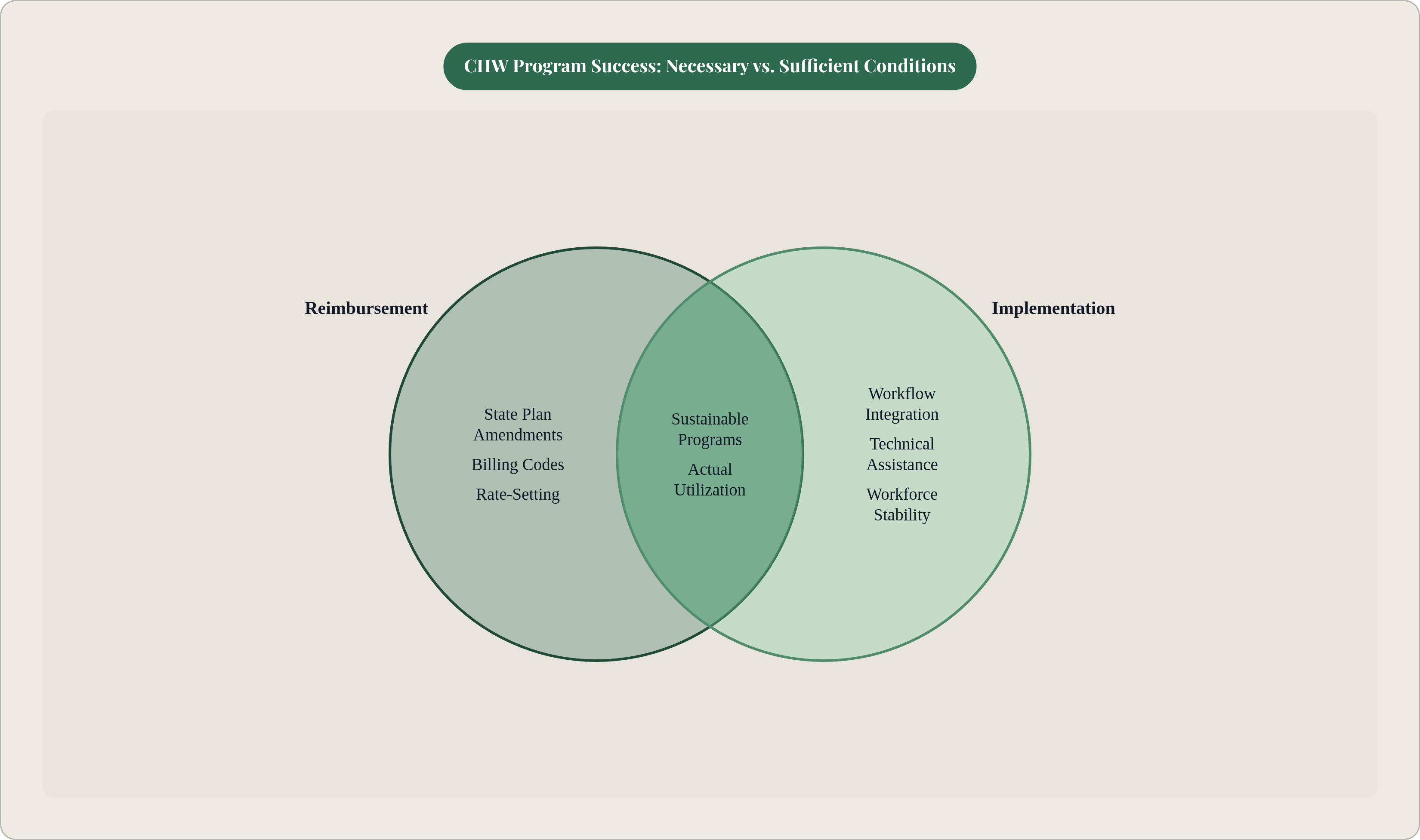
The National Academy for State Health Policy has found that research evaluating the impact of CHW certification on outcomes is mixed, which is relevant here because it reinforces a broader point: certification and reimbursement are necessary conditions for CHW programs to operate within the Medicaid system, but they are not sufficient conditions for effective programs. The organizations doing the work need implementation support, workflow design, technical assistance, and the administrative capacity to actually navigate billing systems. States that treat SPA approval as the finish line are likely to see a version of the California outcome. States that pair reimbursement authorization with implementation infrastructure are more likely to see actual utilization.
The workforce stability problem underneath the program expansion
Behind the policy mechanisms, the expansion story has a human substrate that doesn't get proportionate attention. CHW attrition rates in the U.S. are high. Low salaries, limited professional status, and constrained career advancement drive dissatisfaction and turnover at rates that should concern anyone evaluating whether program growth is durable. The workforce is expanding on paper while individual CHWs are cycling through roles that remain entry-level by structural default.
The career pathway problem is both a cause and an effect. Without defined advancement tracks, CHW positions stay at the bottom of organizational hierarchies, which depresses wages, which makes retention difficult, which makes it harder to build the community trust and institutional knowledge that makes CHW programs effective. Certification has the potential to address this by creating professional identity and a recognizable credential that supports advancement. But what if certification raises barriers to entry without raising wages? It may worsen stability by narrowing the pipeline without improving the conditions inside it.
Funding fragility compounds everything. Some states fund specific CHW services narrowly, excluding others from reimbursement. Annual legislative appropriations make multi-year program commitments structurally difficult. For smaller community-based organizations, uncertain reimbursement timelines and rate levels make it hard to offer competitive salaries or plan beyond a grant cycle. Tennessee's milestone-based grant model addresses part of the readiness gap, but two-year grants do not resolve what sustains wages and positions after the grant period ends. That question is, as of this writing, largely unanswered in the design of most state programs.
The workforce stability problem is the underside of the expansion story. Programs can grow in number while remaining fragile at the level of individual workers' experience of the job, which is precisely the level where trust, continuity, and effectiveness are actually produced.
What distinguishes programs built for durability from those that depend on favorable conditions
The policy mechanisms covered here, SPAs, certification, RHTP funding, alternative payment models, managed care contracts, interact. They work differently when layered than any one does alone. The distinction between programs that endure and programs that collapse when conditions shift is largely a function of how deliberately those mechanisms are designed to reinforce each other.
Oregon illustrates what structural accountability looks like. Managed care contracting creates CHW integration requirements that persist regardless of whether an individual organization stays committed or a new administration deprioritizes the initiative. The accountability is in the contract, not in the commitment.
Maine illustrates payment alignment. When CHW engagement is embedded in a higher per-member per-month rate, practices have a financial reason to integrate CHWs into their model. The incentive is not supplemental; it is built into the payment structure.
California illustrates what happens when policy infrastructure is shallow. Certification, funding, and workforce plans that depended on continued appropriations and political will collapsed quickly when fiscal and political conditions shifted. The infrastructure had not been designed to survive unfavorable conditions.
The markers worth tracking in the next wave of programs are specific. Multi-year funding mechanisms that don't depend on annual appropriation cycles. Reimbursement rates set through provider feedback rather than administrative default. Workforce development paired with billing authorization rather than sequenced separately. Accountability built into managed care contracts or alternative payment arrangements so that institutional demand for CHW services exists independently of any single organization's advocacy for them.
The ten states entering CHW programming through RHTP without existing reimbursement infrastructure represent the clearest near-term test of whether the field has learned from the utilization gaps in earlier adopters. The mechanisms are available. The evidence base is strong enough to justify investment. What determines whether these programs endure is whether states build the mechanisms to reinforce each other or treat each one as sufficient on its own.