Community Health Needs Assessment Process and Requirements
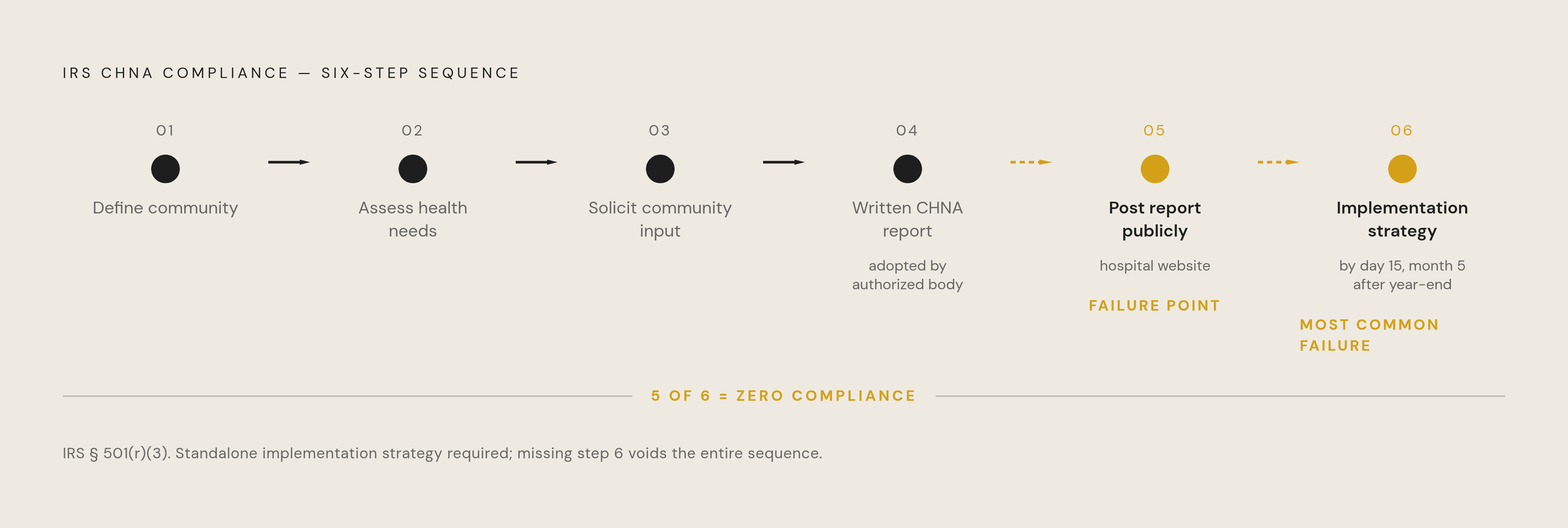
Every hospital must complete all six steps in sequence, not just most of them.
Section 501(r)(3) of the Internal Revenue Code requires every 501(c)(3) hospital facility to conduct a Community Health Needs Assessment every three years and adopt a corresponding implementation strategy. The federal tax exemption at stake was estimated at $14.4 billion across the nonprofit hospital sector in 2020. The statute arrived with the Affordable Care Act in 2010, took effect for tax years beginning after March 23, 2012, and final IRS regulations apply to tax years beginning after December 29, 2015. Roughly half of U.S. private community hospitals operate as nonprofits subject to these rules, evaluated facility by facility. A health system with ten hospitals must satisfy the requirement ten times over, independently, at each location.
What I have watched trip up otherwise rigorous compliance teams is something more conceptual than procedural: the IRS treats this as a sequence, not a checklist. Five of six steps completed with genuine care and real resources invested is not compliance. The entire sequence must close, including public posting, before a hospital facility is considered to have conducted a CHNA at all. That framing matters, because the failure modes I see most often are not in the substantive work. They are in the last fifty yards.
Step 1: Define the community served. The IRS grants hospitals broad flexibility here. A community can be defined geographically, by the population a hospital primarily serves, or by clinical specialty. The hard constraint: medically underserved, low-income, and minority populations residing in the geographic service area cannot be excluded from that definition. Stand-alone hospitals typically draw a local boundary; hospitals embedded in regional systems may define a wider footprint. The definition matters more than hospitals usually realize when they write it, because every subsequent step inherits whatever boundaries were set in this one. A community defined too narrowly will produce an assessment that cannot withstand scrutiny when an examiner asks why certain zip codes or populations were absent.
Step 2: Assess the community's significant health needs. This step requires both quantitative secondary data and qualitative primary data. Secondary sources include government agencies, County Health Rankings, census data, and academic research institutions such as the Institute for Health Metrics and Evaluation. Primary methods include community surveys, focus groups, in-depth interviews, and community dialogues. Combining both allows triangulation and produces findings substantially more defensible to the IRS, to state regulators, and to the communities being assessed. The scale of a credible effort is not trivial: San Joaquin County's 2025 CHNA process involved 12 key informants, 40 focus group discussions with 350 community residents, and analysis of over 100 health indicators.
Step 3: Solicit and document community input. Federal rules require input from at least three sources: at least one state, local, tribal, or regional governmental public health department; members of or representatives for medically underserved, low-income, and minority populations; and written comments on the most recently completed CHNA and implementation strategy. Additional voices, from consumer advocates to local employers to academic researchers, are permitted and often strategically valuable. If a required input source could not be reached, the hospital must document its reasonable efforts. That documentation obligation is mandatory and is frequently absent in otherwise substantive processes.
Step 4: Document findings in a written CHNA report. The report must contain: the community definition and how it was determined; the process and methods used; how input was solicited and considered; the significant health needs identified; available resources to address those needs; and an evaluation of actions taken since the prior CHNA. It must then be formally adopted by an authorized body of the hospital facility, typically the board of directors. Informal executive approval does not satisfy this requirement, a distinction that matters when an IRS examiner asks for the board resolution.
Step 5: Make the CHNA report widely available to the public. The report must be posted on the hospital's website in a manner accessible from the homepage. A paper copy must also be available for public inspection upon request, without charge, for two subsequent CHNA reporting cycles. Requiring users to complete a registration form to access the digital copy constitutes noncompliance. Hospital communications teams encounter this particular nuance with surprising regularity.
Step 6: Adopt an implementation strategy. This is a separate formal document, not an embedded section of the CHNA report. It must be adopted by an authorized body no later than the 15th day of the fifth month after the end of the taxable year in which the CHNA was completed. Missing that deadline, or substituting a narrative section inside the CHNA report for a standalone adopted strategy, remain among the most common compliance failures in the field.
How Hospitals Are Conducting CHNAs in Practice: Collaboration and Data at Scale
IRS rules explicitly permit hospitals to conduct CHNAs collaboratively with other organizations, including other nonprofit hospitals, for-profit hospitals, government hospitals, health departments, and community nonprofits. Collaborating hospitals that serve the same community may issue a joint CHNA report, provided the joint report contains all required elements of a stand-alone report. Permission to collaborate does not reduce the substantive obligation; it distributes the work and the cost, which for smaller hospitals can be the difference between a credible process and a bare-minimum one.
Real collaborative models operate at meaningful scale. A group of hospitals and health systems partnered on a Southeastern Pennsylvania Regional CHNA, coordinated by the Health Care Improvement Foundation and the Philadelphia Department of Public Health. Local health departments are natural partners for this work, given that community health assessments conducted for Public Health Accreditation Board accreditation collect overlapping data. The calendars do not always align, since the IRS requires hospital CHNAs every three years while PHAB requires local health department assessments every five, but partial coordination still eliminates duplicated effort.
The data burden, even in collaborative arrangements, remains substantial. What the San Joaquin County 2025 process illustrates is that a credible CHNA is not a literature review assembled over a weekend. Technology platforms designed to support CHNA data aggregation, such as Community Commons, have emerged to help hospitals compile secondary data efficiently, reducing both cost and documentation time. These tools do not replace judgment; they reduce the friction of assembling indicator sets across multiple public data sources, which is real friction when your team is already stretched.
Practical experience in the field has also surfaced a set of operational decisions that look minor until an IRS examiner is reviewing the file: gift cards and incentives to increase survey and focus group participation; translators to ensure that non-English-speaking residents appear in the primary data rather than being systematically excluded. Their absence signals something. These are not courtesies extended to the community; they are the mechanics of satisfying the requirement to include medically underserved and minority populations in the assessment. A report that cannot demonstrate meaningful engagement with those populations is vulnerable, regardless of how thorough the secondary data analysis is.
Where State Law Adds Requirements on Top of the Federal Baseline
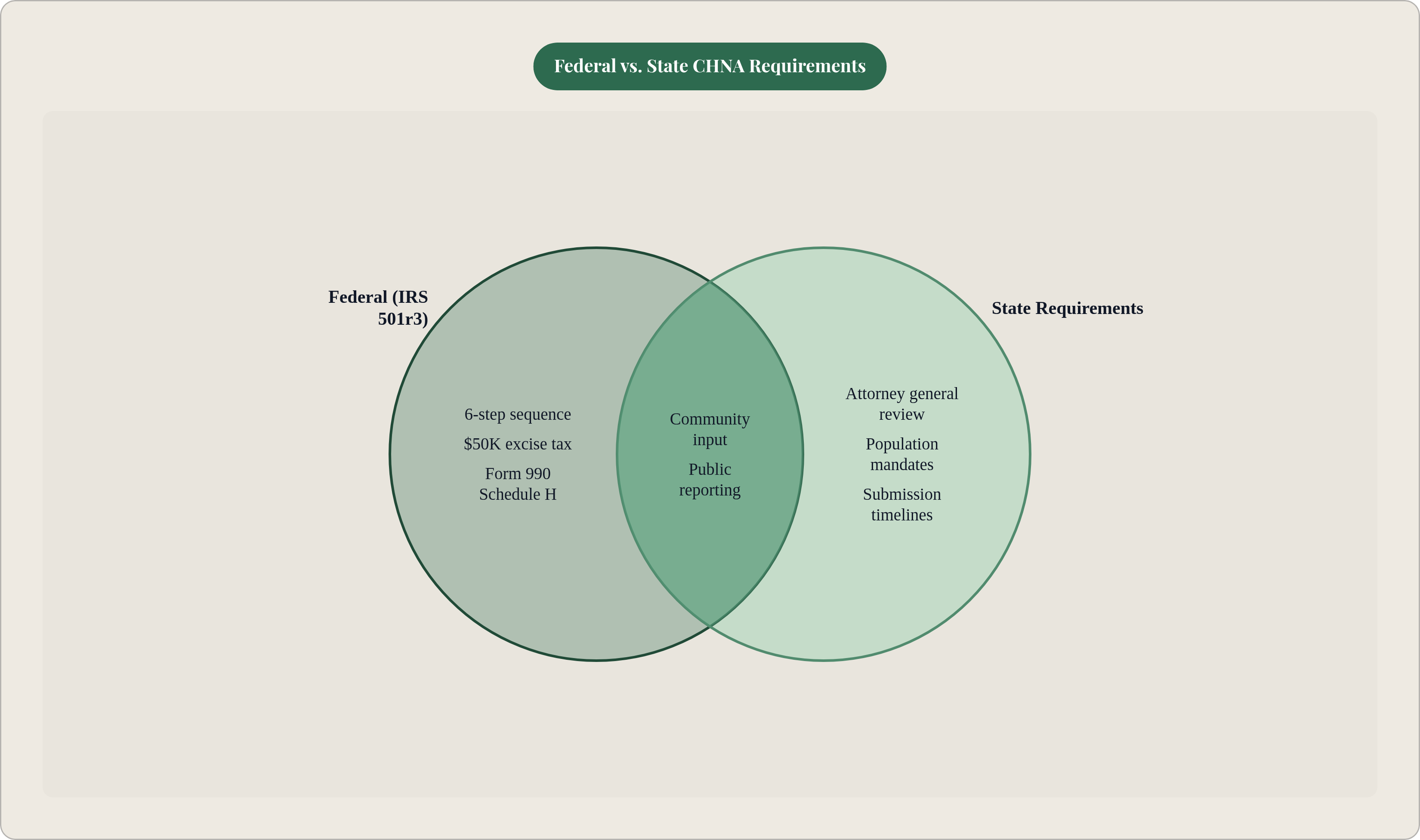
Federal Section 501(r)(3) is the floor. Many states have enacted statutes or issued guidance that impose additional CHNA obligations, and hospitals that design their process exclusively around IRS requirements risk noncompliance with state law.
States addressing community representation requirements in statute include California, Maryland, New Hampshire, New York, Rhode Island, and Texas. Others, including Maine and Massachusetts, operate through voluntary guidance. Four states, California, New Hampshire, New York, and Rhode Island, statutorily require that specific communities or population groups be represented in the CHNA process. At least five additional states, Idaho, Illinois, Indiana, Vermont, and Washington, have CHNA statutes that do not specify required representation but still create distinct state obligations beyond the federal baseline.
A 2018 study found that state CHNA requirements are associated with higher hospital spending on community benefits, suggesting that state-level rules translate into real resource deployment rather than merely adding paperwork. If regulatory stringency around the CHNA drives measurable downstream community investment, then the design choices made in state capitals carry real consequences for how much money flows into underserved communities. The regulatory mechanism shapes the outcome, not just the process.
Every nonprofit hospital organization should audit applicable state law alongside its federal compliance checklist. A process calibrated only to satisfy IRS requirements may fall short of a state mandate on community representation, reporting format, or submission timelines. These gaps surface during state attorney general reviews of hospital nonprofit status, a separate enforcement channel from the IRS entirely, and they are not theoretical. I have seen organizations discover mid-examination that their CHNA process was federally sound and state-noncompliant simultaneously.
The Penalties That Attach When a Hospital Facility Fails to Comply
The immediate financial penalty for noncompliance is a $50,000 excise tax per noncompliant hospital facility per tax year, imposed under Section 501(r)(3). A health system with multiple hospitals faces that exposure separately at each noncompliant location for each year of noncompliance. The arithmetic compounds quickly.
The more severe consequence is revocation of 501(c)(3) tax-exempt status. In August 2017, the IRS published its first revocation of a hospital's exempt status for Section 501(r) failures, citing three distinct deficiencies: failure to conduct a CHNA, failure to adopt an implementation strategy, and failure to make the CHNA report publicly available. That revocation established that the IRS would use the ultimate sanction. Minor, inadvertent, or reasonable-cause omissions that are neither willful nor egregious are protected from exempt status revocation under IRS rules, but that protection does not extend to systematic or repeated failures.
The current enforcement picture deserves honest attention. A May 2025 report from the Treasury Inspector General for Tax Administration found that IRS examination referrals via the Community Benefit Activity Review process dropped by 98% from fiscal year 2022 to fiscal year 2024, and identified 142 hospitals that should have been included in review populations but were omitted. That is a striking figure. It raises genuine questions about how enforcement capacity is being allocated, questions that do not resolve neatly. What it does not do is soften the underlying legal obligation. The IRS Tax-Exempt and Government Entities 2025 Program Letter signals continued scrutiny of this area. A compliance strategy built on the assumption that enforcement has lapsed is, in practical terms, a bet against documented institutional risk.
The Compliance Failures That Most Commonly Appear in Otherwise Well-Intentioned CHNAs
A CHNA can be substantively thorough and still be noncompliant because of procedural or documentation gaps. Hospitals that have invested real staff time and consultant dollars in the work are sometimes the most surprised when an IRS examination surfaces a technical failure, precisely because they conflate effort with compliance. The investment was real; the gap was somewhere in the sequence they did not fully close.
The most frequently cited failure modes: a missing or informal implementation strategy, because a narrative section inside the CHNA report does not substitute for a separately adopted strategy document; failure to formally adopt the CHNA report through an authorized body such as the board of directors; incomplete community input documentation, specifically failing to document attempts to reach the three required input sources or failing to incorporate written comments from the prior CHNA cycle; an insufficient or blank evaluation of prior actions; public posting failures, including burying the report several clicks from the homepage or requiring a registration form to access it; failure to maintain prior CHNA reports for the required two subsequent reporting cycles.
One might argue that hospitals investing substantial resources in community engagement deserve some deference on procedural technicalities. The IRS record does not support that reading. These failures represent the gap between hospitals that treat the CHNA as a strategic organizational process and those that treat it as a documentation exercise assembled under deadline pressure. IRS examinations are reasonably good at distinguishing between the two, and the procedural gaps tend to correlate with the latter posture.
What a CHNA Realistically Costs and How to Manage That Burden
A CHNA is not a low-cost exercise. Depending on hospital size, community complexity, and the scope of primary data collection required, costs can reach into the high five figures or low six figures. For small nonprofit hospitals operating on thin margins, that is a significant compliance expenditure with no direct revenue offset.
That cost sits in direct tension with what is being protected: a federal tax exemption estimated at $14.4 billion across the sector in 2020. The rational calculation still favors compliance. But the burden is real, and for smaller hospitals in particular it is not merely a management inconvenience; it is a genuine resource allocation decision made under financial pressure. Dismissing that tension does not make the decision easier or the tradeoffs less concrete.
Several cost management strategies are operationally viable. Collaborative CHNAs distribute research and data collection costs across multiple organizations, which is the single most effective mechanism for smaller hospitals. Drawing on existing secondary data from public sources, including the CDC, County Health Rankings, and census databases, reduces the need for expensive custom data collection. Aligning the CHNA cycle with local health department community health assessment processes can eliminate duplicated community engagement work, even when the three-year and five-year timelines do not perfectly coincide. Specialized data aggregation platforms can reduce both staff hours and external consultant fees, freeing internal capacity for the higher-judgment work of community engagement and implementation planning.
None of these strategies eliminate the cost. They make it manageable while preserving the substantive integrity that a defensible CHNA requires.
Building a CHNA Process That Holds Up Across the Full Three-Year Cycle
The IRS evaluates CHNA compliance as a continuous cycle. The written evaluation of actions taken since the prior CHNA is a required element of every new report, which means each cycle is formally linked to the last. A hospital that completes one rigorous CHNA and then rebuilds its process from scratch three years later is working harder than necessary and introducing procedural risk it does not need.
Clear internal ownership is the foundational structural decision. Someone must be accountable, by name and by role, for each step from data collection through board adoption and public posting. Diffuse accountability produces exactly the kind of procedural gaps that surface in IRS examinations, because everyone assumes someone else managed the requirement. I have seen this dynamic in organizations that would otherwise pass any substantive review.
The implementation strategy should function as a living document with defined metrics, not a static report filed and forgotten. Maintaining it as an active tracking document means the next CHNA's required evaluation of prior actions can be completed from actual tracked data rather than reconstructed retrospectively. Reconstruction is slower, less reliable, and substantially more labor-intensive.
Community engagement infrastructure, meaning the relationships with public health departments, community organizations, and minority-population representatives that make primary data collection possible, should be maintained between cycles rather than rebuilt at the start of each assessment. Those relationships take time to establish, and starting from scratch every three years produces lower-quality community input alongside higher logistical costs.
Scheduling board review and formal adoption well ahead of the implementation strategy deadline, the 15th day of the fifth month after year-end, protects against last-minute procedural failures that a crowded board calendar can create. Deadlines that fall during fiscal year-end close or executive leadership transitions generate inadvertent noncompliance in otherwise well-run organizations with some regularity.
IRS Form 990, Schedule H is the annual reporting mechanism through which CHNA activities and community benefit spending are disclosed. Treating Schedule H preparation as a year-round documentation discipline, rather than a year-end assembly project, produces more accurate filings and creates the paper trail an IRS examination will expect to find. Given that both federal scrutiny and state-level requirements are active and evolving in 2025, hospitals that treat CHNA compliance as a continuous operational process are better positioned than those that treat it as a triennial project assembled under deadline pressure.