Low Sodium Diet Recommendations for Heart Failure Patients
Newer research challenges decades of sodium-restriction dogma in heart failure care.
Roughly 6.7 million Americans over 20 are living with heart failure right now, and that number is climbing toward 8.7 million by 2030 and 11.4 million by 2050, according to the Heart Failure Society of America's 2024 statistics. About one in four of us will get this diagnosis at some point in our lives. This piece is about the one lever heart failure patients hear about constantly and understand least: sodium. The physiology behind why it matters is straightforward, but the science on exactly how much to cut has shifted underneath clinicians' feet in the past few years, and most patients never hear why.
I've sat in enough clinic rooms to know how this conversation usually goes. A cardiologist says "watch your sodium," a dietitian hands over a pamphlet with a number on it, and the patient nods and mostly guesses at what that means for dinner. Here's the mechanism behind the advice, worth sitting with for a second: in heart failure with reduced ejection fraction, the heart can't pump enough blood to meet the body's needs, so the body fights back by activating the sympathetic nervous system and the renin-angiotensin-aldosterone system, or RAAS. Both systems try to make up for reduced cardiac output by holding onto sodium and water. That's the direct chain from a salty dinner to fluid buildup, to congestion, to a hospital admission. It's one of the more common preventable events in cardiology: 71.6% of heart failure patients who show up in emergency departments show signs of fluid volume overload. That single number is why sodium became such a fixture of heart failure advice in the first place.
What major guidelines actually recommend, and where they diverge
Ask three cardiologists what a heart failure patient's daily sodium limit should be, and you'll likely get three different numbers. Nobody's wrong, exactly. The major guideline bodies just never fully agreed, and patients are the ones stuck reconciling the difference.
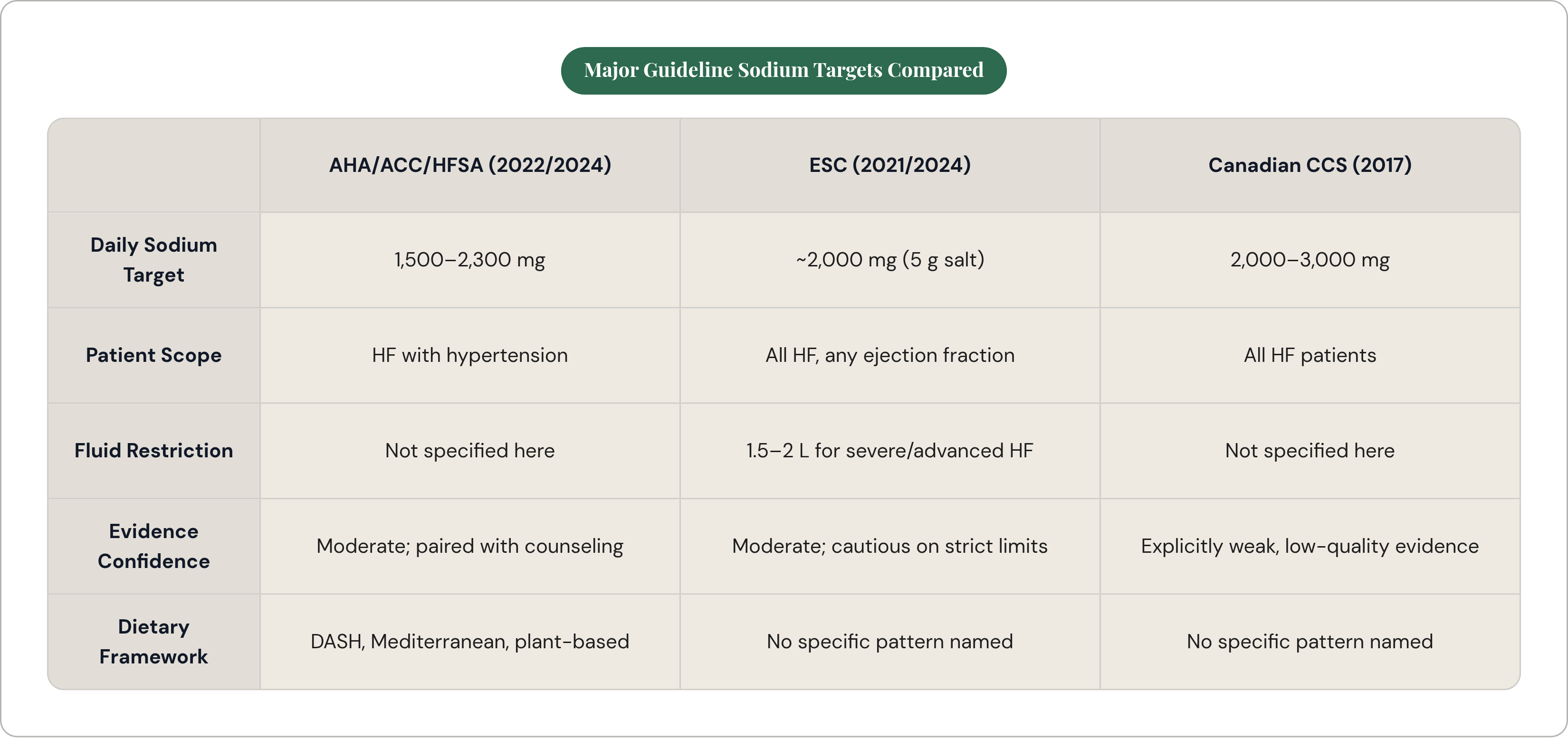
The American Heart Association, American College of Cardiology, and Heart Failure Society of America published joint guidance in 2022, updated with performance measures in 2024, recommending 1,500 to 2,300 mg of sodium per day for heart failure patients who also have hypertension. That guidance also leans on the DASH diet, along with Mediterranean and plant-based eating patterns, as practical frameworks for cutting sodium without gutting the nutritional quality of what a patient actually eats. The guideline is explicit that this works best paired with individual counseling, not a printed handout shoved into a folder on the way out the door.
The European Society of Cardiology takes a looser stance. Its 2021 guidelines, reinforced by a 2024 consensus statement, recommend avoiding more than 5 grams of salt per day for all heart failure patients regardless of ejection fraction, and reserve fluid restriction of 1.5 to 2 liters daily for a narrower group with severe or advanced disease. Do the math and 5 grams of salt works out to roughly 2,000 mg of sodium, which lands close to the American range. But ESC talks in salt and AHA talks in sodium, and that alone causes real confusion at the kitchen table. Patients read "5 grams" on a European pamphlet and "2,300 mg" from their American cardiologist and assume they're wildly different targets when they're actually close cousins.
The Canadian Cardiovascular Society, in its 2017 guidance, recommended 2,000 to 3,000 mg per day, and flagged this outright as a weak recommendation built on low-quality evidence available at the time. That admission turned out to be prescient, as the next section gets into.
So the honest cross-guideline takeaway: everyone agrees some restriction helps, but the specific ceiling swings by hundreds of milligrams a day depending on which body a patient's clinician follows. A patient bouncing between an ESC-trained cardiologist and an AHA-trained dietitian might hear two different numbers in the same month, and that inconsistency does real damage to how well anyone sticks with either one. If the experts can't fully agree on the number, why should a patient trust any single figure enough to build a whole diet around it?
How the evidence base shifted — and what the SODIUM-HF trial actually showed
For decades, the case for sodium restriction in heart failure borrowed heavily from hypertension research. The long-term follow-up to the Trials of Hypertension Prevention found that sodium restriction cut cardiovascular events by 25% over 10 to 15 years. That's a real number, and it shaped clinical intuition for a generation of cardiologists. But that population didn't have established heart failure, and extending a hypertension finding to a heart failure population assumes the underlying mechanism works the same way in both groups. That assumption finally got tested directly.
SODIUM-HF, published in the Lancet in 2022, is the largest randomized controlled trial to test dietary sodium restriction specifically in ambulatory heart failure patients. Researchers enrolled 806 patients with chronic heart failure, NYHA class II to III, median age 67, about a third women, and split them 1:1 between a target of under 1,500 mg of sodium daily and usual care. The restriction worked as an intervention, at least mechanically: the low-sodium group dropped from a median 2,286 mg per day at baseline to 1,658 mg at 12 months, while the usual-care group barely moved, from 2,119 to 2,073 mg.
And then the primary outcome showed no statistically significant difference between groups. All-cause death came in at 6% in the low-sodium group versus 4% in usual care; cardiovascular hospitalization was 10% versus 12%. The restricted group did report a modest bump in quality of life, but the six-minute walk test, a common functional measure, showed no difference at all. The trial was also stopped early, which limits how much weight anyone should put on these numbers either way.
One subgroup detail is worth flagging, though I'd hold it loosely: patients with a higher ejection fraction showed a lower cumulative event risk with restriction, but the subgroup was too small to reach statistical significance. It's a lead, not a conclusion, but it points toward something worth remembering through the rest of this piece: heart failure isn't one disease, and sodium restriction probably isn't one policy either.
The trial achieved real, measurable sodium reduction, roughly 630 mg a day less in the intervention arm, and it still didn't move the needle on death or hospitalization. So what was that restriction actually buying anyone, if not fewer hard clinical events the way it did in the hypertension trials? The link between sodium intake and outcomes in heart failure is evidently more tangled than in hypertension alone.
What the broader trial evidence and observational data add to the picture
SODIUM-HF wasn't a lone data point. It landed inside a wider body of evidence that's been complicating the sodium story for a few years now, and it's worth walking through why.
A 2023 meta-analysis in Circulation: Heart Failure pooled 17 trials covering 1,683 patients, 834 in intervention arms and 871 controls, and found sodium restriction wasn't tied to fewer deaths or hospitalizations. There was a hint of modest improvement in NYHA functional class or quality of life, but nothing that would justify calling restriction a life-extending intervention on its own.
A 2025 overview of systematic reviews by Liu and colleagues in Heart Failure Reviews went further, suggesting that strict restriction at or below 2,000 mg per day may actually raise the risk of death, rehospitalization, and symptom flare-ups in some patients. That's an uncomfortable finding for anyone who's spent years telling patients to cut salt as hard as possible, myself included.
Then a 2025 meta-analysis combined 20 studies, 11 randomized trials and 9 observational cohorts, covering hundreds of thousands of participants. In randomized trials, restriction reduced mortality risk among hypertensive patients but trended toward harm in patients with established heart failure. In the observational cohorts, low sodium intake was tied to a 20% higher mortality risk (hazard ratio 1.20, 95% CI 1.05 to 1.38). Put those two findings side by side and you get what researchers call a J-shaped curve: too much sodium is bad, but going too low carries its own risk, particularly for patients already on medications that activate RAAS as a side effect of doing their actual job.
None of this means sodium doesn't matter. It clearly does. It means that pushing every heart failure patient down to the same very low ceiling isn't what the newest evidence supports. The right number for one patient may not be the right number for another, and that depends on things like ejection fraction, current medications, and how much active congestion someone is dealing with right now. Even the ESC's 2024 synthesis echoes this caution, noting a tendency toward higher all-cause mortality with very restrictive sodium intake in chronic, ambulatory heart failure patients.
Where the guidelines have landed after the evidence evolved
So where does clinical practice sit today? Sodium restriction hasn't been abandoned; the goal behind it has changed. Cardiologists increasingly treat it less as a tool for preventing death or hospitalization outright, and more as a way to manage fluid retention, ease symptoms, and protect quality of life day to day.
Personalizing the target now sits at the center of the conversation. A patient dealing with active fluid overload or symptomatic congestion still benefits from tighter sodium control; that part of the physiology hasn't changed regardless of what SODIUM-HF found about broader outcomes. But a patient already stable on optimal guideline-directed medical therapy, with symptoms well controlled, may see little added benefit from pushing below 1,500 mg daily, and could even risk driving more RAAS activation in the process. Whether heart failure with preserved ejection fraction should be treated differently from reduced ejection fraction on this front remains genuinely unsettled. The physiology differs, but the trial data hasn't caught up enough to set separate firm targets yet.
The shift toward talking about dietary patterns (DASH, Mediterranean) rather than sodium in isolation reflects this same recalibration. These patterns bring moderate sodium reduction while improving overall diet quality, which matters enormously for a patient population that's often managing diabetes, kidney disease, or hypertension all at once. Working with a care team to land on an individual number lines up with where the evidence actually stands better than grabbing the strictest published figure and locking it in for good.
Where sodium actually comes from in a typical American diet
Most people picture the salt shaker when they think about sodium intake. That's mostly a myth, and it might be the single most important fact in this whole topic: the overwhelming majority of dietary sodium in a typical American diet comes from processed, packaged, and restaurant food, not from what gets added at the table.
Canned soups, broths, and canned vegetables deserve specific suspicion. A single serving can carry a huge share of a day's target, and "low sodium" versus "no salt added" on the same product line can mean pretty different actual numbers. Deli meats, cured meats, and smoked fish use sodium for preservation as much as flavor, so the sodium load often isn't obvious from taste alone. Bread and other baked goods are individually modest, maybe 150 to 200 mg a slice, but they show up in nearly every meal, and that adds up fast without anyone noticing it happening.
Condiments are sneaky, honestly sneakier than most people expect. Soy sauce, ketchup, mustard, bottled salad dressing: a tablespoon of soy sauce alone can carry close to 900 mg of sodium, nearly half of the AHA's tighter daily ceiling in one splash. Frozen meals and fast food are worse in a different way, since portion sizes get misread constantly; a single frozen entrée can approach or even blow past a full day's sodium target on its own. Restaurant meals compound the problem because portions run larger than home cooking and sodium content is rarely posted anywhere visible. Asking for sauces on the side is a small habit that meaningfully cuts intake over time.
Salt substitutes deserve a specific caution here. Potassium chloride-based products do cut sodium, but they raise potassium intake, and that's a real concern for heart failure patients on ACE inhibitors, ARBs, or aldosterone antagonists, all of which can already push potassium levels up. Worth mentioning too: some over-the-counter antacids carry hidden sodium loads that patients never think to ask about. A quick question to a pharmacist closes that gap easily enough.
Reading labels and tracking intake without making every meal a calculation
Nutrition labels reward a specific reading order, and most people read them backward. Check the serving size first, before the sodium number even registers, because that milligram figure applies only to the serving as packaged, and packaged servings are often smaller than what people actually eat in one sitting.
A few terms are worth knowing cold. The FDA defines "low sodium" as 140 mg or less per serving. "Reduced sodium" only means 25% less than the original version of that product, which tells you nothing about the absolute number; a wildly salty product cut by a quarter can still be wildly salty. And "no salt added" doesn't mean sodium-free. The food may still carry naturally occurring sodium that has nothing to do with what the manufacturer added during processing.
For day-to-day tracking, a food diary or an app in the first few weeks does more good than most people expect, mostly because patients are consistently surprised at how much higher their baseline intake runs than they assumed. Batch cooking with whole ingredients gives a level of control that buying convenience food simply can't match; once a dish comes out of a box or a can, someone else has already made the sodium decision for you. Keeping a handful of reliable low-sodium staples on hand, dried legumes, fresh vegetables, unseasoned grains, means there's always a safe foundation for a meal even on a chaotic day.
None of this has to mean bland food. Herbs, citrus, garlic, vinegar: these aren't consolation prizes for losing salt, they're genuine flavor tools that professional kitchens lean on constantly. The goal isn't obsessive daily math so much as pattern recognition. Once a patient spots which regular foods in their own rotation are quietly high in sodium and swaps or trims them, the rest mostly takes care of itself.
Why more than half of HF patients don't follow sodium restrictions — and what actually helps
More than half of heart failure patients can't consistently stick to low-sodium recommendations. That's not a knowledge problem, and it deserves to be treated as its own separate challenge from picking the right target number. Most patients already know they're supposed to cut back on salt. Knowing and doing turn out to be two very different problems.
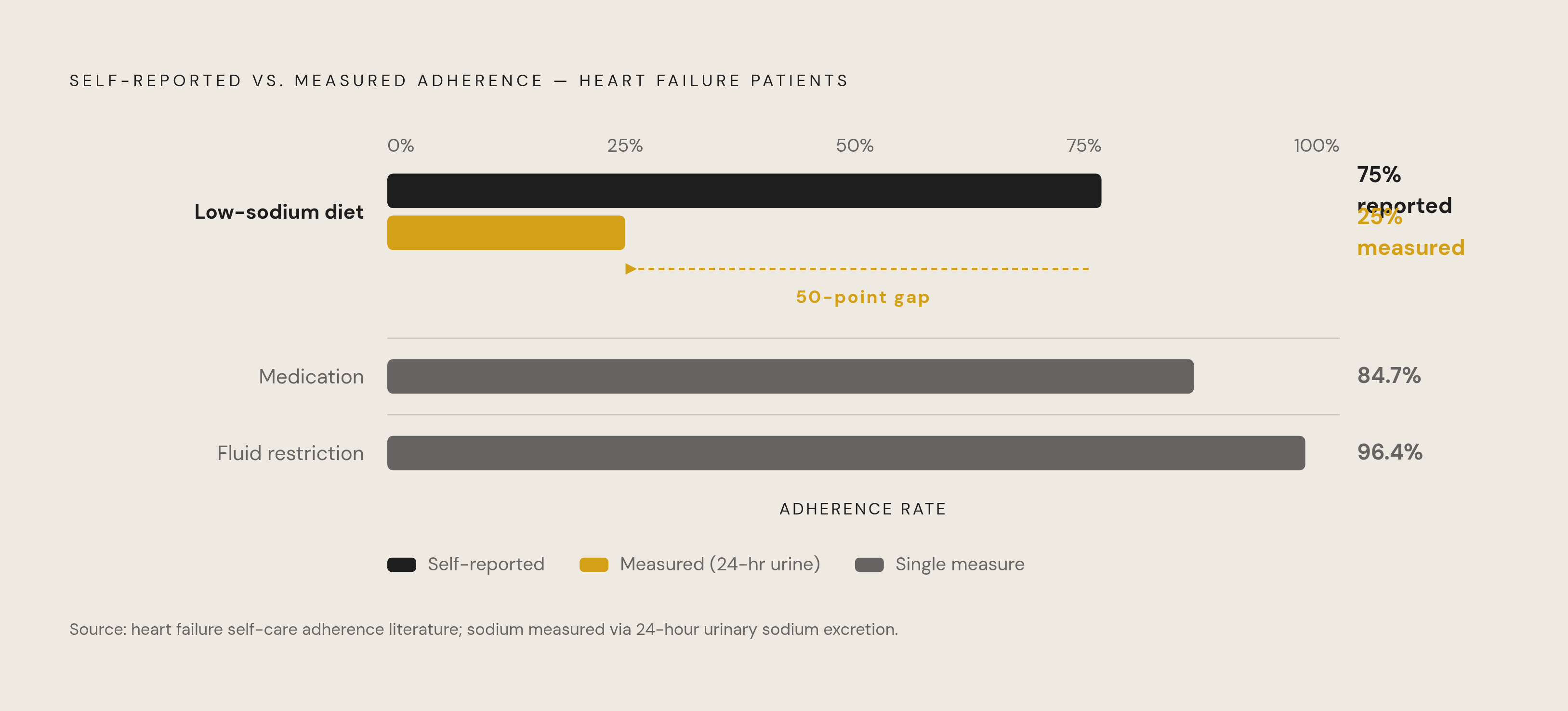
Self-reported adherence numbers are misleading in a specific, measurable way. Studies show around 75% of patients report following a low-sodium diet when asked directly. But when researchers check actual sodium intake through 24-hour urine excretion, real adherence comes out closer to 25%. That's a massive gap between what patients believe they're doing and what's actually landing on their plate. One dataset tracking multiple heart failure self-care behaviors found low-sodium diet adherence at just 42.4%, compared to 84.7% for medication adherence and 96.4% for fluid restriction in the same population. Sodium restriction is, by a wide margin, the hardest heart failure self-care behavior to sustain.
Why does this one lag so far behind the others? Taking a pill is a single decision, once or twice a day. Managing sodium takes an active choice at every single meal, every day, indefinitely. Food is also social in a way medication isn't; family traditions, shared meals, and cultural cooking all run through sodium-heavy patterns that a patient can't unilaterally rewrite without affecting everyone else at the table. Taste preferences genuinely do shift over time as sodium exposure drops, that part is real physiology, but the transition period tastes flat and unpleasant before it tastes normal again. And stacking a sodium restriction on top of medication schedules, fluid limits, and daily weight checks piles up a cognitive load that wears people down.
What actually moves the needle, then? Individual counseling from a registered dietitian is the one intervention the AHA/ACC/HFSA guidelines call out by name as effective, which is not a small endorsement given how cautious guideline language usually reads. Specific written targets beat vague advice to "cut back on salt" every time; a number a patient can check against a label is something they can actually act on. Involving a spouse, partner, or whoever does the household cooking matters more than most people expect, because food environments shape behavior more reliably than willpower does. Tying daily weight checks to dietary choices builds a feedback loop that reinforces the habit day to day. And gradual reduction beats an abrupt cutoff, since the palate needs real time to adjust; asking someone to drop from a very high intake to 1,500 mg overnight is asking for failure.
Putting it together: how a patient and care team can set a workable sodium target
There's no single sodium number that fits every heart failure patient. After walking through SODIUM-HF, the meta-analyses, and the adherence data, that should feel less like a frustrating lack of clarity and more like an honest reflection of how varied this disease actually is. The right target depends on whether a patient has active fluid overload, what medications they're on, their ejection fraction, and whether the immediate goal is symptom control or general diet quality.
A few concrete questions make for a better conversation with a care team than a generic instruction to eat less salt. Ask for a specific milligram-per-day target in writing, not a vague gesture toward "watching the salt." Ask whether that number should shift if symptoms change: more swelling, faster weight gain, worsening shortness of breath. Ask for a referral to a registered dietitian if one isn't already part of the plan; it's guideline-endorsed and, going by the adherence numbers above, the single most effective tool for actually changing behavior rather than just describing it. And before reaching for a potassium-based salt substitute, check with the care team first, given whatever medications are already in the mix.
Day to day, a few anchor habits tend to hold up better than complicated meal plans. Daily weight monitoring catches fluid shifts before symptoms do, often days ahead. Cooking most meals at home from whole ingredients puts sodium control back in the patient's hands rather than a food manufacturer's. Identifying the two or three highest-sodium foods already in a regular rotation and swapping them out tends to be the highest-impact, lowest-effort change available. And knowing the specific warning signs, rapid weight gain, increasing swelling, worsening breathlessness, gives a patient a clear trigger for calling their care team rather than waiting to see if it passes.
Fold sodium restriction into a broader pattern like DASH or Mediterranean eating, built around whole foods rather than a single number to hit, and the whole exercise starts to feel less like a punishment and more like just how the household eats now. That's not nothing. For a condition where adherence, not knowledge, is the real battle, it might be the whole game.