What Peer Support Actually Costs a Health Plan
Plans must weigh peer support's full operating cost against the hospital claims it prevents.

Peer support costs a health plan more than the wages of peer specialists, but its financial value extends well beyond that payroll. An honest assessment compares the full cost of running the program with the claims that better engagement can help avoid. The investment case depends on both sides of that ledger, including whether the program pays and supports its workers well enough to sustain the results.
Why health plans keep asking the wrong version of the cost question
Health plans typically ask what it costs to add peer support to an existing care model. That question addresses the budget component of an investment decision. Procurement sees salaries and operating expenses, while actuaries see claims trends. When those figures sit in separate analyses, the expense is visible but the potential offset is not. A program can consequently look unaffordable before anyone examines the utilization it is designed to change.
The missing comparison is between spending on peer support and spending without it. What happens to hospital use when members lose contact with care after discharge? Without the connection, plans risk underinvesting in programs whose downstream savings could exceed their operating costs.
What peer specialists actually do at the moments that drive cost
The period following hospital discharge puts the mechanism in focus. For people with serious mental illness, or SMI, treatment dropout risk and readmission risk peak at this transition. Peer specialists bring lived experience of recovery to a relationship that is distinct from clinical treatment. The American Hospital Association’s January 2026 issue brief describes a role that “builds rapport and trust with patients by providing a sense of connection and firsthand insights.”
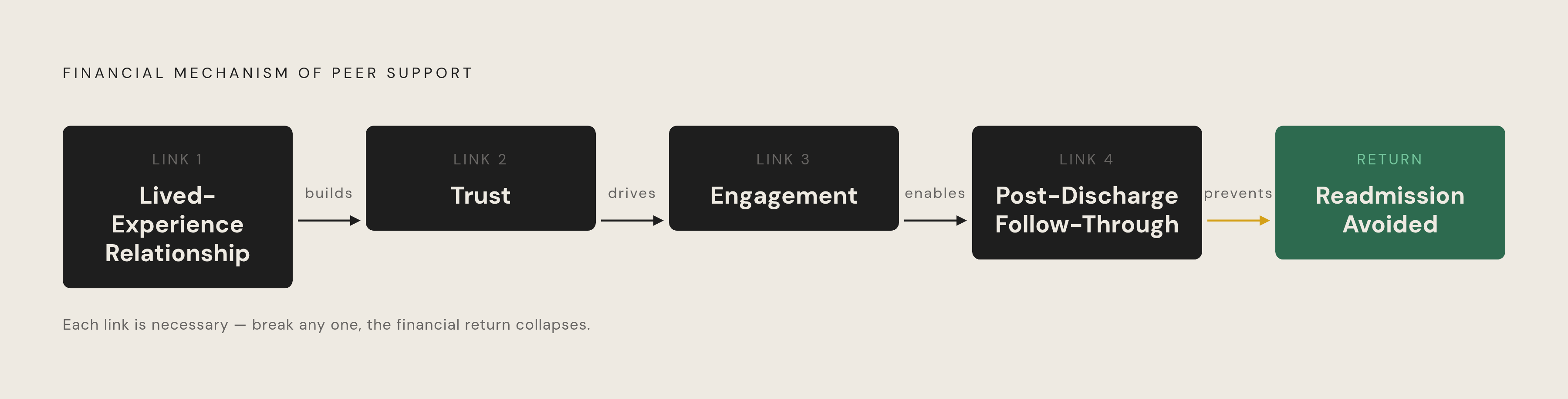
Peer specialists support people during inpatient stays, develop crisis plans, connect them with community resources, and reduce isolation that can drive relapse. The proposed causal chain is specific, rather than simply a claim that support improves health. Trust supports engagement, engagement helps people follow through after discharge, and successful follow-through can prevent a readmission and its associated claim. Each link is necessary to the financial argument.
Housing instability, food insecurity, and transportation gaps can stand between an SMI member and medication or an appointment. Peer specialists draw on their own experience with the same systems to help people get what they need. Their contribution can also extend into chronic disease management, including diabetes adherence and HIV and hepatitis C risk reduction. Peer support could thus change claims beyond behavioral health, though that wider effect needs to be measured on its own.
What a peer support program actually costs a plan to run
A small program with two full-time peer specialists has a realistic first-year budget of roughly $155,000–$211,000. That estimate includes salaries, supervision, coordination, training, technology, space, and administration. Wages are only one part of the total. Peer specialists are among the lowest-cost workers in a care model, with salaries well below those of licensed clinicians, but that comparison cannot substitute for a program budget. The service requires an operating structure around the people delivering it.
Supervision and coordination belong in that structure because peer support is not simply an isolated encounter. Training is another explicit expense. Technology and documentation infrastructure also require funding. A plan that counts only member-facing time overlooks the resources needed to support and document the work. These delivery costs are required alongside salaries.
The budget also needs to distinguish what a service costs from what a payer will reimburse. The Texas Libraries for Health program pays peer specialists well above the state standard, illustrating how non-traditional funders can fill gaps left by underfunded Medicaid rates. Billing alone may not cover a sustainable program. That gap means reimbursement is an incomplete measure of the full cost of delivery.
How Medicaid and commercial reimbursement actually work — and where the structure breaks down
CMS’s 2007 State Medicaid Director letter, SMD #07-011, established the option for states to cover peer support within Medicaid. Services are billed in 15-minute intervals using code H0038, for self-help and peer services, or the equivalent codes in each state. SAMHSA’s 2023 report found that nearly all state Medicaid plans reimburse for peer support services billed in those intervals. Coverage is therefore broadly available through Medicaid. It is not, however, a uniform financing system.
Some states cover peer support through managed care contracts, where plans set their own rules for credentialing and their own payment rates. Differences in state certification rules also constrain how programs can work across markets. A multistate plan cannot assume one process will suffice. More fundamentally, some rates cover less than the cost of delivering an hour once required supervision and documentation time are included. The provider can then lose money on a service that saves the plan money by helping members avoid hospital claims.
Commercial coverage is another way to pay for peer support, though the rules vary. The AHA brief names Aetna, Cigna, and BC/BS MN as commercial plans that have begun to cover peer support. For commercial plans weighing an investment, this shifts the focus to how peer support fits into value-based contracts. The brief identifies private insurance, federal and state grants, and public-private partnerships as possible routes for members without Medicaid, with grants and partnerships serving as supplementary mechanisms.
SAMHSA’s FY2026 Building Communities of Recovery program awards up to $350,000 per award per year. An award can help finance delivery, but its limit makes it different from a durable reimbursement pathway. For the business case, service payment and claims avoidance therefore need separate treatment. The first finances work performed, while the second is the potential return from changing members’ use of care.
What the savings evidence actually shows — and what it can and cannot prove
Reduced inpatient utilization provides the clearest documented financial signal. Optum saw an average reduction in inpatient days exceeding four-fifths across two managed care contracts for individuals who had at least two hospitalizations per year on average. That population is central to interpreting the result. Reducing inpatient use among members who are often admitted offers a different chance to save than providing the same care to members who spend little time in the hospital. The finding supports targeted investment.
Other named programs point in the same direction. Recovery Innovations in Arizona saw a 56% reduction in hospital readmission rates. Pierce County, Washington cut involuntary hospitalization by nearly a third through certified peer specialists who offered respite services, saving a large amount in one year. A Yale-New Haven study found that individuals assigned a peer mentor had double the average time to psychiatric rehospitalization compared with those receiving standard post-discharge care. These outcomes describe distinct changes with different implications for savings.
The distinction is financially important when translating results into a forecast. Fewer admissions, fewer inpatient days, and more time before rehospitalization each change claims in a different way. The program’s full delivery cost still has to be deducted, and the observed period may not capture its long-term financial effect.
How confidently can a plan transfer these findings to its own population? Few studies have thoroughly evaluated the overall cost of integrating peer specialists into treatment systems or the long-term financial impact of their work. Studies also vary in design, population, and program structure. Those differences limit how much a single ROI estimate can tell a plan, even though the named examples all show improvement. A plan’s return will depend on the acuity of its SMI population, program fidelity, and local reimbursement rates.
The practical response is conservative modeling. Named programs provide a basis for estimating the opportunity, while the plan’s own claims and operating assumptions determine the forecast. Their outcomes provide directional evidence for potential returns. Keeping that distinction explicit allows a strong investment case without making the research prove more than it can.
Why the savings accrue to plans while the costs fall on workers — and why that matters financially
The low wage expense in a peer support budget creates a financial tension. Plans benefit from avoided claims, while workers can face salaries that do not cover basic needs. In every state, the living wage for households with children and one worker is higher than the mean wage for peers. The equity problem is direct. It also exposes a weakness in any savings model that assumes a stable workforce without funding one.
Workforce findings make that concern more than hypothetical. A 2025 University of Iowa survey found that nearly a third of Iowa’s peer support workers experienced burnout. The Utah 2025 Peer Support Specialist Workforce Survey found that about three-quarters of those who answered faced at least one barrier to work. The same survey found that nearly all agreed it was important for their direct supervisor to be a peer support specialist or have lived experience. Pay and the working environment both belong in the analysis.
Turnover threatens the mechanism on which savings depend. A departing specialist takes a trusted relationship out of the member’s care, disrupting the continuity that helps sustain engagement. Low salaries and stressful working environments are also associated with burnout, compassion fatigue, and suboptimal service provision. A cheap staffing model can therefore undermine program fidelity. The financial exposure is not limited to replacing an employee, because weaker engagement can erode the expected reduction in readmissions.
Retention interventions offer a way to address that exposure. Chestnut Health Systems was deploying reflective supervision in 2025 to help peers process job stresses that can lead to burnout. Chestnut also published the design of PATH, or Peer Advanced Training in Harm reduction, as a workforce intervention intended to reduce burnout and strengthen service delivery. These are investments in delivery capacity. A reimbursement rate or contract that cannot support livable wages and appropriate supervision leaves the plan’s projected return dependent on an unstable workforce.
What a plan actually needs to build a credible business case for peer support investment
For a plan building the case, the starting point is its own claims data. How many SMI members have two or more psychiatric hospitalizations per year? What are their current 30-day readmission rate and average inpatient length of stay? Those measures establish the claims base that the program could plausibly change. They also help identify the high-utilizing, post-discharge population in which the named-program evidence shows concentrated savings opportunities.
The model should then separate the outcomes it expects to change. Inpatient days avoided, readmissions prevented, emergency visits reduced, and outpatient engagement increased are categories the plan already tracks. Increased outpatient engagement should not simply be labeled a saving. It is part of the shift in care whose costs and benefits need to appear together. This keeps the forecast tied to changes in actual services.
On the spending side, the plan needs the full program budget, including retention-supporting wages, supervision, training, technology, documentation, and administrative overhead. The earlier first-year estimate is a baseline for a small program that requires local costing. Reimbursement assumptions then determine the funding gap. Where rates fall short of delivery costs, the plan must decide whether to absorb that gap or seek supplementary grants or public-private partnerships. Workforce sustainability belongs in that decision from the outset.
A plan can assess whether an organization brings trained peers with lived experience, peer-led leadership, compliant technology, and the infrastructure needed to support consistent delivery. Those capabilities offer an alternative to building from scratch. The investment case is strongest when the projected savings depend on resources the contract actually funds. Peer support has documented returns substantial enough to justify investment under conservative assumptions, but the evidence and its limits belong in the same analysis as the full cost of a program built to last.