Why People With Serious Mental Illness Often Skip Dental Appointments
Medication and symptoms create barriers that stack before external obstacles even appear.
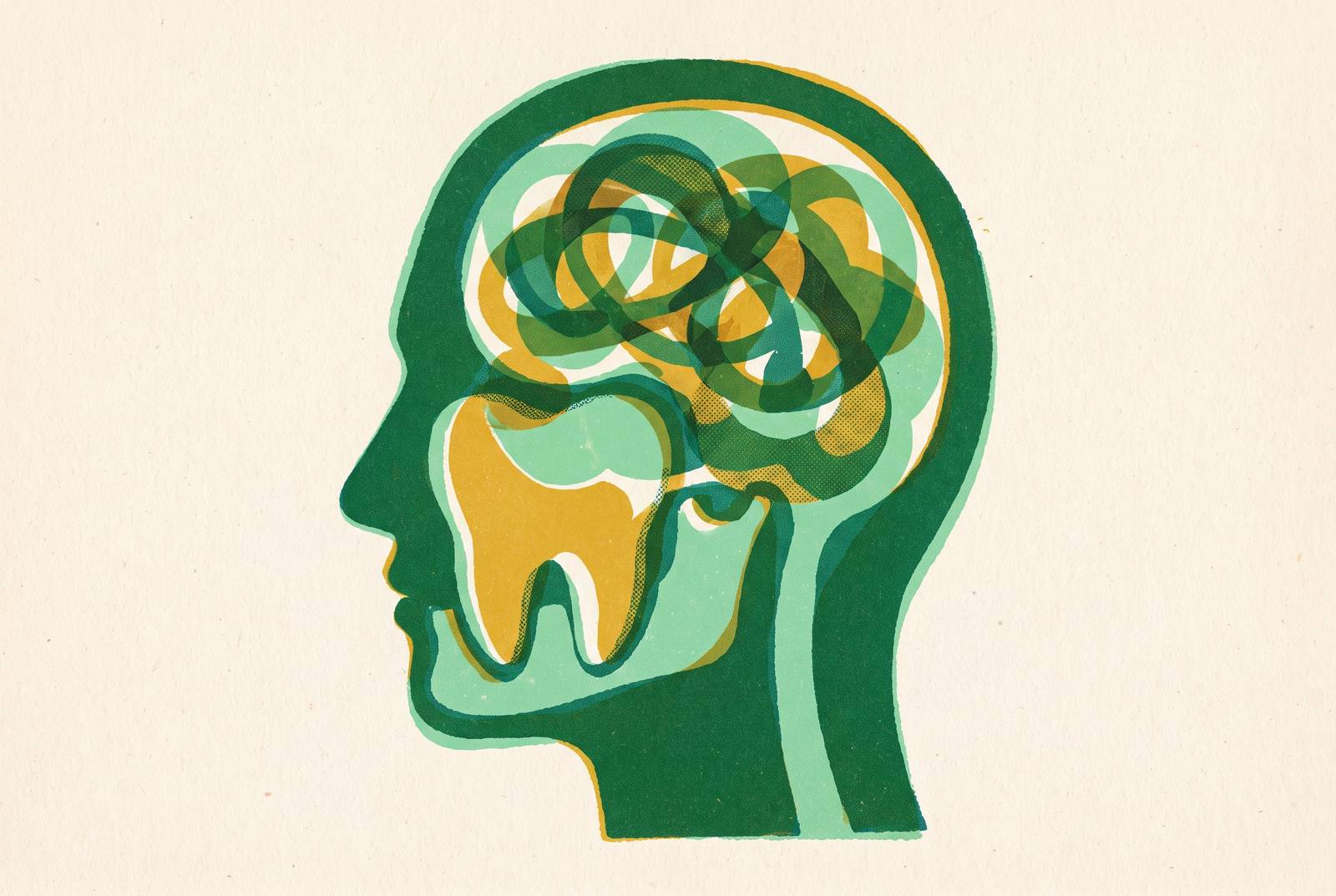
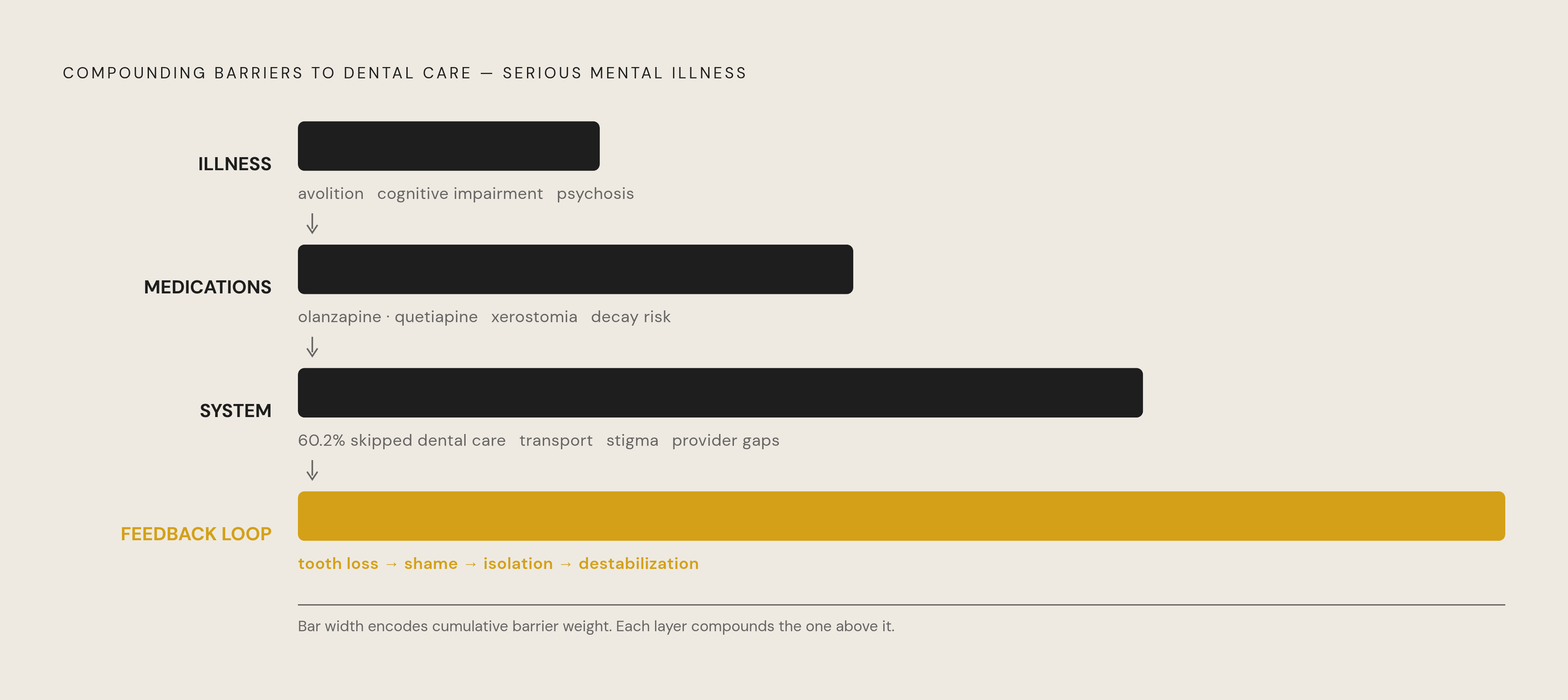
A missed dental appointment among people with serious mental illness is rarely a matter of not caring. It is the predictable output of several barriers stacking on top of each other, each one reinforcing the next until the appointment itself becomes nearly impossible to keep. A 2025 qualitative meta-synthesis confirms dramatically higher rates of caries, tooth loss, and periodontal disease among people with SMI compared to the general population, and that gap has persisted even where Medicaid coverage exists on paper for much of this group. If coverage were the whole story, the gap would have closed by now. It has not, which suggests the explanation lies somewhere beyond the insurance card in a person's wallet. The same forces that keep someone from making a dental appointment, be it low motivation, medication side effects, fear, cost, or lack of transport, are often the very forces that erode the daily brushing and flossing that would have made the appointment less urgent. Understanding why this happens means looking at several distinct layers in sequence: the illness itself, the medications used to treat it, the external system a person has to navigate, and the feedback loop that poor oral health creates once it takes hold.
How SMI symptoms undermine oral hygiene and appointment-keeping before any external barrier appears
Before a person with serious mental illness ever encounters a scheduling system, a copay, or a bus route, the illness itself has already made basic oral care harder. Negative and cognitive symptoms, avolition, cognitive impairment, and psychosis among them, wear down the capacity to do something as simple as brushing twice a day or as logistically demanding as booking and keeping a dental visit. That is a symptom of the illness, not evidence of a person's character. Cognitive impairment compounds the problem by making it harder to remember an appointment that was scheduled weeks earlier, to follow a multi-step hygiene routine, or to process the written aftercare instructions a dental office hands over at checkout. Psychosis adds another dimension entirely: the dental chair itself, with its proximity to a stranger's hands, its unfamiliar sounds, and the vulnerability of lying back with one's mouth open, can read as genuinely threatening rather than merely unpleasant. The 2025 meta-synthesis treats the characteristics of mental illness as their own barrier category, distinct from external access problems, which signals that researchers in this field see this layer as a first cause rather than a footnote, a distinction that matters for what comes next. If the illness alone can derail hygiene and attendance, then treatment ought to help. But what if treatment introduces its own set of problems? That is the second layer of the argument.
Medications as a Second Layer of Oral Health Risk
Antipsychotic medications, the backbone of SMI treatment for millions of people, carry anticholinergic effects that cause xerostomia, commonly known as dry mouth. Saliva is not incidental to oral health. It buffers acid, clears away food particles, and carries minerals that help repair early enamel damage, so when its flow drops, the mouth loses a frontline defense against decay and gum disease. A 2025 pharmacovigilance study published in Oral Diseases linked two commonly prescribed antipsychotics, olanzapine and quetiapine, specifically to dry mouth and tooth loss, a finding consistent with the 2025 qualitative meta-synthesis spanning 11 studies that named these pharmacological effects as a documented driver of oral health decline. Sedation, another common side effect of these medications, tends to reduce physical activity and can shift eating patterns toward more sugary foods and drinks, which adds a second channel of decay risk on top of the dry mouth itself. The medication that keeps a person psychiatrically stable is, at the same time, working against the health of their teeth and gums. And because chronic oral pain can itself destabilize mood and functioning, the damage done by the medication can eventually feed back into the very condition the medication was meant to treat. None of this is an argument against psychiatric medication, nor a basis for second-guessing a prescriber's judgment.
The external barriers that compound the symptom and medication layers: cost, transport, stigma, and provider gaps
By the time a person with SMI has managed their symptoms enough to consider a dental visit, and absorbed the oral health costs of the medication that makes that management possible, they still have to contend with a system that was not built with them in mind. Cost is at the top of that list, but not in the way it is usually framed. Despite Medicaid covering dental cleanings for many in this population, 60.2% of respondents in one study had not seen a dentist in the past year, and the reasons they gave were out-of-pocket costs beyond the cleaning itself, confusion about what their coverage actually includes, and difficulty finding a provider who accepts their plan. Coverage existing on a policy document does not mean coverage functions as access in the exam room. Transportation stacks on top of that. Patients, psychiatrists, and dentists, interviewed independently of one another, all named transportation as a shared obstacle, which makes it a convergent finding across three different vantage points rather than a complaint from one side alone. Stigma adds a third layer: the same meta-synthesis found that dental providers often lack training in working with people who have SMI, producing encounters that range from uncomfortable to openly stigmatizing, which gives a patient every reason to avoid coming back. Fear rounds out the list, and it is not a minor detail. Fear of dental procedures ranks as a top-two barrier across patient, psychiatrist, and dentist groups in the qualitative literature, and for someone with SMI, that fear can be sharpened further by symptom profiles and by memories of past appointments that went badly. Each of these barriers would be a reasonable obstacle on its own. Stacked on top of the internal symptom and medication layers already described, they describe a path to the dentist's chair that very few patients in the general population are ever asked to walk.
How poor oral health feeds back into isolation, shame, and reduced engagement with care
Untreated oral disease does not stay confined to the mouth. It works its way into how a person sees themselves and how willing they are to engage with any kind of care going forward. Visible tooth loss and decay invite judgment from others, both in daily life and inside healthcare settings, and that judgment tends to push a person toward withdrawal rather than toward the next appointment. People with SMI report significantly higher oral health-related quality of life impact scores than the general population: the burden of a damaged mouth is felt daily, in pain, in self-consciousness, in avoided conversations. It appears in concrete ways: smiling less, speaking less in public, eating around others less, applying for jobs less, each one adding another brick to an isolation that serious mental illness has often already built. Chronic oral pain brings lost workdays and disrupted sleep along with it, along with a creeping sense of shame and worthlessness, all of which work directly against psychiatric recovery rather than alongside it. The shame itself carries a clinical cost: someone who feels humiliated by the state of their teeth is less likely to open their mouth, literally, in a dental chair, and figuratively, in any conversation with a provider, which makes the basic work of building trust harder for everyone involved, peer specialists included. Serious mental illness already carries a shortened life expectancy relative to the general population, and oral health stands as one contributor to that gap. That places this conversation closer to a mortality question than a cosmetic one.
Why the standard single-point fix (education, reminders, better insurance) has not moved the needle
Given how many layers stack on top of each other, it should come as no surprise that interventions aimed at just one of them, cost, education, or transport alone, have not produced lasting change. One might ask why an educational pamphlet or a reminder call would fail to help. The answer sits in the evidence itself: an educational intervention aimed at the individual patient failed to produce significant long-term clinical improvement in oral health, which is part of why the field has moved toward system-level and integrated-care models rather than relying on patient education campaigns. Insurance tells the same story from a different angle. Even where Medicaid coverage exists, most people in this population had not seen a dentist in the prior year, which makes clear that coverage is necessary but nowhere near sufficient when transportation, fear, provider training, and the symptom burden described earlier all remain unaddressed. Comprehensive, multi-layered interventions cost more and are harder to scale than a brochure or a benefits update. That is a real tradeoff. But the alternative on offer is the status quo already described in the sections above: tooth loss at rates far above the general population, a shame cycle that works against psychiatric recovery, and a life expectancy gap that dental disease helps to widen. Fixing one layer while leaving the rest in place has already been tried, and the data say it does not hold.
What integrated, community-based approaches look like in practice
The approaches that have actually shown promise share a structure: they bring dental care into the settings where people with SMI already receive mental health support, they build on relationships of trust rather than cold referrals, and they coordinate across providers instead of asking the patient to manage the handoffs alone. The University of Michigan effort, developed with the Michigan Department of Health and Human Services, offers one concrete model. A psychiatry professor, a dentistry professor, a representative from Michigan DHHS, the executive director of a peer-run drop-in center, and five certified peer support specialists worked together to design an integrated oral health program, partnering with four peer-specialist-run drop-in centers and one community mental health center. The team worked with a health education nonprofit, McMillen Health, to build oral health materials designed specifically for people with SMI and meant to be delivered by nondental professionals, and an evaluation involving 41 respondents found the program acceptable, feasible, and sustainable. The design choice that stands out is who delivered the material. The content was built to be handed over by peer specialists rather than dentists or hygienists, so the trust that already existed between peer and patient became the delivery mechanism itself.
A second model comes from the UK, where a co-production study published in Health Expectations in 2026 brought together a multi-stakeholder team to design a six-step intervention built around dental professionals visiting mental health settings directly. The six steps run in sequence: dental health professionals visit the mental health setting, a conversation about dental health gets initiated within that setting, a brief check-up happens using a dental mirror, oral health advice gets tailored to the individual, positive reinforcement gets offered, and continuous engagement and support accessing further dental visits follows. The sequence is notable for what it does not do: it does not ask the patient to find their way to a dental office at all for that first contact. The office comes to them.
A third model, built at the health plan level rather than the clinic level, comes from HealthPartners, which created the Center for Oral Health Integration under the HealthPartners Institute. The center integrates medical and dental records so that physicians and dentists work from the same up-to-date patient information, which makes primary care doctors more likely to encourage patients toward dental visits they would not have sought out on their own. Three different models, three different starting points, one shared logic: none of them ask the person with SMI to be the one holding the map.
Peer support as a structurally well-suited mechanism for closing the oral health engagement gap in SMI
Trust underlies most of the others described above, producing fear of a dental chair, wariness toward a provider who has never been trained to work with SMI, or the shame that keeps someone from opening their mouth in an exam room. Peer support is built around exactly that problem. It draws on lived experience with mental illness or recovery to help someone navigate systems that are complicated, multi-step, and often loaded with stigma, and dental care checks every one of those boxes. The Michigan program demonstrates that before it, no peer support specialist-led wellness intervention had focused on oral health specifically, so the work applied a mechanism already proven in other areas of recovery to a gap that had been documented but not acted on. Peer specialists are also positioned to help with the conditions surrounding the appointment: a ride to the clinic, help understanding what a Medicaid dental benefit actually covers, support stabilizing housing, a plain explanation of what a medication's dry-mouth side effect means day to day. That is what a holistic approach looks like when it is practiced rather than merely described.
firsthand's model reflects that same logic. Its Guides and STRIVE Specialists bring personal experience navigating serious mental illness into the work, meeting people where they already are in their communities rather than waiting for them to arrive at a clinic door. None of the layers covered in this piece, symptom-driven, pharmacological, logistical, or systemic, yield to a single fix applied in isolation. What they respond to is a relationship sturdy enough to carry a person through all four at once, and programs that co-design integrated oral health support with peer specialists, clinicians, and community partners have been found acceptable, feasible, and sustainable.
Sources
- Oral health care challenges in individuals with severe mental illness: a qualitative meta-synthesis - PMC
- Barriers to and Facilitators of Oral Health Among Persons Living With Mental Illness: A Qualitative Study
- Barriers and facilitators of accessing primary healthcare for patients with severe mental illness: a mixed-methods systematic review using framework synthesis
- Oral Health Needs and Experiences of Medicaid Enrollees With Serious Mental Illness - PubMed
- Oral Health Recovery: A Peer Support Specialist–Led Health Education Program for People With Serious Mental Illness