How to Stop a Panic Attack When It's Happening
Practical techniques to interrupt panic's physical cycle and calm your nervous system.
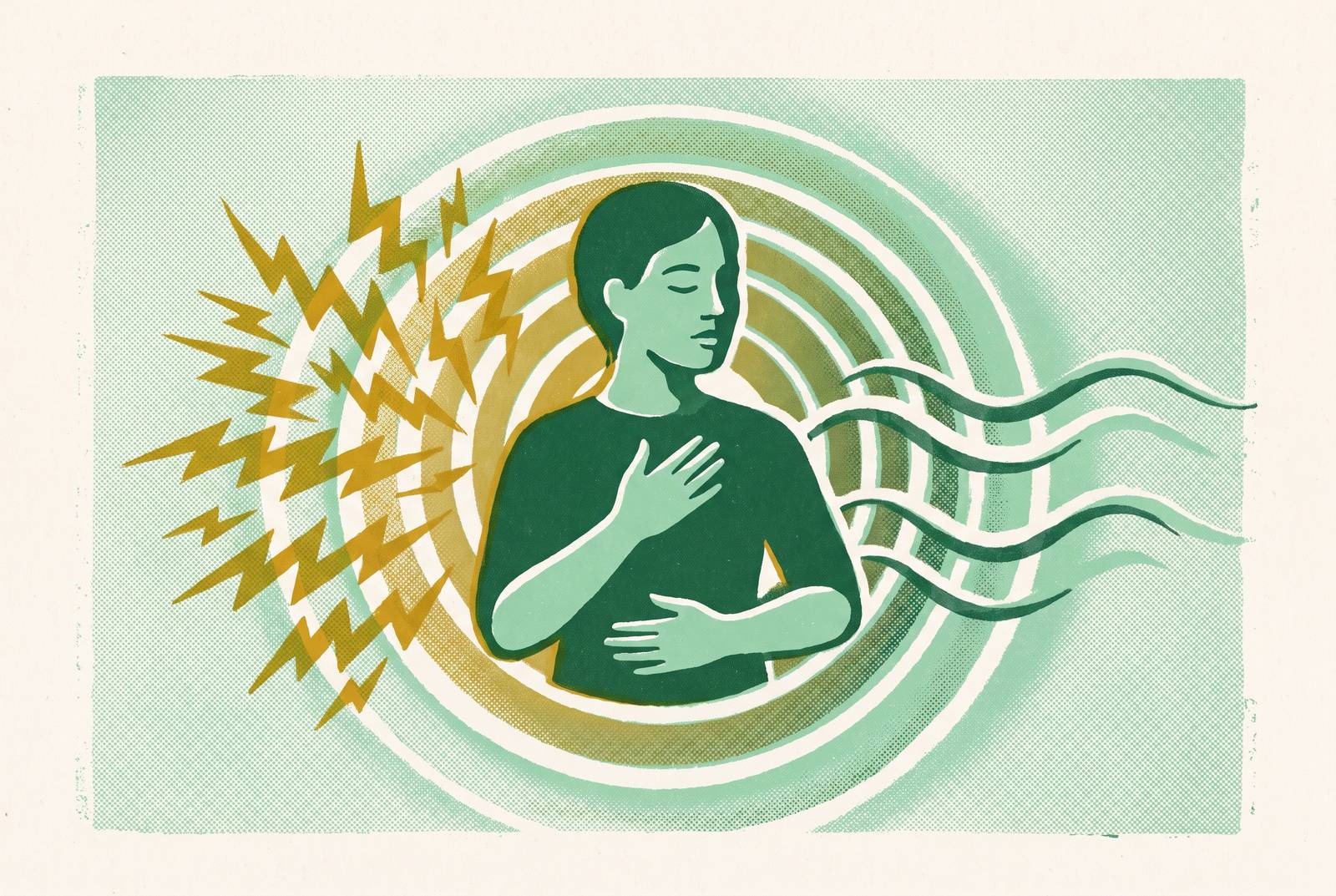
Stopping a panic attack starts with understanding what the body is doing. The body’s alarm response can occur without danger. Breathing, grounding, and other evidence-based tools target different parts of that alarm response. Knowing why they work can help a person feel more sure about using them, and knowing their limits can help them turn to treatment and support when panic keeps coming back.
What the body actually does during a panic attack
The amygdala initiates the fight-or-flight response when it detects a threat, including a perceived threat without actual danger. During a panic attack, that signal floods the body with adrenaline, followed by cortisol. Heart rate rises, breathing quickens, and muscles tense. The survival response is acting on a false signal. At the same time, the prefrontal cortex’s ability to reason about the threat is partly sidelined, which explains why simply trying to think an attack away rarely works.
Rapid, shallow breathing can then sustain the alarm. Hyperventilation lowers carbon dioxide levels in the blood, producing dizziness, tingling, and chest discomfort. Those sensations can be mistaken for signs of a heart attack or stroke, giving the brain what seems like further evidence of danger. More fear drives more adrenaline and faster breathing. This feedback loop helps explain how unease can become overwhelming terror within seconds.
Panic attacks peak within minutes, even when they feel unending. The sensations of panic itself are generally not dangerous, but that does not establish that unfamiliar symptoms are panic. New or severe chest pain, fainting, or possible stroke symptoms require urgent medical assessment to establish their cause. For a recognized panic attack, the key distinction is between the sensations and their interpretation.
Why understanding the mechanism is what makes the techniques work
What changes when a person understands that loop? The symptoms become less convincing as evidence of disaster. Psychoeducation is the process of learning what is happening, including why sensations can be intense without indicating danger. Clark (1986) provides the foundational account of how catastrophic interpretations sustain panic and why changing those interpretations can reduce its severity.
Knowledge changes the response to the sensations. A person can see a racing heartbeat as part of a process they know and act on it, without treating it as a new emergency each time. Urgently demanding that panic stop can reinforce the sense of threat, while acceptance leaves room to use a technique without fighting every sensation. The methods that follow work best when the person using them understands which part of the loop they are trying to interrupt.
Breathing as the first-line intervention and how to do it correctly
Because hyperventilation can sustain panic, controlled breathing offers a direct way into the cycle. Slower diaphragmatic breathing helps restore carbon dioxide levels, while an extended exhale stimulates the vagus nerve and the parasympathetic nervous system, the body’s brake on fight-or-flight. The goal is a gentle, deliberate rhythm that reduces overbreathing and gives the out-breath enough time.
To put that mechanism into practice, inhale gently through the nose for approximately four seconds, hold briefly, then exhale slowly for approximately six seconds. Let the breath come slowly from the diaphragm. The longer exhale is the key feature here. Repeat the rhythm without turning the timing into another source of urgency. The purpose is to change the breathing pattern.
Box breathing is another pattern to try when a steady rhythm feels easier to follow. Inhale for four counts, hold for four, exhale for four, and hold for four before repeating. Unlike the first pattern, it uses equal intervals. The pattern gives the rational brain a clear task to repeat while the adrenaline surge passes. The choice is personal, and neither pattern needs to become a performance test.
During calm moments, rehearse the sequence so it is familiar before panic narrows attention. That preparation reduces the need to learn and apply instructions at the same time. Breathing is a useful first-line tool, but it is not a guarantee of immediate relief or a substitute for treatment when attacks recur.
Grounding through the senses to pull the brain out of its alarm loop
While breathing addresses the respiratory part of panic, grounding redirects attention from internal alarm toward the surrounding world. Sensory processing competes with the fear response for attention, and naming details engages language and rational processing.
To use the 5-4-3-2-1 technique, name five things you can see, then four things you can touch. Continue with three things you can hear, two things you can smell, and one thing you can taste. Name the specific details of each thing. What distinguishes this particular thing from the others nearby? The task is to attend to concrete sensory information.
Going through all the steps may feel hard during an attack. In that case, focus on one nearby object and describe it in detail, including its color, texture, shape, weight, and temperature where these can be observed. Take time to stay with the object as you describe it. This simpler task takes up working memory, leaving less room for thoughts driven by panic. It offers another way to anchor attention when several steps are difficult to hold in mind.
Cold water, muscle release, and cognitive reframing as supporting interventions
Cold water, progressive muscle relaxation, and cognitive reframing are other ways to work on the same cycle. They address the physical alarm, muscle tension, and the interpretation of symptoms respectively. They are not a ranked sequence to complete. Different tools will be accessible in different settings, and they can be combined with breathing or grounding, including before those methods have “failed.
Cold water can trigger a competing physical response. Applying it to the face or back of the neck can activate the mammalian dive reflex, which slows heart rate and shifts blood flow. Gooden (1994) provides the peer-reviewed basis for this reflex mechanism. Cold water works through the body without the need to reason the fear away, as a spoken reminder would. Keeping a cold water bottle nearby is one preparedness option, although the technique should not be treated as a guaranteed physiological reset.
For progressive muscle relaxation, deliberately tense and then release muscle groups, working upward from the feet through the calves, thighs, abdomen, fists, shoulders, and face. The contrast between tension and release is the exercise. Conrad and Roth (2007) provide evidence for progressive muscle relaxation as an anxiety intervention. Its role here is to reduce the body-wide tension that panic creates and that can, in turn, sustain alarm.
Cognitive reframing addresses the meaning assigned to the sensations. For a recognized panic attack, replace a catastrophic interpretation with an accurate statement that this is panic, that it is uncomfortable, and that it will pass. That is different from demanding immediate calm. Acceptance makes room for the sensations without treating their presence as proof of danger. It does not require liking the experience, only reducing the struggle that can add another layer of fear.
What to do after the attack passes — the recovery period and what it means
The end of acute fear does not always mean an immediate return to normal. Fatigue, muscle soreness, physical discomfort, and emotional flatness can follow the intense fight-or-flight response. This is sometimes called a panic “hangover.” Understanding that recovery phase helps prevent lingering discomfort from becoming a new source of fear or shame. Recovery time varies between people and according to how the attack was managed.
A calming statement can remain useful during this period. Repeating a phrase about the episode passing provides a verbal anchor when fearful thoughts begin to spiral again. Preparation also extends beyond the attack itself. A predetermined personal plan, including which technique to reach for first, removes a decision at the point when thinking clearly is hardest and can help shorten the attack and recovery. If attacks keep returning, that does not erase the value of the tools. Frequent recurrence is a signal for more support.
When in-the-moment tools are not enough — the case for professional care
An occasional panic attack and panic disorder are not the same thing. Panic disorder involves recurrent unexpected attacks together with persistent worry or behavior changes related to future attacks. The anticipation of another episode can become part of the problem, even between attacks. That is why managing the immediate surge and treating the recurring pattern are different, complementary goals.
If self-management helps, why seek professional care? Because reducing one episode does not necessarily change what keeps episodes returning. Cognitive behavioral therapy, or CBT, identifies and restructures the catastrophic thought patterns that fuel panic. Over time, those automatic interpretations can weaken, making the cycle less self-reinforcing. In-the-moment tools remain useful during that work.
Exposure-based therapy is a central part of this approach. It helps a person approach bodily sensations with less fear, reducing reliance on avoidance during recovery. The distinction follows directly from the feedback loop. If the sensations are repeatedly interpreted as dangerous, fear keeps finding new evidence for itself. Treatment addresses that learned interpretation, rather than only helping the person wait for adrenaline to subside.
Panic disorder is highly treatable, and CBT is among the best-supported approaches. Seeking care is therefore an active extension of self-management. For people whose mental health needs intersect with unstable living conditions or limited access to services, knowing what treatment can do is only part of the solution.
How peer support changes the experience of managing panic for people with serious mental illness
For people living with serious mental illness, panic may occur amid housing instability, food insecurity, financial pressure, and limited access to care. These conditions raise the baseline stress on which a panic management plan has to operate. They also complicate ongoing treatment. Transportation challenges, financial pressure, and housing instability are associated with worse medication adherence. A breathing exercise cannot fix those conditions, even when it helps with the alarm in the moment.
Basic needs belong within the clinical picture. Getting food assistance has been linked to mental health outcomes, though the evidence is mixed on whether meeting basic needs directly protects people from long-term mental health struggles. That distinction prevents a plausible connection from becoming an overstated promise. Care still has to account for the conditions in which a person is expected to use it. Without that, even a technique that works may be hard to get help with or keep using.
Peer support can help bridge that gap through relationships grounded in lived experience of mental illness or crisis. Its credibility differs from clinical authority. Someone who has navigated similar circumstances can help make guidance feel usable. Peer support has been shown to help with self-stigma and mental health outcomes, including anxiety. Puschner et al.’s multicentre randomized controlled trial, UPSIDES, published in The British Journal of Psychiatry, found positive effects on social inclusion, empowerment, and hope, but no direct effects on personal recovery or health and social functioning.
firsthand puts this community-based approach into practice through Guides and STRIVE Specialists with lived experience of serious mental illness. They meet people in their communities and address housing, food, medication, and behavioral health together. The helpinghand platform supports that work with secure, HITRUST r2-certified infrastructure. The relationship and the practical support serve distinct purposes. One helps establish trust, while the other helps make care reachable in the places where people live.
For health plans and provider systems, integrating peer support into care delivery connects evidence-based treatment with the circumstances of daily life. A person may understand the panic loop and still need help getting care, meeting basic needs, or feeling sure enough to use a plan. Peer support can help with those needs while clinical treatment keeps its place in care. The goal is not to make someone manage panic alone, but to make effective help available when and where it can be used.