Post Crisis Follow Up Care and Reducing Psychiatric Readmissions
Peer support workers cut psychiatric readmissions by meeting patients where they are.
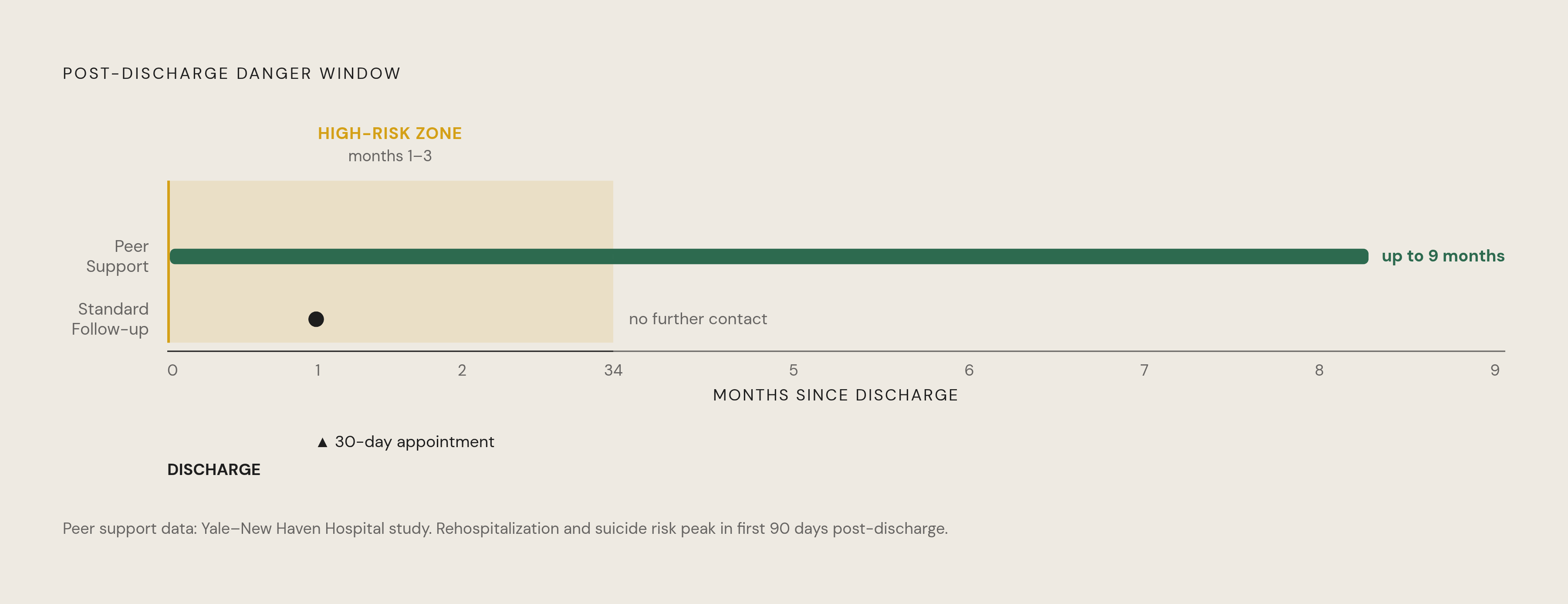
Discharge day for someone living with serious mental illness rarely looks like relief. It looks like a stack of paperwork, a follow-up appointment scheduled for three weeks out, and a ride home to an apartment that may or may not still have food in it. The system treats the moment of release as the end of a crisis. For many patients, it is closer to the beginning of the next one. Suicide risk and rehospitalization rates both peak in the three months immediately following discharge, which makes this narrow window one of the most dangerous stretches in all of medicine, not just in psychiatry. People living with schizophrenia, schizoaffective disorder, bipolar disorder, and major depressive disorder bear the weight of this danger most heavily, and they tend to be the same patients with the thinnest community support and the most strained histories with the health systems meant to help them. The question that follows is why the attention the post-discharge period already receives keeps failing to change the outcome.
How the standard follow-up model misreads the problem
The standard response to this danger is a scheduled outpatient appointment, typically within 30 days of release. On paper, this looks like continuity of care. In practice, it treats discharge as a handoff, a transfer of responsibility from one clinical setting to another, rather than a transition that needs active support to survive. That distinction, treating discharge as a handoff rather than a transition needing active support, is the root of the model's failure, resting on the assumption that the primary obstacle facing a discharged patient is a lack of professional contact and that a trained clinician sitting across from that patient will be enough to stabilize them. For many people with serious mental illness, that assumption misses the actual obstacles standing in the way of stability: whether they trust the person offering help, whether they can physically get to where help is offered, and whether anyone exists to bridge the distance between a hospital bed and the ordinary demands of daily life.
Researchers who tried and failed to build effective administrative fixes for repeat hospital admissions reached a conclusion that reframes the entire problem: engagement outside the conventional clinician-patient relationship may be what actually helps. That finding does not just suggest doing follow-up better within the existing model. It suggests the intervention needs to happen in a different setting, delivered by a different kind of person. For patients with schizophrenia in particular, the period right after discharge is one of the most important windows for preventing both relapse and suicide, and a once-a-month appointment with a psychiatrist, however well-intentioned, was never built to hold that weight on its own.
What peer support workers do in the post-discharge window
Peer support, in this context, is a structured, deliberate intervention delivered by Peer Support Workers (PSWs), people in recovery themselves, who carry their own lived experience of mental health challenges into the job. Their work takes the form of face-to-face visits, phone calls, text check-ins, advocacy on the patient's behalf, direct connection to community resources, and plain conversation grounded in shared experience.
What makes this work land differently than a clinical appointment is both relational and practical. A PSW might spend an afternoon helping someone fill out a Medicaid renewal form, or riding along to a pharmacy that would otherwise go unvisited, or simply talking a person through a symptom that is starting to escalate before it becomes a crisis. The advice carries weight because the person giving it has walked a similar road and knows what the walk actually feels like.
The structure of this support has been tested directly. A publicly funded trial in the UK built peer support as up to ten individual sessions, beginning within a month of discharge from a crisis team, running alongside continuing community mental health care. Peer workers used their own recovery experiences to help patients set goals, offered a kind of listening that felt less clinical and more human, and shared concrete strategies for staying stable.
A study out of Yale-New Haven went after an even higher-risk population: adults 18 and older with major mental illness who had already been hospitalized three or more times in the prior 18 months, the exact group most likely to cycle repeatedly through inpatient care. Peer mentors were assigned immediately after discharge and stayed with participants for nine months, a far longer follow-up horizon than most studies in this space attempt.
What separates this model from standard outpatient follow-up is not only who delivers the support but when and where it happens. Peer workers meet people in homes, on the phone, in the middle of an ordinary Tuesday, not in a waiting room scheduled weeks in advance. They appear during the exact stretch when clinical contact tends to be sparsest and the risk of relapse runs highest.
Peer Support and Readmission Rates
Across different study designs and different settings, peer support delivered in the post-discharge period produces reductions in psychiatric readmission that standard clinical follow-up has not matched.
At the trial level, the Yale-New Haven study found that patients assigned a peer mentor had significantly fewer rehospitalizations and fewer total days spent in the hospital at the nine-month mark, compared with patients who received usual care alone. The effect concentrated in exactly the group most prone to repeat, revolving-door admissions, the patients the system struggles hardest to keep stable. A separate meta-analysis of randomized controlled trials found that peer support was associated with a meaningful drop in the relative risk of psychiatric hospital admission compared with standard care.
Program-level data tells a similar story at a larger scale. Assessment data gathered by HHS on peer support initiatives showed substantial drops in both involuntary admissions and 30-day readmission rates. One program tracked in that assessment cut 30-day readmissions by nearly a third over three years. Another reported a dramatic fall in recidivism in the very first year peer support entered the hospital setting.
A fair objection follows naturally from how these trials are built: peer support study populations are often self-selected, and they sometimes exclude the most acute patients, including those who present a risk to others. That limits how confidently the trial results can be generalized to the hardest cases a hospital sees. But the HHS program data closes much of that gap, since it includes involuntary admissions and restraint use as tracked outcomes, reaching into the highest-acuity end of the spectrum that trials tend to avoid. The direction of the effect holds there too.
Peer support's return on investment for the most expensive patients
The financial case for peer support turns out to be strongest exactly where the clinical case is most urgent, among the patients with the highest acuity and the longest inpatient stays. Analysis from the ENRICH trial found that one-to-one peer support, delivered starting in inpatient care and continuing through the post-discharge period, cost approximately £540 per participant and came with a meaningful drop in costly acute contacts with the health system.
Lower average costs in the peer support group were not spread evenly across the whole population. They were driven mainly by a smaller number of participants who would otherwise have run up exceptionally high total costs, the patients with very long inpatient stays. That pattern points to something specific: the financial return on peer support concentrates at the high end of the acuity distribution, among the patients whose costs worry health plans and hospital finance departments the most.
HHS program-level data put a number on this at scale, estimating savings in the millions of dollars over multi-year periods from peer support initiatives that reduced both involuntary admissions and 30-day readmissions. For a health plan or an integrated health system operating under a value-based contract, that math is direct. A low-cost, high-trust intervention that diverts even a small fraction of the highest-acuity patients away from inpatient care produces a return that dwarfs what the program itself costs to run. One might argue that no single intervention should be expected to carry this much weight on its own, and that is fair. But the cost data suggests peer support does not need to work for everyone to be worth funding. It needs to work for the costliest patients, and the evidence says it does.
The social factors that standard follow-up ignores and peer support is built to address
For someone living with serious mental illness, the proximate cause of a relapse is rarely a symptom in isolation. More often it is a missed dose of medication because there was no ride to the pharmacy, an eviction notice, or a week spent without reliable food. Standard follow-up, built around fifteen-minute clinical appointments, was never designed to catch problems like these before they turn into an emergency room visit.
The health system is beginning to catch up to this reality through policy. The 2025 IPPS Final Rule expanded the diagnosis codes tied to housing instability, raising them from non-CC to CC status for Medicare reimbursement purposes. It is a regulatory signal, however incremental, that social circumstances are starting to be treated as medical variables. CMS also allows reimbursement of the SDoH assessment code G0136 during psychiatric diagnostic evaluations on the same date of service, giving clinical teams a structured way to screen for and document social risk right at the point of care.
Peer specialists were built for exactly this kind of work, long before the coding caught up to it. They often share community context with the people they support, have frequently navigated the same housing authority or benefits office themselves, and can physically walk someone to an appointment or a food pantry in a way no case manager working from a call center ever could. The policy shift matters less as an abstraction and more as confirmation: what peer workers have been doing on the ground for years is now, slowly, being recognized as part of the clinical picture.
Patients most likely to fall through the gap after discharge
The gap in follow-up care does not fall evenly across the population. It falls hardest on patients already underserved by the mental health system long before they ever reach a hospital bed, and it tends to compound disparities that already existed.
Black, Hispanic, and Indigenous populations receive mental health treatment at lower rates than white individuals, despite experiencing psychological distress at comparable or higher rates. That gap traces back to systemic racism, bias among providers, cultural stigma, language barriers, and a real shortage of clinicians equipped to work across cultural lines. Among Latino, Asian, and Black individuals, unmet mental health need runs far higher than among non-Latino whites, with roughly 80% reporting unmet need against a substantially smaller share of non-Latino white individuals. Medicaid expansion, meaningful as it was for coverage, did not close this gap. Insurance alone cannot fix a barrier built from mistrust, language, and geography. Hispanic or Latino patients, and those who live farther from a provider, experience lower rates of post-discharge follow-up, a number that puts how distance and race compound each other in practice.
A peer worker who shares a patient's cultural background and has lived through comparable struggles starts several steps ahead of a clinician who has not, simply on the question of trust. And because peer support happens in the community rather than behind a clinic's front desk, it sidesteps the transportation and distance barriers that drive so much of the geographic disparity in care. They are people whose distance from stable care is measurable, and whose path back to it looks different depending on who is standing next to them when they walk it.
Building the peer specialist workforce
What was once an informal, community-based role is turning into a recognized health profession. States are building credentialing pathways for peer specialists, directing public funding toward training programs, and weaving peer roles into the formal structure of hospitals and managed care organizations as a core clinical service. That shift answers a concern health systems have voiced for years about peer support: how to hold it accountable to the same standards as any other clinical service, with defined training, supervision, and documentation.
This is not a finished transition. Credentialing requirements still vary widely from one state to the next, and funding streams remain inconsistent, which leaves many hospitals and health plans building peer programs without a single national template to follow. But the direction is consistent: peer support is moving from the margins of care toward its center, built not on good intentions but on the outcomes data laid out across nine-month trials, multi-year program assessments, and a regulatory system slowly catching up to what lived experience has been proving all along.
Sources
- Peer support for discharge from hospital to community mental healthcare: a cost analysis - Healey - 2025 - General Psychiatry - Wiley Online Library
- Effectiveness of Peer Support in Reducing Readmissions of Persons With Multiple Psychiatric Hospitalizations
- Peer support may reduce readmissions following mental health crises
- An Assessment of Innovative Models of Peer Support Services in Behavioral Health to Reduce Preventable Acute Hospitalization and Readmissions