Bipolar Disorder Treatment Adherence Challenges
Missed doses and mood episodes, not refusal, drive most treatment dropout in bipolar disorder.

The consequences of nonadherence in bipolar disorder are not subtle, and after years of watching this unfold clinically, the consistency with which they are underestimated still surprises me. Stopping medication is directly associated with relapse, recurrence, emergency visits, and rehospitalization. Abrupt discontinuation of lithium in particular can trigger rebound mania or depression, making the dropout itself a clinical event with its own forward momentum. Not simply a gap in coverage.
The longitudinal damage is where the stakes become hardest to overstate. Manic exacerbations in early-stage bipolar disorder have been linked to cognitive impairment and worse long-term functional outcomes, per Faden and Maymind writing in Bipolar Disorders (2025). Nonadherence early in the illness course can permanently narrow the ceiling of recovery before patients are even aware it is happening. The losses are invisible until they become irreversible, and that is exactly the kind of thing that does not translate well in a fifteen-minute appointment.
Suicide risk adds a separate, urgent dimension. Individuals with bipolar disorder in the U.S. are estimated to be 10 to 30 times more likely to die by suicide than those without the condition, and nonadherence compounds that risk by leaving the underlying illness undertreated during precisely the periods when mood dysregulation is most dangerous.
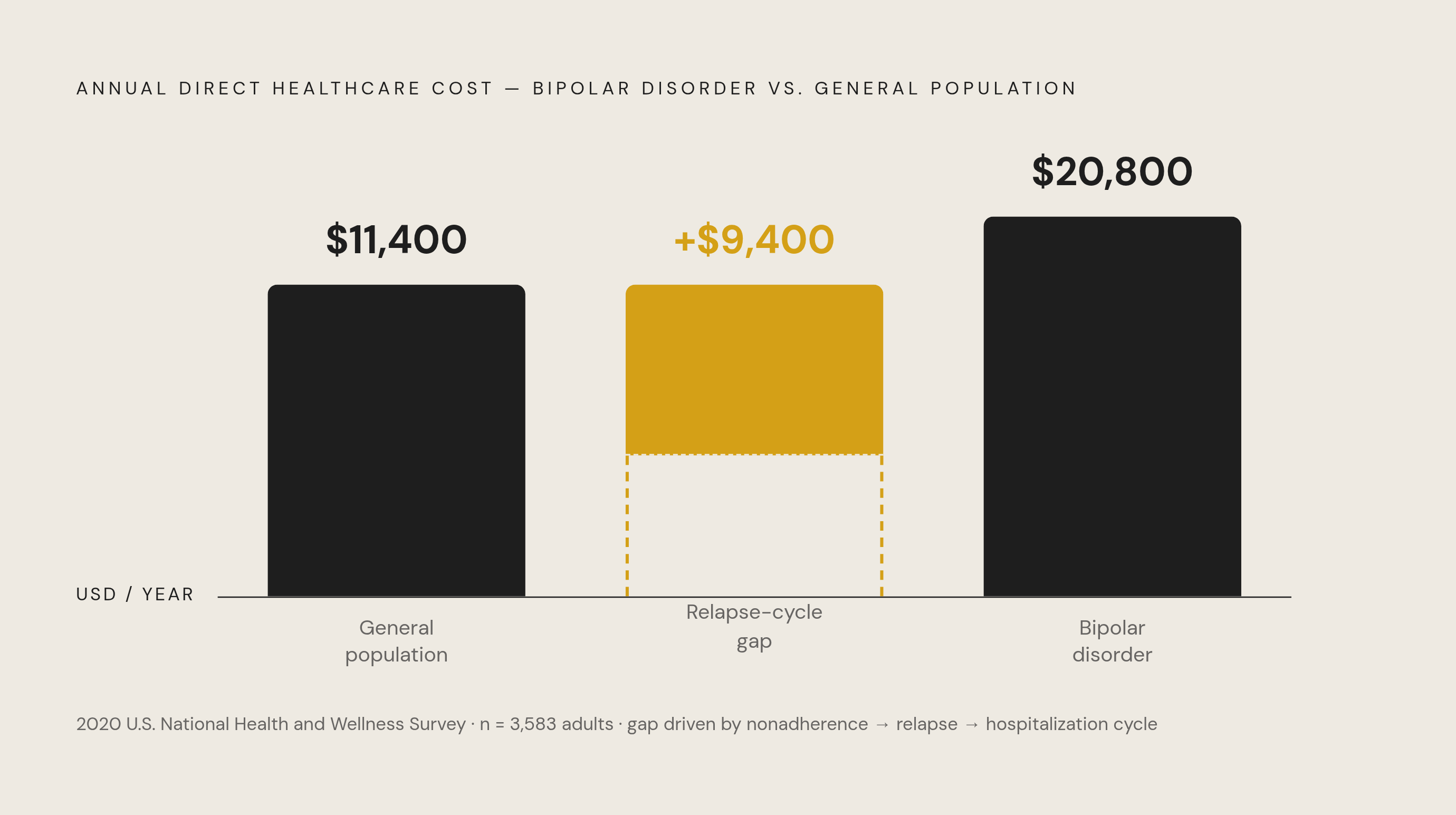
The economics follow naturally from all of this. The U.S. economic burden of bipolar disorder exceeds $195 billion annually, with approximately 25% attributable to direct medical expenses, per a 2025 Lancet report. Data from the 2020 U.S. National Health and Wellness Survey, drawn from 3,583 adults with bipolar disorder, found adjusted mean annualized direct healthcare costs of roughly $20,800 for bipolar disorder patients compared with approximately $11,400 for general population controls; indirect costs tracked similarly. Those differences are not inherent to the diagnosis. They are substantially driven by the relapse-hospitalization cycle that nonadherence accelerates, a cycle that is largely preventable.
The Most Common Reason Patients Stop
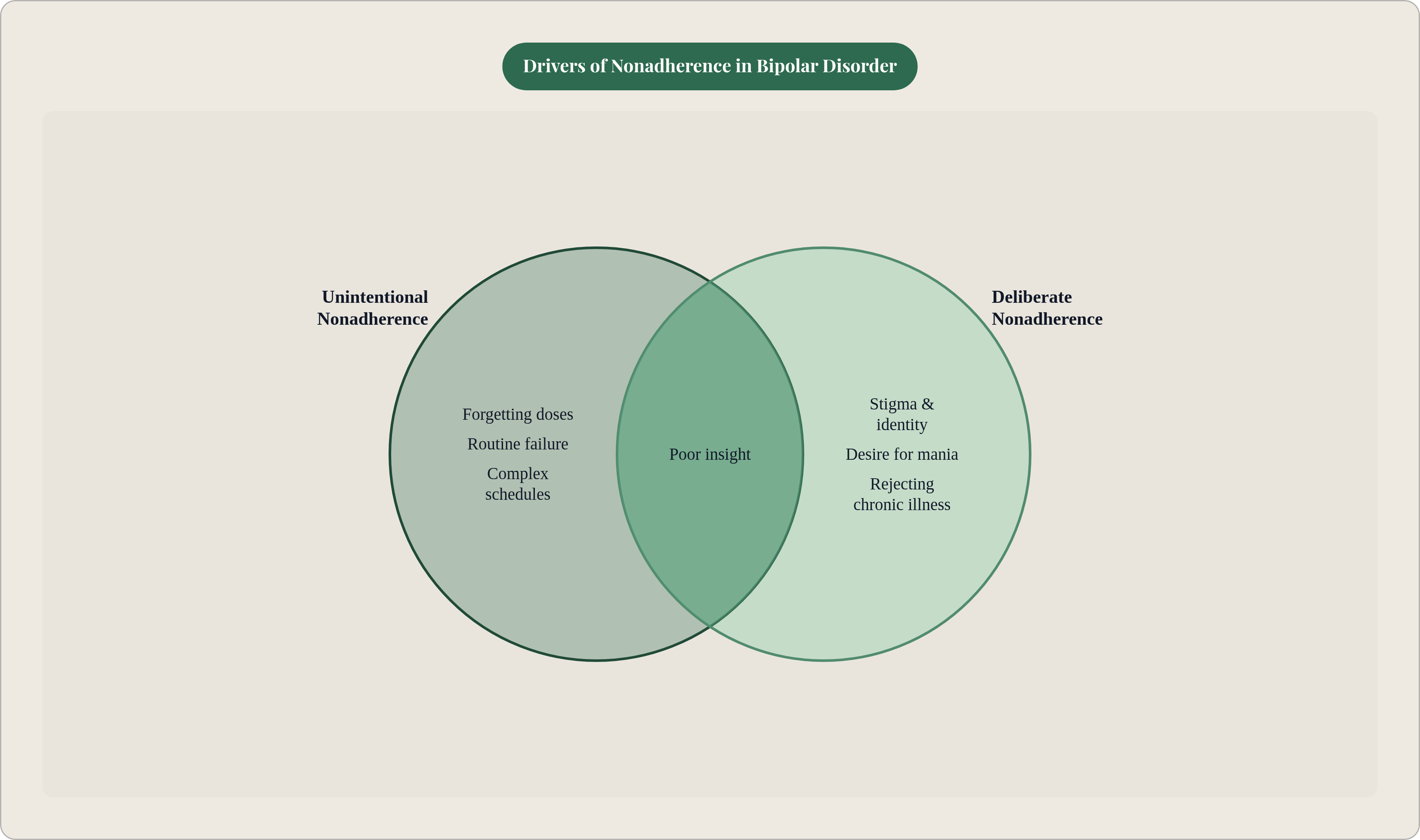
The instinct, when thinking about nonadherence in a psychiatric population, is to reach for explanations rooted in resistance. Spend enough time with patients, though, and that framing starts to look less like clinical insight and more like projection. The data are unambiguous: in a 2025 study by Sahnoun and colleagues, more than half of poor adherers showed unintentional nonadherence, and only a small minority discontinued primarily because of side effects. In a separate qualitative assessment by Sajatovic and colleagues, forgetting was the top self-reported reason, cited by a majority of respondents.
The intentional/unintentional distinction is useful descriptively, but it obscures as much as it reveals. Forgetting is not purely mechanical. Attitudes toward medication, beliefs about illness, and the perceived costs and benefits of treatment all shape whether routines form and hold. A patient carrying ambivalence about their diagnosis is more likely to build a life in which medication has no reliable place, not because they are explicitly refusing it, but because nothing in their daily environment reinforces taking it.
The practical contributors to forgetting are real and addressable on their own terms. Lack of established routine, complex multi-dose schedules, and polypharmacy all increase the probability of missed doses. Mood-state interference compounds everything: depressive episodes reduce motivation and executive function, making even simple daily tasks difficult to sustain; hypomanic states reduce perceived need, making medication feel irrelevant at precisely the moments when the illness is most active. Benzodiazepines and antidepressants added to a bipolar regimen increase pill burden, and the compounding effect on adherence is rarely explicitly weighed in prescribing decisions.
A large share of nonadherence is therefore potentially addressable through behavioral and structural supports: routine anchoring, simplified schedules, reminder systems. The intervention doesn't have to begin with the patient's belief system. That realization, simple as it sounds, redirects a surprising amount of clinical effort toward ground that is actually tractable.
How Poor Insight Into Illness Drives Deliberate and Semi-Deliberate Stopping
Insight, in the context of bipolar disorder, refers to the degree to which a person recognizes they have a condition requiring ongoing treatment. Poor insight, sometimes called anosognosia, is not denial in the colloquial sense. In some phases of illness it is a symptom of the disorder itself: a failure of the cognitive machinery needed to accurately assess one's own mental state. It took me longer than I would like to admit to stop treating insight deficits as a persuasion problem, as though the right argument, delivered the right way, would dissolve something that was partly neurological in origin.
The empirical relationship between insight and adherence is robust. In the 2025 Sahnoun et al. study, adherence scores correlated positively with insight scores at a level of statistical significance, and a substantial portion of the nonadherent cohort demonstrated poor insight. When people do not believe they are ill, medications feel like unnecessary impositions. That logic is internally consistent even when clinically mistaken, which is precisely what makes it resistant to frontal argument.
A 14-year retrospective study identified poor understanding of illness by the family as the leading cause of noncompliance. The insight problem is not confined to the patient. Caregivers who don't understand the chronic nature of bipolar disorder, or who interpret a stable period as evidence that treatment is no longer needed, can actively undermine adherence without any awareness they are doing so.
Qualitative data from Sajatovic and colleagues add texture. A notable subset of patients reported not wanting to take medication indefinitely; another reported a desire to experience manic symptoms. Both reflect beliefs about what the illness is and what treatment is for. Mania distorts insight in real time: elevated mood feels like wellness, and medication, in that frame, feels like suppression of something valuable rather than protection against something dangerous. The clinical conversation that addresses this cannot be a lecture. It has to be an examination of the patient's own perception, conducted alongside them, which is a different skill set entirely and one that receives far less attention in training than pharmacology does.
Insight is not fixed. It improves over time in many patients, making it a legitimate and tractable target. But it is also not a wall clinicians should exhaust themselves arguing against every session.
Side Effects, Stigma, and the Other Barriers That Layer On Top
Acknowledging that forgetting and poor insight are the most prevalent drivers of nonadherence does not minimize the barriers that compound them. Side effects are real, clinically significant, and frequently cited even when they account for a minority of discontinuations in isolation.
Lithium's side effect profile, including nausea, tremor, polyuria, weight gain, and cognitive dulling, is well established and contributes to both patient reluctance and clinician caution. Long-term interstitial nephropathy risk, typically emerging after a decade or more of use, requires active monitoring. Less examined is the self-reinforcing quality of lithium's toxicity reputation: extensive documentation of adverse effects increases clinician hesitancy, which may reduce prescribing rates and the quality of adherence support offered to patients who are already taking it.
A meta-analysis of 38 studies covering tens of thousands of patients identified the main risk factors for nonadherence: younger age, substance use, poor insight, cognitive impairments, low education, minority ethnicity, low socioeconomic status, poor therapeutic alliance, and barriers to care. That list spans attitudinal, cognitive, social, and structural domains simultaneously. No single-domain intervention addresses it in full, and yet single-domain interventions remain the norm in practice.
Substance use comorbidity deserves particular attention. It functions simultaneously as a risk factor for nonadherence and as a consequence of undertreated bipolar disorder, creating a reinforcing cycle that neither psychiatric nor addiction treatment alone reliably breaks.
Stigma operates at two distinct levels. External stigma involves social shame around a psychiatric diagnosis or being seen taking medication; internalized stigma involves a reluctance to accept a chronic illness identity, particularly one implying lifelong treatment. The latter is substantially more resistant to direct intervention because it is bound up with self-concept, not just knowledge or attitude.
Socioeconomic barriers, including medication cost, limited prescriber access, and inability to take time off for appointments, are structural rather than attitudinal. A 2024 Bavarian drug surveillance study found that more than a third of patients were not administered any guideline-recommended drug for bipolar depression, a reminder that provider-side gaps contribute to poor outcomes independently of anything the patient does or does not do. Where multiple barriers are simultaneously active, an intervention targeting only one will consistently underperform.
What Long-Acting Injectable Antipsychotics Change About the Adherence Equation
Long-acting injectable antipsychotics, administered every few weeks to months rather than daily, remove the daily decision to take medication. For patients whose nonadherence is rooted in forgetting, routine failure, or mood-state interference, eliminating that daily decision point addresses the mechanism directly rather than trying to reinforce a behavior that the illness itself keeps undermining. Whether that constitutes genuine barrier-matching or a structural workaround probably depends on which theorist you ask; clinically, the distinction matters less than whether it works.
In bipolar disorder type I, LAIs are associated with improved adherence, reduced relapse and hospitalization rates, and lower healthcare system burden compared to oral antipsychotics, per a 2025 expert consensus by Vieta and colleagues published in Bipolar Disorders. LAIs also resolve clinical ambiguity about whether a patient is adherent at all. Clinicians know. That changes the nature of clinical conversations and allows for earlier identification of emerging problems before a missed dose becomes a relapse.
There is a polypharmacy dimension as well. By anchoring the regimen to a regularly administered injectable, the number of daily oral medications may decrease, reducing pill burden without requiring behavioral change from the patient.
The current usage pattern is where the real problem lies. LAIs have historically been reserved for patients with severe symptoms, chronic nonadherence, or multiple prior relapses, precisely the population where the damage from nonadherence is already extensive. Expert consensus, including both Vieta et al. (2025) and Faden and Maymind (2025), is shifting toward earlier use, before the relapse cycle establishes itself and before the cognitive and functional losses that early nonadherence produces become permanent. Reserving the most adherence-supportive tools for the most treatment-refractory patients inverts the logic of prevention.
The barriers to LAI uptake are largely attitudinal and knowledge-based rather than clinical. Clinicians frequently assume patients prefer oral medication, often without directly asking. Patients associate injectables with severe or involuntary treatment. Country-specific access and reimbursement structures create additional friction. The gap between what LAIs demonstrably offer and how rarely they are proactively discussed represents a collective failure to apply available tools to the populations who would benefit from them earliest, and it is a difficult gap to defend on clinical grounds.
Psychosocial Interventions and Psychoeducation as the Evidence-Based Complement
Pharmacological strategies address delivery and side effect burden. They don't change what patients believe about their illness, their medication, or themselves. Psychosocial interventions occupy that space, and the evidence for several of them is more than adequate to justify much wider use.
A literature review in Psychiatric Services identified more than ten controlled studies of psychosocial interventions targeting adherence in bipolar disorder, with a majority finding meaningful improvements. Psychoeducation specifically targets the insight deficit: structured programs help patients understand the course of bipolar disorder, recognize early warning signs, and grasp why maintenance medication matters during stable periods, precisely when it feels least necessary and is most commonly abandoned.
Family-focused psychoeducation addresses the finding that poor understanding of illness by the family is a leading driver of noncompliance. Bringing caregivers into the treatment frame, rather than treating the patient as an isolated individual surrounded by an inert social environment, changes the conditions under which daily adherence decisions are made.
Cognitive-behavioral approaches can address medication beliefs and the internalized stigma that makes long-term treatment feel like an identity problem rather than a health decision. Motivational interviewing is particularly suited to the semi-deliberate stopper: the patient who is ambivalent rather than categorically refusing, who has real reasons for both taking and not taking medication, and who responds poorly to persuasion but well to candid exploration of that ambivalence. The technique is not subtle and cannot be easily abbreviated, which probably explains its underuse in systems that reward throughput.
Therapeutic alliance is not a soft variable. The same meta-analysis of 38 studies that catalogued demographic and clinical risk factors listed poor therapeutic alliance as a significant independent predictor of nonadherence. Patients who trust their prescriber are more likely to report side effect concerns before stopping, more likely to ask about alternatives, and more likely to engage with psychoeducational content when it is offered. The relationship itself is part of the intervention.
Practical behavioral supports, including simplified dosing schedules, reminder systems, blister packaging, and integrated pharmacy and clinical follow-up, address forgetting without requiring insight change. They are underutilized relative to their potential impact, partly because they don't feel sufficiently clinical to the providers who could recommend them. That is a category error worth correcting.
What It Takes to Match the Intervention to the Barrier
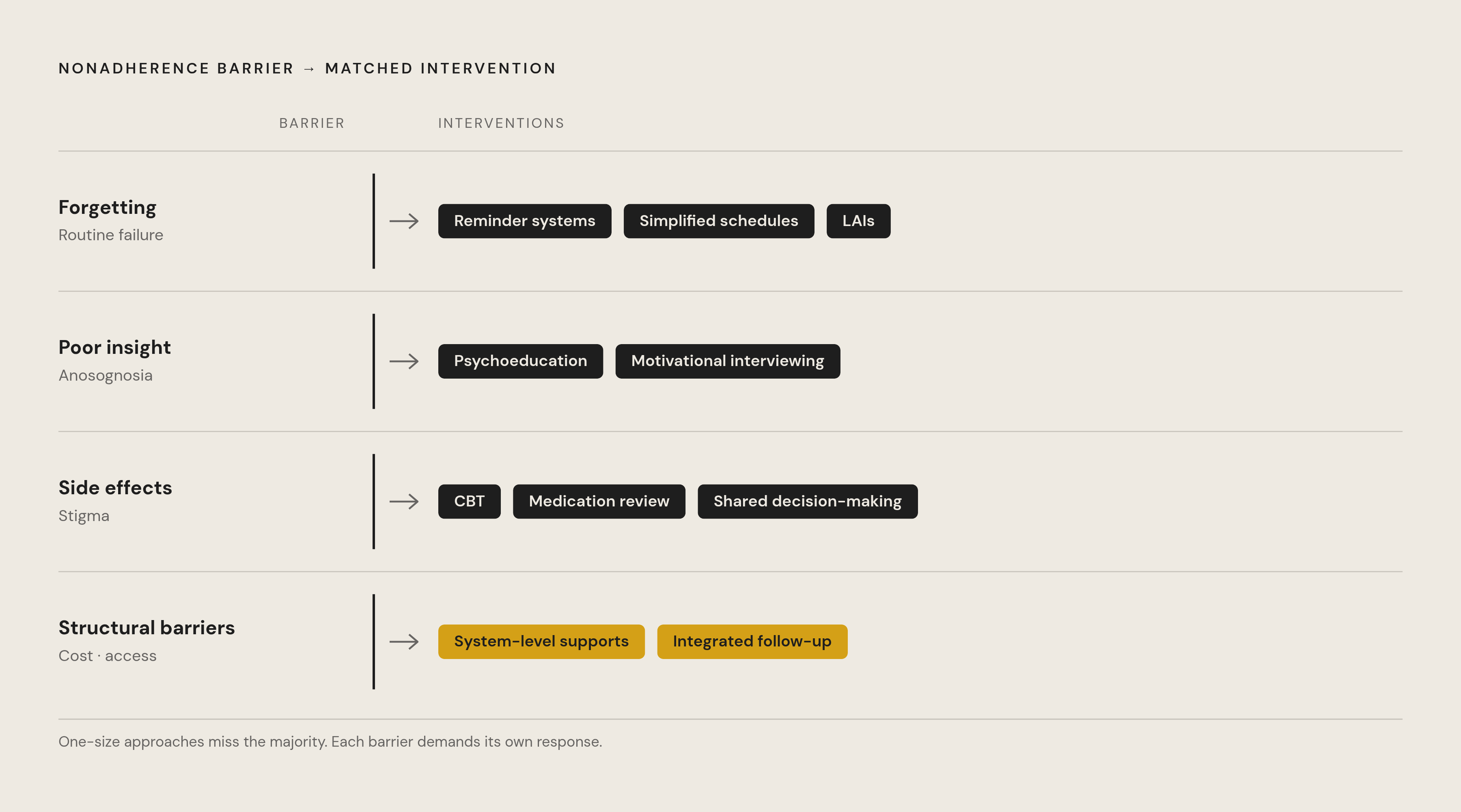
Adherence failure has distinct mechanisms: forgetting, insight deficit, side effect burden, stigma, structural access problems, poor therapeutic alliance. Each responds to different approaches. The prerequisite step, one that clinical practice frequently skips, is assessing which barriers are actually active for a specific patient at this specific point in their illness.
A one-size approach misses the majority because the mix varies by person, mood phase, and illness stage. The patient who is nonadherent because of a disorganized routine needs something fundamentally different from the patient who stopped because mania made medication feel unnecessary; that patient needs something different from the one who discontinued because of intolerable weight gain; that patient needs something different from the one who cannot afford refills. Treating these as interchangeable produces interchangeable failures, with the added frustration of having technically delivered an intervention.
Mood-state awareness is especially important here. What supports adherence during a stable period may need to be reinforced differently during a depressive or hypomanic phase, when specific barriers shift. A patient who manages a routine well while euthymic may lose that capacity entirely during a depressive episode, not because of attitude, but because of the illness itself. Clinical monitoring capable of catching this requires contact patterns more frequent than most outpatient systems currently provide, which is a structural problem that cannot be solved at the individual clinician level.
Early-stage bipolar disorder is a particularly high-leverage window. Faden and Maymind (2025) note that nonadherence in early disease can produce lasting cognitive and functional damage. Intervening before the relapse cycle establishes itself is substantially more effective than attempting to repair damage after the fact. The current pattern of reserving the most adherence-supportive interventions, including LAIs, for the most treatment-refractory patients inverts the logic of prevention in a way that is hard to explain by anything other than institutional inertia.
The guideline-to-practice gap documented across the sources reviewed here points to something the field has been slow to fully acknowledge: improving adherence is not solely a patient behavior problem. Prescriber behavior and system design are part of the picture. Shared decision-making, explicitly discussing treatment preferences and directly asking about LAIs rather than assuming oral preference, closes part of this gap without requiring new resources. It requires only a different conversation, which is either encouraging or indicting depending on how long that conversation has been available and how rarely it happens.
Adherence status changes. A patient who is adherent during a stable period may stop during a depressive episode without the clinical team noticing until a crisis occurs. The goal is not perfect adherence as an abstract metric but a treatment relationship in which barriers are visible enough to be addressed before they become hospitalizations.