Catatonia Symptoms and Causes Across Psychiatric Conditions
Catatonia appears across psychiatric conditions, not just schizophrenia as long assumed.
Catatonia is a syndrome, not a diagnosis, and psychiatry took about 150 years to work out the difference between the two. Karl Kahlbaum described it in 1874 as its own clinical entity, a cluster of motor and volitional abnormalities that didn't belong to any single illness. Kraepelin folded it into dementia praecox not long after, and for most of the twentieth century the DSM treated catatonia as strictly a schizophrenia subtype. That one editorial choice trained generations of clinicians to look for catatonia inside a schizophrenia workup and nowhere else, and it took until DSM-5 in 2013 and ICD-11 in 2022 to formally undo it. What follows traces what got corrected, why it took so long, and what treating catatonia as a cross-diagnostic syndrome now demands of the people standing at the bedside.
What catatonia actually is, and what makes it a syndrome rather than a disease
A syndrome is a pattern, not a cause. Catatonia is a recognizable cluster of motor, volitional, and behavioral abnormalities that a wide range of underlying conditions can produce; it has no single etiology the way strep throat has a single bacterial one. Think of it less as a disease and more as a final common pathway, a state the brain can arrive at from several different directions, sometimes psychiatric, sometimes not.
The presentation itself is a contradiction, and that's what makes it strange to watch unfold in a patient. The same person can swing between total immobility and sudden agitation, between mutism and echolalia, inside a single admission. Clinicians generally sort what they see into three patterns. Retarded, or hypokinetic, catatonia looks like stupor: reduced movement, mutism, withdrawal, a patient who seems to have checked out of the room entirely. Excited, or hyperkinetic, catatonia sits almost at the other pole: purposeless agitation and stereotyped movement disconnected from whatever is actually happening around the patient. Then there's malignant catatonia, the one that keeps consultation-liaison psychiatrists up at night. Fever, autonomic instability, a genuine medical emergency dressed up as a psychomotor syndrome.
These poles aren't fixed, and that's exactly what trips people up. A patient can present hypokinetic on Monday and hyperkinetic by Wednesday, and neither rules out the other showing up again later in the same episode. That fluidity is also why catatonia gets confused with delirium so often; the two look alike on a bad day. Delirium centers on disorientation, poor attention, disorganized thought, and it tends to improve on antipsychotics. Catatonia centers on posturing, increased motor tone, negativism, echolalia or echopraxia, and it often gets worse on those same drugs. Push antipsychotics into an unrecognized catatonia, and you can tip a hypokinetic presentation toward the malignant form. That's exactly the outcome nobody wants, and it's not a hypothetical.
The signs clinicians use to recognize catatonia at the bedside
Diagnosis comes down to counting signs, though the threshold differs slightly by system. DSM-5-TR asks for three or more of twelve psychomotor signs; ICD-11 asks for three of fifteen, spread across hypokinetic, hyperkinetic, and parakinetic categories. The DSM-5-TR list includes stupor, catalepsy, waxy flexibility, mutism, negativism, posturing, mannerism, stereotypy, agitation, grimacing, echolalia, and echopraxia. Each is a specific behavioral observation, not a vague clinical hunch.
Here's what catches people who learned catatonia from a textbook photo. Catalepsy and waxy flexibility, the frozen limb that holds whatever position you bend it into, are the signs everyone remembers, yet in practice they show up less often than three quieter ones: staring, mutism, and refusal to eat or drink. Those three dominate hypokinetic presentations. A clinician holding out for waxy flexibility before entertaining the diagnosis is going to miss a meaningful share of real cases, because staring and withdrawal get written off as depression, fatigue, or a patient being difficult. They deserve the same clinical weight as the dramatic textbook signs. In my experience, they rarely get it.
At the extreme end sits malignant catatonia, where fever and autonomic instability turn a psychomotor syndrome life-threatening. One thing worth flagging: Neuroleptic Malignant Syndrome, long treated as its own separate diagnosis tied to dopamine-blocking drugs, increasingly looks like the same underlying condition wearing a different name. A growing number of catatonia researchers now consider NMS a form of malignant catatonia triggered specifically by antipsychotics; NMS cases score positive on standard catatonia rating scales and respond to the same treatments. That convergence is one more data point suggesting catatonia's boundaries run wider than the old categories assumed.
Why diagnosing catatonia is harder than applying a checklist
A twelve- or fifteen-item checklist sounds like it should make diagnosis mechanical. It doesn't. DSM-5-TR and ICD-11 overlap heavily on which signs count, but neither tells you how pronounced a sign needs to be before it counts. Is brief eye-contact avoidance "staring"? Does a patient who eventually answers, just slowly, count as "mutism"? That threshold call gets left to the examiner, and examiners disagree with each other more than the field likes to admit.
The consequence shows up plainly in validation studies. Among cases independently confirmed as catatonia by expert review, only about three-quarters met DSM-5 criteria under a straightforward checklist application. A diagnostic system missed a quarter of the cases it exists to catch, just from unaided application. Read that twice; it's the whole argument for structured screening in one sentence.
That's the gap the Bush-Francis Catatonia Rating Scale, the BFCRS, was built to close, and it's the instrument the American Psychiatric Association's 2025 Catatonia Resource Document now names as the preferred screening tool. Its first 14 items work as a standalone screen covering all 12 DSM-5-TR criteria; a score of two or higher prompts the clinician to complete the full 23-item scale. That structure buys more reliability than an unaided read of DSM-5-TR criteria, mostly because it forces a consistent process instead of relying on whatever the clinician happens to remember to look for that day.
So how does that actually play out on a hospital floor? Screening only helps if somebody does it, and on medical and consultation-liaison services, where the immediate concern is a fracture or an infection or a metabolic derangement, psychiatric screening slides down the priority list fast. Underdetection here isn't really a knowledge problem; it's a bandwidth problem. Misidentification then cuts two ways at once, missing catatonia because nobody looked, and mistaking it for delirium or acute psychosis when it's sitting right there in front of them. Both errors carry real weight, because antipsychotics are contraindicated in catatonia and can push a quiet hypokinetic case toward the malignant form.
How common catatonia actually is across clinical settings
Catatonia's reputation as rare doesn't survive contact with the numbers. An integrative estimate puts overall prevalence across clinical samples at roughly 9.2%, and a 2018 meta-analysis spanning more than 110,000 participants across 80 studies landed in the same neighborhood. That's nearly one in ten patients across pooled samples showing catatonic signs somewhere in the clinical picture. Not what "rare" usually means.
Condition-specific rates run considerably higher: up to 71% in some mood disorder populations, 67% in some schizophrenia populations. Those numbers need a caveat attached before anyone repeats them out of context; they likely reflect broad screening thresholds rather than strict diagnostic criteria, so treat them as ceiling estimates, not settled prevalence figures. Even as ceilings, though, they say something real. Catatonic signs are a frequent companion of mood and psychotic illness, not a curiosity that shows up once a career.
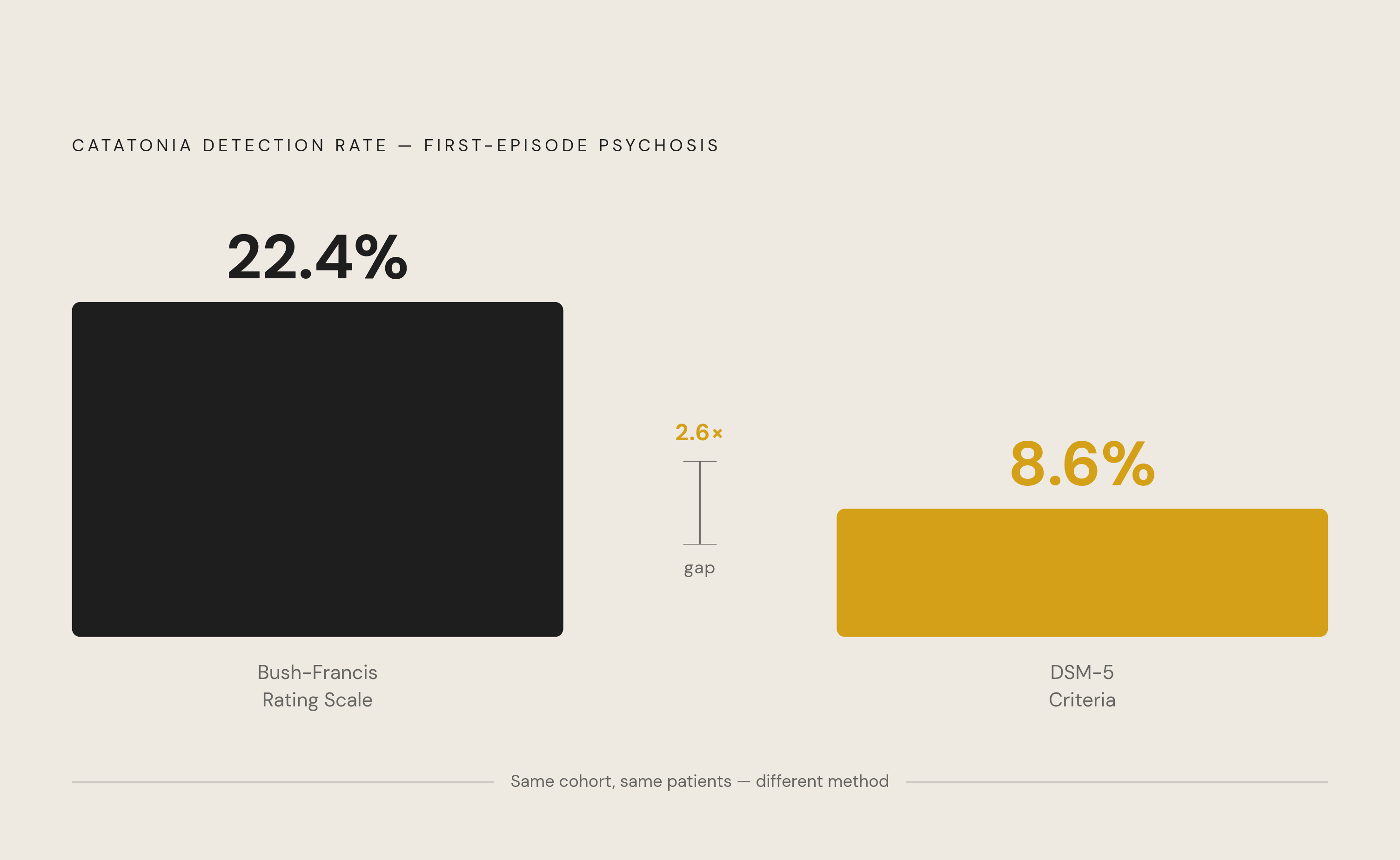
In acute inpatient psychiatric settings, prevalence runs roughly one in ten to one in five admissions depending on the study. In general hospital consultation-liaison services, where medical illness is the primary concern and psychiatric screening has to compete for attention, estimates spread even wider, and this is exactly where underscreening does its worst damage. First-episode psychosis gives maybe the cleanest illustration of the screening-versus-criteria gap: 22.4% of cases showed catatonic signs on Bush-Francis screening, but strict DSM-5 criteria caught only 8.6% of that same sample. Same patients, same illness, nearly a threefold swing depending purely on which instrument you reach for.
Zoom out to the population level and the picture flips. UK and US incidence data published in the Journal of Neuropsychiatry and Clinical Neurosciences in 2025 put new catatonic episodes at a few per 100,000 person-years, genuinely rare once you're counting across an entire population rather than an admission ward. So which is it, rare or common? Depends entirely on where you're standing. Rare across a general population, routine once someone is already inside a psychiatric or medical admission. Catatonia shows up often enough to be unremarkable in the right setting, and gets missed often enough that "unremarkable" still feels like the wrong word for it.
Mood disorders and schizophrenia as the most common psychiatric origins
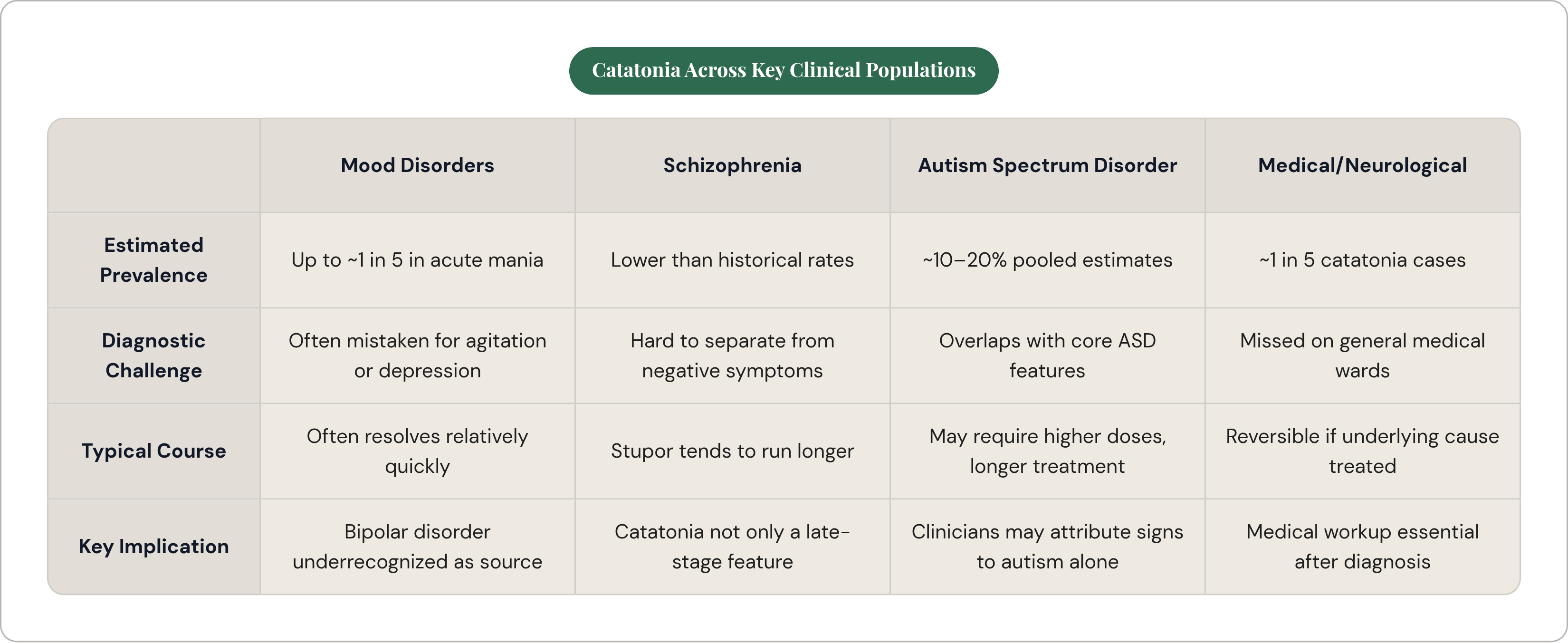
Bipolar disorder deserves more credit here than it usually gets. Up to roughly one in five patients in acute mania shows classic catatonic signs, which makes bipolar disorder, in practice, one of the more common psychiatric settings for catatonia to turn up, not a footnote to the schizophrenia story most training programs still lead with.
Schizophrenia's relationship to catatonia has actually moved the opposite direction over time. Older literature reported catatonia in a large share of schizophrenia cases; contemporary studies put the rate substantially lower. Why the decline? Some of it probably reflects better differential diagnosis, clinicians getting sharper at separating catatonia from negative symptoms or disorganized psychosis. Some of it may reflect changing treatment patterns that alter how the illness presents before catatonia has room to fully emerge. It's likely some mix of both, and honestly, the literature doesn't cleanly separate one explanation from the other.
When catatonia does appear alongside schizophrenia, the course looks different than it does alongside a mood disorder. Stupor tends to run longer in the schizophrenia context, which matters for prognosis and for how aggressively a clinician pushes treatment. A catatonic stupor expected to resolve in days gets managed very differently than one likely to drag on for weeks.
One more point that deserves attention: catatonia isn't exclusively a late-stage or treatment-resistant phenomenon. First-episode psychosis data, with catatonic signs in over a fifth of cases on Bush-Francis screening, shows it can appear right at illness onset, before a patient has been through years of failed treatment attempts. That undercuts the old assumption that catatonia is what shows up after everything else has already failed.
Autism spectrum disorder as a distinct and underappreciated context for catatonia
This is where the diagnostic picture gets genuinely hard. A 2026 scoping review in JAACAP put pooled catatonia prevalence in autism spectrum disorder at 10.4%, with pediatric estimates running higher, somewhere in the 12% to 20% range for autistic youth specifically.
The trouble is that autism and catatonia share a symptom vocabulary. Repetitive behaviors, social withdrawal, motoric oddities all count as core features of ASD and as diagnostic signs of catatonia at the same time. A clinician watching an autistic adolescent rock repetitively or go quiet in social settings faces a genuinely open question: is this the autism doing what autism does, or is catatonia sitting on top of it, unrecognized because it looks exactly like what the clinician already expected to see?
I don't think that question resolves easily, and I've watched it get rushed past more than once. What links the two conditions biologically is still being worked out; the leading candidates include excitatory and inhibitory neurotransmitter imbalance, neuroimmune dysregulation, and genetic vulnerabilities that interact with environmental exposures. None of that is settled science yet. But the overlap in proposed mechanisms is suggestive enough that it shouldn't get waved off as coincidence.
Here's why accurate recognition matters so much in this population. Benzodiazepines and electroconvulsive therapy remain the primary interventions for catatonia regardless of underlying cause, but autistic patients typically need higher doses and longer courses than neurotypical patients do. That's a meaningful clinical difference, and it only matters if someone identifies the catatonia in the first place. A clinician who chalks everything up to "just the autism" never gets the chance to apply it.
Neurological and medical conditions that produce catatonia through distinct mechanisms
Roughly one in five catatonia cases traces back to a medical condition rather than a primary psychiatric one. That's a substantial minority, and it's precisely the group most likely to get misdiagnosed, since nobody on a general medical ward is necessarily trained to screen for a psychiatric syndrome in the first place.
Anti-NMDA receptor encephalitis is the clearest case of a medical cause producing catatonia through a mechanism doctors can actually point to on a slide. It's autoimmune, driven by IgG antibodies that target the NR1 subunit of the NMDA receptor and disrupt glutamatergic signaling directly. The result is the full catatonic picture: mutism, posturing, stupor, rigidity, arising from immune dysfunction rather than anything psychiatric in the traditional sense. It accounts for the largest share of autoimmune encephalitis cases overall, and autoimmune encephalitis as a category keeps getting recognized more often as a cause of acute catatonia, particularly in younger adults who don't fit the profile clinicians expect to screen for it.
This case matters more than its raw numbers suggest, because it's potentially reversible with immunotherapy. A patient correctly identified as having autoimmune encephalitis, rather than a primary psychiatric catatonia, gets routed to an entirely different treatment path, one aimed at the underlying immune process instead of the psychomotor symptoms alone. Miss that distinction, and the patient gets treated for the wrong thing while the actual cause keeps running underneath it.
Beyond autoimmune encephalitis, the list of medical and neurological triggers keeps going: metabolic disturbance, toxic exposure, structural CNS lesions, critical illness itself. Each reaches catatonia through its own pathway, and that breadth is really the whole point. Catatonia looks like what happens when a shared set of neural circuits gets disrupted, regardless of what did the disrupting, rather than the fingerprint of any single disease process. Identifying catatonia is step one. Step two is a broad medical workup for the cause behind it, and skipping that step because the picture looks "psychiatric" is not a safe assumption to lean on.
What the cross-diagnostic pattern reveals about catatonia's underlying biology
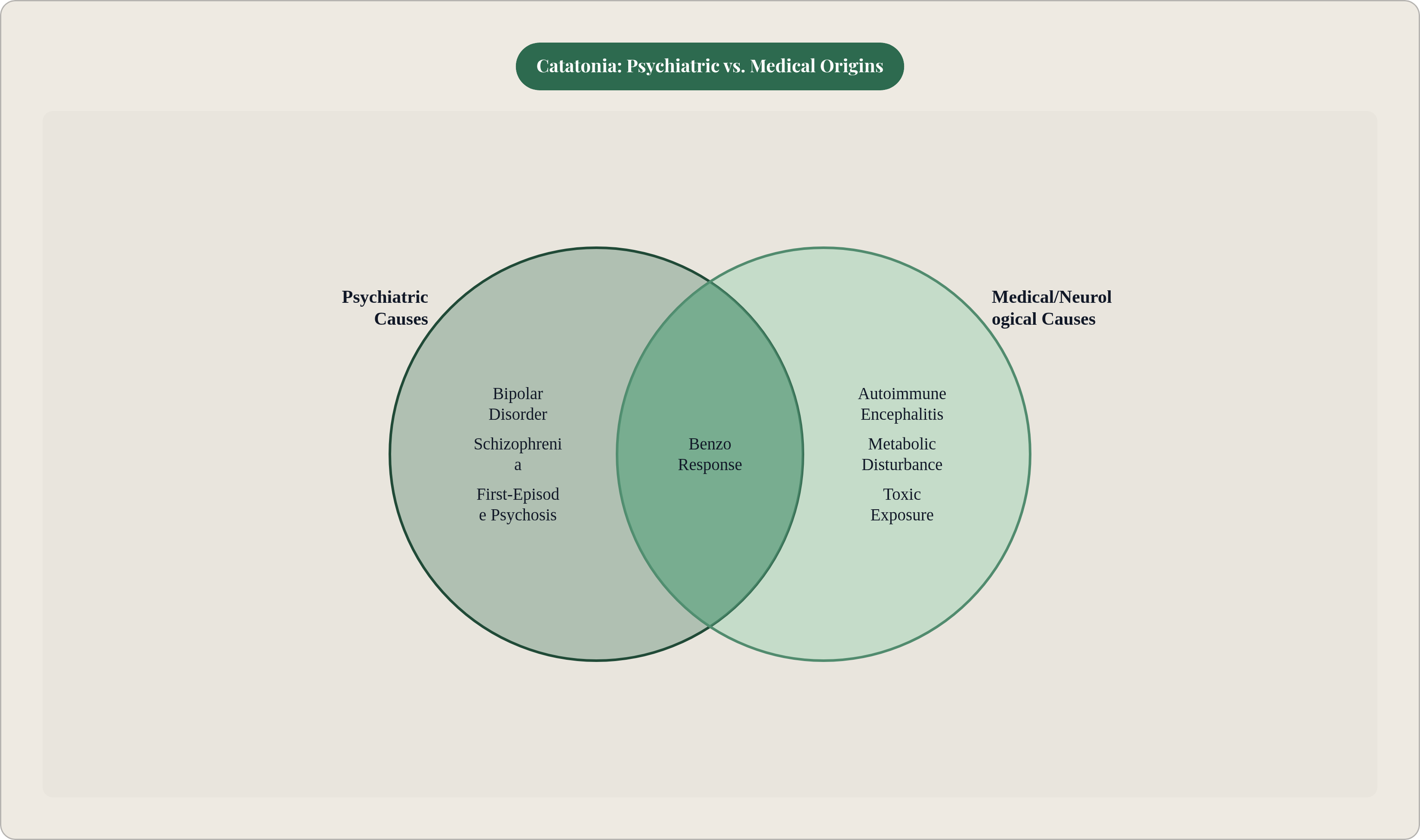
Look at the full list: mood disorders, schizophrenia, autism spectrum disorder, autoimmune encephalitis. Four categories of illness with almost nothing in common on the surface, and all four capable of producing the same recognizable cluster of motor and volitional signs. That convergence is itself a finding, and it points toward shared neural circuitry doing the work rather than each condition stumbling onto catatonia through its own private mechanism.
The most widely cited hypothesis centers on GABA-A receptor hypofunction, reduced activity in the brain's main inhibitory signaling system. It's a compelling frame partly because of what it predicts correctly: benzodiazepines, which boost GABAergic transmission, produce rapid and often dramatic relief from catatonic symptoms across wildly different underlying diagnoses. A patient with bipolar mania and a patient with autoimmune encephalitis can both respond to the same lorazepam challenge test. A shared circuit, responding to the same lever, pulled from two completely different directions.
NMDA receptor dysfunction offers a second angle on the same idea, and anti-NMDA receptor encephalitis makes the connection almost too literal: block NMDA signaling with autoantibodies, and catatonic signs follow as a direct result. That feeds glutamate-GABA interaction models, where the ratio between excitatory and inhibitory signaling, not either system in isolation, determines whether the brain lands in a catatonic state. An imbalance between the two, whatever set it off originally, seems to funnel toward the same psychomotor endpoint.
Add in the fronto-parietal and basal ganglia circuits known to govern motor inhibition and volition, and a coherent picture starts to form, though not a complete one; the exact mechanisms almost certainly differ somewhat by cause, and biology this layered resists a single tidy explanation. But the convergence on overlapping circuits explains something that would otherwise look strange: why the same handful of treatments, benzodiazepines and ECT chief among them, work across such a heterogeneous set of underlying conditions. If the causes were truly separate, one lever wouldn't move all of them at once.
How recognizing catatonia as a syndrome changes what clinicians need to do
The old framing, catatonia as a schizophrenia subtype, let clinicians screen selectively without ever noticing they were doing it. See a patient with mood symptoms, and catatonia simply wasn't on the differential; the diagnostic category itself told you where to look, and by omission, where not to bother looking at all. That selectivity is what generations of missed diagnoses were built on. Not carelessness, a nosology that pointed attention in exactly one direction and left everything else in the blind spot.
DSM-5's reclassification of catatonia as a specifier, attachable to mood disorders, psychotic disorders, autism, and other medical conditions, closed that blind spot on paper. ICD-11 went further in 2022, giving catatonia its own diagnostic category independent of any other condition. The APA's 2025 Catatonia Resource Document now operationalizes what that shift means day to day, anchoring screening around the Bush-Francis instrument instead of leaving detection to whatever pattern recognition a clinician happens to bring into the room.
So what does that actually ask of a clinician on a given shift? Screen regardless of the presenting diagnosis, not only when schizophrenia is already on the chart. Take staring, mutism, and refusal to eat as seriously as catalepsy and waxy flexibility, since those quieter signs turn up more often in real cases than the textbook ones do. Hold off on antipsychotics until catatonia has been ruled out or properly treated, given how directly they can worsen the syndrome. And once catatonia is confirmed, treat that as the start of a workup rather than the end of one; a fifth of cases trace back to a medical cause that changes the entire treatment plan.
None of this asks for anything exotic. It asks clinicians to hold onto something the field spent over a century forgetting, and then had to relearn through misdiagnoses, near-misses, and the occasional malignant case that never should have gotten that far. The syndrome didn't change. What changed, finally, is where people are trained to look for it.