How Medicaid Covers Care for People With Serious Mental Illness
The public insurance program covers roughly a tenth of the country's serious mental illness cases.
Medicaid is one of the largest single sources of mental health care financing in this country. For people diagnosed with serious mental illness, schizophrenia, bipolar disorder, major depression with psychotic features, it is often not one option among several but the only door that opens.
Why Medicaid is the financial backbone of serious mental illness care
A quarter of all mental health and substance use disorder treatment spending in a major national health program runs through a large public insurance program for low-income people. Not a fifth, not a third, a quarter, which puts it ahead of a public insurance program for older adults, ahead of commercial insurance, ahead of out-of-pocket spending, as a single funding stream for this kind of care.
Zooming into the enrollee population makes the numbers get sharper. Roughly a third of nonelderly adults with any mental illness are covered through Medicaid, and among nonelderly adult Medicaid enrollees specifically, 35% report a mental illness diagnosis and 10% report serious mental illness. Among nonelderly adult Medicaid enrollees, 10% report serious mental illness. Ten percent of tens of millions of people is a population larger than several states. states. Millions of adult Medicaid enrollees carry a diagnosis of bipolar disorder, schizophrenia, or another psychotic disorder. These are not edge cases that a health system can treat as exceptions to standard design. They are a core constituency, and Medicaid's benefit structure, whatever its flaws, has been built to a significant degree around their needs, because the alternative, no coverage at all, is the outcome for a lot of people with SMI who don't qualify for Medicaid and can't afford commercial insurance or the underlying cost of psychiatric care.
Why does this concentration happen? Serious mental illness frequently disrupts the very things that make employer-sponsored insurance possible: steady work, stable income, continuous enrollment. Medicaid's eligibility pathways, particularly disability-linked eligibility and, in expansion states, income-based eligibility, catch people that the employer-insurance system was never built to hold.
What Medicaid covers for people with serious mental illness
Here is a structural fact that explains almost everything confusing about Medicaid behavioral health coverage: there is no single, unified "mental health benefit." Some services are mandatory under federal law, physician services and inpatient hospital care among them. Others are optional, so a state can choose to cover them or not, and rehabilitative services, the category that covers a lot of community-based psychiatric rehab, falls into this optional bucket. That one distinction, mandatory versus optional, is the root of nearly every downstream variation covered in the next section.
The baseline that most enrollees can expect looks fairly consistent across states: outpatient therapy, inpatient psychiatric hospitalization, prescription medication coverage, crisis services in some form, and case management. But the more interesting story over the past decade has been what states have chosen to add on top of that baseline.
Assertive Community Treatment, or ACT, is one example. It's a 24/7, multidisciplinary team model built for adults at the highest risk of hospitalization, homelessness, or entanglement with the criminal justice system, and rather than a patient traveling to a clinic, the team comes to the patient. Certified Community Behavioral Health Clinics, or CCBHCs, are another. They bundle a wide continuum of services under a single roof so patients aren't referred out to five different providers for five different needs. States are moving toward this model quickly: 19 states recognized CCBHCs as an enrolled Medicaid provider type in fiscal year 2025, more than double the 9 states that had done so in fiscal year 2022.
Coordinated Specialty Care for First Episode Psychosis, abbreviated CSC-FEP, is narrower but arguably more consequential, because it targets the earliest window after a first psychotic episode, when early intervention has an outsized effect on long-term trajectory. Seven states covered it in fiscal year 2025. Add to this list mobile crisis intervention, home and community-based services, and peer support (covered fully in its own section below), and a pattern comes into view: Medicaid behavioral health benefits have been expanding almost every year for the past decade. Every KFF Medicaid budget survey over the past ten years has identified behavioral health as the single most frequently reported area of benefit expansion. That's a sustained, decade-long trend line.
A proposed piece of federal legislation aimed at strengthening this program for people with serious mental illness would formally allow housing support and employment support services to be covered. A proposed piece of federal legislation aimed at strengthening this program for people with serious mental illness. 3320) would formally allow housing support and employment support services to be covered under an enhanced federal matching rate. Whether that becomes law is a separate question, but its existence signals where advocates and some lawmakers think the next expansion needs to happen: outside the clinic walls.
How coverage varies by state and produces unequal access
Optional benefits are optional.
The data bears this out starkly. The share of adult Medicaid enrollees reporting any mental illness ranges from 22% in New Jersey to 51% in Iowa. For serious mental illness specifically, the range runs from 4% in Mississippi to 22% in Wyoming and Missouri. Some of that spread reflects underlying population differences, but a meaningful part of it reflects how expansive or restrictive each state's eligibility and benefit design happens to be, and how well each state's system identifies and documents SMI.
What drives these state-level choices? Clinical evidence plays a role, certainly, but state fiscal conditions play an equal, if not larger, one. When state budgets tighten, rate increases for behavioral health providers and new benefit additions face real headwinds because the money isn't there. A person's access to ACT teams or CCBHCs can hinge less on their symptoms and more on their state's revenue forecast for the fiscal year.
Then there's the rural dimension, which cuts across state lines. An estimated 60% of rural Americans live in areas with a shortage of mental health professionals. Covering a service on paper means very little if there's no enrolled provider within a reasonable drive. A state can add ACT to its Medicaid benefit package tomorrow, but if no ACT team exists within a hundred miles of a given enrollee, the benefit is theoretical. Coverage and access are not the same thing, and this gap between them will come up again in the final section of this piece.
Where coverage still falls short for people with serious mental illness
Nobody in psychiatric research is confused about what works for serious mental illness. Assertive Community Treatment works. Coordinated Specialty Care for first-episode psychosis works. Long-acting injectable medications work for adherence. This is not a knowledge gap, the clinical evidence base is well established. What's missing is access, infrastructure, and systems that can deliver these interventions consistently to the people who need them.
Consider the period immediately after a psychiatric hospitalization. Suicide risk in the three months following inpatient discharge runs approximately 100 times higher than the global baseline rate. That is an extraordinary number, and it should reorganize how anyone thinks about post-discharge care. Yet Medicaid coverage of intensive post-discharge follow-up, the kind of close-contact, rapid-response support that could plausibly reduce that risk, remains inconsistent from state to state. A benefit that exists robustly in one state may barely exist in the next.
Social determinants of health sit largely outside what traditional Medicaid benefit design was built to address. Housing instability, food insecurity, and transportation barriers are among the largest drivers of poor outcomes for people with serious mental illness, and yet housing support and employment support remain optional, patchwork benefits rather than core coverage. A person can have excellent medication coverage and still lose stability because there's no ride to the pharmacy or no fixed address to receive mail at.
And then there's the IMD exclusion, a federal rule with a long history and outsized consequences. Under this rule, Medicaid reimbursement for inpatient psychiatric care is restricted in facilities with more than 16 beds, the "Institution for Mental Diseases" designation. The policy logic behind it dates back decades, but its practical effect today is a structural bottleneck: it constrains access to higher levels of inpatient psychiatric care for adults with serious mental illness.
How peer support fills the gaps Medicaid's clinical benefits leave open
Peer support is Medicaid-reimbursable in 46 states, which makes it one of the most widely adopted behavioral health benefits in the entire Medicaid system, clinical or otherwise. The model is straightforward in concept: Certified Peer Support Specialists, or CPSs, are people who have their own diagnosis of mental illness and who are hired, trained, and formally certified to deliver support services to others navigating similar diagnoses. CMS formally authorized peer support as a Medicaid service in 2007, and since then it has grown into one of the fastest-expanding segments of the community-based mental health workforce.
What does a peer specialist do that a fifty-minute session with a psychiatrist or therapist cannot? A few things stand out, and they need naming specifically rather than gesturing at broadly.
First, trust. Someone who has lived through psychosis, hospitalization, or a bipolar mood episode carries a kind of credibility that no clinical credential can replicate for a person who has disengaged from traditional treatment systems, whether out of past trauma, stigma, or simple mistrust of institutions. Second, peer specialists work hands-on with the social determinants that clinical visits rarely touch directly, medication reminders, transportation to appointments, navigating a housing application, figuring out where the nearest food pantry is. Third, the orientation of peer support tends to center on strengths and recovery skills rather than symptom tracking alone, which is a genuinely different lens than most clinical encounters offer. Fourth, peer support happens where people actually are, in community settings, not exclusively inside a clinic or hospital.
Does this actually change outcomes, or is it just a nice idea? An effectiveness study comparing 2,156 Medicaid-enrolled adults receiving peer support services, matched at a 1:2 ratio against 4,312 adults receiving outpatient mental health services without peer support, tracked utilization between 2021 and 2024. The study tracked service utilization between 2021 and 2024 across both groups. That pattern suggests reduced crisis-driven demand, fewer emergency encounters, fewer acute episodes requiring intensive intervention, though it's worth being careful about overstating causation from a matched observational comparison like this one. Still, the direction of the finding lines up with what the model is designed to do: catch problems earlier, in community settings, before they escalate into crises that Medicaid's more expensive benefits then have to absorb.
The federal policy shift that now threatens what Medicaid has built
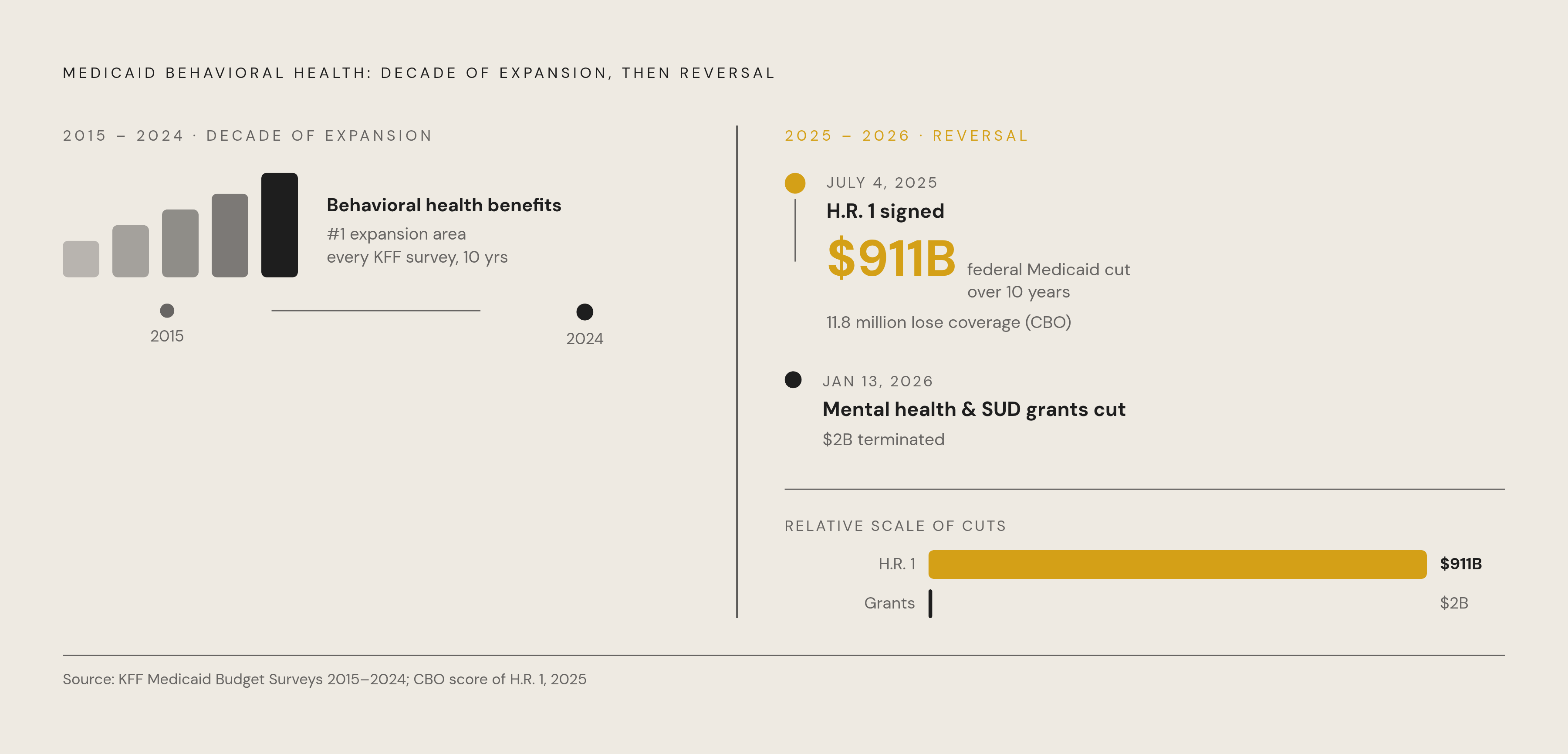
Everything described above, the decade of steady benefit expansion, the growth of CCBHCs and peer support, now sits under threat from a federal policy shift moving in the opposite direction.
H.R. 1, the One Big Beautiful Bill Act, passed on July 4, 2025, and cut federal Medicaid spending by approximately $911 billion over ten years. The Congressional Budget Office estimates 11.8 million people will lose Medicaid coverage directly as a result. Separately, a federal agency overseeing mental health and substance use services terminated approximately $2 billion in mental health and substance use disorder grants on January 13, 2026. Two distinct policy actions, one underlying direction.
The mechanism that will touch the SMI population most directly is the new work requirement. Under the 2025 reconciliation law, Medicaid eligibility for the adult expansion group is now conditioned on 80 hours a month of work or a comparable qualifying activity, and most states are required to begin enforcement by January 1, 2027, a deadline affecting 43 states including the District of Columbia.
CMS's interim final rule ties behavioral health exemptions to a "medically frail" test built around a person's ability to work, and this construction explicitly bars states from exempting anyone based on... CMS's interim final rule ties behavioral health exemptions to a "medically frail" test built around a person's ability to work, and this construction explicitly bars states from exempting anyone based on diagnosis alone. Schizophrenia, bipolar disorder, other psychotic disorders, none of these, by themselves, guarantee an exemption. And the population this touches is not small: 45% of Medicaid-covered adults diagnosed with serious mental illness fall into the adult expansion group that's potentially subject to these work requirements.
States have roughly six months to build the verification infrastructure needed to administer this before the January 1, 2027 deadline hits. Building an accurate, humane verification system for a "medically frail" exemption, one that correctly identifies someone in an active psychotic episode or a severe depressive episode without requiring them to navigate a bureaucratic proof-of-disability process they may be in no state to complete, is not a small technical lift. The penalty for noncompliance is disenrollment. It's disenrollment. Loss of coverage. For someone with serious mental illness who misses a reporting deadline because they were symptomatic that month, the consequence is losing the exact coverage that might have prevented the crisis.
What these coverage realities mean for people navigating SMI and recovery
Recovery from serious mental illness does not move in a straight line, and coverage gaps have an unfortunate tendency to strike at the worst possible moments rather than convenient ones. A lapse in Medicaid eligibility during an acute episode, whether from a missed work-requirement report or a state redetermination cycle, can unwind months of hard-won stabilization in a matter of weeks.
Coverage on paper and access in practice get treated as identical but aren't. The same Medicaid card can unlock dramatically different resources depending on the state issuing it, the county administering it, the local provider network's capacity, and, frankly, whether the person holding that card has someone in their life helping them navigate a genuinely complicated system. A benefit written into state Medicaid plan documents means little to someone who doesn't know it exists or can't find an enrolled provider offering it.
The treatment data does show Medicaid working, at least by one measure. In 2023, 59% of adult Medicaid enrollees with any mental illness received treatment, compared with 55% of privately insured adults and just 37% of uninsured adults. That's a meaningful gap in Medicaid's favor, and it's worth taking seriously as evidence that the program is functioning as intended for a lot of people. But treatment rates measure whether care was accessed, leaving adequacy, consistency, and delivery by someone the patient actually trusted as separate questions.
What the coverage numbers can't capture is harder to quantify but arguably more important. Whether someone in crisis trusts the system enough to walk back through its doors. Whether they can get to their appointment, keep their prescription filled, keep a roof over their head between now and their next visit. Whether care continues across the transitions that so often break it, discharge from a hospital, re-entry after incarceration, a sudden loss of housing. Medicaid has built an enormous amount of infrastructure to answer the clinical half of that question. The human half is where the real work of recovery still happens, largely outside what any insurance card can guarantee.
Sources
- H.R.3320 - 119th Congress (2025-2026): Strengthening Medicaid for Serious Mental Illness Act | Congress.gov | Library of Congress
- Medicaid Mental Health and Substance Use: Expansion Trends and the Fiscal Pressure Ahead | KFF
- 5 Key Facts About Medicaid Coverage for Adults with Mental Illness | KFF
- Medicaid Work Requirements 2026: CMS Restricts Behavioral Health Exemptions
- Implications of Medicaid Work and Reporting Requirements for Adults with Mental Health or Substance Use Disorders | KFF
- updates.apaservices.org