Crisis Intervention Team Training and Police Response to Mental Health Calls
Training alone won't solve police response to mental health crises without structural changes.
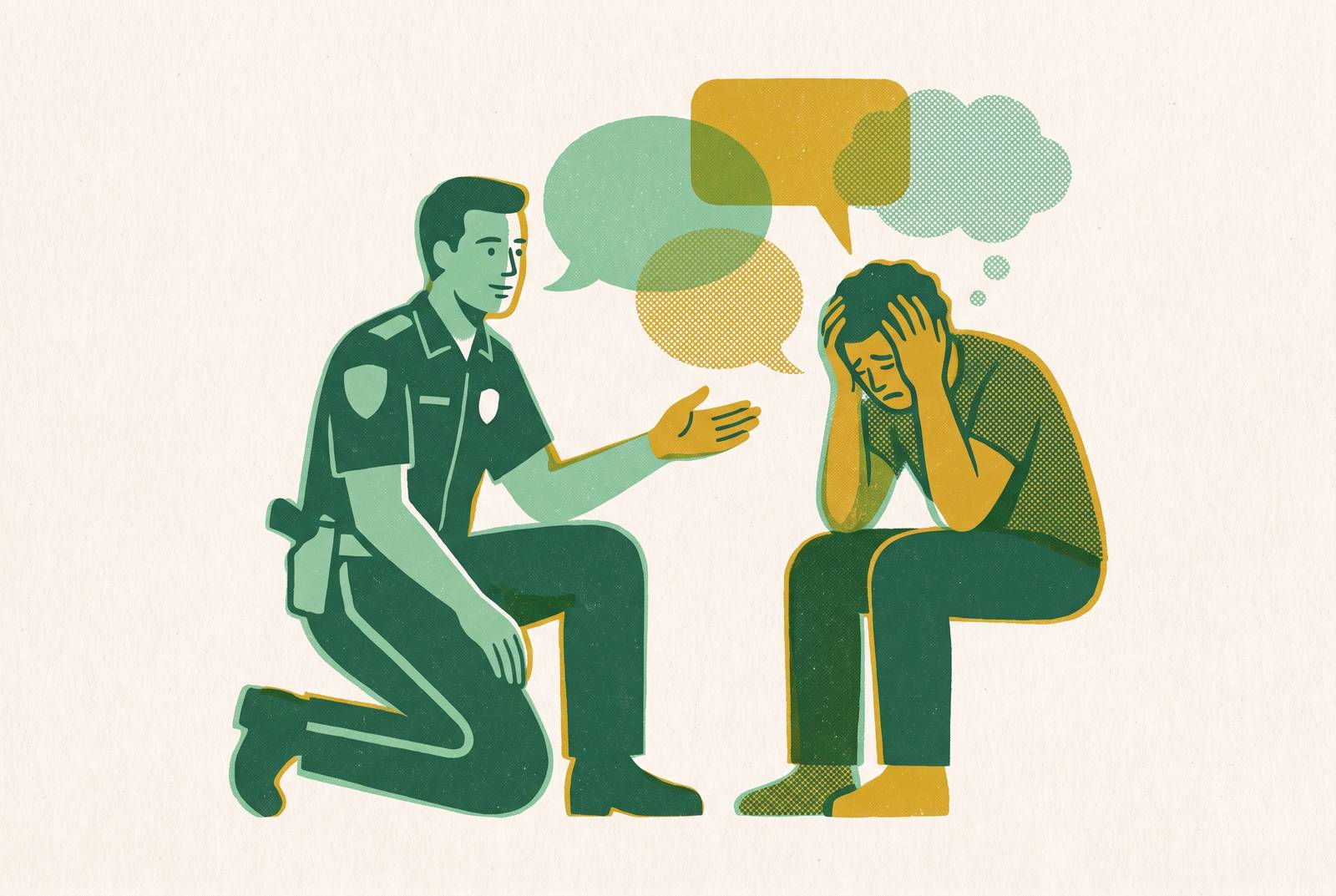
Police officers in many jurisdictions respond to a growing share of psychiatric emergencies, a role they were never built or trained to carry at scale. This article explains the model built to fix that mismatch, Crisis Intervention Team training, how its 40-hour curriculum works, what the evidence actually says it changes, and where co-responder teams and peer support pick up where it stops.
Why police became the default responders to psychiatric emergencies
Deinstitutionalization closed inpatient psychiatric beds across the country without building the community care system that was supposed to replace them. Nobody designed police to fill that space. They ended up there anyway, because when a person in crisis has nowhere else to go, the call routes to the general emergency line, which sends a patrol car. Research tracing the history of Crisis Intervention Teams in police departments finds a direct line connecting these dots: as officers' interactions with people experiencing mental illness increased, training on how to handle those calls did not keep pace, leaving officers unprepared and the resulting interactions prone to bad outcomes. State law compounds the exposure. In most jurisdictions, officers hold the legal authority to initiate involuntary psychiatric detentions, a power that demands real clinical judgment, something standard patrol training was never built to teach.
The numbers back up what officers on the street already know. A case study of a suburban-rural police department found mental-health-related calls rising 5.7% year over year, a trend also visible in departments across the country. Call volume climbed. Training did not. That gap between what officers face and what they're equipped to do is what Crisis Intervention Team training was built to close.
CIT training: origins and structure
CIT is a community-based partnership linking local mental health professionals, police departments, and community members, with a training component sitting at its center. A primer on the model for mental health practitioners lays out the basic structure: officers complete the training, keep their regular patrol assignments, and become specialized first-line responders whenever a mental health call comes through dispatch.
The design choices behind that structure matter more than its history. Why 40 hours, a full work week pulled from an officer's regular duty? Because mental health awareness, familiarity with community resources, and de-escalation skills each take real time to teach, and compressing the curriculum further would mean cutting one of those three. Why build it as a partnership with local mental health agencies rather than an in-house department policy? Because the model depends on officers knowing where to actually send someone, and that knowledge only holds up if the referral pathways are real and current, not names on a list nobody has called in months. Completion ends in a graduation, and graduates become the officers dispatched to mental health calls within their ordinary patrol rotation. Whether a department makes that training mandatory for all officers or leaves it voluntary is itself a consequential choice, one the evidence sections ahead will return to, because who signs up for CIT training shapes what the data can and cannot show about whether it works.
What the 40-hour curriculum teaches
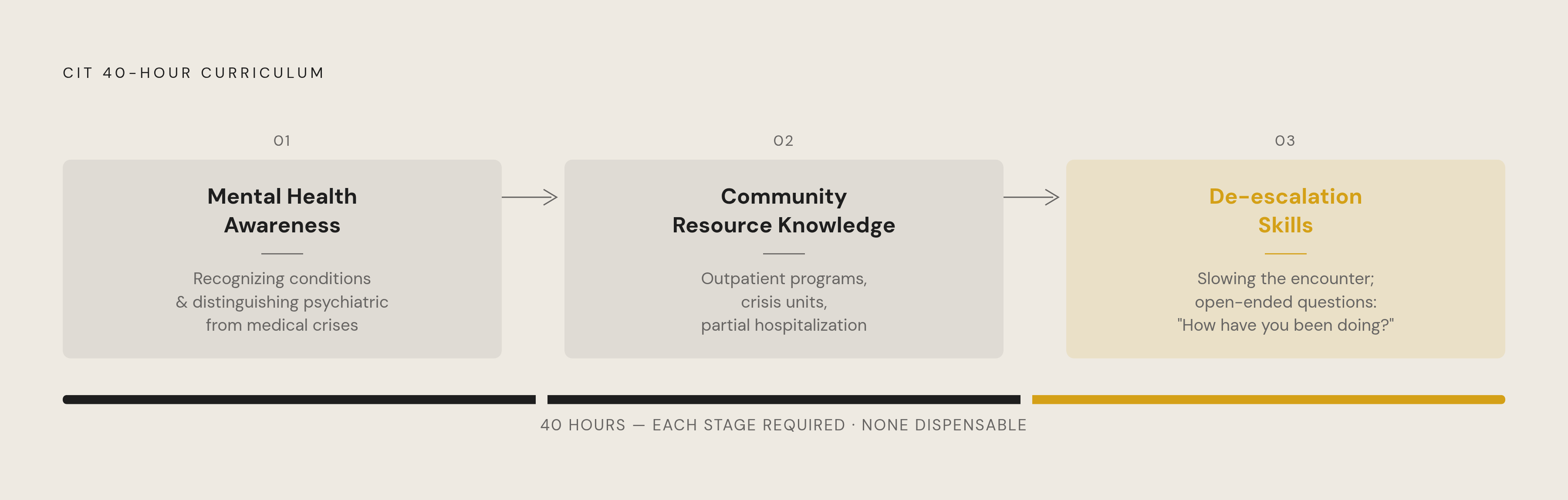
Strip the curriculum down and three capacities remain: recognizing what a psychiatric crisis looks like, knowing where to route someone once the immediate danger has passed, and handling the encounter itself without force. None of these ask an officer to diagnose. They ask an officer to notice enough, and know enough, to make a better decision than guesswork would produce.
The mental health awareness piece covers how different conditions present, including the harder discrimination of telling a psychiatric crisis apart from a medical one that looks similar on the surface. Melissa Camp, a licensed professional counselor and executive director of Behavioral Health Services at HCA Florida Memorial Hospital, has worked with police agencies from South Carolina to Jacksonville and describes the content: "There is a lot of education about different disorders, how they present, also some medical conditions that might present similarly to a mental health crisis. Getting that distinction wrong carries real consequences. Treating a diabetic emergency as psychiatric agitation, or the reverse, sends someone down the wrong path before anyone has had the chance to help.
Community resource knowledge gives officers somewhere to send people other than a jail cell or an emergency room. Outpatient programs, crisis stabilization units, partial hospitalization, these only function as alternatives if the officer standing in the room actually knows they exist and how to reach them. Diversion stops being a talking point and becomes an option someone can act on.
De-escalation is the most hands-on piece of the training, and the central technique is deceptively simple: slow the encounter down. Give everyone in the room time to breathe and listen before anything escalates further. Camp points to a concrete version of this in how officers are taught to ask questions. Swapping "Are you OK?" for "How have you been doing lately?" changes the dynamic of the whole interaction, because the open-ended version signals that the officer actually wants an answer, not a yes that closes the conversation.
Training does not end at graduation, either. The Albuquerque Police Department, in partnership with the University of New Mexico's Department of Psychiatry and Behavioral Sciences, built CIT ECHO specifically to keep the material alive through continuing education. An evaluation of 113 weekly sessions run for law enforcement officers across New Mexico between 2017 and 2020 pointed to the same conclusion: a single 40-hour week does not stick on its own. Reinforcement is the mechanism that keeps the skills usable months and years after graduation.
What CIT training changes
Taken as a whole, the evidence on CIT training supports a measured verdict. Officer readiness improves consistently, and arrest rates for people with mental illness show some improvement too. Use of force is a different story: the effects there are mixed, often small, and frequently fail to reach statistical significance. That distinction between what the training reliably changes and what it does not matters for anyone trying to evaluate or improve the model, because treating CIT as a use-of-force solution sets it up to look like a failure when the stronger evidence sits elsewhere.
One study from 2023 found CIT-trained officers more likely to use the lowest levels of force available on mental health calls, a real and specific finding about force calibration. It does not, on its own, demonstrate that force goes down across the board. An earlier meta-analysis by Taheri in 2016, pulling together multiple quasi-experimental studies, found that CIT training's average effects on arrests and use of force did not reach statistical significance, a result researchers in the field have continued to work through since.
The deepest gap in the evidence base is not a mixed finding. No randomized controlled trial has ever tested the 40-hour CIT curriculum, even though tens of thousands of officers across the country have completed it. Observational and quasi-experimental studies keep accumulating, but they cannot establish causation the way a trial could. One might argue that a program this widespread should have been tested more rigorously by now, and that argument has force. But the honest answer is that it hasn't been, and anyone citing CIT outcomes should hold that absence in mind alongside the positive findings.
The suburban-rural case study adds a layer that pure outcome numbers miss. Trained officers, supervisors, CIT trainers, and department leadership, all within the same organization, described meaningfully different ideas of what CIT was supposed to accomplish and whether it was working. That disagreement inside a single department says something important on its own: inconsistent understanding of the program's goals undermines consistent delivery of it, no matter how good the curriculum is on paper.
Why implementation quality determines whether CIT works at all
If the evidence on CIT is mixed in aggregate, implementation quality is a large part of why. Most of the gap between departments that see strong results and departments that see little traces back to organizational choices, not flaws buried in the 40-hour content itself.
The suburban-rural case study names the core failure point directly: when leadership sends unclear or inconsistent messages about what CIT is supposed to achieve, trained officers end up receiving conflicting signals about when and how to use what they learned. No curriculum fixes that on its own, because the problem sits above the training, in how the department communicates expectations from command staff down to the officers answering calls. The study's own findings underscore that clear, consistent messaging about CIT's goals, delivered from the top of the department all the way down, matters as much as the quality of the training session itself.
Departments also face real choices that shape how well the program functions. Is training mandatory for all patrol officers, or is it voluntary? Who gets trained, and on what timeline? How often does refresher training happen after graduation? Each of these decisions affects whether CIT skills survive the months between training and the next real crisis call. Voluntary enrollment carries its own complication: officer background appears to shape who chooses to join a CIT program in the first place, which means officers who self-select into training may differ systematically from the broader patrol force in ways that make before-and-after comparisons harder to trust.
Research on co-responder programs, a related but distinct model, finds structural problems that apply just as much to CIT-only departments: staffing shortages, coverage gaps that leave shifts without a trained officer available, burnout among the officers who do get trained, funding that doesn't keep pace with demand, and outcome measurement that's too weak to tell a department whether its program is actually working. None of these are curriculum problems. They are management problems, and they compound over time without deliberate attention. A department that trains officers well but ignores these structural pressures should expect its results to erode. That is precisely the opening that a complementary model, built around a different division of labor, is designed to fill.
Co-responder programs: extending CIT training
Pairing a trained officer with a qualified mental health clinician produces outcomes that CIT training by itself consistently struggles to reach, particularly around keeping people out of involuntary detention and unnecessary hospital transport. The clinician brings something a 40-hour course cannot fully substitute for: sustained clinical judgment, built over years, applied in real time.
The evidence here is specific. One quasi-experimental study found that a co-responder program cut involuntary psychiatric detentions substantially, producing hundreds fewer detentions over two years. The same study found no detectable effect on overall calls for service, criminal offenses, or arrests. Co-response, in other words, is a targeted tool aimed at a particular outcome, not a general strategy for reducing crime. In direct comparisons, co-responding teams showed low rates of both injury and arrest, and relative to police-only responses they produced more hospital escorts overall but fewer involuntary ones. People reached care more often, and more of that care came by choice.
People on the receiving end of these calls describe what they value in plain terms: responders who understand mental illness, who know how to de-escalate verbally, and who approach the situation with compassion. Those are the same traits CIT training tries to instill in officers. Clinicians bring them more reliably because that is their full-time professional training, built over years on the job. Seo and colleagues found in 2021 that agencies running co-responder teams outperformed agencies relying on crisis training alone across officers' ability to handle mental health interactions, their overall mental health knowledge, and their confidence in handling these calls. The two models appear to work better together than either does carrying the weight alone.
Concrete programs show what this looks like in practice. The Missoula, Montana Co-Response Team diverted 783 emergency room visits and 123 police detainments for people in mental health crisis within a single year, with estimated hospital savings of $1.6 million. Oregon's CAHOOTS program takes a related but distinct approach, sending teams of medics, drawn from nurses, paramedics, and EMTs, alongside mental health crisis workers to non-violent mental health and substance use calls, handling on-scene assessment, de-escalation, basic medical support, and referrals without a police officer present. None of this makes CIT training obsolete. It extends what CIT alone cannot reliably deliver, which is exactly the gap that officer-only response, however well trained, keeps running into.
Peer support in crisis response and post-crisis care
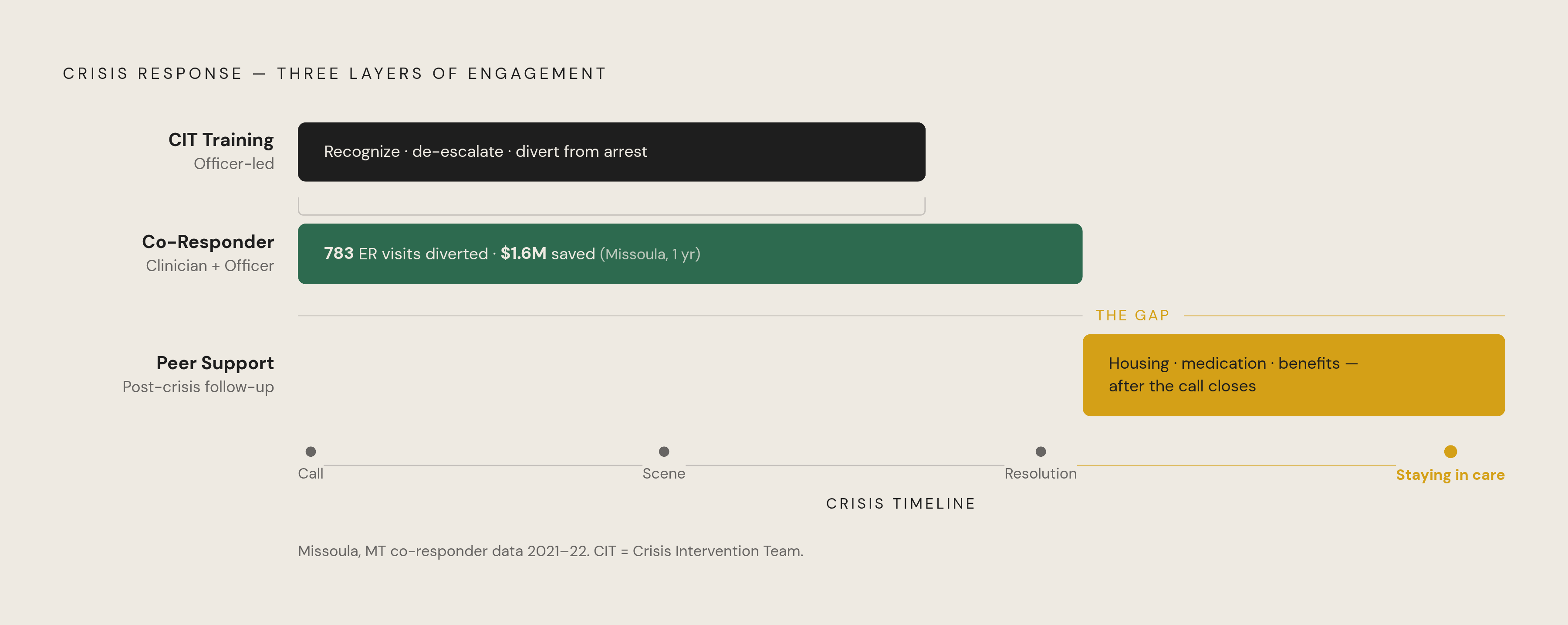
A crisis call ending is not the same as a person being cared for. CIT officers and co-responder teams are built for the acute encounter: they stabilize the moment, connect someone to services, and then the call closes. What happens between that connection and actual follow-through, filling the prescription, showing up to the appointment, finding stable housing, is a space neither model was built to occupy, and a lot of people with serious mental illness fall out of the system there.
Certified peer support specialists are built for exactly that space. These are people with their own lived experience of serious mental illness, trained to engage someone after a crisis has passed, build the kind of trust that makes ongoing care possible, and help navigate the practical obstacles, benefits paperwork, housing applications, medication management, that derail recovery long after the emergency call is a memory. The mechanism here is relational. Shared experience closes a trust gap that credentials alone cannot close. Peer specialists reach people that other behavioral health providers sometimes cannot.
A public hospital system offers a working example at scale. Its Critical Time Intervention teams, part of a $32.2 million initiative, pair peer specialists with nurses, social workers, care managers, and mental health professionals to accompany patients home on the day of hospital discharge, help secure public benefits, and connect people to ongoing community-based care. A companion program, the Peer Bridger initiative, pairs patients discharged from Comprehensive Psychiatric Emergency Programs with certified peer counselors for continued community follow-up, a direct, built-for-purpose model of what post-crisis peer engagement looks like in practice.
The same relational logic runs through other peer-based models built around meeting people where they actually are, in their communities, after the crisis has passed, rather than waiting for them to find their way back into a clinical setting. The work covers housing, food, medication, and access to behavioral health care, delivered as sustained, trust-based support. CIT training teaches officers to recognize a crisis and respond to it safely. Co-responder teams add clinical judgment to that response in real time. Peer support picks up the thread afterward, and carries it forward, long after the patrol car has left and the call has closed.
Sources
- Crisis Intervention Team Mental Health Training for Law Enforcement Officers: Protocol for a Multi‐Site, Randomized, Controlled Trial - Compton - 2025 - Psychiatric Research and Clinical Practice - Wiley Online Library
- Crisis Intervention Team (CIT) training: A case study of the perceptions of officers, leadership, and CIT trainers in a suburban-rural police department - ScienceDirect
- Ameliorating Mental Health Emergencies: Crisis Intervention Teams in Police Departments
- The Crisis Intervention Team Model of Police Response to Mental Health Crises: A Primer for Mental Health Practitioners - PMC
- Evaluation of Ongoing Crisis Intervention Team (CIT) Training for Law Enforcement Using the ECHO Model
- Crisis intervention team training for police officers responding to mental disturbance calls - PubMed
- Does the crisis intervention team (CIT) training improve police officers’ knowledge, attitude, and mental health stigma?