Antiviral Drugs for Flu Approved Options and Eligibility
Oseltamivir is first-line, but timing and patient factors determine which antiviral works.

Four antiviral drugs carry FDA approval to treat influenza, and oseltamivir should sit at the front of nearly every clinical decision involving them. The other three exist to cover the specific cases where oseltamivir can't be used. That position is worth stating before the mechanisms and dosing tables, because eligibility for each drug hinges on age, timing, underlying health conditions, and how sick a patient already is. Get the match wrong, and a patient loses the narrow window in which any of these medications actually work.
Flu causes serious illness and death in the United States every year, with risk falling hardest on vulnerable groups. Antivirals are not a substitute for other preventive measures, and they only work within a fairly rigid set of conditions. What follows is an attempt to lay out those conditions plainly.
How the two drug classes work differently against the virus
Three of the four approved drugs, oseltamivir, zanamivir, and peramivir, belong to a class called neuraminidase inhibitors, or NAIs. Neuraminidase is an enzyme influenza uses to cut newly formed viral particles loose from the surface of an infected cell. Block that enzyme, and the virus can still replicate inside a cell, but it can't efficiently release copies to go infect neighboring cells. The mechanism slows the spread of the virus through the body rather than preventing infection outright.
Baloxavir marboxil works differently, and the difference is not a minor technical footnote. It's a prodrug, meaning the body converts it into its active form, baloxavir, after ingestion. That active compound targets the PA protein inside the viral RNA polymerase complex, an enzyme influenza needs to transcribe its own genes. Baloxavir stops the virus from copying itself at an earlier step in the replication cycle than anything the NAIs touch.
Why does that distinction matter beyond the biochemistry lecture? A different mechanism usually means a different resistance profile, and it raises a question worth sitting with: does hitting the virus earlier, at the transcription step, translate into less virus shed into the air and onto surfaces, meaning less onward transmission to household members? That's not settled science yet, but it's a thread worth picking back up later, because the answer could reshape how clinicians think about prescribing baloxavir beyond just treating the patient in front of them. Both drug classes cover influenza A and B; neither is a type-specific tool.
The 48-hour window that governs every antiviral decision
Here's the fact that governs nearly everything else in this piece: the CDC states that antivirals work best when started within one to two days after symptoms begin, and The Medical Letter similarly notes treatment is most effective within 48 hours of illness onset. Miss that window, and the drugs still exist, but their benefit shrinks considerably.
Why does the window exist at all? Viral shedding, the actual quantity of live virus a person is producing and spreading, peaks in the first 24 to 48 hours of illness and then drops off fairly quickly after that. Treatment that arrives after peak shedding has less viral activity left to act on. It's the same logic behind why firefighters obsess over response time; a fire that's already burned through the structure doesn't respond to speed the way one caught at first smoke does.
Yet the 48-hour rule is not an absolute cutoff for every patient, and this is where the nuance actually lives. For anyone hospitalized, or anyone whose illness is severe or getting worse, the CDC recommends starting treatment as soon as possible regardless of when symptoms first appeared. For hospitalized patients, however, the calculus differs, and treatment is recommended as soon as possible regardless of when symptoms began. That's a meaningfully different calculus than the outpatient case, and conflating the two is one of the more common mistakes in how people talk about these drugs.
For high-risk outpatients, the right move is to treat on suspicion, immediately, without waiting for a positive test result. A rapid flu test that takes even a few hours to arrange and process is a few hours the patient didn't need to spend outside the window. For an otherwise healthy adult with mild symptoms who has already passed the 48-hour mark, the benefit of starting an antiviral now is considerably smaller. The decision that determines whether any of these four drugs are even on the table is how fast someone picks up the phone.
Oseltamivir: the most broadly used antiviral and who it covers
Oseltamivir is the closest thing this drug class has to a default, and for good reason: it's FDA-approved for treatment in anyone 14 days of age or older, and for prophylaxis in anyone 1 year or older. The CDC and the American Academy of Pediatrics go further and endorse off-label use in infants under 14 days old for treatment, and in infants between 3 months and 1 year for prophylaxis. That's a wider effective age range than the label alone suggests.
The AAP designates oseltamivir as the preferred antiviral for children with influenza. The reasoning isn't exotic: it's accumulated the most clinical experience, it's relatively affordable, and it comes as an oral formulation, a practical consideration for young children. That oral route matters more than it might seem. Getting a squirming 3-year-old to use an inhaler correctly is a genuinely different clinical problem than getting them to take liquid medicine from a syringe.
Two other facts set oseltamivir apart from the other three drugs entirely, and together they explain why it functions as the default rather than one option among four. It's the only one of the four recommended for pregnant or breastfeeding women, since the alternatives either lack sufficient safety data in that population or carry outright contraindications. And for hospitalized flu patients, oral or enterically administered oseltamivir is the first-choice agent; the other three simply don't have the evidence behind them yet to be routinely recommended in that setting. Dosing is twice daily for treatment and once daily for prophylaxis, simple enough that adherence isn't usually the barrier it can be with more complex regimens.
Zanamivir: the inhaled option with a critical contraindication
Zanamivir is approved for treatment in adults and children 7 years and older who've been symptomatic no more than two days, and for prophylaxis in adults and children 5 years and older. It's delivered as an inhaled powder, which immediately narrows its practical use: a patient needs a functioning inhaler device and enough coordination to use it correctly, ruling out a lot of very young children and anyone with impaired lung function before a clinician even gets to the bigger issue.
The bigger issue is this: zanamivir is not recommended for treatment or prophylaxis in anyone with underlying airways disease, including asthma or COPD, because of the risk of serious bronchospasm. Sit with that for a second, because it's a genuinely awkward clinical fact. Chronic lung disease is one of the risk categories that makes flu more dangerous in the first place; a meaningful share of the patients who'd benefit most from an antiviral are precisely the patients this drug is built to avoid. Clinicians have to screen for respiratory conditions before this one ever gets prescribed, no exceptions, and that screening step is what makes zanamivir a narrower tool than its approval range suggests.
There's also insufficient data on zanamivir's use in severe influenza, which reinforces its place as an outpatient drug for mild-to-moderate illness rather than anything used in a hospital setting. Treatment dosing runs 10 mg twice daily for five days. One niche where zanamivir still holds real value: institutional outbreak control, where the CDC recommends it alongside oseltamivir for post-exposure prophylaxis lasting at least two weeks, extending to one week after an outbreak resolves. Nursing homes, dormitories, that kind of setting, where one infected resident can turn into a floor-wide problem fast.
Peramivir: the intravenous option for patients who cannot take oral or inhaled drugs
Peramivir solves a specific problem the other two NAIs can't: what happens when a patient can't swallow a pill and can't manage an inhaler. It's approved for acute uncomplicated influenza in patients 6 months and older who've been symptomatic no more than two days, and it's given as a single intravenous infusion. One dose, administered in a clinical setting.
That single-dose structure is both its main selling point and the reason it's not a drug someone picks up at a pharmacy and takes home. Adults and adolescents 13 and older get a single 600 mg dose; pediatric dosing for ages 6 months to 12 years runs 12 mg/kg up to a 600 mg ceiling. Clinicians also need to check kidney function before dosing, since adults and adolescents with creatinine clearance below 50 mL/min require a reduced dose.
Like zanamivir, peramivir isn't routinely recommended for hospitalized patients; the evidence base for severe illness just isn't there yet, and oseltamivir remains the preferred choice in that setting. Where peramivir actually earns its place is the outpatient or emergency department scenario: a patient who's vomiting, can't swallow, or is being fed through an enteral tube that makes oral oseltamivir impractical. That's a narrower lane than oseltamivir's, but it's a real one, and it's the reason peramivir belongs on this list at all rather than sitting as a redundant fourth option.
Baloxavir marboxil: the single-dose oral option and what makes it different
Baloxavir is indicated for acute uncomplicated influenza in patients 5 years and older who've been symptomatic no more than 48 hours, and it covers both otherwise healthy patients and those at elevated risk. The age floor used to sit at 12 years and was lowered to 5; it doesn't go below that, because younger children show a higher rate of treatment-emergent resistance, a real enough concern that regulators drew a hard line rather than extend the label further.
Dosing is weight-based and, notably, a single oral dose: 80 mg for patients 80 kg or heavier, 40 mg for those between 40 and 80 kg. Its single-dose design extends its reach across the eligible age range. That single-dose design is more clinically meaningful than it sounds at first. A multi-day regimen depends on a patient, or a parent, remembering to follow through; a single dose removes that variable entirely, which matters most in exactly the outpatient and pediatric settings where adherence tends to slip.
Cost barriers are starting to come down too. Access, alongside efficacy, is part of what determines whether a drug actually gets used at scale.
Baloxavir is not recommended for pregnant or breastfeeding women, a firm contrast with oseltamivir's status as the pregnancy-safe option among the four. And then there's the open question raised earlier: a 2025 paper by Monto and colleagues in the New England Journal of Medicine examined whether baloxavir treatment reduces transmission of influenza to household contacts. If that holds up under further study, it would be a genuine point of differentiation from the NAIs, a public health argument for who gets treated and why, beyond mere dosing convenience. Resistance monitoring, particularly in younger children, remains the thing to watch, and it's the direct reason the age-5 floor exists at all.
Which patients should be treated regardless of timing and which can wait
The CDC draws a clear line around who should get antiviral treatment promptly, without waiting on lab confirmation first. That list includes pregnant and postpartum women, adults 65 and older, children younger than 5 (especially those under 2), anyone with a chronic condition, anyone hospitalized with suspected or confirmed flu, and anyone whose illness looks severe, complicated, or is actively getting worse.
For an otherwise healthy outpatient outside those categories, antiviral treatment is something to consider rather than something required. The benefit is real, but it's more modest, and it still depends on catching that 48-hour window. The CDC is clear on children specifically: kids under 5, especially under 2, are at increased risk for serious complications and should get antivirals, and treatment is appropriate for any hospitalized child regardless of age.
The logic underneath all of this is fairly blunt once it's spelled out. For a high-risk patient, the cost of skipping treatment, meaning severe illness, hospitalization, or worse, outweighs the cost of treating empirically even when the diagnosis isn't confirmed yet. That's why clinicians are told to start treatment on clinical suspicion for priority groups rather than wait for a rapid test to come back positive. A test result that arrives after the window has closed hasn't helped anyone, and treating on suspicion is the only version of this decision that actually respects how fast the 48-hour clock runs.
How the four drugs compare when a clinician has to choose
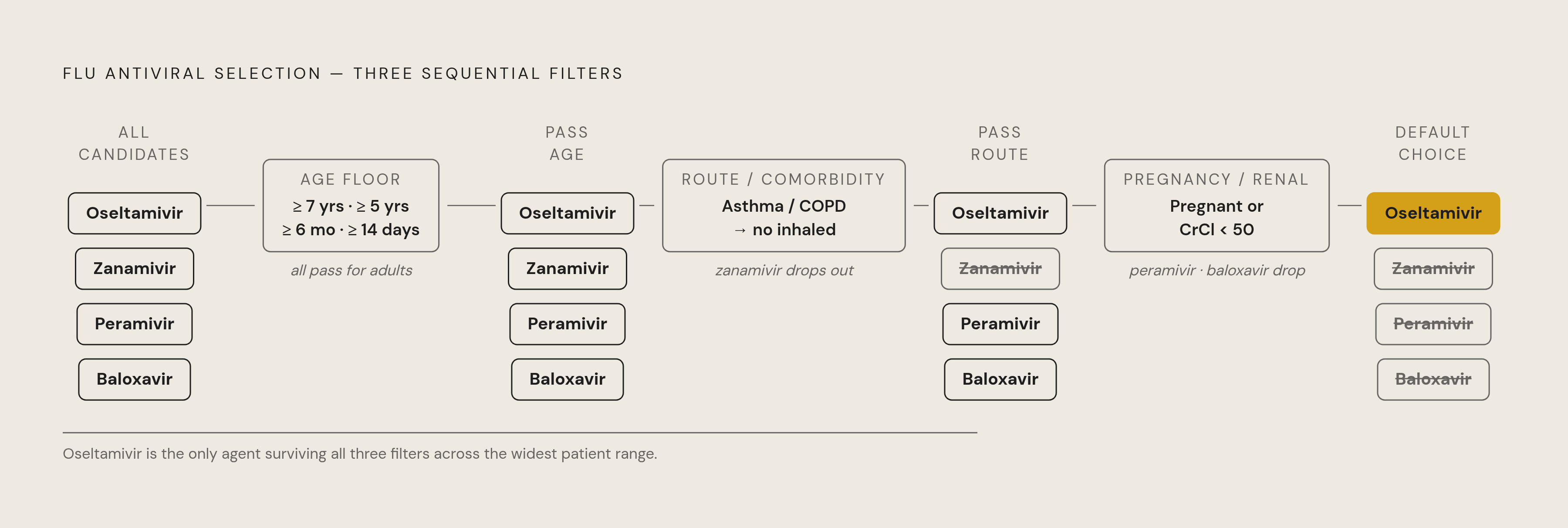
No single drug wins across every patient, but the choice isn't a coin flip either. Age is the first filter: oseltamivir covers patients from 14 days old (younger, off-label), zanamivir starts at 7 for treatment and 5 for prophylaxis, baloxavir starts at 5, and peramivir starts at 6 months. Route of administration is the second filter: oral for oseltamivir and baloxavir, inhaled for zanamivir, IV for peramivir.
Underlying conditions narrow the field further. Respiratory disease takes zanamivir off the table. Pregnancy takes both baloxavir and peramivir off the table, leaving oseltamivir as the only option. Setting matters too: a hospitalized patient gets oseltamivir, a patient who can't take anything orally and has no IV contraindication gets peramivir, and a healthy outpatient who wants the simplicity of one dose and isn't pregnant is a reasonable candidate for baloxavir. Kidney function adds one more variable, since peramivir needs a dose adjustment when creatinine clearance falls below 50 mL/min.
Put it all together and oseltamivir is the drug that should get reached for first in most clinical situations. It has the broadest age range, the deepest evidence base, the only clearance for pregnancy, and it's the only one of the four routinely recommended for hospitalized patients. Any clinician reaching past it needs a specific reason tied to one of the contraindications above: a respiratory diagnosis, an inability to swallow, a strong preference for single-dose convenience in a healthy outpatient. A general sense that a newer drug must be better isn't one of those reasons. Baloxavir is the clearest alternative for a healthy outpatient aged 5 or older who isn't pregnant and wants to be done with dosing after a single pill. Zanamivir's role has narrowed considerably over time, mostly because its respiratory contraindication disqualifies a large share of the patients who'd otherwise be candidates; its sturdiest remaining use case is institutional outbreak prophylaxis. Peramivir fills the gap when neither oral nor inhaled routes are workable. None of the four besides oseltamivir currently carries a routine recommendation as first choice for hospitalized or severe cases, which says less about their individual merits and more about how much evidence still needs to accumulate.
What patients and caregivers should do before flu season arrives
Knowing a risk category in advance, before symptoms show up, is the single most useful thing a patient or caregiver can do. High-risk individuals should have a plan for contacting a clinician right when symptoms start, not after three or four days of waiting to see if it passes on its own.
Vaccination still comes first. Antivirals treat and, in narrow circumstances, prevent short-term infection, but they're not a seasonal strategy the way a vaccine is. Anyone in a high-risk group, or caring for someone who is, benefits from raising the antiviral question with a clinician before flu season rather than during it. A few specifics are worth naming directly: pregnancy or plans to become pregnant point toward oseltamivir as the only recommended option; asthma or COPD rules out zanamivir and means confirming a safe alternative ahead of time; a child under 5 means baloxavir isn't appropriate and oseltamivir dosing should be worked out in advance; kidney disease means peramivir dosing may need adjustment if that route ever comes up.
Household and institutional exposure is its own category worth planning for. If one person in a household gets diagnosed, high-risk contacts may qualify for post-exposure prophylaxis, an approved use for both oseltamivir and zanamivir. Speed decides all of it, though, since none of these options works if the 48-hour window has already closed by the time someone decides to act. That's the fact underneath every other fact in this piece: four real drugs exist, each suited to a different patient, but their entire value depends on speed most people don't think to bring to a flu diagnosis until it's already too late to matter.