Telehealth Adoption Rates After COVID-19
Virtual care stuck where it matched clinical need, not where emergency forced it.

The triumph narrative goes something like this: telehealth was stagnant, COVID-19 hit, and virtual care finally broke through. The data supports that framing, partially. Before March 2020, only 37% of people had ever used telemedicine. Provider adoption was growing but thin, with roughly one in five physicians using it to examine patients in 2019, up from about one in twenty in 2015. Payment parity existed in only about ten states. Telehealth had momentum, but it lacked the reimbursement architecture, the patient habits, and the regulatory flexibility to scale on its own.
Then the numbers became difficult to frame without superlatives. Telemedicine encounters increased 766% in the early months of the pandemic. Medicare, which offers the clearest longitudinal record, saw visits jump from 5 million to over 53 million during that period. At its peak, telehealth approached 17% of all outpatient and office visit claims with evaluation and management services, according to McKinsey. Venture investment in digital health ran at roughly three times its 2017 level by 2020.
What drove this wasn't latent consumer demand finally unlocked. Lockdowns made in-person care impossible for a wide range of non-emergency needs; federal emergency waivers relaxed longstanding restrictions on how and where telehealth could be delivered; expanded payer coverage made the economics viable almost overnight. These three conditions arrived simultaneously, and that simultaneity is the thing most analysts glossed over. This was emergency mobilization. But what if systems and behaviors that scale under duress don't necessarily persist when the duress lifts? The interesting question was never about the peak.
What Happened When the Emergency Receded — and What Didn't Fall Back
Utilization declined from peak. But where it landed is the underreported story.
As of 2023, 80% of people had used telemedicine at least once, compared with 37% before the pandemic. A 2024 Deloitte survey found that 44% of patients had a virtual visit in the prior twelve months; of those, 94% said they would use it again. The provider side mirrors this: 80% of physicians indicated plans to continue using telehealth post-pandemic, and as of early 2024, 78.6% of U.S. hospitals had installed a telemedicine solution, per Definitive Healthcare. More than half of healthcare providers reported holding a more positive view of telehealth than before COVID-19.
Describing this as retreat misreads what consolidation looks like. Patients tried telehealth because they had no alternative, discovered it worked for a real portion of their care needs, and kept the behavior. Providers rebuilt workflows around a new capability. Once that reconstruction happens, removing the capability doesn't restore the old workflow; it breaks the new one. I've watched this pattern repeat in adjacent health IT contexts, and the reversal almost never comes cleanly. The adaptation calcifies faster than most people expect.
How Adoption Settled Differently Across Specialties and Patient Types
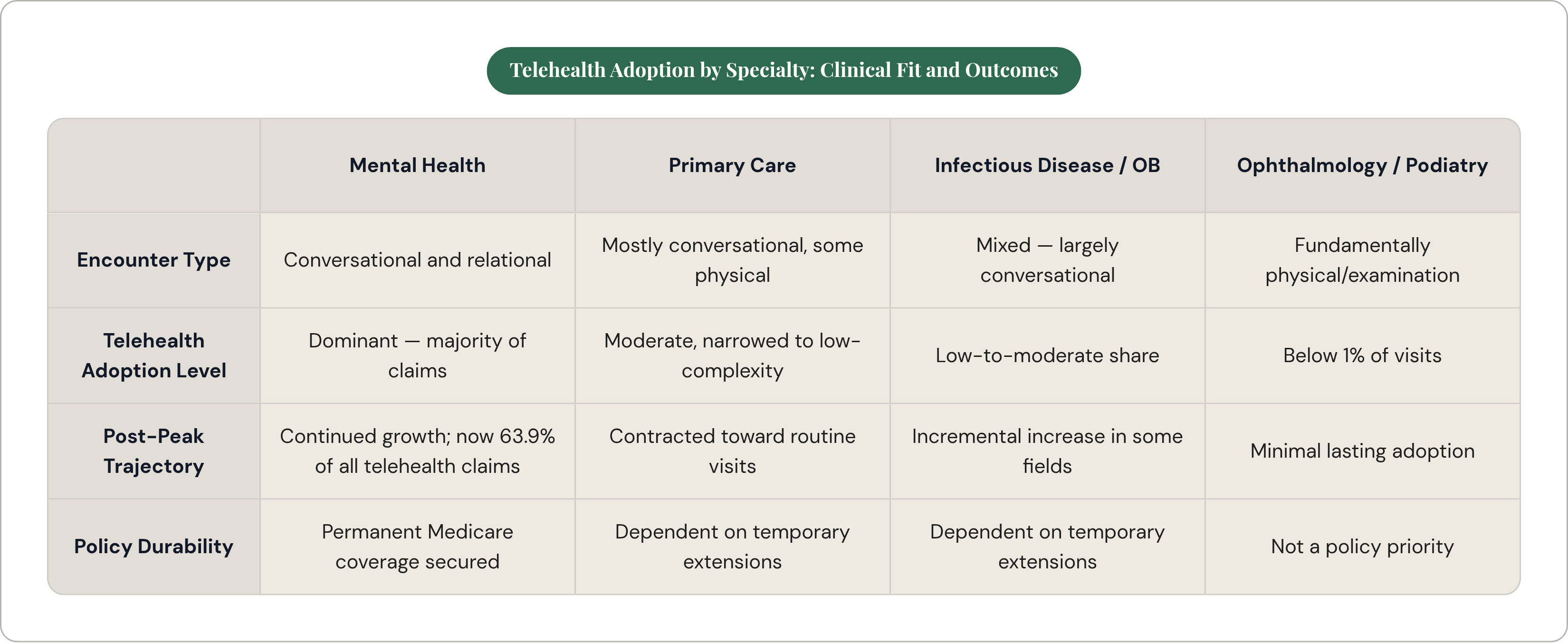
The aggregate adoption figures obscure a more useful picture. Telehealth did not settle evenly, and the variation isn't random.
In primary care, virtual visits found a narrower lane: routine, low-complexity consultations where the clinical stakes of a remote encounter are manageable. Research from AJMC found that primary care telehealth use contracted toward that lane as emergency conditions lifted. Non-primary care specialties tell a different story; moderate- and high-complexity visits via telehealth continued to increase after the peak in several fields. To understand why this works, we must first look at whether the clinical encounter is fundamentally conversational or fundamentally physical. Not a complicated filter, but a reliable one.
Mental health visits were conducted via telehealth at a notably high rate in 2023. Infectious disease followed at a considerably lower share, obstetrics at a similar level. At the other end, ophthalmology and podiatry saw telehealth usage below 1%. That ceiling isn't a failure; it's a rational sorting by clinical fit, and the fact that it emerged organically across diverse specialties is informative about how the technology functions absent emergency pressure.
Rural residents and patients over 55 both saw meaningful increases in adoption, per Rock Health, reflecting the friction those groups faced in accessing in-person care. Younger patients leaned in harder still, with roughly three in four millennials expressing preference for virtual appointments when convenience and immediacy are factors. Across specialties and demographics, telehealth held where traditional care imposed the highest friction and where the visit format matched the clinical need.
Mental Health as the Defining Use Case of Post-Pandemic Telehealth
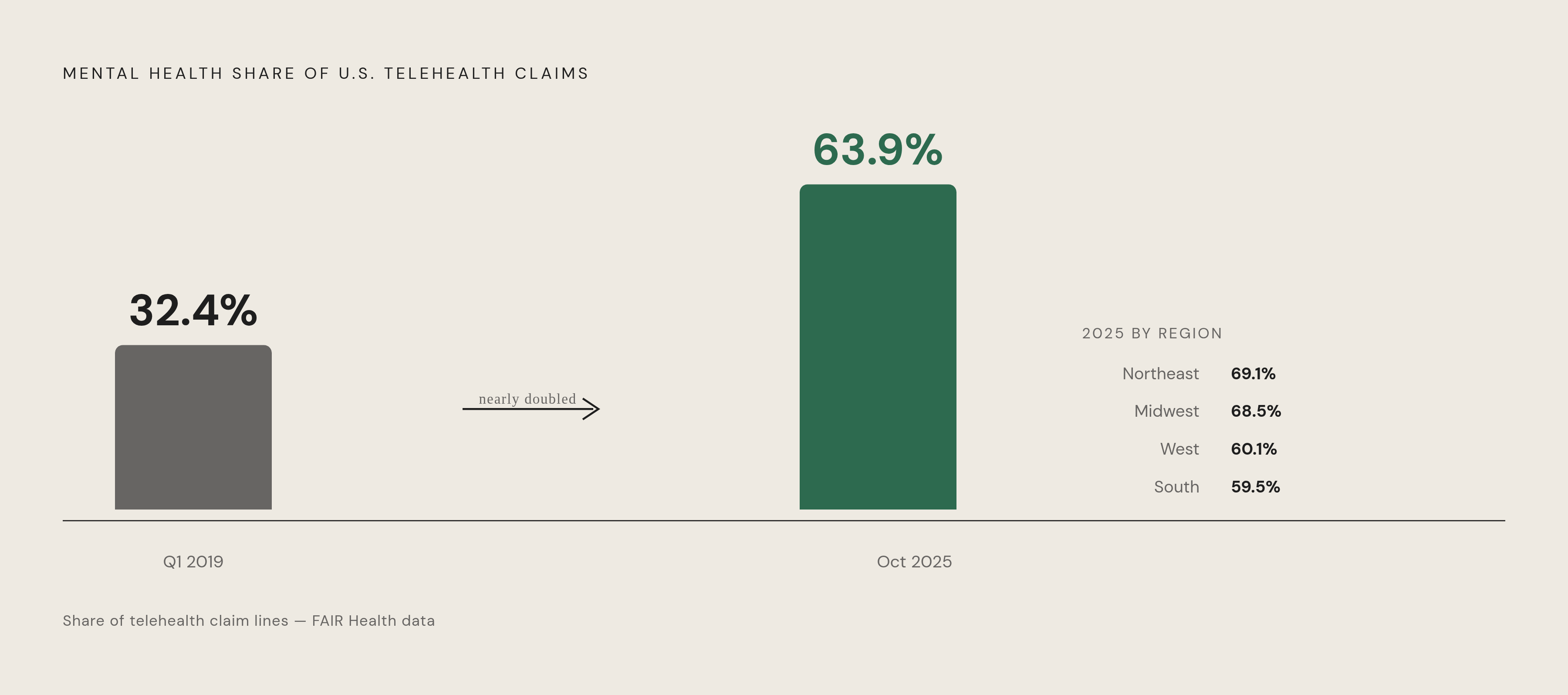
The concentration of telehealth in mental health is underappreciated in most general discussions of virtual care, and it substantially changes what the aggregate numbers actually mean.
In Q1 2019, mental health conditions represented 32.4% of all telehealth claim lines. By October 2025, that figure had reached 63.9%, making mental health the majority use case across all U.S. regions. The regional variation is real: the Northeast leads at 69.1%, the Midwest at 68.5%, the West at 60.1%, the South at 59.5%. The structure holds regardless of region.
Provider behavior corroborates the claim data. Per the AMA, 85.9% of psychiatrists reported providing virtual video visits weekly, and 56.9% used telehealth for more than 20% of their weekly visits. The infrastructure scaled accordingly: telehealth availability for mental health treatment facilities grew 77% from 2020 to 2021; for substance use disorder facilities, the figure was 143%.
Why exactly does this happen? Therapy and psychiatric consultation are inherently conversational; what a clinician needs is largely verbal and relational rather than physical. Stigma reduction matters for access, because patients who would not seek in-person mental health care will sometimes engage remotely. And the chronic shortage of in-person mental health providers created genuine pull toward any modality that could extend capacity. These dynamics reinforce each other. Mental health telehealth didn't merely grow; it came to define the category.
This has a practical implication for how anyone reads telehealth data. When aggregate figures are cited to draw conclusions about virtual care broadly, they are increasingly describing a mental health delivery story. Failing to disaggregate produces distorted conclusions about what telehealth is actually doing, and for whom.
Where Rural and Home Health Adoption Created Access — and Where It Hit Infrastructure Limits
A nationally representative survey of 474 Medicare-certified home health agencies found that 69% used telehealth, primarily for care coordination, virtual visits, remote monitoring, and care initiation. That adoption rate reflects how naturally telehealth integrates into a care model already distributed across geographies by design.
The urban-rural split within that group is where things get harder. Urban agencies adopted video-based modalities more broadly; rural agencies relied more heavily on audio-only, reflecting broadband access disparities that remain stubbornly persistent. Audio-only and video are not clinically equivalent, and they are not treated equivalently by regulators and payers. The gap in modality access maps directly onto existing infrastructure inequality. The patients who most needed an alternative to driving three hours to a specialist are, in many cases, receiving a lower-fidelity version of the care that urban patients receive. That's not a small caveat.
The rural adoption gains documented in Rock Health data are meaningful: patients who previously faced multi-hour drives to access specialist care now have options they didn't have in 2019. But those gains are also the most policy-sensitive in the telehealth ecosystem, because they depend disproportionately on audio-only reimbursement policies and continued regulatory flexibility. The communities that benefit most from telehealth are the most exposed to its policy instability. If those policies contract, rural patients lose the most, and they had the least to begin with.
How Reimbursement Policy Became the Variable That Telehealth's Future Hinges On
Pandemic-era Medicare telehealth flexibilities were not made permanent. They have been extended through a sequence of temporary legislative actions, each renewal carrying a deadline and a stretch of uncertainty before it arrived. The October 2025 government shutdown illustrated the fragility of this arrangement with unusual clarity: the shutdown coincided exactly with the deadline to renew Medicare telehealth flexibilities, placing both on the same legislative chopping block simultaneously. A continuing resolution restored the flexibilities; Congress subsequently extended them through December 31, 2027. Temporary, again.
Permanent structures do exist, and they're worth noting precisely because they're the exception. Medicare patients can now permanently receive telehealth for behavioral and mental health care in their home, with no geographic restrictions. Audio-only platforms are permanently permitted for those services. Their alignment with the dominant use case is not coincidental; policymakers institutionalized what the data had already demonstrated was working. But how does this affect our original promise of broad-based telehealth reform? Whether that template extends further is the open question.
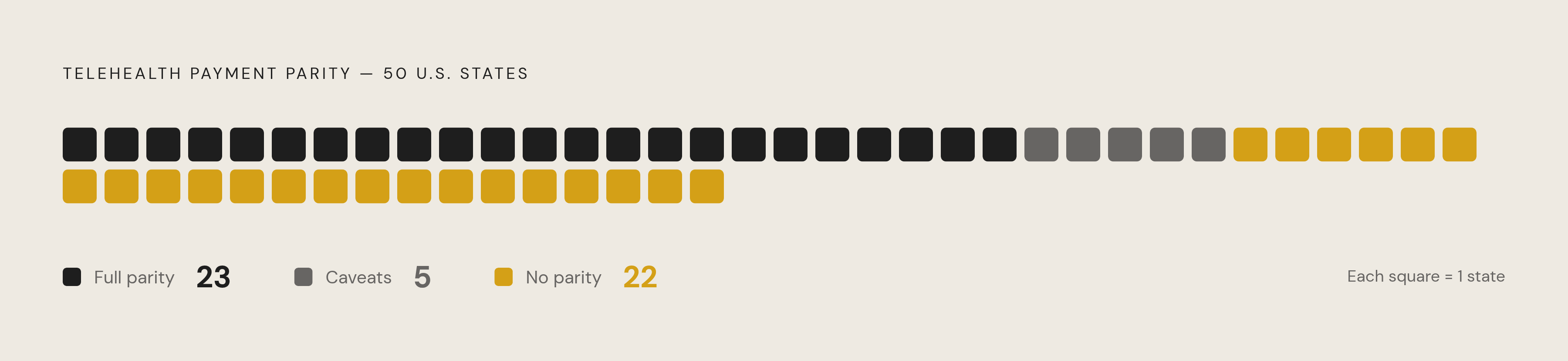
The state-level picture, as of late 2025, is fragmented. Twenty-three states have implemented payment parity; five have it with caveats; twenty-two have none. A patient's telehealth economics depend substantially on geography, in ways that have nothing to do with clinical appropriateness. Provider investment decisions, staffing models, and the patient habits built over the past five years have all been constructed on a foundation of flexibilities that remain contingent outside the behavioral health carve-outs. That is a structurally unstable condition for a delivery modality now embedded in how care is actually provided, and it is the kind of instability that doesn't announce itself until something breaks.
What the Global Market Trajectory Says About Where Confidence Is Actually Being Placed
Market sizing figures for telehealth vary significantly across forecasting firms depending on how the category is defined and what geographies are included; treating any single projection as authoritative is a mistake. Keeping that in mind: MarketsandMarkets estimated in January 2025 that the global telehealth and telemedicine market was valued at $83.62 billion in 2023, reached $94.14 billion in 2024, and is projected to grow at a compound annual growth rate of 11.5% through 2030. North America held roughly 38.9% of global market share in 2025.
The faster story is in Asia-Pacific. China has over a thousand officially registered internet hospitals. India's government-backed eSanjeevani platform has recorded hundreds of millions of cumulative consultations. These are not small pilots; they are national-scale deployments reflecting deliberate policy commitment to virtual care infrastructure.
It is also worth considering what capital and government behavior signal that projections alone don't. When investors fund infrastructure and governments build platforms at this scale, they are expressing a durable view about virtual care's role in health systems. The United States is still working through its reimbursement debates while the global buildout continues regardless. A return to pre-2020 norms is not a realistic scenario when assessed against the full scope of investment being committed worldwide. The question worth sitting with isn't whether telehealth persists globally. It's whether the United States capitalizes on the position it built under emergency conditions, or fritters it away through policy drift and temporary extensions that never quite become permanent.
Where Telehealth Has Taken Hold Versus Where Early Optimism Overreached
Some things transformed substantially. Mental health delivery found in telehealth both a clinical fit and a policy infrastructure now made durable. Routine primary care visits, low-complexity and conversational, found a sustainable virtual lane. Home health coordination, where distributed care is the model by definition, integrated telehealth without much friction. Rural and older patients who faced the highest barriers in the pre-pandemic system gained real, documented access. These aren't trivial gains.
General outpatient utilization is down sharply from its pandemic peak but settled well above pre-pandemic levels across most specialties. A meaningful baseline shift, not a revolution, but not a retreat.
Where early optimism outpaced reality: specialties requiring physical examination saw minimal lasting adoption, and that outcome was, in retrospect, predictable from basic clinical logic. The assumption that pandemic-era regulatory flexibility would convert to permanent, broad-based policy reform has not been borne out. The behavioral health carve-outs are the exception, not the rule. Gaps in payment parity across twenty-two states, continued dependence on congressional reauthorization for Medicare flexibilities, and infrastructure disparities affecting rural audio-only users all indicate that the optimistic scenario, where emergency mobilization leads seamlessly to a reformed and equitable system, was an overread.
Telehealth is now a permanent, mainstream component of U.S. healthcare delivery. That sentence would have been contested in 2019. It is not seriously contested now. Permanence and equity, though, are not the same thing. The scope of virtual care, who can access it without geographic penalty, and what it will cost patients and providers to use it remain contingent on legislative, regulatory, and infrastructural decisions still being negotiated. The emergency forced the opening. What gets built inside it is still being decided, and the people making those decisions are, more often than not, working at considerable distance from the clinical realities that made the case for telehealth in the first place.