Flu A vs Flu B Differences in Symptoms and Severity
Flu A dominates most seasons, but flu B poses distinct risks to children.
Four types of influenza exist, but only two matter once flu season starts. Type C causes mild illness that never builds into real outbreaks, and type D doesn't infect humans at all. What follows works through what actually separates flu A from flu B: how often each circulates, who they put at greatest risk, and when a symptom in either one should send someone to a clinic instead of the medicine cabinet.
A rapid test at urgent care can tell A from B quickly, but most people are already three days into body aches and a 102-degree fever before they sit down for one. That's the real argument for knowing the pattern ahead of time: who's vulnerable, when each type peaks, what the early symptoms tend to mean. There's also a structural reason flu A draws more attention than flu B ever will. Flu B infects only humans. Flu A infects humans, plus birds, pigs, horses, and other mammals, and that animal reservoir is the root of nearly every meaningful difference covered below.
How much flu A and flu B actually circulate, and when each tends to appear
Flu A dominates most seasons, and recent years have skewed harder in that direction than the historical norm suggests. Cleveland Clinic reported that flu A made up 96% of cases recorded in late 2024. CDC FluView hospitalization data from early January 2026 tells the same story from a different angle: 97.2% of reported hospitalizations traced back to influenza A, against 2.3% for influenza B. Whatever the exact split in a given year, the pattern holds season after season: flu A gets there first and gets there harder.
Flu B doesn't disappear, it just shows up on a different clock. It tends to circulate later in the season, often peaking in spring after flu A has already run through most of its course. The practical read for anyone tracking symptoms at home: get sick in November or December, and flu A is the overwhelming favorite. Get sick in March or April, and flu B's odds rise substantially, sometimes enough to close most of the gap.
None of this is small stuff at scale. The CDC estimates the 2024-2025 season alone produced between 43 million and 73 million symptomatic illnesses, 560,000 to 1.1 million hospitalizations, and 38,000 to 99,000 deaths. Those ranges are wide because flu surveillance is inherently imprecise; even the low end of each range describes a disease burden most other illnesses never approach in a single year.
The shared symptom profile that makes telling them apart so difficult without a test
Flu A and flu B look almost identical once they take hold. Both produce the same core syndrome, and the onset is famously sudden, not the slow creep of a common cold but a fast turn from fine to flattened. The typical order runs fatigue and chills first, then fever, body aches, cough, headache, and congestion, with the whole episode lasting anywhere from a few days to two weeks. Gastrointestinal symptoms, nausea, vomiting, diarrhea, show up in both types too, and children get them more often than adults do.
Published clinical literature on PubMed backs this up at the population level: fever, cough, and runny nose show up at essentially the same rates whether the flu is A or B. Which raises the obvious question. If the symptoms overlap this completely, why bother separating the two at all?
Because without a rapid test, even a physician at the bedside cannot reliably say which type is driving the illness in front of them. That's precisely why the differences that do exist, in severity, in complications, in who's most vulnerable, need to be named clearly rather than left implied. Nobody solves that puzzle by staring harder at a fever chart, and pretending otherwise wastes the two or three days when early treatment actually matters.
Where flu A tends to be more severe, and what the evidence actually shows
The standard clinical summary says flu A runs hotter: higher fevers, more intense body aches, a higher rate of complications overall. Pneumonia rates and the need for mechanical ventilation both come in higher with flu A than flu B in several published comparisons. Take that summary at face value and you'd expect flu type to be the dominant variable in how sick any one patient gets. It isn't, and the data that complicates the picture is worth sitting with.
The SUPERFLUOUS study, run through a hospital network tied to Paris-Saclay University between 2016 and 2018, followed 234 flu A patients and 113 flu B patients. Flu A patients were prescribed oseltamivir more often (43.5% versus 27.9%), yet the rate of abnormal chest imaging came out close between the two groups: 27.8% versus 24.8%. The strongest single predictor of hospitalization in that study wasn't flu type at all. It was age 65 or older, with an adjusted odds ratio of 4.78, dwarfing anything tied to the A/B distinction.
A 2020 Israeli cohort study found no significant difference between A and B on a composite outcome that included pneumonia, myocarditis, encephalitis, mechanical ventilation, ICU admission, and death within 30 days. What predicted mortality on multivariate analysis was comorbidity burden and baseline physiological markers, not which letter the flu carried. A systematic review of the literature through January 2017 reached a similar conclusion: very few clinical differences show up across types, with only weak evidence tying the H1N1 pandemic strain to higher rates of secondary bacterial pneumonia, ICU admission, and death in the years following 2009.
So the "flu A is worse" claim holds at the population level, but it's the wrong thing for any one person to bank on. Age and underlying health condition do more to shape individual risk than the flu type ever will; older adults, 65 and up, accounted for 57% of all flu hospitalizations in the 2024-2025 season, a number that explains far more about who ends up hospitalized than any A-versus-B comparison could. If someone in that age bracket gets a positive flu test, the letter on the result matters less than the fact of the positive test itself.
Pediatric differences — where flu B creates distinctive and underappreciated risks
Zoom in on children specifically and the story shifts. A fourteen-year Finnish study published in the Pediatric Infectious Disease Journal, covering 2004 through 2018, tracked 279 hospitalized children with flu A and 112 with flu B. The study found that hospitalized kids with flu A and flu B, on the whole, look a lot alike.
Specific complications tell a different story. Ear infections show up more often with flu A than flu B in children, per Cleveland Clinic. Flu B, meanwhile, produces a complication that flu A barely touches: benign acute childhood myositis, or BACM. BACM causes severe calf pain and is associated with flu B at far higher rates than flu A.
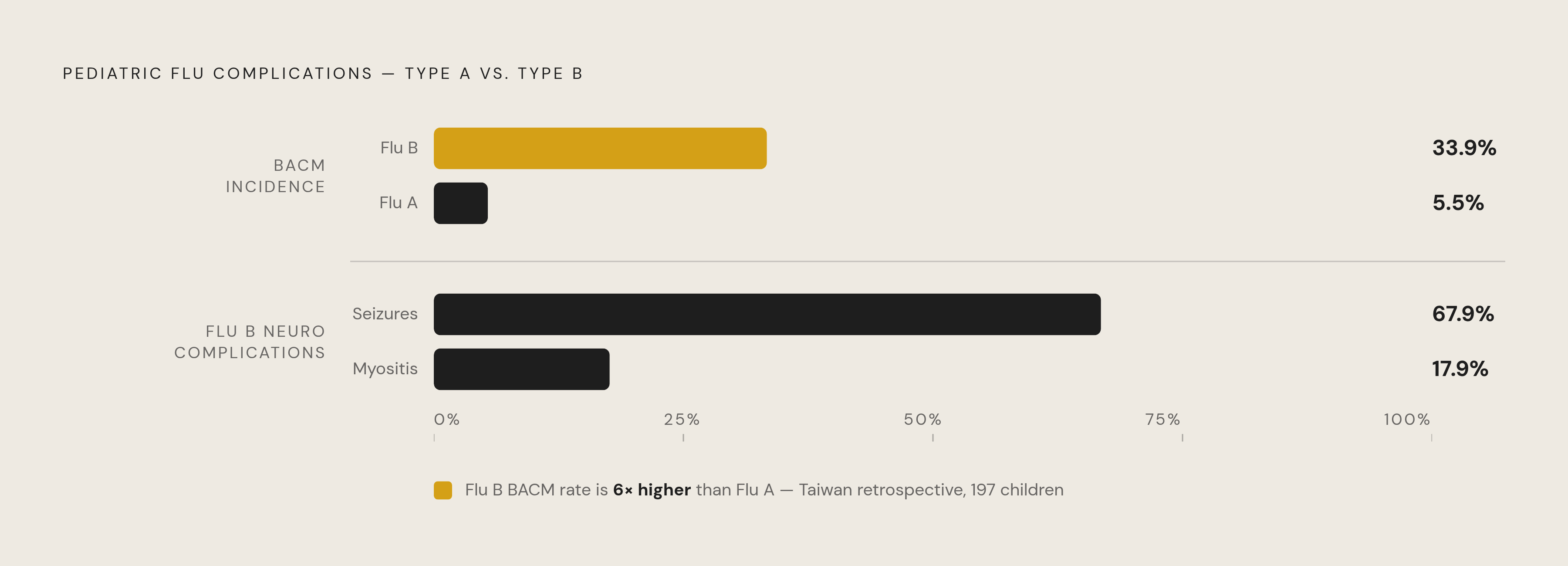
Here's where the numbers do real work. A retrospective Taiwanese study of 197 children from the 2000-2001 season found BACM in 33.9% of flu B cases compared to just 5.5% of flu A cases, a gap wide enough to count as one of the clearest type-specific signals in all of pediatric flu research. Sudden calf pain in a kid who just had the flu is exactly the kind of thing a parent should recognize by name rather than write off as growing pains.
Seizures follow a similar pattern. One PubMed study found that among pediatric flu B patients who developed neurological complications, seizure was the most common at 67.9%, with myositis close behind at 17.9%. Breaking the seizures down further: 78.9% were simple febrile seizures, 15.8% were complex febrile seizures, and 5.3% progressed to febrile status epilepticus. Most febrile seizures look terrifying to a parent watching one happen, and resolve on their own within minutes with no lasting harm. Status epilepticus is the exception; it needs emergency care immediately, not a wait-and-see approach.
Flu B gets treated as the milder cousin of flu A, and at the population level that reputation is earned. But its specific complications in children, calf pain and seizure above all, deserve real attention rather than a shrug, precisely because the reputation for mildness makes parents less likely to look for them.
Why flu A carries pandemic risk and flu B does not
Here's the mechanism that separates these two types at a level deeper than symptoms or hospitalization counts. Flu B infects only humans. Flu A infects humans, plus birds, pigs, horses, and other mammals. That animal reservoir is the entire reason flu A carries pandemic potential and flu B, as far as current evidence shows, does not.
Both types mutate gradually through antigenic drift, small genetic changes accumulating over time, which is why flu vaccines get reformulated every year regardless of type. Only flu A, though, can undergo antigenic shift: a sudden, large-scale genetic reassortment that happens when a human flu strain and an animal flu strain infect the same host and swap genetic material. The result can be an entirely new subtype that human immune systems have no defense against, because they've never encountered anything like it before.
History gives this mechanism a face. The 1918 "Spanish flu," an H1N1 strain, infected roughly a third of the world's population at the time and killed more than 50 million people, notable in part for killing healthy young adults at unusually high rates, a pattern researchers link to an overwhelming immune overreaction called a cytokine storm. The 2009 "swine flu" pandemic came from a different H1N1 strain, formed through reassortment between swine, avian, and human flu genes. Same swap mechanism, decades apart, global consequences both times.
The flu A subtypes circulating now are H1N1 and H3N2, and H3N2 generally produces a higher attack rate than H1N1 in a given season. Flu B, confined to humans with no animal reservoir to draw new genetic material from, mutates more slowly and stays more antigenically stable season over season. One practical consequence: flu B mutates more slowly and stays more antigenically stable than flu A from season to season. Pandemic preparedness is, at bottom, a flu A problem. Flu B's risks are real, but they stay bounded in a way flu A's never fully do, and that boundedness is the whole point of this section.
An unusual footnote: what happened to flu B/Yamagata
Flu B has historically split into two lineages, B/Victoria and B/Yamagata, circulating alongside each other for decades. Then, sometime around the COVID-19 pandemic, something odd happened: the circumstances surrounding the COVID-19 pandemic coincided with a dramatic decline in B/Yamagata detections in global surveillance.
That's not a small footnote for vaccine manufacturing. The quadrivalent flu vaccine used to cover both flu B lineages as a matter of course. With no evidence of Yamagata circulating anymore, vaccine manufacturers began reconsidering the need to cover both B lineages given the absence of detected Yamagata circulation. What isn't settled is whether Yamagata is genuinely extinct in human populations or just circulating below what surveillance systems can detect. Global monitoring continues either way, because the distinction matters enormously for how future vaccines get built.
So when "quadrivalent versus trivalent" turns up in a news story about this year's flu shot, this is the backstory: a viral lineage that circulated for decades appears to have vanished during a pandemic aimed at an entirely different virus, and nobody is fully certain yet whether that's permanent.
When symptoms from either flu type warrant medical attention or emergency care
Certain groups face higher stakes with either flu type, not because one virus targets them specifically but because their baseline health leaves less room for error. Adults 65 and older top that list, consistent with the 4.78 odds ratio for hospitalization found in the SUPERFLUOUS study. People managing heart disease, diabetes, obesity, or a suppressed immune system follow close behind, along with pregnant individuals and children under five.
For adults, certain warning signs call for same-day evaluation regardless of flu type: trouble breathing, chest pain or pressure that doesn't let up, sudden confusion, vomiting severe enough to block hydration, or a pattern where symptoms seem to improve and then sharply worsen again. That last pattern can signal a secondary bacterial pneumonia setting in on top of the original viral infection, and it's easy to miss if the assumption is that the worst has already passed.
Children carry all of the same warning signs, plus two that point specifically toward flu B. Severe pain in both calves, or a sudden refusal to walk during or just after a flu illness, should raise concern for BACM, particularly given how disproportionately that complication ties back to flu B in the Taiwanese data above. Any seizure during a fever needs a calm, clear-eyed assessment: most are simple febrile seizures that resolve within a couple of minutes, frightening to witness but not typically dangerous. A seizure lasting more than five minutes, or one presenting with complex features, is different, and it needs emergency evaluation right away rather than a wait-and-see approach at home. Watch, too, for dehydration signs: no tears when crying, a dry mouth, urination that's dropped off noticeably.
One timing detail applies across both flu types and every age group: antivirals like oseltamivir work best when started early in the illness. That window is exactly why early contact with a clinic matters most for anyone in a high-risk group, regardless of whether the eventual test comes back A or B. A rapid test can confirm which type is involved, and that confirmation shapes some clinical decisions. But for most healthy adults, it doesn't change the core plan: rest, fluids, and watching closely for the specific signs that mean it's time to stop waiting it out.