Sentinel Events in Healthcare Reporting and Prevention
Joint Commission data reveals which preventable harms kill most and who gets left uncounted.
Something dies, or nearly dies, and the Joint Commission calls it a sentinel event: unexpected death, permanent harm, severe temporary harm. This piece works through what the 2024 sentinel event numbers say about where American healthcare breaks down, how the response system is built to catch that harm, and why the gaps left behind land hardest on people already living with serious mental illness. The most uncomfortable finding in the 2024 data isn't the count of any single event type. It's what the numbers reveal about who never gets counted at all.
A sentinel event isn't just a bad outcome; it's a signal that something in the process, not just the moment, went wrong. That premise holds up the whole machinery, from root cause analysis to the Joint Commission's revised behavioral health reporting rules that took effect at the start of 2024. Reporting to the Joint Commission is voluntary, so the system runs on a mix of institutional goodwill and self-interest: hospitals report because accreditation status depends on demonstrated safety practices, because internal review genuinely improves care, and because trust with patients and regulators is worth protecting. A parallel framework from the National Quality Forum, its Serious Reportable Events list, adds a second layer by naming a narrower set of events that are both serious and largely preventable. Two systems, two definitions, one shared goal: stop the same harm from happening twice.
What 2024's sentinel event numbers actually reveal about where harm concentrates
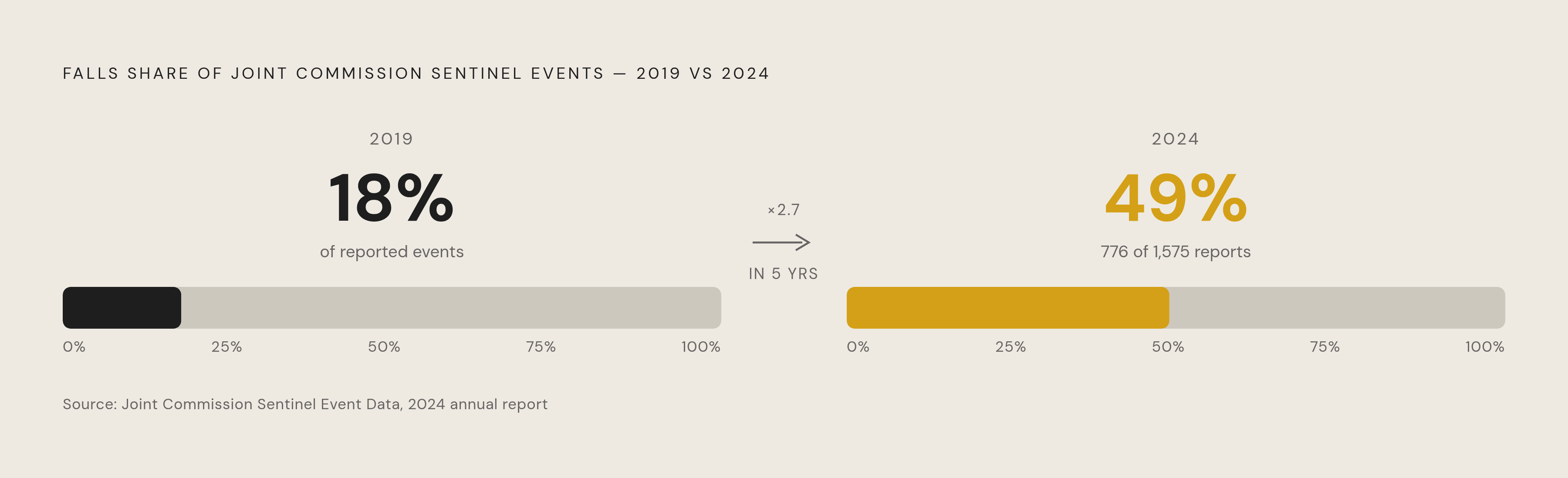
The Joint Commission received 1,575 sentinel event reports in 2024, up from 1,411 the year before. Severity didn't ease up either: 21% of those events ended in death, and another 49% caused severe harm. Five categories made up 85% of everything reported: wrong-site or wrong-procedure surgery (127 events), delay in treatment (126), patient suicide (122), retained foreign objects after surgery (119), and workplace violence (65).
But the number that actually reframes the dataset is falls. They made up 776 of the 1,575 reported events, 49%, essentially half of everything TJC received that year. In 2019, falls were just 18% of the total. That's not a modest uptick. That's a category nearly tripling its share of total harm in under five years, and it's the clearest single data point in this entire piece. Falls aren't a new clinical mystery. Hospitals have understood fall risk for decades: bed alarms, hourly rounding, fall-risk scoring at admission. So why the surge?
The likely answer isn't a sudden failure of clinical knowledge. It's a workforce running thinner than the protocols assume: staffing ratios stretched tighter, documentation slipping under the same workload pressure, nurses covering more patients per shift than the fall-prevention playbook was ever built around. The rise in falls says more about who's watching the bed rail than about the bed rail itself.
The reporting rate deserves its own pause, and it may be the most important number in the piece. Less than 2% of sentinel events that actually occur are believed to reach TJC. The 1,575 reports from 2024 aren't a census of harm; they're a sample, and a self-selected one at that. Hospitals with stronger safety cultures tend to report more, since reporting itself gets treated as a marker of institutional maturity. That means the visible data probably undercounts harm at exactly the institutions least equipped to catch it. Treat the 2024 numbers as a floor, not a ceiling; what sits below the waterline is likely worse than what's above it.
How root cause analysis is supposed to turn a single failure into system-wide learning
Once an event is reported, the clock starts. TJC requires a root cause analysis, or RCA, finished within 45 days, along with an action plan describing what the organization will change. An RCA is a backward-looking, structured inquiry built around refusing to stop at "who made the mistake." It asks why the system let the mistake happen at all.
A rigorous RCA usually turns up the same handful of culprits regardless of the clinical specifics: communication breakdowns between shifts or departments, policies that read fine on paper but get skipped under pressure, staffing loads that force shortcuts, and training gaps that leave clinicians unprepared for edge cases the manual never covered. The 2024 data backs this up directly. Most of the serious harm reported wasn't caused by rare, freak anomalies. It traced back to familiar, recurring failure patterns, the same ones RCA has been surfacing for years.
Here's the catch, and it's the one people miss: finishing an RCA is not the same as fixing anything. Action plans vary enormously in how seriously they get carried out, and TJC's 45-day window measures whether the analysis happened, not whether the resulting changes stuck. The framework works best where safety culture treats RCA as genuine learning rather than a box to check. It strains hardest in smaller or under-resourced facilities, in settings where reporting still carries stigma, and especially in care transitions, where no single institution owns the outcome and nobody's RCA covers the handoff itself.
Why suicide ranks among the top three sentinel events and what the 2024 policy expansion means
Suicide sentinel event reports hit 122 in 2024, the highest count in five years. Compare that to 81 in 2020, 74 in 2021, 80 in 2022, and 71 in 2023: the trajectory wasn't steadily climbing, it was flat or falling until 2024's sharp jump. Something changed, and it wasn't just behavior.
Part of that jump is almost certainly the definition changing underneath the numbers. For more than a decade, TJC's sentinel event definition for suicide only covered inpatient deaths and deaths within 72 hours of discharge, a narrow window that assumed risk dropped off sharply once a patient left the building. Effective January 1, 2024, the definition widened considerably. A death now qualifies as a sentinel event if it occurs while the patient is in a healthcare setting, within 7 days of discharge from inpatient services, within 7 days of discharge from an emergency department, or while receiving, or within 7 days of discharge from, behavioral health services, including Day Treatment, PHP, IOP, Residential, Group Home, and Transitional Supportive Living settings.
Why does the window matter this much? Because 72 hours never reflected where the actual risk lived. Post-discharge suicide risk peaks well beyond three days out, and the 7-day threshold finally lines the accountability period up with the period where danger runs highest. The change does something structurally new too: it pulls community-adjacent behavioral health settings, not just hospitals, into the sentinel event accountability framework for the first time. Organizations running PHP or IOP or residential programs are now on the hook for reporting obligations they never had before, and readiness across that field is uneven at best. Some of the 2024 spike is a genuine increase in harm. Some of it is simply better detection, catching events the old 72-hour rule would have missed entirely. Both are probably true at once, and untangling exactly how much belongs to each cause isn't something the available data can settle cleanly.
The system failures that most often precede a suicide sentinel event
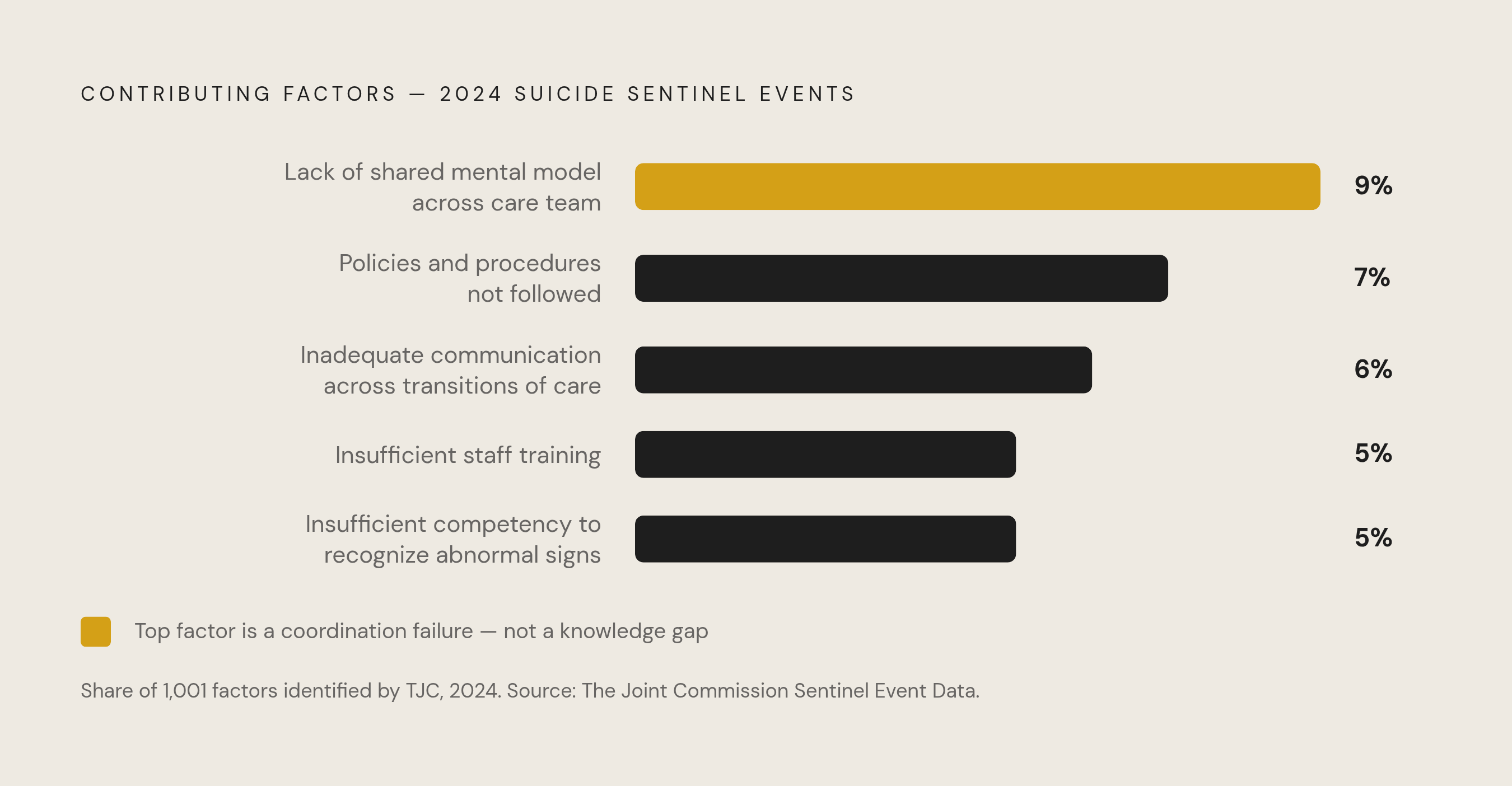
TJC identified 1,001 contributing factors across the suicide sentinel events reported in 2024, and the leading ones tell a fairly consistent story. Lack of a shared mental model across the care team accounted for 9% of contributing factors, the single largest driver. Policies and procedures not being followed, things like suicide screening or risk assessment protocols that existed but weren't used, came in at 7%. Inadequate communication with external providers or across transitions of care hit 6%. Insufficient staff training landed at 5%, and insufficient provider competency to recognize abnormal clinical signs was also 5%.
Look closely at that list, and a different pattern emerges than "clinicians don't know enough." These are relational failures and coordination failures. The care team either didn't share a common picture of the patient's risk, or they had one and failed to act on it consistently. That's a different problem than not knowing what suicide risk looks like on paper, and treating it as a knowledge gap misses what the data actually points at.
Transitions of care stand out as the sharpest vulnerability in the entire dataset. The period between inpatient discharge and stable community follow-up is where risk peaks and where the handoff between institutions runs least reliable, exactly the gap the revised 7-day definition was built to capture. Screening tools and documentation requirements matter, but they don't close this gap on their own. A screening tool doesn't call the patient three days after discharge to check whether they made it to their outpatient appointment. That 6% attributed to poor communication with external providers points directly at the boundary between hospital-based care and community-based support, a boundary that clinical protocol alone was never built to bridge.
Where the SMI population stands in relation to the care system these events expose
Serious mental illness affected 5.6% of U.S. adults in 2024, roughly 14.6 million people, according to SAMHSA. Treatment coverage for this group runs better than for mental illness broadly: 70.8% of adults with SMI, about 10.3 million people, received some treatment. Still, that leaves close to three in ten without care of any kind, a population sitting entirely outside the reporting and prevention infrastructure built around sentinel events. A system built on hospital reporting can't catch harm to people who never reach a hospital, and that's worth stating plainly rather than treating as a footnote.
Consider the timeline too. NIH data puts the average gap between symptom onset and first treatment for SMI at 11 years. Most people arrive at the care system already in crisis rather than at the start of their illness, which changes what "prevention" even means for this population; there's often no early window left to intervene in. Layer onto that the fact that more than 120 million people in the U.S. live in areas formally designated as short on mental health providers, and the overlap between provider scarcity and SMI burden is hard to look past.
Nearly 49,000 people died by suicide in the U.S. in 2022, and roughly 46% of people who die by suicide had a diagnosed mental health condition. People with SMI move through more care transitions than the general population: more discharges, more re-admissions, more contact with exactly the PHP, IOP, and residential settings the 2024 definition now covers. Add housing instability, food insecurity, and unreliable transportation into the mix, and post-discharge follow-through gets harder for the patient and the provider both. The system's most serious documented failures land, disproportionately, on people whose care was already the most fragile to begin with.
Why peer support is especially well-positioned to address the gaps sentinel event data keeps finding
Go back to the contributing factors behind suicide sentinel events: lack of shared mental model, poor external communication, insufficient recognition of clinical signs. None of those are primarily clinical knowledge problems. They're relational, and that's precisely the terrain peer support specialists work in. More clinical training was never going to close this gap on its own, no matter how much of it gets stacked into the curriculum.
Peer support does a few things clinical protocol structurally can't do. It builds trust with people who've disengaged from formal care, often because a peer specialist has lived through something recognizably similar. It maintains contact through the transition gap, the exact stretch between discharge and stable community re-engagement where the contributing-factor data says risk concentrates. It treats housing, food access, transportation, and medication follow-through as part of care rather than someone else's problem. And it offers continuity when no single clinical provider is tracking the whole person across settings.
The evidence base, while not without caveats, backs the model up. Research on peer support programs has linked the model to improvements in re-hospitalization rates, outpatient engagement, and quality-of-life measures. Studies conducted across different health systems suggest the model holds up in varied cultural and clinical contexts. Systematic reviews of the broader literature show mixed results, largely because studies test different bundles of peer support components rather than one standardized intervention. That inconsistency is real, and it means the field still doesn't know precisely which elements of peer support drive which outcomes. Name that limitation honestly; it isn't a reason to write off the model.
What peer specialists bring that's harder to put a number on is the lived-experience read on risk. Sentinel event data flags "insufficient provider competency to recognize abnormal clinical signs" as a contributing factor in suicide events. Someone who has navigated a similar crisis themselves sometimes catches a shift in a person's affect or language that formal clinical training doesn't reliably teach anyone to spot. Some organizations build their model directly around this insight, placing peer specialists in communities rather than clinics and working specifically in that post-discharge window where the sentinel event data says the handoffs fail most often.
What the peer support workforce needs to actually fill this role at scale
The workforce exists, and it's grown fast. The workforce exists, and it has grown substantially. Certified peer specialists work nationally, and as of 2024, 49 states plus D.C. run statewide training and certification programs. Medicaid reimbursement has expanded right alongside it: 48 states and D.C. now reimburse peer support services in some form, so the payment infrastructure to support this workforce is largely in place on paper.
On paper is the operative phrase. The median Medicaid reimbursement rate sits at a low rate per 15-minute unit of service, a rate that state mental health authorities and peer specialists themselves describe as too low to sustain a stable workforce. Low pay drives high turnover, and turnover is uniquely damaging to a model built entirely on trust and continuity. A peer specialist relationship that resets every few months because the last person left for a better-paying job isn't delivering what peer support is supposed to deliver, no matter how well the certification program trained them going in. Here's the blunt version: paying for peer support at a rate below what it costs to keep someone in the job isn't a funding gap. It's a design flaw.
Training itself runs reasonably substantial: candidates pursuing National Certified Peer Recovery Support Specialist credentials typically complete 40 to 80 hours of state-approved coursework. Standardization across states remains inconsistent, though, so a certification earned in one state doesn't always transfer cleanly to another. Sentinel event policy just expanded accountability for behavioral health organizations through the 2024 suicide definition, putting more pressure on exactly the settings, PHP, IOP, residential, where peer specialists often work. The workforce best positioned to meet that new accountability is simultaneously the one least financially stable. Fixing that takes more than growing the certification pipeline. It takes reimbursement structures that treat peer support as a clinical asset with real economic value, not a discounted add-on squeezed in around the edges of a Medicaid budget.
What the reporting and prevention system still gets wrong, and where the gaps persist
Start with the number that undercuts everything else in this piece: less than 2% of sentinel events that occur actually get reported to TJC. The entire prevention infrastructure, RCA requirements, accreditation standards, policy revisions like the 2024 suicide definition, gets built on learning from a narrow, self-selected slice of total harm. Voluntary reporting rewards organizations that already have strong safety cultures, since those are the ones most likely to report in the first place. The database probably over-represents institutions already performing better than average, which means the picture regulators and hospitals work from skews toward the better end of the distribution, not the worse one.
The accreditation framework itself was built around acute inpatient care. It's being stretched into community behavioral health settings through changes like the 2024 suicide definition, but many of those settings, PHP, IOP, residential, group homes, don't have the documentation systems, dedicated quality staff, or RCA capacity the framework assumes exists everywhere. Extending accountability to a setting doesn't automatically extend the infrastructure needed to meet it, and that gap is where the next wave of preventable harm is most likely sitting right now.
Care transitions remain the most dangerous, least governed moment in the entire system. No institution owns the period between hospital discharge and stable community re-engagement, which creates a real structural problem for root cause analysis: an RCA can't assign a root cause to a gap that nobody is formally responsible for closing. Social determinants stay largely invisible in how events get classified, too. A fall connected to untreated pain from unstable housing, or a suicide tied to medication non-adherence driven by food insecurity, gets filed under its clinical category, not its upstream cause. The paperwork captures what happened. It rarely captures why the conditions for it existed in the first place.
What would move the system forward isn't a mystery, even if it isn't simple to pull off. Close the reporting gap so the data reflects actual harm rather than institutional willingness to disclose it. Build RCA capacity into community behavioral health settings instead of assuming it already exists there. And treat care transitions as accountable events in their own right, the seam between two systems that each currently assumes the other one is watching.