Community Reinforcement Approach in Substance Use Recovery
Restructuring a person's environment proves more effective than willpower alone.
Addiction treatment has spent decades built around a simple idea: that recovery is an individual act, something a person either has the willpower to achieve or doesn't. The Community Reinforcement Approach (CRA) rejects that premise entirely. Developed by Hunt and Azrin in the early 1970s, CRA treats substance use as a behavior sustained by its environment, meaning the people, routines, and rewards surrounding someone day to day, and it treats recovery the same way: as something that has to be built into that environment, not willed against it.
The disease model that dominated addiction treatment for most of the twentieth century framed the problem as one of individual deficiency. Fix the person's thinking, fix their coping skills, fix their moral resolve, and sobriety follows. What that model consistently ran into was a structural weakness: a patient could get sober inside a clinic and relapse within weeks of leaving it, because nothing about the world they returned to had changed. The bar was still there. The using friends were still there. The boredom, the unemployment, the family conflict, all of it was still there, exerting the same pull it always had.
Hunt and Azrin's insight was that this wasn't a failure of willpower. It was a failure to address contingencies, the actual rewards and cues in a person's daily life that made using more reinforcing than not using. Their proposition was blunt: restructure the environment so that a sober life delivers more reward than a using one, and the behavior will follow the incentive. That's not a motivational slogan. It's an engineering problem, and CRA is the engineering.
What CRA actually does: the mechanics of environmental redesign
CRA starts with functional analysis, a tool that maps out when substance use happens, what triggers it, and what short-term benefit it provides. This sounds obvious in retrospect, but it's a meaningful shift from asking "why can't this person stop" to asking what, specifically, is being reinforced and by what. A functional analysis might reveal that a person drinks every evening after a specific coworker calls, or that use spikes on weekends when there's no structured activity to fill the hours. Once that pattern is visible, it becomes a target.
Critically, CRA runs functional analysis in both directions. It maps the substance use, but it also maps existing pro-social and sober behaviors, looking for footholds already present in a person's life that can be expanded. Maybe there's one friend who doesn't use. Maybe there's one hobby that still holds some appeal. CRA treats those fragments as raw material.
From there, the method introduces what's sometimes called sampling sobriety: short, manageable stretches of abstinence during which new routines get tested. The point is to avoid demanding permanent commitment upfront. It's to let someone experience, in a low-stakes way, that a sober afternoon or a sober weekend can actually be rewarding, before asking for anything longer.
That sampling happens across four domains simultaneously. On the social and relational side, CRA works on family involvement, new peer connections, and communication skills, because isolation is itself a risk factor and reintegration has to be practiced, not assumed. On the vocational side, it targets employment, job-seeking support, and the daily structure that a job provides, since unstructured time is often where use fills the gap. Recreationally, it introduces substance-free hobbies and activities, sampled incrementally rather than imposed all at once. And familially, it works to restructure home dynamics directly, so that sobriety gets reinforced at the kitchen table, not just in a counselor's office.
Running underneath all four domains is skills training: communication, problem-solving, coping strategies for cravings and high-risk situations. These aren't abstract life skills. They're the specific tools a person needs to actually operate inside the redesigned environment CRA is building around them. The method also leans on structured materials, activity planners, relapse prevention templates, problem-solving worksheets, treating self-assessment and tracking as part of the intervention rather than paperwork bolted onto it.
A 2024 trial published in Frontiers in Public Health by Khalid et al. illustrates what this looks like as a standard course of treatment: 12 individual sessions, each 45 minutes to an hour, run alongside group activities. Progress is deliberately gradual. Small behavioral changes come first, and longer abstinence commitments follow only as both confidence and the surrounding rewarding environment build in parallel.
What the early controlled trials showed, and why the numbers still matter
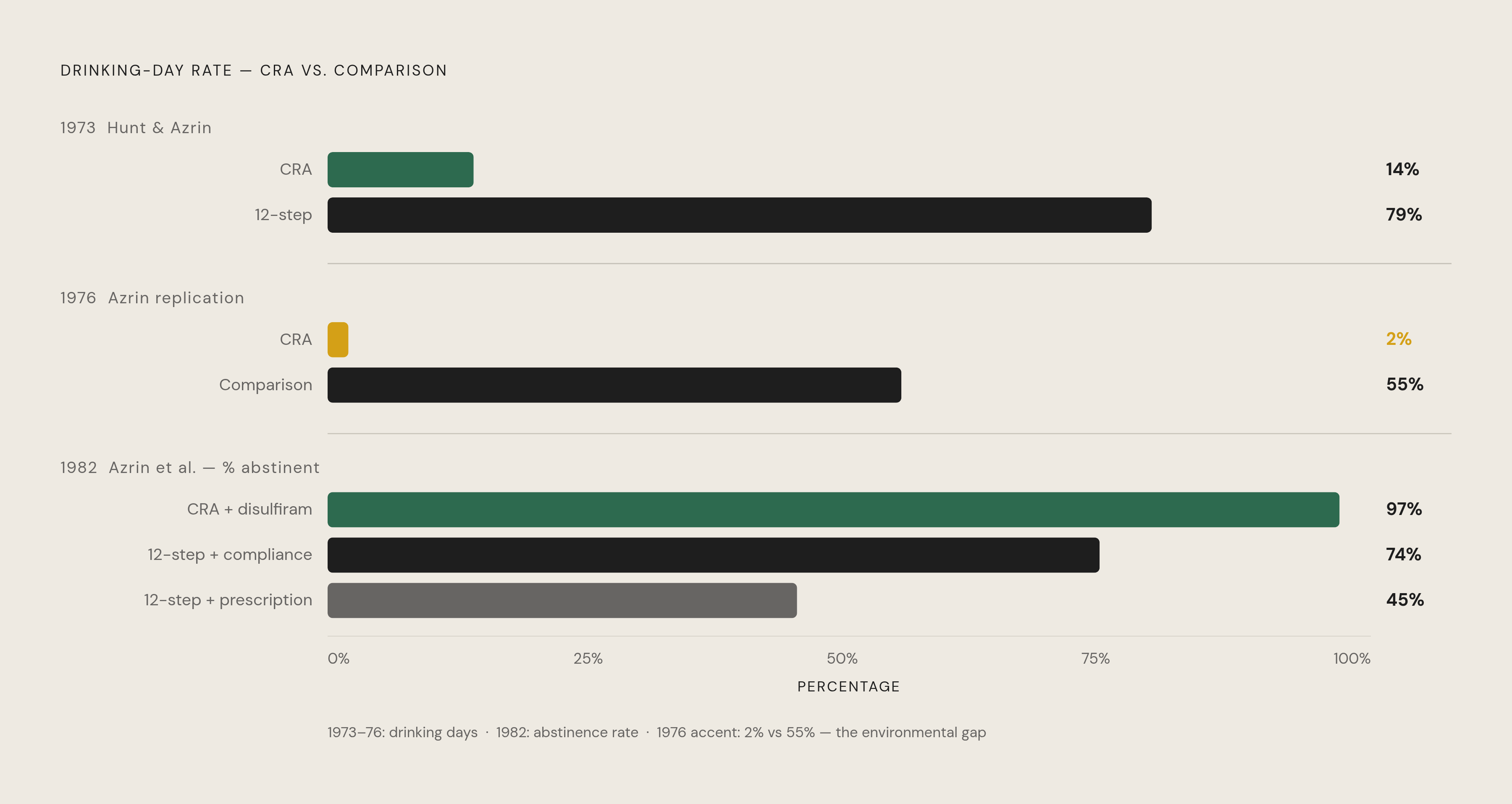
The evidence for CRA isn't recent. It goes back to Hunt and Azrin's first controlled trial in 1973, which randomized 16 alcohol-dependent inpatients to either CRA or a traditional 12-step program. At six-month follow-up, the CRA group was drinking on just 14% of days, compared to 79% for the 12-step group. That's not a marginal difference. That's a gap wide enough to make the environmental premise hard to dismiss.
Azrin followed up in 1976 with a larger inpatient replication, and the pattern held, arguably got starker. The CRA group averaged drinking on just 2% of follow-up time, versus 55% for the comparison group. At two years out, CRA's abstinence rate was still holding at 90%. For a field where relapse is the norm rather than the exception, numbers like that demand attention.
The 1982 outpatient extension, run by Azrin, Sisson, Meyers, and Godley with 43 participants, moved CRA out of the inpatient setting for the first time and added a notable variable: a trained disulfiram compliance component. The group receiving CRA plus disulfiram compliance training averaged 97% of days abstinent at six-month follow-up. The 12-step group with the same compliance training reached 74%, and the 12-step group with only a disulfiram prescription and no compliance support reached just 45%. That comparison matters because it isolates the active ingredient: it wasn't the medication doing the work. It was the relational and environmental reinforcement wrapped around it.
Then there's the 1998 trial by Smith, Meyers, and Delaney, which took CRA into a homeless population, delivering it in group format with skills training, a Friday non-drinking social event, and housing support as part of the program's structure. Social and environmental reinforcement wasn't an add-on here; it was built into the program's architecture. Participants showed significantly better outcomes than standard shelter care.
What ties these trials together isn't just the drinking-day statistics. Across the board, CRA participants also did better on employment and time spent institutionalized, evidence that the environmental redesign wasn't just suppressing one behavior. It was changing the shape of people's lives more broadly.
And yet, per information published on Robert Meyers' site, virtually every major review of addiction treatment research lists CRA among the strongest evidence-based approaches available, while very few clinicians treating substance use disorders today are even familiar with it. That's a strange paradox to sit with: a fifty-year evidence base, and a dissemination gap wide enough to keep most of the field from using it.
Quality of life and happiness as outcome measures, not afterthoughts
Most addiction trials measure success in days abstinent, or relapse rates, or time to first drink. Those numbers matter, but they don't capture whether a person's life actually got better in the process. A 2024 randomized trial by Khalid et al., published in Frontiers in Public Health, tried to close that gap. Conducted over 12 weeks with 60 inpatient substance users post-detoxification in Lahore, Pakistan, the study split participants into two groups: 30 receiving CRA integrated with the traditional Minnesota model, and 30 receiving the Minnesota model alone.
The CRA group showed a significant increase in quality of life, measured using the WHOQOL-BREF instrument, along with improved happiness scores relative to the control group. That result matters for the environmental thesis specifically, because quality of life and happiness function as proxies for how rich and rewarding a person's rebuilt environment actually is. If CRA is doing what it claims, those scores should move, and in this trial, they did.
The study also noted something practical: CRA worked well when combined with the Minnesota model rather than replacing it, suggesting the approach is adaptable rather than exclusionary. It can strengthen an existing program's foundation instead of requiring clinics to tear down what they've already built.
Cost matters too. Three separate meta-analytic reviews, cited on Robert Meyers' site (Finney and Monahan 1996, Holder et al. 1991, Miller et al. 1995), point to CRA's cost-effectiveness relative to other treatment modalities. Richer outcomes, in other words, didn't require richer infrastructure. Some studies report long-term success rates as high as 60% for individuals in CRA-based programs, a figure that places CRA's outcomes near the upper range of what behavioral treatment for substance use disorder tends to achieve.
How CRA's variants extend the environmental logic to families and younger people
CRA's core insight, that the environment sustains or undermines recovery, doesn't stay locked to one population. It extends outward, and the variants built on it are worth examining individually, because each targets a different reinforcement environment.
CRAFT, Community Reinforcement and Family Training, flips the entry point entirely. Instead of working with the person using substances, CRAFT works with the family members around someone who's resistant or unwilling to enter treatment. It trains concerned significant others to reward behaviors connected to sobriety and withhold reinforcement from behaviors connected to use, essentially applying operant conditioning to the home environment without the person who's using ever setting foot in a clinic. That's a meaningful expansion of reach: it means an intervention exists even for people who won't seek one themselves.
A-CRA, the Adolescent Community Reinforcement Approach, adapts the model developmentally for young people between ages 12 and 24. It places greater weight on caregiver involvement and school engagement, recognizing, correctly, that an adolescent's reinforcement environment doesn't look like an adult's. School, peer groups, and family structure are central reinforcement environments at that age.
There's also a completed pilot trial (NCT05300633, run through the Centre for Addiction and Mental Health, finished in September 2022) that adapted CRAFT specifically to target substance use within early psychosis intervention. That's a signal worth sitting with: CRA's framework is being tested in populations where serious mental illness and substance use disorder co-occur, which is exactly the kind of dual-diagnosis complexity that a purely individual-willpower model has never handled well.
What connects all three variants is the same move, applied to different settings. Each one identifies the reinforcement environment relevant to that population, whether that's the home, the school, or the clinical setting, and redesigns it, rather than isolating the individual and treating them as a closed system.
Where peer support amplifies what CRA is already doing
CRA's relational domains, the social connections, the family dynamics, the sense of community belonging, all require something a clinical office structurally can't provide: someone who can credibly occupy those spaces alongside the person in recovery, not just advise on them from behind a desk. That's where peer support enters the picture, and it maps onto CRA's logic almost exactly.
SAMHSA defines a peer support worker as someone with lived experience of mental health or substance use challenges who supports others through shared experience, navigation and linkage to resources, social support, and skill building. Read that list again against CRA's four reinforcement domains, social, vocational, recreational, familial, and the overlap is hard to miss. Peer support is central to CRA's method. It's a delivery mechanism for it.
The trust gap matters here. A clinician can help design a plan for someone to walk into a grocery store sober, attend a job interview sober, or navigate a social event without using. But a peer specialist can actually walk in with them, because they've been in that same grocery store, that same interview, that same room, and made it through.
A 2025 systematic review in Current Addiction Reports, covering 28 studies and 12,601 participants (including 17 new studies identified through December 2024), found evidence that peer recovery support services are associated with meaningful improvements in outcomes for substance use disorder. That's not a minor finding. Engagement and retention are exactly what CRA depends on to work at all; a method built on gradually sampling a rewarding sober life can't do anything for someone who disengages before the sampling starts.
The largest single study in that evidence base, published in Addiction and run through a hospital-based walk-in clinic with 1,175 participants, found that people who received peer support were more likely to be abstinent at six months across every substance category measured: cocaine alone (22.3% versus 16.9%), heroin alone (40.2% versus 30.6%), and both drugs combined (17.4% versus 12.8%). That's a consistent pattern across substances, and it suggests that relational contact with someone who has lived experience changes the environmental equation almost immediately, not just over months of sustained contact.
Peers also function as living proof of concept. Their visible recovery makes sobriety legible as something achievable, which is precisely what CRA's sampling phase is trying to demonstrate in miniature: that a different life is not just theoretically possible but actually livable.
None of this is uncomplicated, though. A 2024 umbrella review synthesizing 35 separate reviews found mixed meta-analytic results across psychosocial outcomes for adults with serious mental illness. The evidence held up most consistently for risk of hospitalization and certain clinical outcomes, including perinatal depression, along with recovery, self-efficacy, and stigma-related measures. It held up less consistently for overall psychiatric symptoms and quality of life measures broadly. Worth naming plainly: the evidence base for peer support is real, but it isn't uniform, and treating it as a solved question would overstate what the research currently shows.
How firsthand's model puts CRA's logic into practice at scale
firsthand's Guide and STRIVE Specialist model draws its staff from people who have personally navigated serious mental illness or substance use disorder, treating that lived experience as a clinical asset rather than something to route around. That's a direct structural echo of what the peer support literature above describes, and it's built to operate on the same environmental domains CRA identifies as decisive: housing, food access, medication adherence, medical appointments, behavioral health resources. Each of those is a social determinant that CRA's framework would recognize immediately as part of the reinforcement environment that either sustains recovery or quietly undermines it.
The model is community-based and in-person by design. Guides meet people in their actual communities, not in a waiting room, which is the spatial version of CRA's central insistence: the environment has to change, not just the individual sitting across from a clinician. A helpinghand platform, HITRUST r2-certified, provides the operational backbone underneath that field presence, letting support get coordinated across domains and tracked over time rather than existing as disconnected, one-off contacts.
Underneath all of it sits a premise that firsthand's model treats as foundational: trust, built through shared experience, is the precondition for any environmental work to actually take hold. That's not a soft claim. It's the same claim CRA has been making since 1973, that relationship is the vehicle through which reinforcement changes, restated in a modern, field-deployed form. And like CRA itself, the model is built to integrate with existing care delivery rather than replace it, partnering with health plans and systems the same way CRA has shown it can strengthen another treatment program instead of competing with it.
Why willpower-only recovery models keep failing, and what the evidence suggests instead
Willpower framing has one structural flaw that's easy to miss because it feels intuitive: it locates recovery entirely inside the individual, which means every relapse gets attributed to personal failure rather than to environmental conditions that were never actually addressed. If someone gets sober in a clinic and relapses back into the same apartment, the same unemployment, the same using friends, the framing says they didn't want it enough. CRA's evidence says something else entirely.
Look again at the gap in the founding trials: 14% versus 79% drinking days in 1973, 2% versus 55% in 1976, 97% versus 45% in 1982. Those numbers don't reflect a difference in how badly two groups of people wanted to get sober. They reflect a difference in what each group's environment was actually rewarding once they walked out the door.
And yet the paradox holds: CRA sits near the top of nearly every major review of addiction treatment evidence, and remains largely unfamiliar to the clinicians actually treating addiction day to day. That's not a small gap. It's a dissemination failure with a real human cost attached to it, measured in relapses that a fifty-year-old method might have prevented.
The scale of unmet need makes that cost harder to ignore. Of adults who needed substance use disorder treatment in 2024, roughly 80% did not receive it. An approach that only works inside a well-funded clinical setting, no matter how effective, can't close a gap that large on its own.
Community-based, peer-delivered care, CRA's logic carried outward through peer support and sustained field presence, is positioned to reach people where clinics structurally cannot: in their homes, their neighborhoods, their daily routines, on their own terms. What that model asks of larger systems is not modest. It asks for sustained investment in relational, community-based infrastructure, a recognition that trust and social connection function as clinical inputs rather than pleasant extras, and workforce models that treat people with lived experience as full participants in care delivery rather than a supplementary layer bolted on afterward.
CRA's durability across five decades of evidence isn't an accident of timing or branding. It holds up because it started from an accurate theory of why people use substances in the first place, and worked backward from there to build a method that makes not using the more rewarding path. That's a modest-sounding claim for something with this much data behind it, and maybe that's exactly why it still hasn't caught on the way it should have.
Sources
- Frontiers | The effectiveness of the community reinforcement approach (CRA) in the context of quality of life and happiness among people using drugs
- CRAFT, CRA and A-CRA - the methods and the empirical evidence
- Study Details | NCT05300633 | Community Reinforcement Approach and Family Training for Substance Use in Early Psychosis Intervention | ClinicalTrials.gov
- Community Reinforcement Approach (CRA): Definition, Approach, Worksheet, and Benefits - Right Choice Recovery
- pubmed.ncbi.nlm.nih.gov
- onlinelibrary.wiley.com