Calming an Anxiety Attack in Public or at Work
Discreet techniques to manage panic without leaving the room.
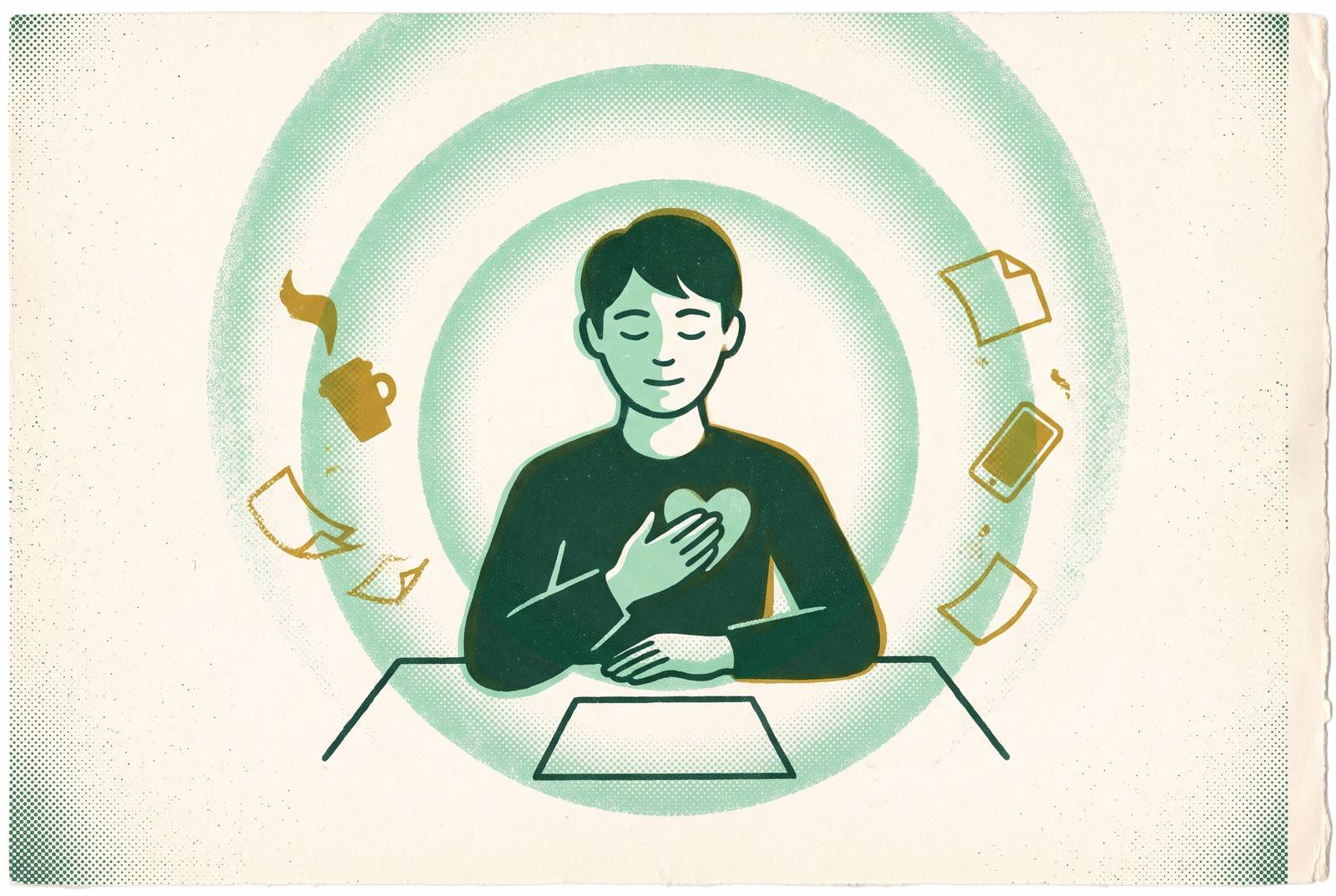
An anxiety attack in public or at work creates two pressures at once, managing the surge inside your body and trying not to show it. In the next 60 seconds, aim for containment, using a discreet sequence of breathing, attention and movement to make the next action manageable without automatically leaving the situation.
What actually happens in your body when anxiety peaks in a public place
A panic attack activates the body’s fight-or-flight response, the same alarm system that prepares it to respond to a threat. Adrenaline puts the body on high alert, and the result can include a pounding heart, shortness of breath and chest discomfort. These sensations can feel urgent even when there is no external danger. Because the alarm is felt in the body, reasoning with yourself may not quiet it right away.
In public, the alarm also competes with the effort to appear composed. How do you follow a conversation while your body behaves as though there is a fire? Trying to maintain an ordinary outward performance while experiencing intense internal fear can be exhausting and isolating. Recognizing a familiar panic pattern as something that is not itself life-threatening can reduce the fear of the sensations. That recognition is different from assuming that every unfamiliar physical symptom is anxiety, a distinction that becomes important when deciding whether medical evaluation is needed.
Why the goal in the first 60 seconds is not calm — it is containment
The demand to stop an attack right away can add to the pressure. If calm is the test, every pounding heartbeat can seem like evidence that the effort is failing. Containment sets a more workable target for the first 60 seconds, namely physical safety, gentler breathing and one manageable next action. You do not have to feel calm first. The actions are available while the alarm is still present.
In practice, containment means pausing, softening the breath, finding one external detail, naming what is happening and choosing a small action. None requires closing your eyes or lying down. You can use them while standing in a meeting, sitting on public transit or waiting in a queue. Naming the pattern with “this is a panic wave, not a command to run” acknowledges the experience without treating its urgency as an instruction. The sequence below begins with breathing, adds an external focus when useful, and then addresses where to position your body.
The discreet breathing move that gives you a place to start
Start with one long, comfortable release of breath rather than trying to fill your lungs as much as possible. Then inhale for four counts and exhale slowly for six to eight counts. Keep the breath comfortable. A maximum inhale can worsen chest tightness, which is the opposite of what this step is meant to achieve.
Why put the longer exhale first in the sequence? Making the exhale longer than the inhale can help move the body from sympathetic, fight-or-flight activity toward parasympathetic, rest activity. It gives you a direct physical action rather than another argument to conduct with anxious thoughts. The movement can stay small and unobtrusive. You can breathe through your nose with your mouth closed, without an obvious change that draws attention across a conference table or in a crowded aisle.
Box breathing is another pattern to try if equal counts feel easier to follow. Inhale for four counts, hold for four, exhale for four and hold for four. This pattern can be silent, with your eyes open and your attention apparently on a screen. Which structure is easier to remember under pressure? Pick one and practice it while calm, so the next attack does not also require choosing between two unfamiliar instructions.
Grounding the senses when breathing alone is not enough
Breathing helps with the alarm in the body, but attention may still be caught in a racing-thought loop. Sensory grounding adds an external point of focus. Instead of continually interpreting what the body might be doing, you notice something physically present. The shift is small but concrete.
NHS Inform describes the 5-4-3-2-1 grounding sequence as focusing on five things you can see, four you can touch or feel, three you can hear, two you can smell and one you can taste. You can work through it silently without moving. Its guidance presents the full sequence, rather than saying that a single sensation is sufficient. For the choices offered here, though, you can choose how many steps to do. If smell or taste is hard to isolate in a loud, crowded place, you do not need to turn grounding into another test you must pass.
A tactile micro-anchor is an alternative when the full sequence is impractical. Press your thumb against a fingertip, feel both shoes against the floor, or hold something with a cool surface. Another option is to press your palms together briefly and concentrate on the pressure. Choose the sensation that is easiest to notice. These actions also draw your attention to what you can feel outside the racing-thought loop, without an exercise others can see or a need to explain what you are doing.
What to do with your body when the environment itself is part of the problem
Sometimes the surroundings are adding to the alarm, so an internal technique is only part of the response. The choice is not simply to stay exactly where you are or abandon the situation entirely. A nearby reset offers a middle course. Moving to a less stimulating spot can give you room to continue breathing and grounding without making departure the automatic answer to panic. Physical safety comes first, so move before using these tools if you are near a platform edge, in traffic or in extreme heat.
Once you are safe, choose a destination that fits the setting. At work, that might be a bathroom or stairwell. In a store, it might be the end of an aisle or a seat near staff, while at an event it could be the lobby or perimeter of the room. On public transit, a different seat may help, or you can notify an employee that support is needed.
Repeatedly avoiding anxiety-provoking situations can maintain the association between that setting and danger. That does not make every brief departure a failure, nor does it mean staying somewhere unsafe. The reason for moving matters, to reduce what is coming at you while leaving you a choice about what happens next. Planning where to go in each familiar place saves you from having to decide when it is hardest to think clearly.
Workplace-specific tools that are invisible to coworkers
At work, the general sequence can be adapted to actions that do not require a pause in the meeting or an explanation to colleagues. Progressive muscle relaxation can happen under a desk, beginning by squeezing your toes tightly for five seconds and then releasing them. Move next to the calves, thighs and stomach. The action stays out of view. Tensing and releasing these muscles gives you a way to address physical tension without changing the social situation.
A one-minute body scan is another quiet option. Notice where tension is held in the shoulders, jaw and hands, then consciously release each spot. No announcement or visible routine is needed. If a bathroom visit is possible, cold water on the wrists or face offers a separate physical tool. Cold water on the face can activate the body’s dive reflex and help slow the heart rate.
A phrase such as “this feeling is temporary” can remind you that the current intensity is not permanent, provided it acknowledges the alarm. For anxiety that builds before meetings or performance reviews, box breathing before entering the room can become a small pre-meeting ritual. Repetition makes that action familiar before the pressure rises, rather than leaving the whole response to the moment of peak anxiety.
How to prepare before the next episode so the sequence runs automatically
Preparation moves some of the work into calmer moments. You can make the next response easier to retrieve by practicing the breathing pattern you chose. Controlled breathing is more useful as a stored habit than as an instruction you are trying to learn while frightened. Attach a short practice to something already in the day, such as before the first coffee or when sitting down after a meeting.
Next, identify recovery spots at work, along the commute and in places you visit frequently. A known bathroom, stairwell, lobby or quieter edge of a room gives the positioning step a destination. That is one less decision under pressure. The aim is not to map every possible escape, but to know where a nearby reset is available.
A trigger journal kept for one week can make preparation more targeted. Note the time, the task and who was present during each anxiety spike. Do particular meetings or situations recur in those entries? The record may reveal patterns that broad vigilance would miss, allowing you to connect the breathing practice or recovery spot to the circumstances where it is most useful.
When in-the-moment tools are not enough and what comes next
You may be able to soften your breathing yet still start avoiding work tasks, certain places or the commute. That distinction deserves attention. Recurring panic accompanied by expanding avoidance is a signal that symptom management alone is not doing enough.
Professional support can build on self-management. Cognitive behavioral therapy is one of the most evidence-supported treatments for panic, addressing both attacks and the anticipatory patterns that develop around them. It need not wait until every personal strategy has failed. If the techniques help but leave substantial fear or avoidance in place, treatment is a logical next step.
Peer support can address a different part of that wider picture, particularly when recurring anxiety exists with housing instability, isolation or disrupted routines. Peer specialists are people with lived experience who have received training to support others in recovery. Their contribution is relational as well as practical. A relationship with someone who has navigated similar experiences can help with trust and with obstacles to engaging in care. Clinical tools alone may leave those obstacles in place, so help with daily life can make it easier to get care.
There is also a boundary beyond which an anxiety-management sequence is not the appropriate first response. New, severe or notably different chest pain, fainting, or serious breathing difficulty calls for emergency medical evaluation. Familiarity with panic does not remove that distinction. Containment gives you a way to respond to a recognized anxiety wave, while professional and emergency care address needs that a discreet exercise cannot.