What Holistic Care Actually Looks Like for Someone With Schizophrenia
Effective schizophrenia care requires addressing housing, food, and employment alongside medication.

Picture the week after a psychiatric discharge: a bottle of pills, a follow-up appointment three weeks out, and no one checking whether the refrigerator at home has food in it. That gap, between what a prescription treats and what a life actually requires, is where the prevailing model of schizophrenia care breaks down. Schizophrenia functions as a life-complexity problem, one that touches financial management, independent living, friendship, exercise, physical health, and access to day programs, and a system organized almost entirely around antipsychotic prescribing and crisis-driven hospitalization has no mechanism for reaching any of it. Patients sent home on oral medications are especially prone to stopping within days, largely because inpatient and outpatient providers rarely talk to each other, leaving no one accountable for what happens next. Part of the story traces back to 1965, when the Medicaid IMD exclusion barred federal funds from psychiatric hospitals and states responded by closing facilities rather than building community alternatives, a decision whose consequences still shape the bed shortages hospitals contend with today.
Social determinants, housing instability, food insecurity, childhood trauma, and socioeconomic status, likely explain more of the variation in outcomes than medical factors do on their own. Treating those forces as background conditions rather than as mechanisms of the disease itself is a clinical misjudgment, not a matter for social services to sort out downstream. What does it cost to keep treating them that way? People with serious mental illness lose up to 25 years of life on average, dying prematurely and disproportionately from cardiovascular disease, stroke, sepsis, and tobacco-related illness, none of which an antipsychotic prescription is designed to touch. A model built to manage psychotic symptoms was never built to address the causes of premature death, and the mortality data make that limitation impossible to ignore.
Who the current system is most likely to abandon
The people most likely to fall out of care are not a marginal subset. SAMHSA's 2024 National Survey on Drug Use and Health found that a substantial share of adults with serious mental illness received no care at all, a workforce shortfall that makes the system structurally unable to reach the people who need it most. What does that failure look like from inside the system meant to prevent it? A 2025 qualitative study, "Slipping Through the Cracks," drew on clinicians across New York City's public mental health system, and every single one of them reported gaps in the system they worked within. They described three recurring failure modes: waits that stretch long enough to become permanent absences, an inability to step someone up to higher-intensity specialized care once their needs outpace what's available, and a missing middle tier of lower-intensity options that actually connect to medical and social services rather than operating in isolation.
That pattern does not land evenly. Research documents a higher incidence of schizophrenia among African-Caribbean populations linked to poor housing, and living in a deprived neighborhood is associated with more severe negative symptoms and worse adjustment to community life. One might argue this is simply a housing problem wearing a psychiatric label, and in a sense it is: the same 1965 Medicaid IMD exclusion that shut down psychiatric hospitals rather than replacing them with community infrastructure is the same policy legacy that left deprived neighborhoods without the treatment infrastructure to catch people before a crisis. The clinicians were describing a system doing what it was built to do: manage acute symptoms, and little else. Everything that follows in this piece is an argument for building the "else."
How "holistic" applies to someone's daily life with schizophrenia
Holistic care means treating housing, food security, medication adherence, employment, relationships, physical health, and transportation as core clinical terrain. Each domain carries its own evidence base, and each has its own name-brand intervention. Start with housing: systematic review evidence confirms that inadequate housing is negatively associated with mental health outcomes in schizophrenia, and Housing First stands as the evidence-based model with a demonstrated track record for addressing it. A randomized controlled trial found Housing First improves antipsychotic adherence specifically among homeless adults with schizophrenia, which should reframe how clinicians think about the relationship between a roof and a refill.
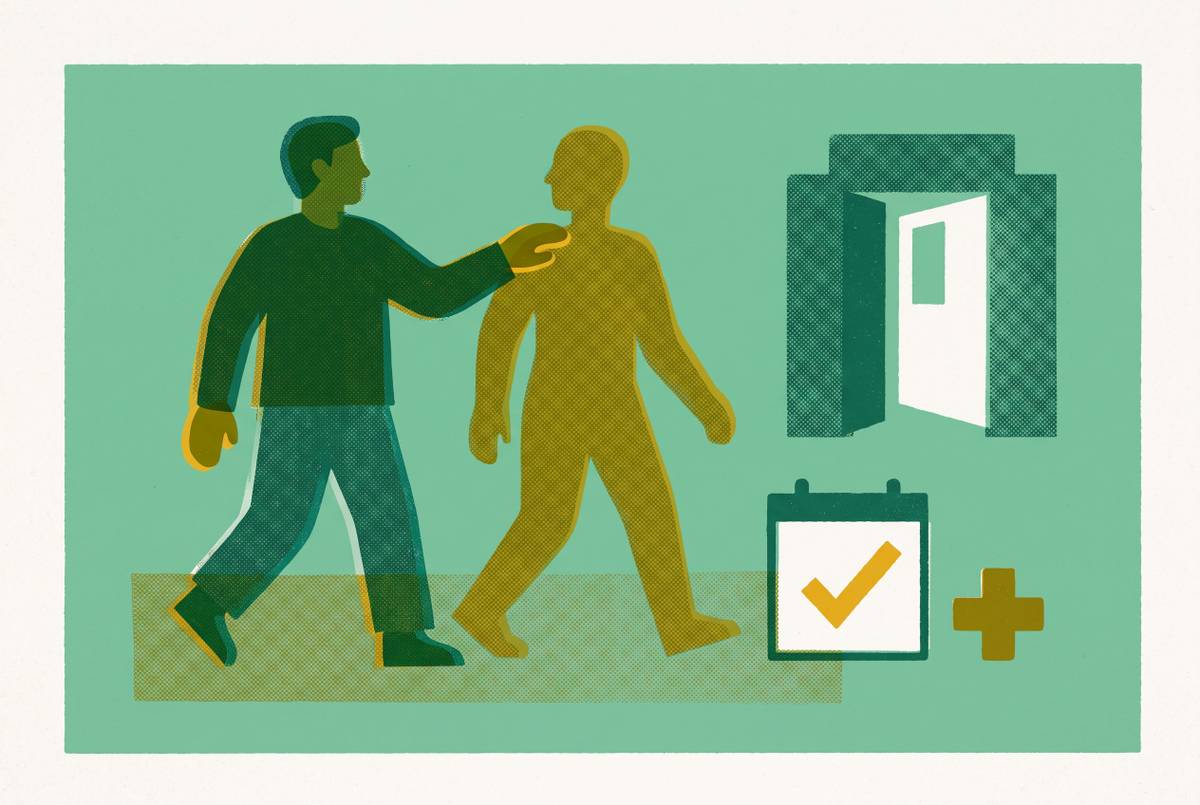
Food security is tangled up with the same adherence question. A systematic literature review found that medication adherence was directly shaped by two social determinants of health, food insecurity and unstable housing. What gets labeled "non-compliance" is frequently a resource problem rather than a character flaw. Employment carries its own solution: Individual Placement and Support, known as IPS, is the evidence-based model with an established record of helping people with serious mental illness find and keep work. None of these domains function in isolation, and that is exactly the challenge. Who holds housing, food, medication, and employment together in one coordinated plan? Assertive Community Treatment, or ACT, is the model built for that integration: teams of social workers, nurses, and psychiatrists provide care directly in the community, helping with illness management, medication, housing, finances, and daily tasks like grocery shopping and navigating public transit. A team shows up, doing coordinated, on-the-ground care.
A layer of history that medication cannot touch underlies all of these domains. Childhood abuse and neglect, unemployment, and incarceration each carry moderate-to-large effect sizes on the risk and severity of schizophrenia-spectrum psychotic disorders. What looks like a symptom to be managed pharmacologically is often a scar from a social history a clinician never asked about. That is the scope of what holistic care is meant to hold, and the next question is who has the standing and the trust to hold it together.
Peer support as the connective tissue for holistic care
A social worker can refer someone to a housing program. A psychiatrist can adjust a dose. Neither one, by the nature of the relationship, easily earns the kind of trust it takes for someone to admit they stopped taking their medication three days ago because they were embarrassed, or that they haven't eaten a real meal in two days. That is the trust gap at the center of this piece, and it is the reason peer support functions as connective tissue rather than as a supplementary service. A person with lived experience of serious mental illness can build the kind of trust that keeps someone engaged across housing, food, medication, and relationships, in a way a clinical encounter, however well-intentioned, structurally cannot.
SAMHSA defines peer support as "offering and receiving help, based on shared understanding, respect and mutual empowerment between people in similar situations." That mutuality, rather than hierarchy, is what closes the gap traditional clinical models cannot close on their own. It matters that this is a credentialed role and not an informal kindness: a certified peer support specialist has lived experience overcoming mental health or substance use challenges and receives specialized training, certified by their state to provide mental health support services. The legitimacy of the role rests on that combination, lived experience paired with formal training, and it is what allows peer support to sit inside a clinical team rather than alongside it as an afterthought.
What does that combination actually produce? Prior systematic review of in-person peer support documents reductions in self-stigma, improved treatment engagement, greater hopefulness about recovery, higher patient activation (a person's own sense that they can manage their health), and stronger feelings of empowerment. Digital tools are extending that reach. A study in Frontiers in Digital Health found that digital peer support showed promising evidence of promoting recovery, hope, social support, and medical and psychiatric self-management among people diagnosed with serious mental illness, a finding that matters most for people living in areas without enough in-person peer specialists to go around. The mechanism is not abstract. When someone who has navigated housing instability, medication side effects, and the maze of a public system sits down with another person living the same reality, the conversation reaches places a clinical appointment cannot. Staying housed, staying fed, and staying on treatment tend to get decided in exactly those conversations.
What the evidence shows
Does the evidence support all of this as clearly as the argument so far suggests? Mostly, but not without real caveats, and the piece is stronger for naming them directly. A 2024 systematic review and meta-analysis in Schizophrenia Research, covering 5,974 participants, found that peer support interventions significantly improved recovery outcomes and empowerment compared to standard care for people with schizophrenia, though the review characterizes those effects as small. A broader meta-analysis published in PMC found that clinical recovery effects held at six-to-nine months but were not sustained at 12-to-18 months, a durability question the field has not resolved.
The strongest objection comes from Cochrane. Its 2019 review concluded there is currently no high-quality evidence available to either support or refute the effectiveness of peer support interventions for people with schizophrenia or other serious mental illnesses, citing significant concerns about risk of bias in the included studies. But absence of high-quality randomized evidence is not the same as evidence that the intervention fails. Blinding a peer support trial presents practical and ethical problems that don't arise in a drug trial, someone always knows whether they are talking to a peer specialist, and that means the conventional evidence hierarchy doesn't map cleanly onto this kind of intervention. The consistent direction of findings across a set of imperfect studies carries its own kind of weight, even without a clean randomized trial to anchor it.
If effects fade, that points toward a design fix rather than a verdict against the model. If effects fade, the honest reading is that peer support needs to be sustained and integrated into ongoing care rather than delivered as a time-limited add-on. That is precisely the argument for embedding peer specialists inside ACT teams and CCBHCs rather than running peer support as a freestanding pilot program, a structural point the next section makes concrete.
Building this model at scale
The organizations getting this right are not offering peer support as a standalone service bolted onto existing care. They are building it into multidisciplinary, community-based structures where it functions as one part of a coordinated team. A white paper from the National Council for Mental Wellbeing and Bristol Myers Squibb, published in March 2026 and updated that April, examined how peer support programs led by trained individuals with lived experience of serious mental illness can help close critical gaps in schizophrenia care nationally, describing how two specific CCBHCs are already employing peer support workers to care for clients with schizophrenia.
NYC Health + Hospitals launched a Peer Transition Initiative in 2025, projected to serve roughly 650 New Yorkers, aimed squarely at the discharge gap described at the start of this piece, the period right after hospitalization when continuity of care tends to collapse. At the federal level, the CCBHC Medicaid Demonstration Program expanded on May 28, 2026, when HHS, through CMS and SAMHSA, added ten new states, Alaska, Colorado, Hawaii, Louisiana, Maryland, Mississippi, Montana, North Dakota, Washington, and West Virginia, into the program. Peer specialists and family support partners are a required part of every CCBHC's staffing plan, not an optional add-on, and SAMHSA's criteria list peer support as a core component of the model itself. The National Council and Bristol Myers Squibb white paper found that 77% of Medicare CCBHCs have already hired peer support workers as newly hired staff, a program that started in 2017 with a small cohort of CCBHCs across eight states and has grown significantly since.
firsthand operates within that same architecture. Its network of Guides and STRIVE Specialists, people with their own lived experience of serious mental illness and substance use disorder, meets people in the communities where they live, helping them access housing, food, medication, medical appointments, and behavioral health resources. The helpinghand platform, which holds HITRUST r2 certification, supplies the secure infrastructure that health plan and health system partners require to operate at that scale. It belongs in this list because it runs the same integrating model the CCBHC program is built around, not as a separate category of solution but as one working example of the architecture already under discussion.
Building and sustaining a peer workforce at scale
None of this works without enough trained peer specialists to staff it, and that raises a harder question than program design: how does lived experience become a stable, paid profession rather than a volunteer role that depends on goodwill? State certification systems are the answer, the infrastructure through which someone's personal history of mental health or substance use recovery becomes eligibility for formal training as a Certified Peer Support Specialist. The training itself is substantive, covering recovery principles, how to tell one's own story safely, trauma-informed practice, ethics and boundaries, cultural competence, goal setting, and documentation. Washington State recently doubled its required training hours from 40 to 80. One state-approved training provider offers a program whose completion certificates satisfy the state's requirement for Certified Medi-Cal Peer Support Specialists, building competency across 17 state-approved domains.
SAMHSA's National Model Standards go further, recommending that state certification entities contract with peer- and family-run organizations, and with people who have lived experience themselves, in developing and delivering the required training. Lived experience should govern the standards of the profession. But training and standards solve only half the problem. The harder structural barrier is reimbursement: peer support services need to be billable through Medicaid and other payers at rates that make employing peer specialists financially sustainable. The CCBHC model's staffing requirement ties federal funding directly to this workforce rather than leaving it to grants and goodwill.
firsthand's workforce reflects that same foundation. Its Guides and STRIVE Specialists have personally navigated serious mental illness and substance use disorder, and that shared history functions as the organization's central clinical asset rather than a gap to be managed around. That is, in the end, the same case this entire piece has been making about holistic care itself: people living with serious mental illness deserve support from people who understand what that life actually requires, day to day, and recovery becomes possible precisely when that kind of support reaches them.
Sources
- public-pages-files-2025.frontiersin.org
- Peer support for schizophrenia and other serious mental illnesses
- The effectiveness of peer support on the recovery and empowerment of people with schizophrenia: A systematic review and meta-analysis - ScienceDirect
- New White Paper: Peer Support Workers Improve Care for Patients With Schizophrenia
- The effectiveness of peer support for individuals with mental illness: systematic review and meta-analysis - PMC
- Social Determinants of Health and Long-Term Engagement in Schizophrenia Care
- A systematic review of the social determinants of physical and mental health in women with schizophrenia: focus on housing conditions
- A New Era in Schizophrenia Care: National Council for Mental Wellbeing and Bristol Myers Squibb Collaborate to Advance Evidence-Based Care Models