Chagas Disease Risk From Triatomine Bugs in US Housing
Most U.S. Chagas risk stems from housing quality and local ecology, not bug geography.
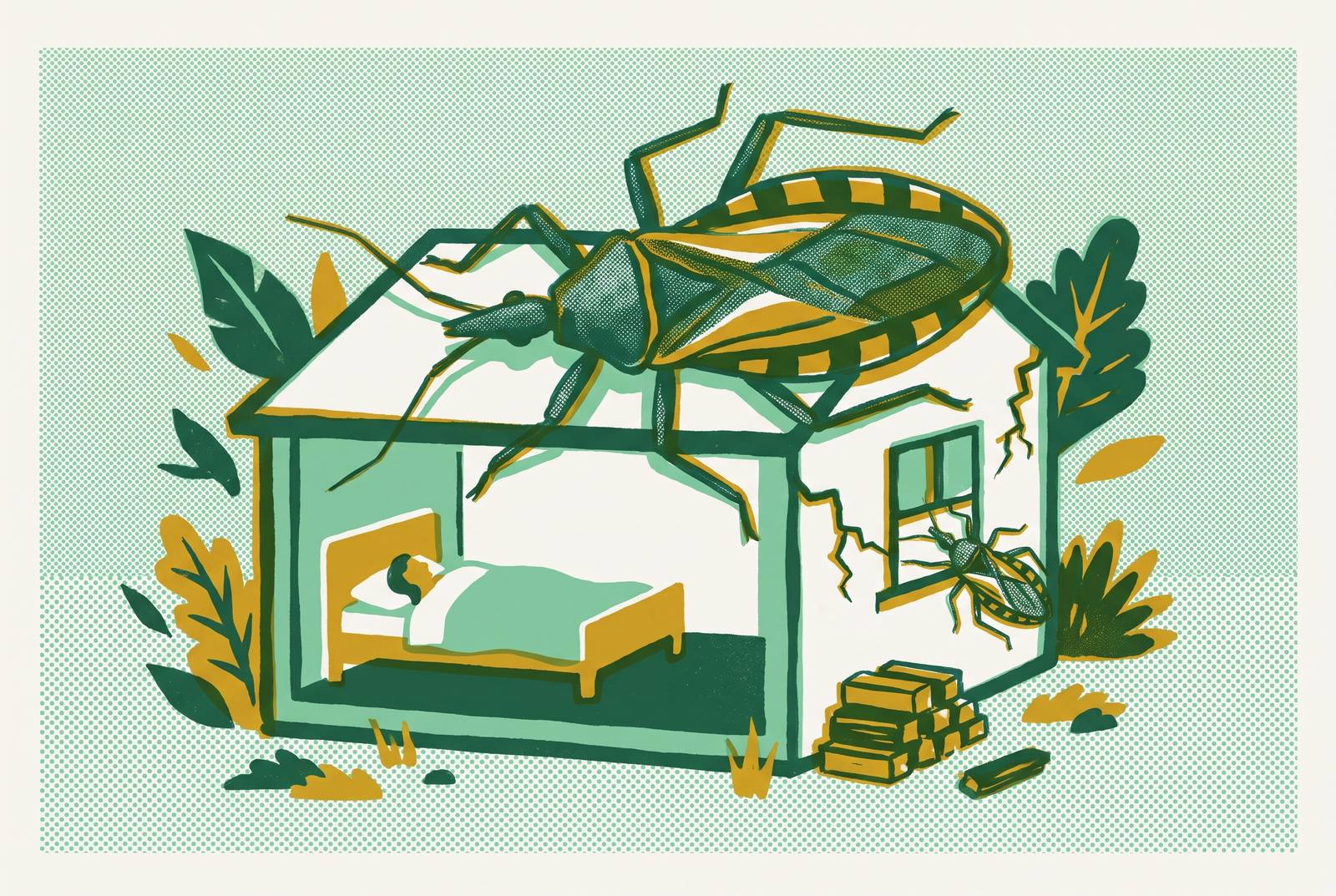
Chagas disease risk from triatomine bugs in U.S. housing depends on more than a bug’s presence. The threat depends on whether infected bugs can enter a home, feed on its inhabitants, and complete an indirect transmission route. Understanding those conditions makes housing quality and local ecology more useful guides than a map of where “kissing bugs” live.
How triatomine bugs actually transmit Chagas disease — and why most people misunderstand the mechanism
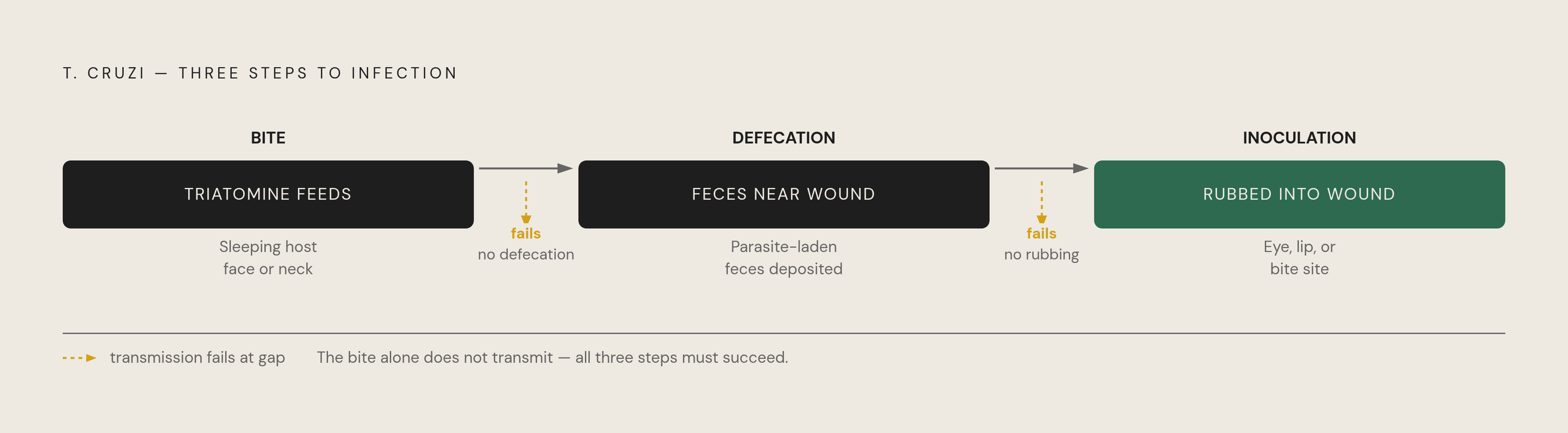
The bite itself does not transmit the parasite. Trypanosoma cruzi, the parasitic protozoan that causes Chagas disease, reaches people through contact with infected triatomine feces. Bugs can defecate on the skin after feeding, and contaminated material can be rubbed into the bite wound or a mucous membrane. Because these bugs tend to feed on sleeping people’s faces, they are called “kissing bugs,” a name that directs attention toward the bite.
An infected bug must feed, defecate near a wound or mucous membrane, and leave material that gets rubbed in. Each step can fail to occur. Congenital, oral, transplant-derived, transfusion-derived before 2007, and occupational transmission also occur, but the fecal route is the one central to understanding exposure in U.S. housing.
Where triatomine bugs live in the U.S. and which species enter homes
Beatty et al.’s September 2025 perspective in Emerging Infectious Diseases describes eleven triatomine species that live naturally across the southern half of the United States and have been found in dozens of states. Nine have been found naturally infected with T. cruzi. Their behavior, however, differs substantially by species. Four are commonly found in human dwellings, namely Triatoma sanguisuga, T. gerstaeckeri, T. protracta, and T. rubida.
T. sanguisuga and T. protracta have the largest overall U.S. distributions. T. gerstaeckeri appears to be the most common species in domestic settings in Texas and is likely responsible for locally acquired infections in dogs and humans there. Geography alone does not describe their relationship with people. U.S. triatomines are primarily sylvatic, living within wildlife cycles in burrows, nests, woodpiles, and rock piles.
T. sanguisuga reaches from Texas to the eastern seaboard and has been found in at least 23 states. A 2024 report in the American Journal of Tropical Medicine and Hygiene documented two live bugs found in a New Castle County, Delaware, home in July and October 2023. One infected bug was on a resident’s pillow under the comforter. The finding placed an infected vector inside a home in Delaware’s northernmost, most densely populated county, well beyond the geography many people associate with Chagas disease.
Why a bug being present in your region does not mean your home is at risk
What separates a regional wildlife cycle from household exposure? A central distinction is whether bugs merely enter a building or establish themselves there. Beatty et al. describe home colonization in the United States as far less common than in Chagas-endemic rural Latin American communities, where highly domiciliated species live. Well-sealed homes and plastered walls provide structural protection by helping interrupt that transition.
A single adult indoors is not equivalent to infestation. Adults fly at night and are attracted to artificial light, so an encounter can reflect an isolated intrusion. Wingless immature nymphs indoors are the key indicator of colonization. When bugs are found inside, they are often near pet sleeping areas, rodent activity, beds, or nightstands, placing some encounters close to sleeping people.
This distinction prevents both overstatement and false reassurance. A regional record does not establish exposure in every nearby household, but a general pattern of low transmission cannot describe every poorly sealed home. Even entry and feeding do not guarantee that the fecal transmission sequence will occur. For household assessment, ask not “Are there kissing bugs in this state? but “Can they get into and live in this home?”
What makes a home genuinely vulnerable to triatomine entry and infestation
An assessment of a California home found that above-ground wooden plank floors without a concrete foundation made it easier for bugs to get in. That detail makes vulnerability concrete. Poorly constructed or unplastered walls can offer gaps and cracks for shelter, while unsealed windows, doors, and utility penetrations provide entry points. Research also identifies lack of residual insecticide use in and around a structure as a risk factor. No single feature establishes infestation, but their combination can make entry and persistence more plausible.
The surrounding yard can strengthen that connection to wildlife. Pack rats and other rodents are reservoir hosts, and their burrows are primary triatomine habitat. When burrows are disturbed, bugs can seek new refuges, while artificial light draws flying adults toward houses. Wooded land, construction, or land clearing near a poorly sealed home can therefore link habitat disruption to accessible indoor shelter. Exterior lighting near entry points adds another opportunity for incidental intrusion.
Dog kennels, poultry sheds, and stacked firewood adjacent to a home can provide nearby harborage. Dogs are particularly important domestic reservoirs for T. cruzi, so their presence connects household assessment to the local animal transmission cycle. Living in rural areas, hunting, camping, and agricultural or outdoor work are also among the exposure factors found in locally acquired U.S. cases. These activities show why exposure history extends beyond a home’s walls.
Who faces the highest risk: the intersection of substandard housing and marginalized communities
Locally acquired infection occurs most often in the southern United States, where research links risk to residents living in substandard housing. That association describes an inequality. People whose homes do less to keep bugs out may also find it harder to get the healthcare needed to detect infection.
The care gap begins well before treatment. Fewer than one in a hundred infected people in the United States accesses testing and treatment, and the long asymptomatic period leaves most unaware of their infection. Provider knowledge is a primary bottleneck because Chagas rarely enters the clinical differential diagnosis. The Delaware report described a homeowner who spent months calling federal, state, private, and academic institutions just to get the bug identified and tested.
A diagnosis does not end those difficulties. A study of patients in the northeastern United States documented substantial treatment dropout among people who tested positive. For communities where healthcare is hard to get and people distrust conventional healthcare, information alone cannot clear the way from exposure to diagnosis and a full course of care. Reaching affected people takes work within their communities to build trust and tie health advice to the conditions in which they live.
The active scientific debate over whether the U.S. should be called a Chagas-endemic country
WHO and PAHO list 21 countries in the Americas as Chagas-endemic, excluding the United States. That classification helps shape whether clinicians and residents think of the disease as a domestic concern. Beatty et al. argue that the United States should be called endemic, specifically hypoendemic, because it has infected vectors, infected wildlife and domestic animals, and locally acquired human cases in eight states. Their concern is not simply terminology. They write, “Labeling the United States as non–Chagas disease–endemic perpetuates low awareness and underreporting”.
CDC’s Parasitic Diseases Branch challenged that position in a May 2026 letter. It emphasized that fewer than 100 locally acquired, vectorborne human infections have been documented, that U.S. triatomines are primarily sylvatic, and that infection in animals and bugs does not establish emerging human disease. Housing and the way bugs behave may do much to reduce transmission. The letter also warned that an endemic designation could encourage universal testing of low-risk patients, with false positives, costs, effects on organ transplantation processes, and unnecessary anxiety.
The disagreement turns partly on what the label should describe. Should it be enough that the parasite keeps circulating and local human transmission has been documented, or should the label depend on how often people get the disease? The debate helps explain why people hear conflicting accounts, but it cannot tell them the risk inside a given home.
How infection rates in bugs vary by region and what local data actually shows about human risk
Regional studies make the distinction between infected vectors and infected people especially clear. Beatty et al. report that the share of U.S. triatomines found to be infected starts at roughly 30% and is much higher in some studies. People have different chances of exposure to bugs found inside homes than to bugs that live mostly in wildlife habitat. Neither measurement alone is a human infection rate.
The Florida study published in a tropical disease journal found that nearly a third of bugs collected indoors tested positive for T. cruzi, and nearly a quarter had fed on humans. This is the most concerning exposure signal among these examples because it documents bugs already inside homes and human-vector contact. It does not demonstrate that the same proportions apply to residents. Nor does feeding establish that contaminated feces entered a wound or mucous membrane.
University of Arizona research found infected bugs in nearly two-thirds of the Tucson homes that kissing bugs had entered. Despite thousands of bites, no homeowner tested positive. The researchers concluded that the resident bugs’ current behavior presented little transmission risk absent direct ingestion of fecal matter. The California Department of Public Health’s 2013–2023 study likewise found more than a quarter of tested bugs positive, but none were linked to the 40 human cases reported during that period.
The El Paso–Las Cruces research from April 2024–March 2025 leaves it unclear how things have changed over time. It found an especially high proportion positive by qPCR, above a prior regional study, suggesting intensified transmission in that area. Ecological or climatic shifts and improved molecular detection are possible explanations. Taken together, these findings point toward housing barriers and transmission behavior as explanations for the gap between vector infection and documented human disease.
What climate change and range expansion mean for areas that currently consider themselves low-risk
Projections based on climate suggest that the places where triatomines can live could shift northward, so housing and local ecology could matter in more places. Land development can also change contact without waiting for a broad geographic shift. Destroyed wildlife burrows displace bugs, while nearby houses offer light and possible refuge. Residents in older, less-sealed housing near wooded or agricultural land in the mid-Atlantic and the country’s north-central regions therefore have reason for sustained attention. That is not a forecast of inevitable infection.
The Delaware finding establishes presence. Beatty et al. caution that available data cannot establish whether triatomines are increasing in geographic distribution or abundance because standardized surveillance over time is lacking. More reports may reflect more observers and more research. This uncertainty limits claims about expansion, but it also limits confidence that the risk landscape is stable.
What residents and renters can actually do — and what the healthcare system needs to do better
For residents and renters, the practical response begins with observable conditions. Seal gaps and cracks, address unplastered wall surfaces and utility openings, and make sure doors and windows close tightly. Keep rodents in check, and move firewood, lumber piles, and debris away from foundations and outside walls. Use less outdoor lighting that draws insects toward ways into the home, especially near where people sleep.
An indoor find deserves identification, especially a wingless nymph. Local public health or university extension resources can be approached for species identification and T. cruzi testing. A dog diagnosed with the infection is also a meaningful signal of local transmission. For medical assessment, people who have lived in or traveled to Latin American endemic regions, or who live in substandard southern U.S. housing with known triatomine activity, should discuss Chagas screening with a provider. Early treatment with benznidazole is more effective than late-stage treatment, while completing a course requires consistent follow-up support.
Healthcare systems need to make that pathway accessible. Providers who know more about Chagas can consider it when a patient's history suggests exposure, without assuming that every patient needs testing. Trust-based outreach can help people reach care and remain engaged after diagnosis. Standardized wildlife and vector surveillance would also make changing exposure patterns easier to interpret.
Sources
- Chagas Disease, an Endemic Disease in the United States - Volume 31, Number 9—September 2025 - Emerging Infectious Diseases journal - CDC
- Evidence Lacking for Endemic Chagas Disease in the United States - Volume 32, Number 5—May 2026 - Emerging Infectious Diseases journal - CDC
- Low risk for locally acquired Chagas disease in California: A review of human cases and triatomine submissions, 2013–2023
- First Report of Chagas Disease Vector Species Triatoma sanguisuga (Hemiptera: Reduviidae) Infected with Trypanosoma cruzi in Delaware
- How Chagas Disease Spreads
- Anaphylactic Reactions Due to Triatoma protracta (Hemiptera, Reduviidae, Triatominae) and Invasion into a Home in Northern California, USA